Exam questions · Biology · Evidence for Evolution and Classification
Darwin, Lamarck and the Theory of Evolution
- 7 exam questions
- 24 marks
- 8 quick checks
-
1 State [2 marks]
State two things that Darwin did that helped him to develop the theory of evolution by natural selection.
Show answerHide answer
Model answer
Any two of: he made observations on a round-the-world expedition, he carried out years of experimentation and discussion, he linked his ideas to developing knowledge of geology and fossils.
Mark scheme
- First correct thing — 1 mark
- Second correct thing — 1 mark
-
2 Describe [3 marks]
Describe the theory of evolution by natural selection.
Show answerHide answer
Model answer
There is a wide range of variation for a characteristic between individuals in a species. Individuals with the characteristics most suited to the environment are more likely to survive to breed successfully. The characteristics that enabled these individuals to survive are passed on to the next generation.
Mark scheme
- Variation between individuals — 1 mark
- Best-suited individuals survive and breed — 1 mark
- Characteristics passed on to the next generation — 1 mark
-
3 Explain [3 marks]
Explain why the theory of evolution by natural selection was only gradually accepted.
Show answerHide answer
Model answer
The theory challenged the idea that God made all the animals and plants on Earth, which many people believed. There was not enough evidence at the time it was published to convince many scientists. The mechanism of inheritance and variation was not known until 50 years later.
Mark scheme
- Challenged the belief that God made all organisms — 1 mark
- Insufficient evidence at the time — 1 mark
- Mechanism of inheritance not known for 50 years — 1 mark
-
4 Describe [3 marks]
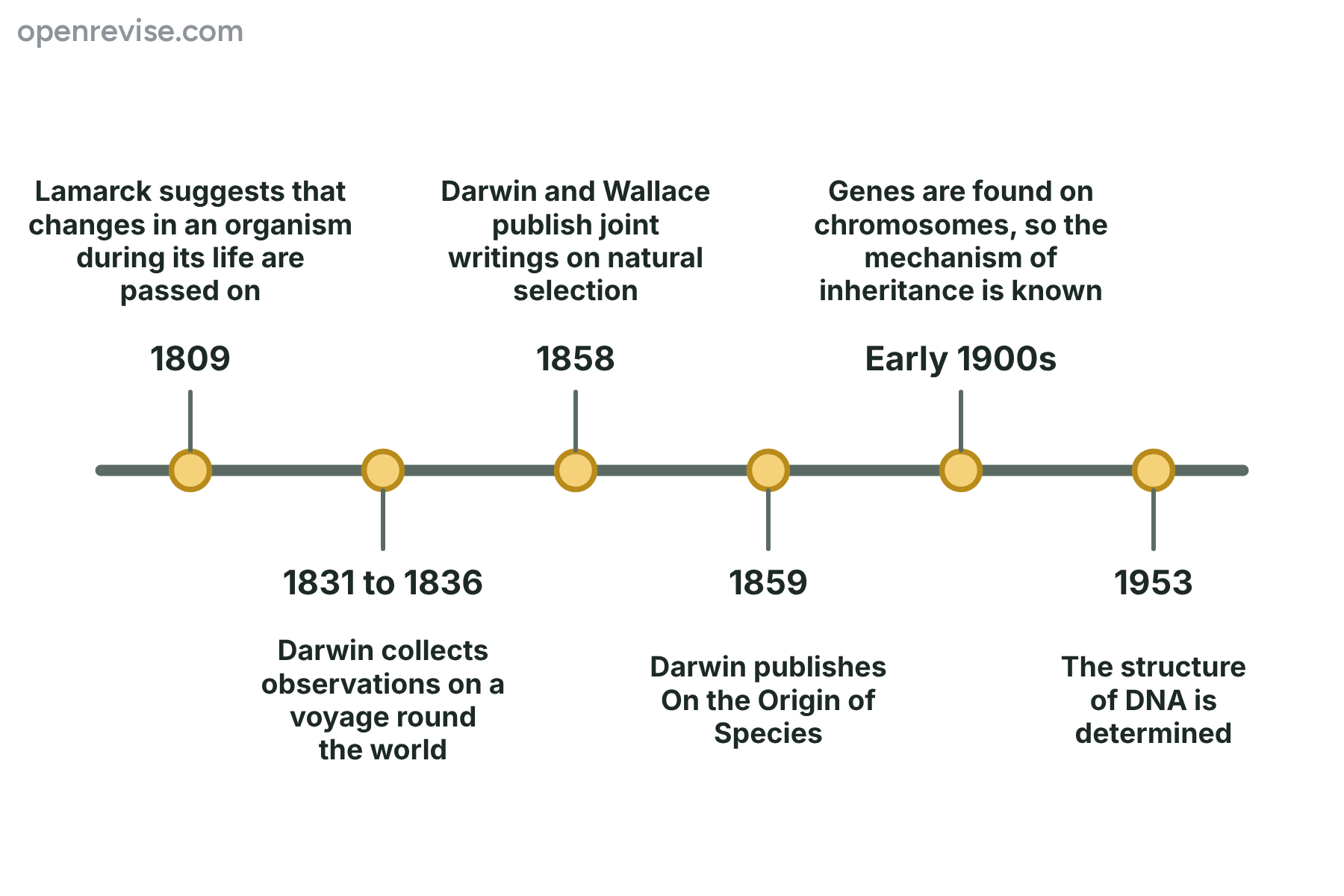
Use the timeline to describe how the theory of evolution developed over time.
Show answerHide answer
Model answer
Lamarck proposed an earlier idea in 1809. Darwin collected observations on his voyage between 1831 and 1836, and he and Wallace published their joint writings in 1858, followed by Darwin's book in 1859. About fifty years later, in the early 1900s, genes were found on chromosomes, which explained inheritance, and in 1953 the structure of DNA was found. The theory developed over time using work by many scientists.
Mark scheme
- Earlier idea by Lamarck — 1 mark
- Darwin and Wallace 1858 and 1859 publication — 1 mark
- Later discoveries about genes and DNA support the theory — 1 mark
-
5 Compare [4 marks]
Compare Lamarck's explanation of how a giraffe came to have a long neck with Darwin's explanation.
Show answerHide answer
Model answer
Lamarck thought that giraffes stretched their necks to reach leaves, so their necks became longer during their lives and this change was inherited by their young. Darwin's explanation is that there was variation in neck length. Giraffes with longer necks could reach more food, so they survived and bred, and passed on the alleles for long necks, so over many generations the population had longer necks.
Mark scheme
- Lamarck: neck stretched during life — 1 mark
- Lamarck: the change was inherited — 1 mark
- Darwin: variation in neck length — 1 mark
- Darwin: longer-necked giraffes survived and bred, passing on alleles — 1 mark
-
6 Explain [3 marks]
Explain why Lamarck's idea that a blacksmith's children would inherit his large muscles is not correct.
Show answerHide answer
Model answer
Large muscles are developed during the blacksmith's life by exercise, so they are an acquired characteristic. They are not caused by a change to the genes in his gametes, so they are not passed on. In the vast majority of cases this type of inheritance cannot occur.
Mark scheme
- Muscles developed through exercise during life — 1 mark
- Genes in the gametes are not changed — 1 mark
- So the characteristic is not inherited — 1 mark
-
7 Evaluate [6 marks]
Evaluate the importance of the work of many scientists, and not just Darwin, in the development of the theory of evolution by natural selection.
Show answerHide answer
Model answer
Darwin made observations on his voyage and linked them to geology and fossils, and spent years gathering evidence. Wallace independently proposed the same idea, which prompted Darwin to publish, so the theory was not the work of one person. Later scientists provided evidence that Darwin lacked. Mendel's work and the discovery of genes on chromosomes explained how characteristics are inherited, and the structure of DNA explained the nature of variation, while fossils and antibiotic resistance gave more evidence. So the theory developed over time with information from many scientists, and it was strengthened as new evidence became available. Although Darwin's insight was central, the theory could not have been accepted without the work of the others.
Mark scheme
- Darwin's observations and evidence — 1 mark
- Wallace independently proposed the theory — 1 mark
- Genes and inheritance explained how characteristics are passed on — 1 mark
- Fossils or bacteria provide further evidence — 1 mark
- The theory developed over time using work by many scientists — 1 mark
- A reasoned conclusion — 1 mark
Quick check
-
1
Who proposed the theory of evolution by natural selection?
Show answerHide answer
A: Charles Darwin
Charles Darwin proposed the theory, which was also proposed independently by Alfred Russel Wallace.
-
2
In which year did Darwin publish On the Origin of Species?
Show answerHide answer
C: 1859
It was published in 1859.
-
3
Which statement is part of the theory of natural selection?
Show answerHide answer
B: Individuals best suited to the environment are more likely to survive and breed
Individuals with the characteristics most suited to the environment are more likely to survive to breed.
-
4
Which of these was a reason why the theory was only gradually accepted?
Show answerHide answer
D: The mechanism of inheritance was not known
The mechanism of inheritance and variation was not known until 50 years after the theory was published.
-
5
What did Lamarck suggest?
Show answerHide answer
A: Changes during life are inherited
Lamarck suggested that changes that occur in an organism during its lifetime can be inherited.
-
6
Which is evidence against Lamarck's idea?
Show answerHide answer
C: A blacksmith's children do not inherit his muscles
In the vast majority of cases, characteristics that change during life cannot be inherited.
-
7
Why did Darwin visit the Galapagos Islands?
Show answerHide answer
B: As part of a voyage round the world
He was a naturalist on HMS Beagle, a voyage round the world on which he made observations.
-
8
Which was an important result of the 1858 joint writings?
Show answerHide answer
D: Darwin published his book the next year
Wallace and Darwin published joint writings, which prompted Darwin to publish On the Origin of Species the following year.