Biology · Evidence for Evolution and Classification
Darwin, Lamarck and the Theory of Evolution
This lesson is for separate Biology only: Combined Science students do not need it. It covers how Charles Darwin developed the theory of evolution by natural selection, why it was only gradually accepted, and how it differs from the ideas of Jean-Baptiste Lamarck.
Learning Objectives
- 1Describe how Charles Darwin developed the theory of evolution by natural selection, and state its main ideas.
- 2Explain why the theory of evolution by natural selection was only gradually accepted.
- 3Describe Lamarck's theory and explain why it is not accepted now.
- 4Explain how scientific theories develop over time, using information gathered by many scientists.
Retrieval practice
-
1
What is evolution?
Show answerHide answer
A change in the inherited characteristics of a population over time, through natural selection.
-
2
What is natural selection?
Show answerHide answer
The process in which individuals best suited to their environment survive and breed, passing on their alleles.
-
3
Where do new alleles come from?
Show answerHide answer
Mutations.
-
4
What can fossils show?
Show answerHide answer
How much or how little organisms have changed over time.
A theory built on evidence
Charles Darwin did not wake up one morning with a theory. As a result of observations on a round-the-world expedition, backed by years of experimentation and discussion and linked to developing knowledge of geology and fossils, he proposed the theory of evolution by natural selection. His theory developed over time and from information gathered by many scientists, and it caused great controversy.
How Darwin developed the theory
Darwin's theory grew from observation, thinking and testing over about twenty years.
-
Observations
From 1831 to 1836 Darwin sailed round the world on HMS Beagle as a naturalist, collecting plants, animals and fossils and noting how organisms differed from place to place.
-
Geology and fossils
He read about geology and the age of the Earth, and found fossils of extinct animals, which suggested that life had changed over a very long time.
-
Experiments and discussion
Back in England he spent years breeding pigeons, studying barnacles and writing to other scientists before he published his ideas.
-
The publication
He published On the Origin of Species in 1859, after receiving a letter from Alfred Russel Wallace with a similar idea.
The theory in three ideas
The theory of evolution by natural selection can be set out in three points.
-
Variation
Individual organisms within a particular species show a wide range of variation for a characteristic.
-
Survival
Individuals with characteristics most suited to the environment are more likely to survive to breed successfully.
-
Inheritance
The characteristics that have enabled these individuals to survive are then passed on to the next generation.
Case study
Darwin's finches
On the Galapagos Islands Darwin collected small birds that looked different from one another. Later study showed they were closely related finches, with beaks of different shapes suited to the food on each island: thick beaks for cracking seeds and slender beaks for catching insects. He realised that they might all have descended from one ancestor that arrived from the mainland, and had changed as each group was selected by its own food supply. There are about 15 species, all descended from one ancestor.
Key dates in the development of the theory
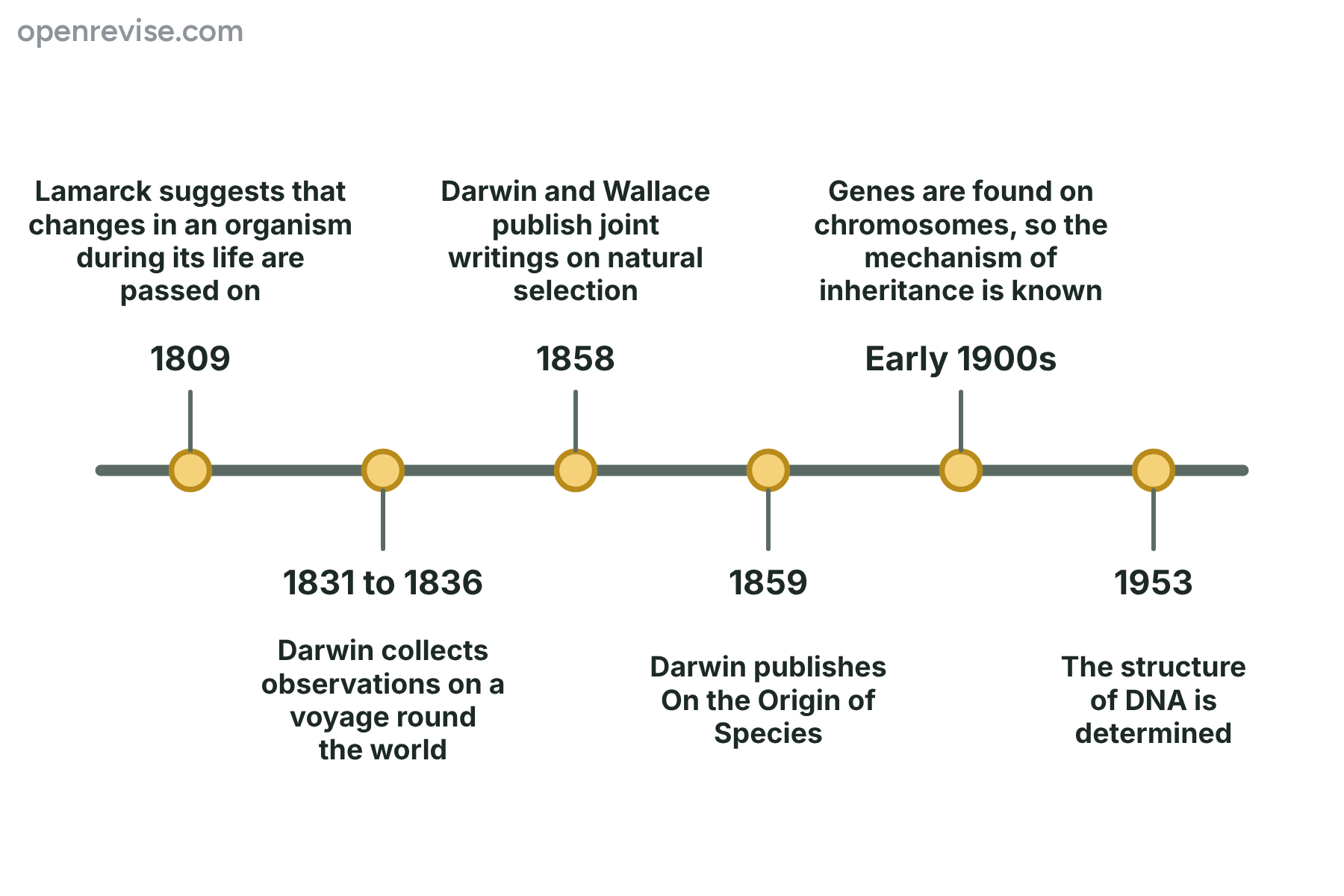
The theory developed over time, and not through the work of one scientist.
Why the theory was only gradually accepted
Darwin's ideas were controversial, and many people at first rejected them.
-
A challenge to belief
The theory challenged the idea that God made all the animals and plants that live on Earth, so many religious people found it hard to accept.
-
Not enough evidence
There was insufficient evidence at the time the theory was published to convince many scientists.
-
No mechanism
The mechanism of inheritance and variation was not known until 50 years after the theory was published, so Darwin could not explain how characteristics were passed on.
-
Controversy
There was much controversy surrounding these revolutionary new ideas. A study of creationism is not required.
Lamarck's different idea
Other theories, including that of Jean-Baptiste Lamarck, are based mainly on the idea that changes that occur in an organism during its lifetime can be inherited.
-
The idea
Lamarck thought that if an organism used a body part a lot, it would become bigger and stronger, and the offspring would inherit that change.
-
An example
In Lamarck's idea, a giraffe stretching to reach leaves would grow a longer neck, and its young would be born with longer necks.
-
Why it is rejected
We now know that in the vast majority of cases this type of inheritance cannot occur. A blacksmith's large muscles are not inherited by his children, because the change is not in the genes in the gametes.
-
Darwin's version
In Darwin's theory, giraffes with longer necks, because of variation, survive better and pass on the alleles.
Lamarck and Darwin
Lamarck
- Changes during an organism's life are inherited
- Use of a body part makes it bigger
- Offspring inherit the changes
- Not supported by evidence about genes
Darwin
- There is variation in a population
- The best-suited individuals survive and breed
- The alleles for helpful features are passed on
- Supported by genetics, fossils and bacteria
The big idea
Darwin proposed that natural selection acts on the variation between individuals, and the theory was accepted gradually as evidence about inheritance and the fossil record accumulated.
Darwin and evolution
Darwin and evolution
-
Observations
- voyage on HMS Beagle
- fossils
- geology
-
The theory
- variation
- survival of the best suited
- passed on to offspring
-
Publication
- On the Origin of Species
- 1859
-
Controversy
- challenged belief
- not enough evidence
- no mechanism known
-
Lamarck
- changes during life inherited
- rejected now
-
Developed over time
- many scientists
Summary and exam focus
- Darwin proposed the theory of evolution by natural selection after observations on a round-the-world expedition, backed by years of experimentation and discussion.
- The theory states that individuals with the characteristics most suited to the environment are more likely to survive to breed, and pass on those characteristics.
- Darwin published On the Origin of Species in 1859, and there was much controversy.
- The theory was only gradually accepted, because it challenged religious belief, there was insufficient evidence, and the mechanism of inheritance was not known.
- Lamarck's idea that changes during life can be inherited is not supported in the vast majority of cases.
Exam focus
Explain why Darwin's theory of evolution by natural selection was not accepted by many scientists when it was published. (3 marks) (3 marks)
Give three separate reasons. The spec gives these three: the theory challenged the idea that God made all the animals and plants, there was insufficient evidence at the time, and the mechanism of inheritance was not known until 50 years after the theory was published.
Key terms
The words this lesson expects you to use. Each one is linked from the first place it appears above.
- Theory of evolution
- The idea that all species have evolved from simple life forms by natural selection.
- Charles Darwin
- The scientist who proposed the theory of evolution by natural selection.
- On the Origin of Species
- The book Darwin published in 1859 to set out his theory.
- Naturalist
- A person who studies plants and animals in their natural environment.
- Jean-Baptiste Lamarck
- The scientist who suggested that changes during an organism's life can be inherited.
- Inheritance
- The passing of characteristics from parents to offspring in genes.
- Controversy
- A disagreement that continues for a long time between groups of people.
- Mechanism
- How something works, such as how characteristics are passed on.
You've finished the notes
Check your understanding
Test yourself while it is fresh. Start with the flashcards, then try the exam questions.
Something here looks wrong?
Tell us what and we will go and look. It goes to whoever writes these pages, nobody else, and we do not ask who you are — so there is nothing to sign and nothing comes back to you.