Exam questions · Biology · Evidence for Evolution and Classification
Extinction
- 7 exam questions
- 23 marks
- 8 quick checks
-
1 State [1 mark]
What is meant by extinction?
Show answerHide answer
Model answer
There are no remaining individuals of a species still alive.
Mark scheme
- No individuals of a species remain alive — 1 mark
-
2 Give [3 marks]
Give three factors which may contribute to the extinction of a species.
Show answerHide answer
Model answer
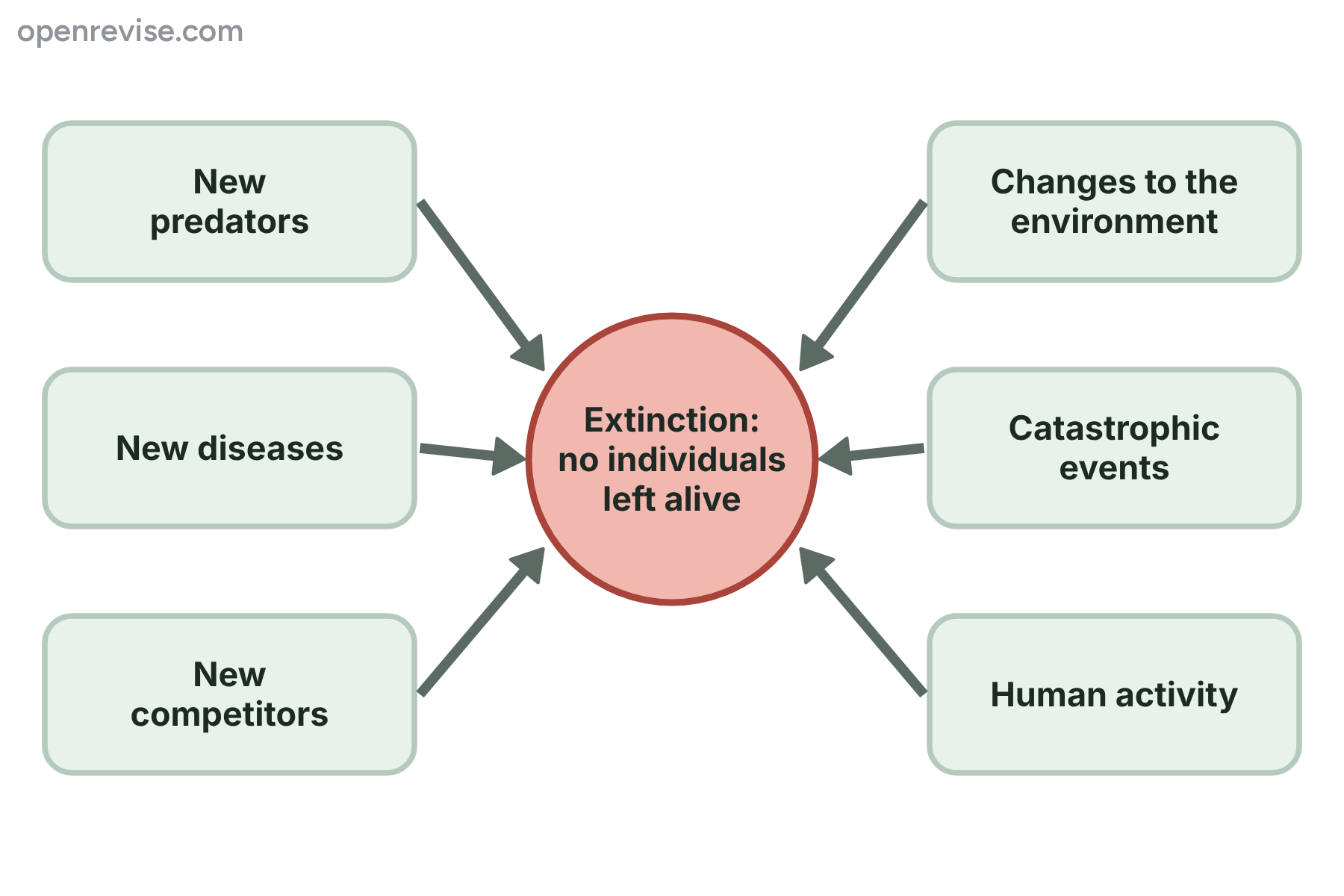
Any three of: a new predator, a new disease, a new competitor, a change to the environment, a catastrophic event such as a volcanic eruption or asteroid collision, human activity such as hunting or habitat destruction.
Mark scheme
- First factor — 1 mark
- Second factor — 1 mark
- Third factor — 1 mark
-
3 Explain [3 marks]
A new species of rat arrives on an island and eats the eggs of a species of ground-nesting bird. Use the diagram to explain how this could lead to the extinction of the bird.
Show answerHide answer
Model answer
The rat is a new predator, so it eats the eggs, so fewer chicks hatch. The birds have not evolved a defence against the rat, so numbers of the birds fall. If every egg is eaten, no new birds are produced, and when the last adult dies the species is extinct.
Mark scheme
- The rat is a new predator (or competitor) — 1 mark
- Eggs eaten, so fewer chicks — 1 mark
- Numbers fall until no individuals remain, so extinct — 1 mark
-
4 Calculate [3 marks]
The population of a rare plant in a nature reserve was 1 800 in 2010 and 450 in 2020. Calculate the percentage decrease in the population.
Show answerHide answer
Model answer
75%. The decrease is \(1800 - 450 = 1350\), and \(\frac{1350}{1800} \times 100 = 75\%\).
Mark scheme
- \(1800 - 450 = 1350\) — 1 mark
- \(\frac{1350}{1800} \times 100\) — 1 mark
- 75% — 1 mark
-
5 Explain [4 marks]
Explain how a catastrophic event such as an asteroid collision could cause the extinction of large numbers of species.
Show answerHide answer
Model answer
The impact throws dust and gas into the atmosphere, which blocks out sunlight and makes the climate colder. Plants cannot photosynthesise, so producers die, and the animals that eat them, and the predators that eat those, have no food. Species that cannot adapt to the new environment die out.
Mark scheme
- Dust and gas block the sunlight, changing the climate — 1 mark
- Plants cannot photosynthesise — 1 mark
- Food chains collapse, so consumers have no food — 1 mark
- Species that cannot adapt go extinct — 1 mark
-
6 Explain [3 marks]
Explain why a species with very little genetic variation is more likely to become extinct when a new disease appears.
Show answerHide answer
Model answer
With little variation, all the individuals are likely to have the same alleles. If none of them has an allele that gives resistance to the disease, they will all be affected in the same way. So the disease could kill them all and the species goes extinct.
Mark scheme
- Little variation means individuals have similar alleles — 1 mark
- None may have a resistant allele — 1 mark
- So all could be killed by the disease — 1 mark
-
7 Evaluate [6 marks]
Some people say that the extinction of species is natural and so nothing should be done to prevent it. Evaluate this view.
Show answerHide answer
Model answer
Extinction has happened naturally throughout the history of life, for example when the dinosaurs died out after an asteroid collision, so it is part of evolution. New species have evolved to take the place of those lost. However, many extinctions today are caused by human activity, such as hunting, habitat destruction and global warming, and they are happening much faster than natural extinctions. Losing species reduces biodiversity, which can make ecosystems less stable, and it removes organisms that may be useful to humans. Many people also believe that humans have a duty to prevent extinctions they have caused. Overall, the view is not convincing for extinctions caused by people, even if extinction is a natural process.
Mark scheme
- Extinction is natural and has always happened — 1 mark
- An example such as the dinosaurs — 1 mark
- Many current extinctions are caused by human activity — 1 mark
- Faster than natural extinctions — 1 mark
- Loss of biodiversity or useful species — 1 mark
- A reasoned conclusion — 1 mark
Quick check
-
1
What is extinction?
Show answerHide answer
C: When no individuals of a species remain
Extinction occurs when there are no remaining individuals of a species still alive.
-
2
Which of these may contribute to the extinction of a species?
Show answerHide answer
A: A new disease
A new disease can spread through a population with no immunity and kill most of the individuals.
-
3
Which event is thought to have caused the extinction of the dinosaurs?
Show answerHide answer
D: An asteroid collision
An asteroid collision about 66 million years ago changed the climate.
-
4
How did humans cause the extinction of the dodo?
Show answerHide answer
B: Through hunting and introduced animals
Sailors hunted them, and the animals they brought ate the eggs, so the dodo was extinct within about a century.
-
5
Why is a species with a small population more at risk of extinction?
Show answerHide answer
C: One event could kill all the individuals
One event could kill all the individuals, and there is little genetic variation.
-
6
Which of these is a human cause of extinction?
Show answerHide answer
A: Habitat destruction
Destroying habitats by building or farming removes the places species live.
-
7
What does a mass extinction mean?
Show answerHide answer
D: Many species die out at about the same time
It is an event in which a large proportion of all species die out together.
-
8
A species depends on one type of plant for food. Why is it at greater risk?
Show answerHide answer
B: The species has no alternative food if the plant is lost
If the plant is lost, the species has no other food and may go extinct.