Biology · Evidence for Evolution and Classification
Extinction
More than 99% of the species that have ever lived on Earth have died out. This lesson is for both Combined Science and separate Biology. It defines extinction and describes the factors that may contribute to the extinction of a species, with examples.
Learning Objectives
- 1Define extinction.
- 2Describe factors which may contribute to the extinction of a species, such as new predators, new diseases, new competitors, environmental change, catastrophic events and human activity.
- 3Use examples such as the dinosaurs and the dodo to explain how extinctions occur.
- 4Link extinction to natural selection and to variation in a population.
Retrieval practice
-
1
What is a species?
Show answerHide answer
A group of organisms that can interbreed to produce fertile offspring.
-
2
What is natural selection?
Show answerHide answer
The process in which individuals best suited to their environment survive and breed, passing on their alleles.
-
3
Where are fossils found?
Show answerHide answer
In rocks.
-
4
Why is variation important in a population?
Show answerHide answer
Some individuals may survive if the environment changes.
When the last one dies
Extinctions occur when there are no remaining individuals of a species still alive. Fossils show that extinction is a normal part of the history of life, and a species that cannot survive a change in its environment will die out. Sometimes many species go extinct together, in what is called a mass extinction. Today, extinctions are happening faster than usual because of human activity.
Factors that may contribute to extinction
A species usually goes extinct because of a change that its members cannot adapt to quickly enough.
-
New predators
If a new predator arrives in an area and prey have no defence against it, so many are eaten that the species may die out.
-
New diseases
A new pathogen can spread through a population that has no immunity or resistance. If most individuals die and too few are left to breed, the species may go extinct.
-
New competitors
A new species that competes for the same food or space may be better adapted, so the original species cannot get enough resources.
-
Changes to the environment
Changes in the climate, such as an ice age, or the loss of habitat can leave a species unable to survive if it cannot adapt, move or evolve fast enough.
Factors that may lead to extinction
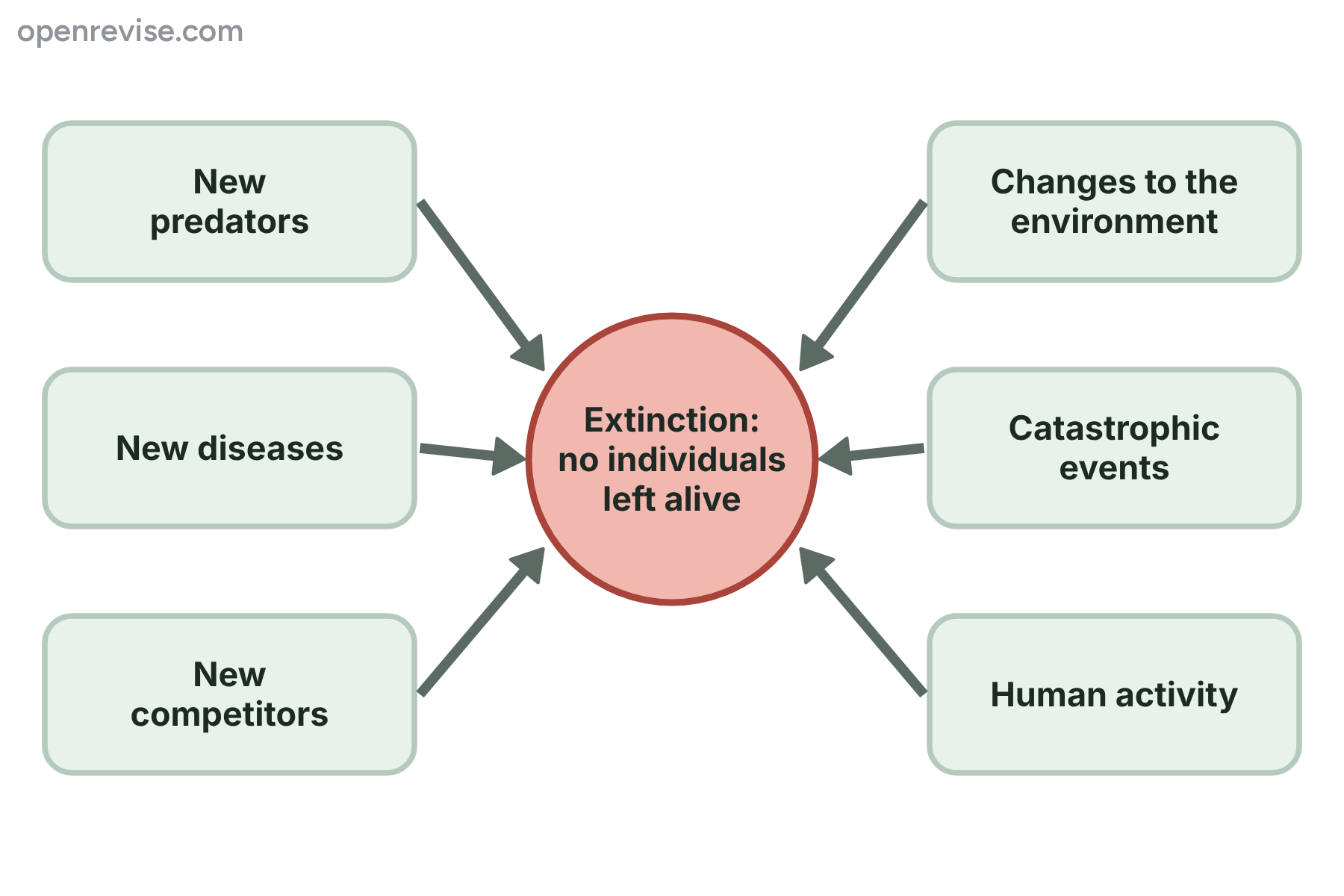
Several of these factors often act together.
Catastrophic events and human activity
Some causes are sudden, and some are the result of what people do.
-
Catastrophic events
A single catastrophic event, such as a massive volcanic eruption or the collision of an asteroid with the Earth, can change the climate so quickly that many species go extinct together.
-
Hunting
People have hunted some species to extinction. The dodo, a flightless bird of Mauritius, was extinct by the late 1600s, within about a century of sailors arriving.
-
Habitat destruction
Building, farming and deforestation destroy the habitats that species need.
-
Other human activity
Pollution, global warming and the introduction of new predators, competitors and diseases by people also contribute.
Case study
The end of the dinosaurs
About 66 million years ago an asteroid about 10 kilometres wide hit the Earth at what is now Mexico. The impact threw dust and gas into the air, which blocked the sunlight and made the Earth much colder for a time, so plants could not photosynthesise and food chains collapsed. About three quarters of all species, including all the large dinosaurs, went extinct. Small mammals survived and later evolved into many new species.
Why some species are more at risk
Some species are more likely to go extinct than others.
-
Small populations
If a population is small, the chance of every individual being killed by one event is higher, and there is little genetic variation.
-
Little variation
If there is little variation, no individual may have the allele that helps it survive a new disease or a change in the environment.
-
Specialists
A species that depends on one food or one habitat, such as a panda eating only bamboo, suffers badly if that food or habitat is lost.
-
Island species
Species that evolved on islands without predators, such as the dodo, are often easy prey for newly arrived animals.
Calculating the decline of a population
The population of a species of frog in a reserve fell from 5 000 to 200 over twenty years. Calculate the percentage decrease in the population.
Show the solutionHide the solution
- 1 Find the decrease \(5000 - 200 = 4800\)
- 2 Divide by the starting population \(\frac{4800}{5000} = 0.96\)
- 3 Turn it into a percentage \(0.96 \times 100 = 96\%\)
AnswerThe population fell by 96%.
Natural and human causes
Natural causes
- Climate change over geological time
- Volcanic eruptions and asteroid impacts
- New diseases, predators and competitors arriving naturally
- Usually take place slowly, except for catastrophes
Human causes
- Hunting
- Habitat destruction and deforestation
- Pollution and global warming
- Introducing new predators and diseases
The big idea
A species goes extinct when its members cannot survive, breed and adapt to a change in their environment quickly enough.
Extinction
Extinction
-
Meaning
- no individuals left alive
-
Natural factors
- new predators
- new diseases
- new competitors
- environmental change
-
Catastrophes
- volcanic eruptions
- asteroid collisions
-
Human activity
- hunting
- habitat loss
- pollution
- global warming
-
At risk
- small populations
- little variation
- specialists
Summary and exam focus
- Extinctions occur when there are no remaining individuals of a species still alive.
- New predators, new diseases and new competitors can contribute to the extinction of a species.
- Changes to the environment and single catastrophic events, such as volcanic eruptions or asteroid collisions, can cause extinctions.
- Human activity, such as hunting and habitat destruction, causes extinctions.
- Species with small populations and little variation are most at risk.
Exam focus
Describe three factors that may contribute to the extinction of a species. (3 marks) (3 marks)
Give three different factors and add a short reason or example to each, so that your points are not simply a list. For example, a new disease could kill most of a population that has no immunity.
Key terms
The words this lesson expects you to use. Each one is linked from the first place it appears above.
- Extinction
- When there are no remaining individuals of a species still alive.
- Mass extinction
- An event in which a large proportion of the world's species die out at the same time.
- Predator
- An animal that kills and eats other animals.
- Competitor
- An organism that uses the same resources as another organism.
- Catastrophic event
- A sudden event, such as a volcanic eruption or an asteroid collision, that changes the environment greatly.
- Habitat
- The place where an organism lives.
- Endangered
- At risk of becoming extinct.
- Pathogen
- A microorganism that causes disease.
You've finished the notes
Check your understanding
Test yourself while it is fresh. Start with the flashcards, then try the exam questions.
Something here looks wrong?
Tell us what and we will go and look. It goes to whoever writes these pages, nobody else, and we do not ask who you are — so there is nothing to sign and nothing comes back to you.