Exam questions · Biology · Genetic Inheritance
Inherited Disorders and Family Trees
- 9 exam questions
- 31 marks
- 8 quick checks
-
1 Name [2 marks]
Name one inherited disorder caused by a dominant allele and one inherited disorder caused by a recessive allele.
Show answerHide answer
Model answer
Polydactyly is caused by a dominant allele. Cystic fibrosis is caused by a recessive allele.
Mark scheme
- Polydactyly (dominant) — 1 mark
- Cystic fibrosis (recessive) — 1 mark
-
2 Explain [3 marks]
Two parents do not have cystic fibrosis, but they have a child who does. Explain how this is possible.
Show answerHide answer
Model answer
Cystic fibrosis is caused by a recessive allele. Both parents have one copy of the recessive allele, so they are carriers and do not have the disorder. Each parent passed on the recessive allele to the child, who has two copies.
Mark scheme
- The allele is recessive — 1 mark
- Both parents are carriers, with one recessive allele each — 1 mark
- The child inherited a recessive allele from each parent — 1 mark
-
3 Calculate [3 marks]
Both parents are carriers of the cystic fibrosis allele. Draw a Punnett square for the cross and give the probability that their child will have cystic fibrosis. Use C for the normal allele and c for the cystic fibrosis allele.
Show answerHide answer
Model answer
The gametes are C and c from each parent. The squares are CC, Cc, Cc and cc. Only cc has cystic fibrosis, so the probability is 1 in 4 (0.25 or 25%).
Mark scheme
- Gametes C and c from each parent — 1 mark
- Squares CC, Cc, Cc, cc — 1 mark
- Probability 1 in 4 — 1 mark
-
4 Explain [3 marks]
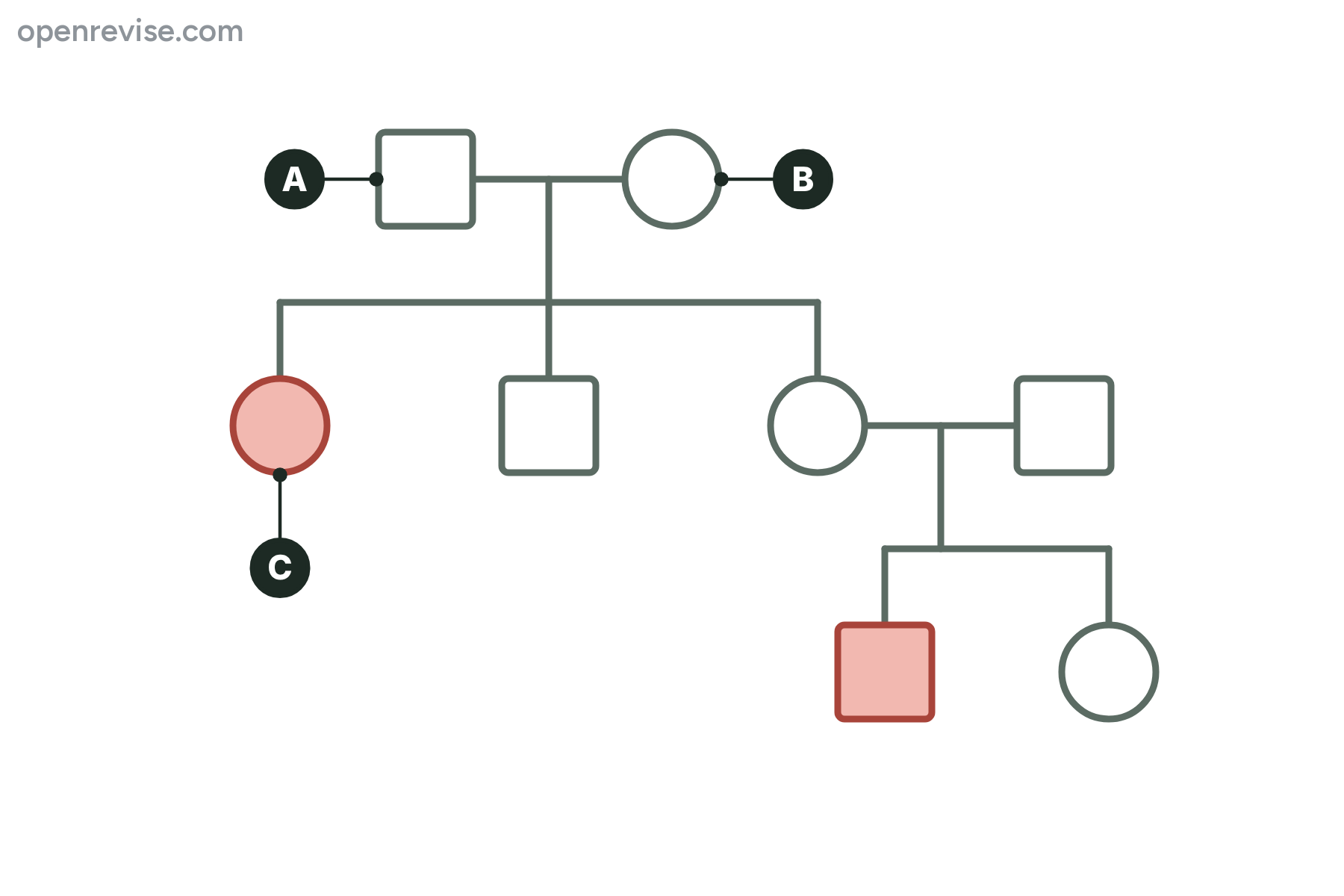
The family tree shows a disorder. A and B do not have the disorder, but their daughter C does. Explain what this shows about the allele that causes the disorder.
Show answerHide answer
Model answer
The allele is recessive. If it was dominant, C would have had to inherit it from A or B, and that parent would have the disorder. A and B are both carriers, and C inherited a recessive allele from each of them.
Mark scheme
- The allele is recessive — 1 mark
- Parents are unaffected, so a dominant allele could not have been passed on — 1 mark
- A and B are carriers and each passed on a recessive allele to C — 1 mark
-
5 Calculate [3 marks]
A woman with polydactyly has the genotype Dd. Her partner does not have polydactyly. The allele for polydactyly (D) is dominant to the normal allele (d). Calculate the percentage chance that their first child has polydactyly.
Show answerHide answer
Model answer
50%. The partner is dd, so the squares are Dd, Dd, dd and dd, and two out of four give the dominant phenotype.
Mark scheme
- The partner is dd — 1 mark
- Two squares in four have a D allele — 1 mark
- 50% — 1 mark
-
6 Describe [3 marks]
Describe how embryo screening can be used to avoid the birth of a baby with a serious inherited disorder.
Show answerHide answer
Model answer
Eggs are fertilised by IVF and the embryos are allowed to grow to a small ball of cells. One cell is taken from each embryo and tested for the faulty allele. Only embryos that do not have the allele are put into the mother's womb.
Mark scheme
- Embryos made by IVF — 1 mark
- A cell is removed and tested for the allele — 1 mark
- Only embryos without the faulty allele are implanted — 1 mark
-
7 Evaluate [6 marks]
Evaluate the use of embryo screening for couples who are both carriers of the cystic fibrosis allele. Use the economic, social and ethical issues in your answer.
Show answerHide answer
Model answer
Embryo screening allows a couple to have a baby who does not have cystic fibrosis, which avoids the suffering of the child and of the family, and the cost of lifelong treatment (an economic and social benefit). It avoids the need to terminate an affected pregnancy. However, embryos with the allele are destroyed, which some people believe is wrong because an embryo is a potential human life (an ethical issue). IVF is expensive, is not always successful and can be stressful. There is also concern that screening could be extended to choose other features. Overall, the benefit of preventing a serious disorder can outweigh these objections for many couples, but the final decision depends on the beliefs of the people involved.
Mark scheme
- A benefit such as a healthy child and less suffering — 1 mark
- Economic point such as the cost of lifelong treatment or the cost of IVF — 1 mark
- Social point such as the effect on the family — 1 mark
- Ethical objection such as destruction of embryos — 1 mark
- A further objection or limitation such as designer babies or IVF failing — 1 mark
- A reasoned conclusion that weighs both sides — 1 mark
-
8 Explain [4 marks]
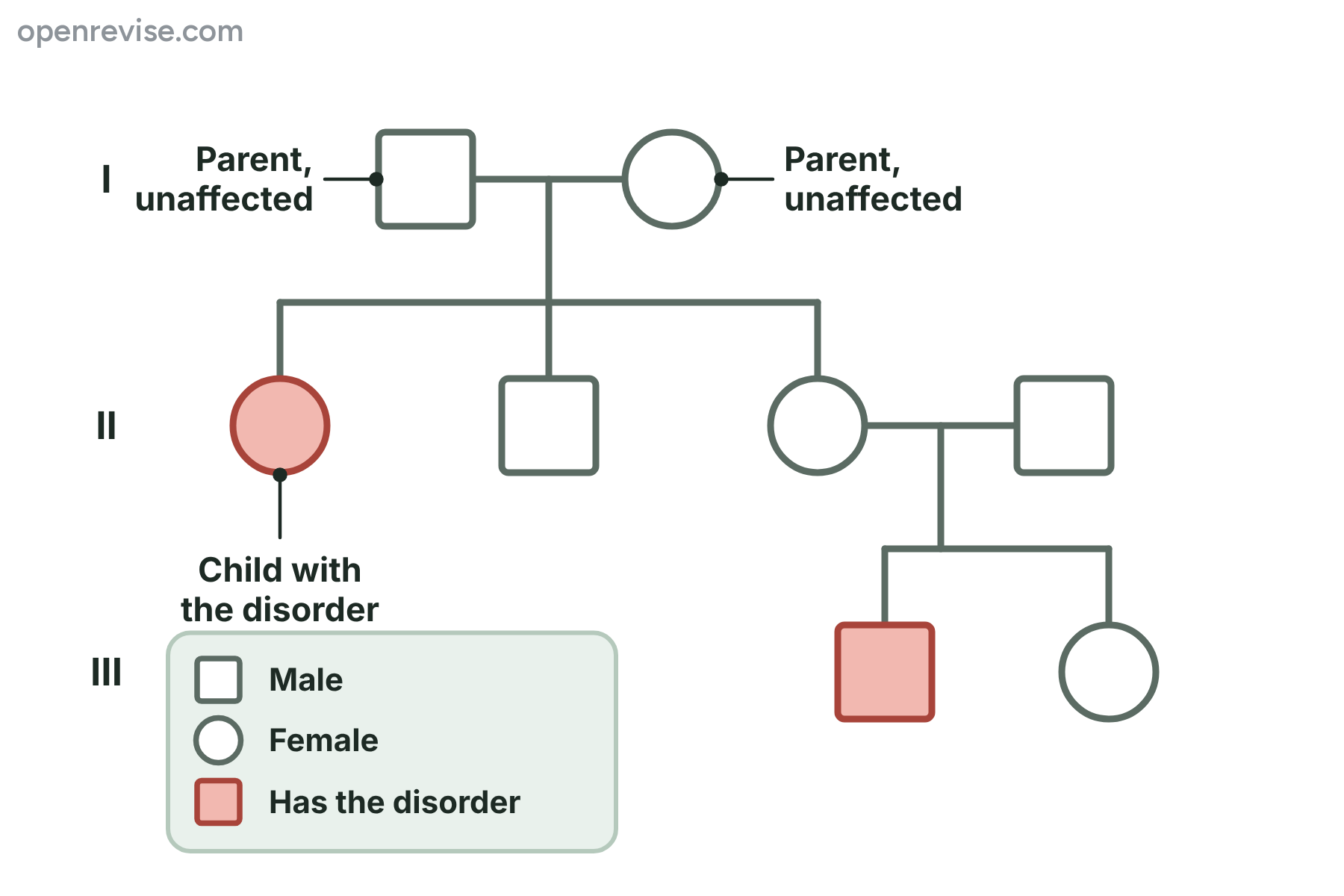
The family tree shows the inheritance of a recessive disorder. Let N be the normal allele and n be the allele for the disorder. Give the genotypes of the two parents in generation I and of their daughter with the disorder, and explain your answers.
Show answerHide answer
Model answer
The daughter has the disorder, which is recessive, so she is nn. She got one n from each parent. The parents do not have the disorder, so each also has a normal allele, so both parents are Nn.
Mark scheme
- Daughter is nn — 1 mark
- She inherited one n from each parent — 1 mark
- Parents do not have the disorder so each has an N allele — 1 mark
- Both parents are Nn — 1 mark
-
9 Calculate [4 marks]
The woman in generation II who is joined to the unaffected man has a shaded son. The disorder is recessive. Explain why both she and her partner must be carriers, then calculate the probability that their next child will have the disorder.
Show answerHide answer
Model answer
Their son has the disorder, so he is nn and inherited an n allele from each parent. As neither parent has the disorder, each must also have an N allele, so both are Nn. A cross of Nn with Nn gives NN, Nn, Nn and nn, so the probability that the next child has the disorder is 1 in 4, or 25%.
Mark scheme
- Son is nn, so each parent passed on n — 1 mark
- Parents do not have the disorder so both are Nn — 1 mark
- Correct cross Nn x Nn — 1 mark
- Probability 1 in 4 (25%) — 1 mark
Quick check
-
1
Which inherited disorder is caused by a dominant allele?
Show answerHide answer
C: Polydactyly
Polydactyly is caused by a dominant allele, whereas cystic fibrosis is caused by a recessive allele.
-
2
What does cystic fibrosis affect?
Show answerHide answer
B: Cell membranes
Cystic fibrosis is a disorder of cell membranes, producing thick sticky mucus.
-
3
What is a carrier of a recessive disorder?
Show answerHide answer
D: Someone with one recessive allele who does not have the disorder
A carrier has one recessive allele and one dominant allele, so does not have the disorder but can pass the allele on.
-
4
Two carriers of cystic fibrosis have a child. What is the probability that the child has the disorder?
Show answerHide answer
A: 1 in 4
The cross Cc x Cc gives CC, Cc, Cc and cc, so one in four have cc.
-
5
In a family tree, two unaffected parents have an affected child. What does this show?
Show answerHide answer
B: The allele is recessive
The disorder must be recessive, and both parents must be carriers.
-
6
What does a circle on a family tree represent?
Show answerHide answer
C: A female
Circles are females and squares are males.
-
7
Which statement about embryo screening is correct?
Show answerHide answer
D: It tests embryos made by IVF for a faulty allele
In embryo screening, cells are tested for a faulty allele and only embryos without it are implanted.
-
8
A man with polydactyly (Dd) and a woman without it (dd) have a child. What is the chance that the child has polydactyly?
Show answerHide answer
A: 50%
The cross Dd x dd gives two Dd and two dd, so 50% have polydactyly.