Biology · Genetic Inheritance
Inherited Disorders and Family Trees
Some diseases run in families because they are caused by the alleles a person inherits. This lesson is for both Combined Science and separate Biology. It covers polydactyly and cystic fibrosis, how to read a family tree, and the economic, social and ethical issues around embryo screening and gene therapy.
Learning Objectives
- 1Describe polydactyly and cystic fibrosis as inherited disorders caused by a dominant allele and a recessive allele.
- 2Use a Punnett square to work out the probability that a child inherits an inherited disorder.
- 3Extract and interpret information from a family tree.
- 4Make an informed judgement about the economic, social and ethical issues of embryo screening.
Retrieval practice
-
1
What is a recessive allele?
Show answerHide answer
An allele that is only expressed if two copies are present.
-
2
What is the genotype of someone who is heterozygous?
Show answerHide answer
Two different alleles, such as Cc.
-
3
What does a Punnett square show?
Show answerHide answer
All the possible combinations of gametes, and so the possible genotypes of the offspring.
-
4
What is the chance of a recessive offspring from two heterozygous parents?
Show answerHide answer
One in four, or 25%.
Disorders written in the genes
Not every disease is caught from someone else. Some disorders are inherited. They are caused by the inheritance of certain alleles that were present in the parents' gametes. Some of these alleles are dominant and some are recessive, and that makes a huge difference to how the disorder appears in a family. This lesson uses two examples and then shows how scientists follow a disorder through generations.
Two inherited disorders
One is caused by a dominant allele and one by a recessive allele.
-
Polydactyly
A person with polydactyly has extra fingers or toes. It is caused by a dominant allele, so a person needs only one copy to have it. It is not usually a serious health problem.
-
Cystic fibrosis
Cystic fibrosis is a disorder of cell membranes. It is caused by a recessive allele, so a person only has the disorder if they have two copies. It makes the body produce thick, sticky mucus in the lungs and digestive system.
-
Carriers
A person with one copy of the cystic fibrosis allele and one normal allele does not have the disorder, but is a carrier who can pass the allele on. About 1 in 25 people in the UK are carriers.
-
A dominant allele can be rare
An allele can cause a serious disorder and still be rare, because people who have it may be less likely to have children.
Polydactyly and cystic fibrosis
Polydactyly
- Caused by a dominant allele
- One copy is enough to have the disorder
- An affected person must have an affected parent
- Affected genotypes are DD and Dd
Cystic fibrosis
- Caused by a recessive allele
- Two copies are needed to have the disorder
- Two unaffected carrier parents can have an affected child
- Affected genotype is cc, and carriers are Cc
Cystic fibrosis: two carrier parents
Two parents do not have cystic fibrosis, but both are carriers. The allele for cystic fibrosis (c) is recessive to the normal allele (C). Use a Punnett square to work out the probability that their child has cystic fibrosis, and the probability that their child is a carrier.
Show the solutionHide the solution
- 1 Write the parents' genotypes Both parents are carriers, so both are Cc
- 2 Write the gametes Each parent makes gametes C and c
- 3 Fill in the four squares CC, Cc, Cc and cc
- 4 Chance of cystic fibrosis Only cc has the disorder, so 1 square in 4, which is 25%
- 5 Chance of being a carrier Cc appears twice, so 2 squares in 4, which is 50%
AnswerThe chance of cystic fibrosis is 1 in 4 (25%) and the chance of being a carrier is 1 in 2 (50%).
Polydactyly: one affected parent
A man with polydactyly has the genotype Dd. His partner does not have polydactyly. The allele for polydactyly (D) is dominant to the normal allele (d). What is the probability that their child has polydactyly?
Show the solutionHide the solution
- 1 Genotype of the partner She does not have the dominant allele, so she is dd
- 2 Write the gametes The man makes D and d. The woman makes only d
- 3 Fill in the four squares Dd, Dd, dd and dd
- 4 Count Two squares in four have a D, so the chance is 1 in 2, or 50%
AnswerThe probability is 1 in 2 (50%).
Reading a family tree
A family tree shows who has a disorder over several generations. Squares are males and circles are females, and a shaded symbol shows a person with the disorder.
-
Lines
A horizontal line joins two parents. A vertical line leads down from it to their children, who are drawn on the next row.
-
Generations
Each row is a generation, often numbered I, II and III.
-
Spotting a recessive disorder
If two unaffected parents have an affected child, the disorder must be recessive, and both parents must be carriers.
-
Spotting a dominant disorder
If a child has the disorder, at least one parent must have it too. If neither parent has it, the allele cannot be dominant.
A family tree for a recessive disorder
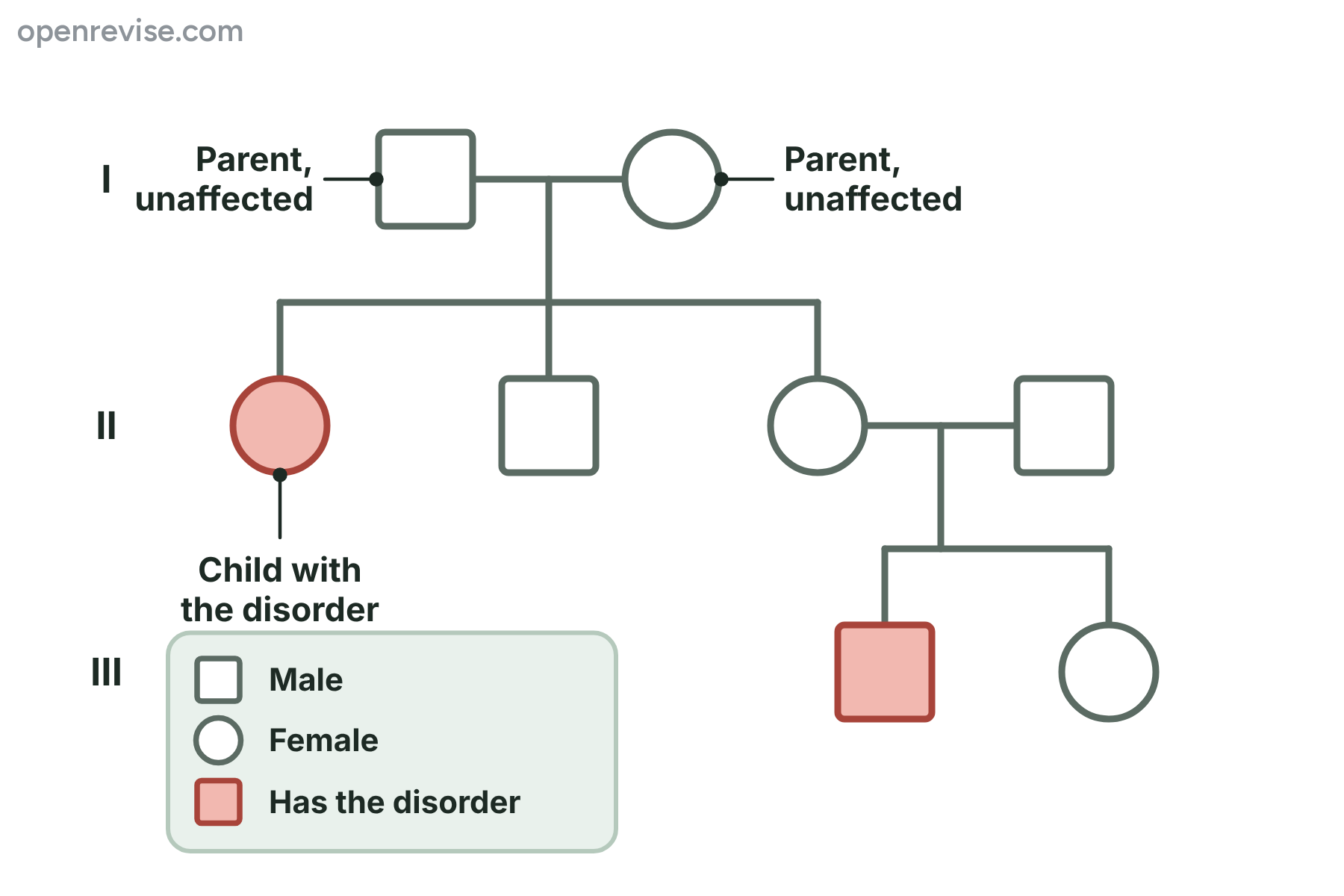
Two unaffected parents with an affected child show that the allele is recessive.
Working out genotypes from a family tree
Use letters such as N for the normal allele and n for the allele that causes the disorder.
-
1
Decide if the allele is dominant or recessive
Unaffected parents with an affected child means it is recessive.
-
2
Write the genotypes of affected people
An affected person with a recessive disorder is nn.
-
3
Work out their parents
Each parent passed on one n, and as they are unaffected they also have an N, so each is Nn.
-
4
Use a Punnett square for the probability
Cross the parents' genotypes and read off the chance for the next child.
Embryo screening and gene therapy
Scientists can now reduce the suffering caused by inherited disorders, but their methods raise difficult questions.
-
Embryo screening
Eggs are fertilised outside the body in IVF. When the embryos are a tiny ball of cells, one cell is removed and tested for the faulty allele. Only embryos without the allele are placed in the womb.
-
Gene therapy
Modern medical research is exploring genetic modification to overcome some inherited disorders, by putting a working copy of the gene into a patient's cells.
-
Benefits
These can prevent a child from being born with a serious disorder and can reduce suffering for the family.
-
Concerns
They raise economic, social and ethical issues, so people have to weigh the benefits against the objections.
Embryo screening: for and against
For
- Healthy babies are born to families with a serious disorder
- Avoids the pain and cost of caring for a seriously ill child
- Avoids a later termination of an affected pregnancy
- Could save the health service money
Against
- Embryos that carry the allele are destroyed, which some people see as wrong
- IVF is expensive and does not always work
- It may lead to parents choosing other features, so-called designer babies
- It may make people with the disorder feel less valued
Case study
Cystic fibrosis in the UK
About 1 in 25 people in the UK carry the allele for cystic fibrosis, and since both parents must pass it on, about 1 in 2 500 babies is born with the disorder. A baby is tested at birth with a heel prick blood test. Treatment includes physiotherapy to clear the mucus and drugs and enzymes to help digestion. Couples who are both carriers can have embryo screening to avoid having a child with the disorder.
The big idea
Inherited disorders are caused by alleles, and whether the allele is dominant or recessive decides how the disorder moves through a family.
Inherited disorders
Inherited disorders
-
Polydactyly
- dominant allele
- extra fingers or toes
-
Cystic fibrosis
- recessive allele
- cell membranes
- carriers
-
Family trees
- squares and circles
- shaded means affected
- generations
-
Probability
- Punnett square
- 1 in 4 for two carriers
-
Embryo screening
- IVF
- test one cell
- only healthy embryos used
-
Issues
- economic
- social
- ethical
Summary and exam focus
- Some disorders are inherited, caused by the inheritance of certain alleles.
- Polydactyly is caused by a dominant allele and cystic fibrosis is caused by a recessive allele.
- Two carrier parents have a 1 in 4 chance of a child with a recessive disorder.
- A family tree shows how a disorder is inherited, and unaffected parents with an affected child show a recessive allele.
- Embryo screening and gene therapy may relieve suffering but raise ethical issues.
Exam focus
Some people think embryo screening should be used for all couples who carry an allele for a serious inherited disorder. Evaluate this idea. (6 marks) (6 marks)
A 6-mark answer needs both sides and a judgement. Give two or three points in favour, such as healthy babies and lower costs, then two or three against, such as destroyed embryos and cost. Say who is affected (economic, social and ethical issues) and finish with a clear conclusion that you have supported.
Key terms
The words this lesson expects you to use. Each one is linked from the first place it appears above.
- Inherited disorder
- A disorder caused by alleles that are passed from parents to offspring.
- Polydactyly
- An inherited disorder in which a person has extra fingers or toes, caused by a dominant allele.
- Cystic fibrosis
- An inherited disorder of cell membranes, caused by a recessive allele, that produces thick sticky mucus.
- Carrier
- A person who has one copy of a recessive allele and does not have the disorder.
- Family tree
- A diagram that shows how a characteristic is inherited through several generations of a family.
- Embryo screening
- Testing an embryo for a faulty allele before it is placed in the womb.
- Gene therapy
- Treating an inherited disorder by changing or replacing the faulty gene in a person's cells.
- IVF
- In vitro fertilisation, in which eggs are fertilised outside the body.
You've finished the notes
Check your understanding
Test yourself while it is fresh. Start with the flashcards, then try the exam questions.
Something here looks wrong?
Tell us what and we will go and look. It goes to whoever writes these pages, nobody else, and we do not ask who you are — so there is nothing to sign and nothing comes back to you.