Exam questions · Biology · Genetic Inheritance
Sex Determination
- 8 exam questions
- 22 marks
- 8 quick checks
-
1 State [2 marks]
State the sex chromosomes found in an ordinary human body cell from a female and from a male.
Show answerHide answer
Model answer
A female has two X chromosomes (XX). A male has one X and one Y chromosome (XY).
Mark scheme
- Female: XX — 1 mark
- Male: XY — 1 mark
-
2 Describe [2 marks]
Ordinary human body cells contain 23 pairs of chromosomes. Describe the job of the 23 pairs of chromosomes.
Show answerHide answer
Model answer
22 pairs control characteristics only. One pair carries the genes that determine sex.
Mark scheme
- 22 pairs control characteristics only — 1 mark
- One pair determines sex — 1 mark
-
3 Name [2 marks]
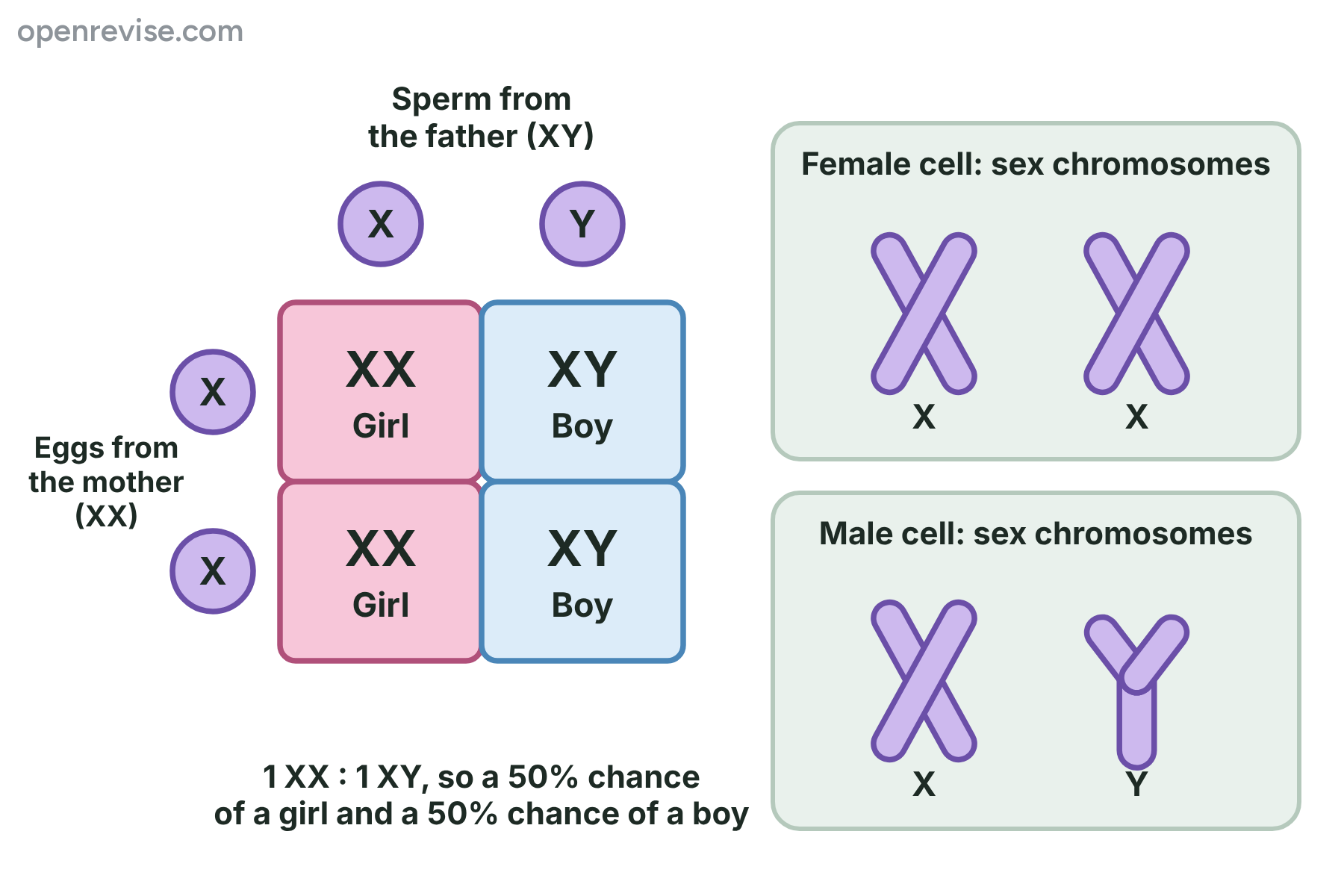
The diagram shows how the sex of a baby is inherited. State the sex chromosomes carried by every egg, and by the sperm.
Show answerHide answer
Model answer
Every egg carries an X chromosome. Half of the sperm carry an X chromosome and half carry a Y chromosome.
Mark scheme
- Every egg carries X — 1 mark
- Sperm carry X or Y — 1 mark
-
4 Explain [3 marks]
Explain why the father, and not the mother, determines the sex of a baby.
Show answerHide answer
Model answer
The mother is XX, so every egg she makes carries an X chromosome. The father is XY, so half of his sperm carry an X and half carry a Y. The sperm that fertilises the egg decides whether the baby is XX (a girl) or XY (a boy).
Mark scheme
- Mother's eggs all carry X — 1 mark
- Sperm carry X or Y — 1 mark
- The sperm that fertilises the egg decides the sex — 1 mark
-
5 Calculate [2 marks]
In one year 2 400 babies were born in a town. Use the sex ratio from a genetic cross to estimate how many of the babies were boys.
Show answerHide answer
Model answer
1 200 boys. The ratio of girls to boys is 1 : 1, so half of the babies are boys, and \(\frac{1}{2} \times 2400 = 1200\).
Mark scheme
- Ratio 1 : 1, so half are boys — 1 mark
- 1 200 — 1 mark
-
6 Explain [3 marks]
A couple have five daughters and are expecting a sixth child. The father says, "It must be a boy this time." Explain why he is wrong.
Show answerHide answer
Model answer
Each baby is the result of a separate fertilisation. The chance that the sperm which fertilises the egg carries a Y chromosome is the same every time, 50%. So the sixth child still has a 50% chance of being a girl.
Mark scheme
- Each fertilisation is a separate event — 1 mark
- The chance is 50% every time — 1 mark
- Earlier children do not change the chance — 1 mark
-
7 Describe [4 marks]
Use a genetic cross to show how sex is inherited in humans.
Show answerHide answer
Model answer
The mother is XX, so she makes only X eggs. The father is XY, so he makes X sperm and Y sperm. The Punnett square gives XX, XY, XX and XY. XX is female and XY is male, so the ratio of girls to boys is 1 : 1, or a 50% chance of each.
Mark scheme
- Mother XX and father XY — 1 mark
- Gametes X, X and X, Y — 1 mark
- Offspring XX, XY, XX, XY — 1 mark
- Ratio 1 : 1 (50% girls and 50% boys) — 1 mark
-
8 Explain [4 marks]
In a family with four children, the ratio of girls to boys was 3 : 1. In a country with 20 million births, the ratio was almost exactly 1 : 1. Explain these results.
Show answerHide answer
Model answer
The ratio from a genetic cross is 1 : 1, but each fertilisation is a separate chance event with a 50% chance of a girl. In a family with only four children, chance variation can easily give a different ratio such as 3 : 1. In a population of 20 million births the chance variation is much smaller relative to the total, so the ratio is very close to the expected 1 : 1.
Mark scheme
- Expected ratio is 1 : 1 — 1 mark
- Each fertilisation is a chance event — 1 mark
- With small numbers, chance can give a different ratio — 1 mark
- With very large numbers the ratio is close to the expected one — 1 mark
Quick check
-
1
How many pairs of chromosomes in a human body cell carry the genes that determine sex?
Show answerHide answer
A: One
One of the 23 pairs carries the genes that determine sex. The other 22 pairs control characteristics only.
-
2
Which pair of sex chromosomes does a human male have?
Show answerHide answer
C: XY
Males have one X and one Y chromosome.
-
3
Which sex chromosome is carried by every egg cell?
Show answerHide answer
B: X
The mother is XX, so every egg carries an X chromosome.
-
4
A sperm cell carrying a Y chromosome fertilises an egg. What is the sex of the baby?
Show answerHide answer
D: A boy
The baby is XY, so a boy.
-
5
What is the expected ratio of girls to boys from a genetic cross?
Show answerHide answer
A: 1 : 1
The Punnett square gives two XX to two XY, which simplifies to 1 : 1.
-
6
A couple have had three sons. What is the chance that their next child is a daughter?
Show answerHide answer
C: 50%
Each fertilisation is independent, so the chance is 50% every time.
-
7
Why can a very large population have almost equal numbers of males and females even though a single family may not?
Show answerHide answer
B: Because chance variation averages out in large numbers
Each birth is a chance event with a 50% probability, and the effect of chance averages out over large numbers.
-
8
Which statement about human chromosomes is correct?
Show answerHide answer
D: 22 pairs control characteristics only
22 of the 23 pairs control characteristics only, and the last pair determines sex.