Biology · Genetic Inheritance
Sex Determination
What decides whether a baby is a boy or a girl? This lesson is for both Combined Science and separate Biology. It covers the sex chromosomes, how to carry out a genetic cross to show sex inheritance, and why the 1 : 1 ratio is an expected result and not a guarantee.
Learning Objectives
- 1State that ordinary human body cells contain 23 pairs of chromosomes, 22 pairs that control characteristics only and one pair that determines sex.
- 2Describe the sex chromosomes of females (XX) and males (XY).
- 3Carry out a genetic cross with a Punnett square to show sex inheritance, and give the result as a ratio.
- 4Explain why the sex of a baby depends on the father's sperm, and why each baby has the same chance of being a boy or a girl.
Retrieval practice
-
1
How many chromosomes are in a human body cell?
Show answerHide answer
46, in 23 pairs.
-
2
How many chromosomes are in a human gamete?
Show answerHide answer
23, one from each pair.
-
3
What does a Punnett square show?
Show answerHide answer
All the possible combinations of gametes, and so the possible offspring.
-
4
What process makes gametes?
Show answerHide answer
Meiosis.
The 23rd pair
Human body cells contain 23 pairs of chromosomes. Twenty-two pairs control characteristics only, such as the shape of the nose, the colour of the eyes and the blood group. The last pair carries the genes that determine sex. Together these two chromosomes are the sex chromosomes, and they are the same in every cell of a person's body.
The sex chromosomes
The two sex chromosomes are called X and Y, and the combination decides the sex.
-
Females
In females the sex chromosomes are the same. A female has two X chromosomes, written XX.
-
Males
In males the sex chromosomes are different. A male has one X chromosome and one shorter Y chromosome, written XY.
-
The Y chromosome
The Y chromosome carries a gene that makes an embryo develop as male, with testes. An embryo without a Y chromosome develops as female.
-
Autosomes
The other 22 pairs control characteristics only. They are the same in males and females.
Sex inheritance in a cross
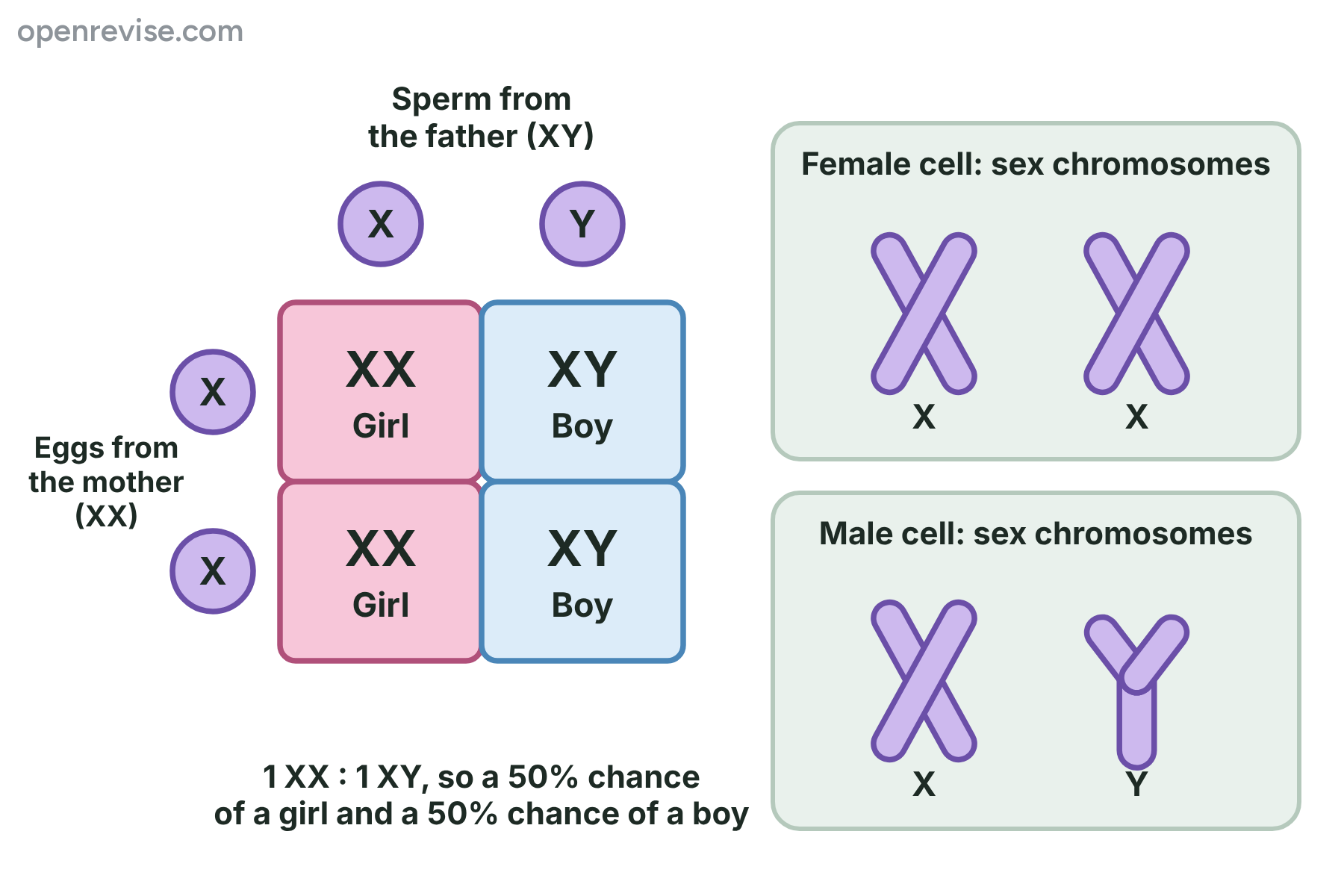
Every egg carries an X chromosome, so the sperm decides the sex of the baby.
How the sex of a baby is decided
Meiosis separates the pair of sex chromosomes, so each gamete has only one.
-
1
Eggs
A woman is XX, so every egg cell she makes carries one X chromosome.
-
2
Sperm
A man is XY, so half of his sperm carry an X chromosome and half carry a Y chromosome.
-
3
Fertilisation
An egg is fertilised by one sperm. If the sperm carries X, the baby is XX and is a girl. If the sperm carries Y, the baby is XY and is a boy.
-
4
Chance
Either kind of sperm is equally likely to reach the egg, so each baby has a 50% chance of being a boy and a 50% chance of being a girl.
Drawing a genetic cross for sex
Draw a Punnett square to show the inheritance of sex in humans, and use it to give the ratio of girls to boys.
Show the solutionHide the solution
- 1 Write the parents The mother is XX and the father is XY
- 2 Write the gametes The mother makes X and X. The father makes X and Y
- 3 Fill in the four squares XX, XY, XX and XY
- 4 Give the sexes XX is female and XY is male, so two girls and two boys
- 5 Write the ratio 2 : 2, which simplifies to 1 : 1
AnswerThe ratio of girls (XX) to boys (XY) is 1 : 1.
Expected ratios and real families
A 1 : 1 ratio is what we expect over a very large number of births. It is not what happens in every family.
-
Large numbers
In a large population the numbers of boys and girls are very close to equal, because each fertilisation is a separate chance event with a 50% probability.
-
Small families
A family with four children could easily have four girls, or three boys and one girl. The ratio is only an average.
-
No memory
A couple who have had four girls still have a 50% chance of a boy next time. Past babies do not change the chance.
-
Who decides
The father's sperm decides, because every egg carries an X. The mother cannot decide the sex of the baby.
Using the ratio
In a hospital there were 1 800 births in a year. Use the ratio from a genetic cross to estimate the number of girls born.
Show the solutionHide the solution
- 1 State the expected proportion The ratio of girls to boys is 1 : 1, so half of the babies are girls
- 2 Use direct proportion \(\frac{1}{2} \times 1800\)
- 3 Give the answer 900 girls
AnswerAbout 900 girls were born.
Female and male cells
Female (XX)
- Two X chromosomes in every body cell
- Every egg carries one X
- Cannot pass on a Y chromosome
- Sex chromosomes are the same
Male (XY)
- One X and one Y in every body cell
- Half of sperm carry X and half carry Y
- Decides the sex of the baby
- Sex chromosomes are different
Case study
Same couple, many children
A couple have five children, and all five are girls. Many people expect that the sixth child is more likely to be a boy, but this is not true. Each baby is the result of a separate fertilisation, and the chance that the sperm which wins carries a Y chromosome is 50% every time. The chance that all five children of any couple are girls was only about 1 in 32.
The big idea
Every egg carries an X chromosome, so the father's sperm, carrying X or Y, decides the sex of the baby, with an equal chance of each.
Sex determination
Sex determination
-
Chromosomes
- 23 pairs
- 22 pairs for characteristics
- one pair for sex
-
Females
- XX
-
Males
- XY
-
Gametes
- eggs all X
- sperm X or Y
-
Cross
- XX, XY, XX, XY
- ratio 1 : 1
-
Chance
- 50% each time
- independent births
Summary and exam focus
- Ordinary human body cells have 23 pairs of chromosomes, and 22 pairs control characteristics only.
- One pair of chromosomes carries the genes that determine sex.
- Females have two X chromosomes (XX) and males have an X and a Y chromosome (XY).
- Every egg carries an X, and half of the sperm carry X and half carry Y.
- A genetic cross gives 1 XX : 1 XY, so a 50% chance of a boy or a girl.
Exam focus
Describe how the sex of a baby is determined in humans. Include a genetic cross in your answer. (4 marks) (4 marks)
Show a Punnett square with the gametes labelled, then fill in all four squares. Say which squares are female and which are male, and state the 1 : 1 ratio. The explanation of why the father decides gets the final mark.
Key terms
The words this lesson expects you to use. Each one is linked from the first place it appears above.
- Sex chromosomes
- The pair of chromosomes that determines the sex of a person: XX in females and XY in males.
- X chromosome
- A sex chromosome carried by all eggs and by half of sperm.
- Y chromosome
- The shorter sex chromosome, carried by half of sperm, which makes an embryo develop as male.
- Autosomes
- The 22 pairs of chromosomes that control characteristics but not sex.
- Gamete
- A sex cell with one copy of each chromosome.
- Fertilisation
- The joining of an egg and a sperm.
- Punnett square
- A diagram showing all possible combinations of gametes in a cross.
- Ratio
- A comparison of two numbers, such as 1 : 1.
You've finished the notes
Check your understanding
Test yourself while it is fresh. Start with the flashcards, then try the exam questions.
Something here looks wrong?
Tell us what and we will go and look. It goes to whoever writes these pages, nobody else, and we do not ask who you are — so there is nothing to sign and nothing comes back to you.