Exam questions · Biology · Genetic Inheritance
Single Gene Crosses and Punnett Squares
- 8 exam questions
- 28 marks
- 8 quick checks
-
1 State [2 marks]
State the gametes that can be made by a parent with the genotype Tt, where T is the allele for tall stems and t is the allele for short stems.
Show answerHide answer
Model answer
T and t. Each gamete carries one allele.
Mark scheme
- T — 1 mark
- t — 1 mark
-
2 Complete [4 marks]
In guinea pigs, the allele for rough coat (R) is dominant to the allele for smooth coat (r). Two guinea pigs with the genotype Rr are crossed. Complete a Punnett square and state the genotypes of the offspring.
Show answerHide answer
Model answer
The gametes from each parent are R and r. The squares are RR, Rr, Rr and rr.
Mark scheme
- Gametes R and r from each parent — 1 mark
- RR in one square — 1 mark
- Rr in two squares — 1 mark
- rr in one square — 1 mark
-
3 Give [3 marks]
Two guinea pigs with the genotype Rr are crossed. Give the ratio of rough-coated to smooth-coated offspring, and the percentage chance of an offspring having a smooth coat.
Show answerHide answer
Model answer
The ratio is 3 : 1 (rough to smooth). The chance of a smooth coat is 25%, because only the genotype rr, one square in four, gives a smooth coat.
Mark scheme
- Rough : smooth is 3 : 1 — 1 mark
- Smooth coat needs rr, one square in four — 1 mark
- 25% — 1 mark
-
4 Calculate [3 marks]
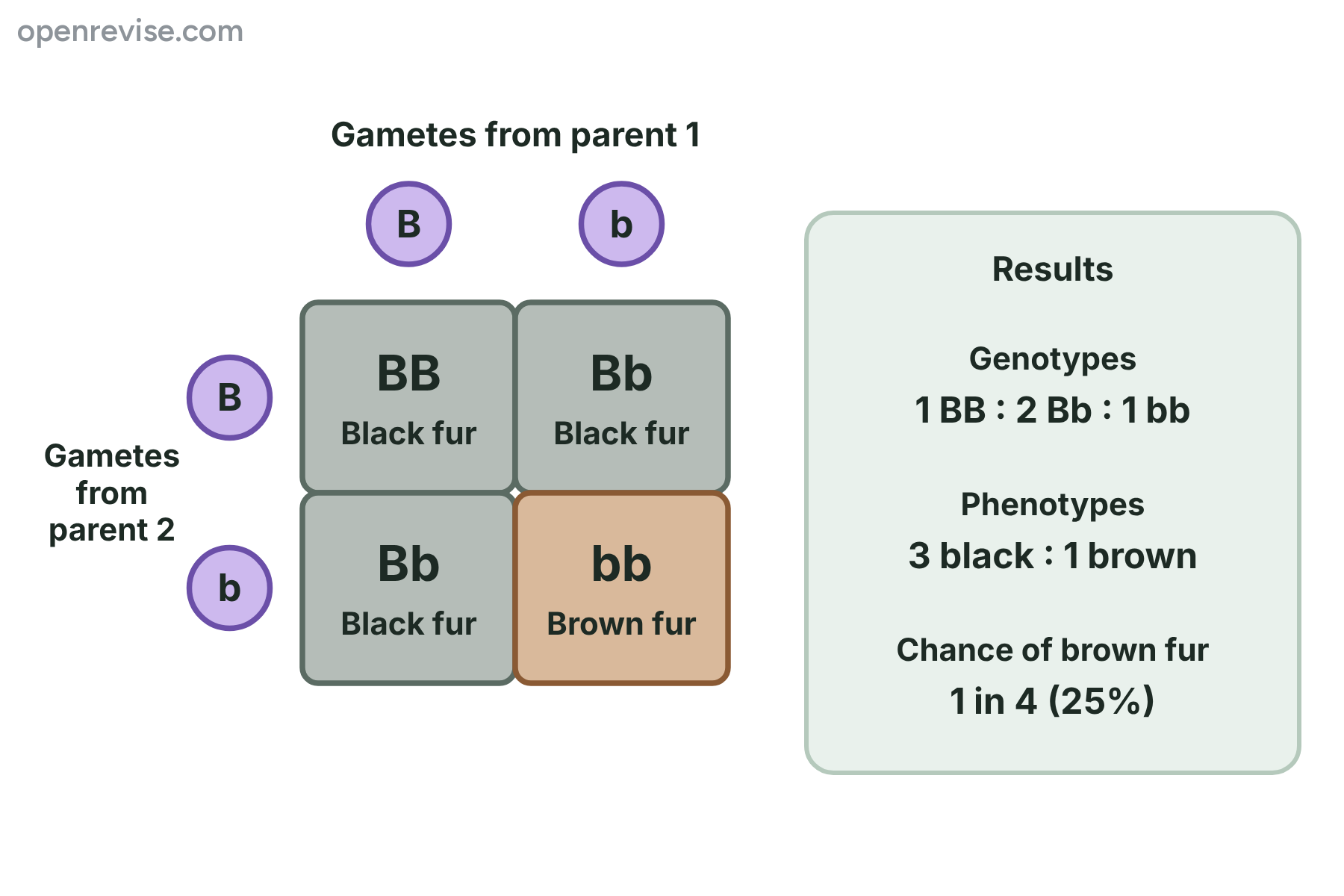
The diagram shows a cross between two black mice. The mice produced 24 offspring. Use the diagram to calculate how many of the 24 offspring you would expect to have brown fur.
Show answerHide answer
Model answer
6 offspring. One in four offspring is expected to be brown (bb), and \(\frac{1}{4} \times 24 = 6\).
Mark scheme
- Chance of brown is \(\frac{1}{4}\) — 1 mark
- \(\frac{1}{4} \times 24\) — 1 mark
- 6 — 1 mark
-
5 Explain [3 marks]
A farmer crossed two Bb black mice and got a litter of four, in which two were brown. A student says that the Punnett square must be wrong because it predicts a 3 : 1 ratio. Explain why the student is wrong.
Show answerHide answer
Model answer
A Punnett square only predicts probabilities. Each fertilisation is a separate chance event, so with only four offspring the result can easily differ from the expected ratio. The 3 : 1 ratio would only be seen on average over a large number of offspring.
Mark scheme
- It only predicts probabilities — 1 mark
- Each fertilisation is a chance event — 1 mark
- A small number of offspring need not match the ratio — 1 mark
-
6 Explain [4 marks]
A black mouse is crossed with a brown mouse. Brown fur (b) is recessive to black fur (B). All of the offspring are black. Use a Punnett square to explain what the genotype of the black parent is.
Show answerHide answer
Model answer
The brown parent is bb, so every gamete it makes carries b. If the black parent was Bb, about half of the offspring would be bb and brown, which did not happen. All of the offspring are black, so the black parent only makes B gametes and is homozygous dominant, BB. Every offspring is then Bb.
Mark scheme
- The brown parent is bb and only makes b gametes — 1 mark
- A Bb parent would give about half brown offspring — 1 mark
- All offspring are black, so the black parent only makes B gametes — 1 mark
- The black parent is BB and all offspring are Bb — 1 mark
-
7 Calculate [4 marks]
Two black mice, both with the genotype Bb, have two offspring. Calculate the probability that both of the offspring have brown fur. Show your working.
Show answerHide answer
Model answer
The chance that one offspring has brown fur (bb) is \(\frac{1}{4}\). Each fertilisation is independent, so the probability that both are brown is \(\frac{1}{4} \times \frac{1}{4} = \frac{1}{16}\), which is 0.0625 or 6.25%.
Mark scheme
- Chance of one brown offspring is \(\frac{1}{4}\) — 1 mark
- Events are independent so multiply — 1 mark
- \(\frac{1}{4} \times \frac{1}{4} = \frac{1}{16}\) — 1 mark
- 0.0625 or 6.25% (any equivalent form) — 1 mark
-
8 Explain [5 marks]
A breeder has a black mouse and does not know whether its genotype is BB or Bb. The breeder crosses it with a brown mouse and gets eight offspring, four black and four brown. Draw a Punnett square for the cross and explain what the result shows about the genotype of the black mouse.
Show answerHide answer
Model answer
The brown mouse is bb and only makes b gametes. If the black mouse was BB, every offspring would be Bb and black. Four brown offspring (bb) means that the black mouse must have passed on a b allele, so it is Bb. A Bb x bb cross gives Bb, Bb, bb and bb, which is a 1 : 1 ratio and matches four black and four brown.
Mark scheme
- Brown parent is bb and makes only b gametes — 1 mark
- Correct Punnett square for Bb x bb — 1 mark
- BB would give all black offspring — 1 mark
- Brown offspring (bb) means the black parent has a b allele — 1 mark
- So the black mouse is Bb, giving a 1 : 1 ratio — 1 mark
Quick check
-
1
What gametes does a parent with the genotype Aa make?
Show answerHide answer
B: A and a
The two alleles separate, so half of the gametes carry A and half carry a.
-
2
In a cross between two Bb parents, what proportion of the offspring are expected to be bb?
Show answerHide answer
C: One quarter
One of the four squares in the Punnett square is bb, so one quarter.
-
3
Two heterozygous parents are crossed. What is the expected ratio of the dominant to the recessive phenotype?
Show answerHide answer
D: 3 : 1
The squares are BB, Bb, Bb and bb, so three show the dominant phenotype for every one that shows the recessive phenotype.
-
4
A cross between Bb and bb is carried out. What percentage of the offspring are expected to be bb?
Show answerHide answer
A: 50%
Two of the four squares are bb, so 50%.
-
5
A couple have three children with a recessive disorder. What is the chance that their fourth child will have it?
Show answerHide answer
B: The same as for each earlier child
Each fertilisation is independent, so the chance is the same as for any other child, such as 1 in 4 if both parents are carriers.
-
6
Which statement about a Punnett square is correct?
Show answerHide answer
C: It shows the probability of each outcome
A Punnett square gives the probability of each outcome, not what will definitely happen.
-
7
Two black mice have a brown offspring. What are the genotypes of the parents?
Show answerHide answer
D: Bb and Bb
The brown offspring is bb, so each parent passed on a b, and as both parents are black they must each be Bb.
-
8
Two independent events each have a probability of one quarter. What is the probability that both happen?
Show answerHide answer
A: One sixteenth
The probabilities are multiplied: one quarter times one quarter is one sixteenth.