Exam questions · Biology · Homeostasis and the Nervous System
Neurones and the Nervous System
- 7 exam questions
- 20 marks
- 8 quick checks
-
1 State [2 marks]
State the two parts of the central nervous system.
Show answerHide answer
Model answer
The brain and the spinal cord.
Mark scheme
- Brain — 1 mark
- Spinal cord — 1 mark
-
2 Name [3 marks]
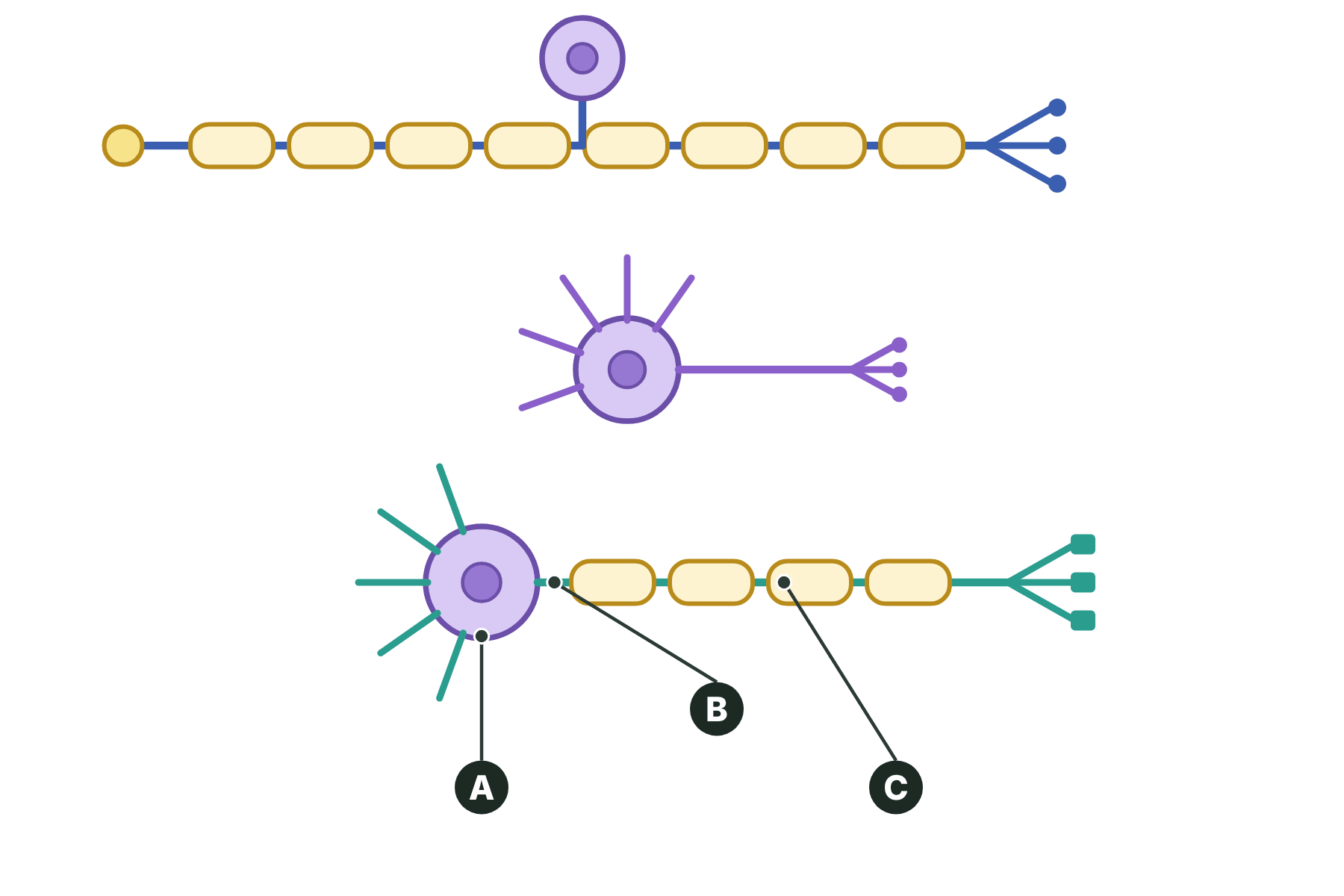
Figure 1 shows a motor neurone. Name the parts shown at A, B and C.
Show answerHide answer
Model answer
A is the cell body. B is the axon. C is the myelin sheath.
Mark scheme
- A: cell body — 1 mark
- B: axon — 1 mark
- C: myelin sheath — 1 mark
-
3 State [3 marks]
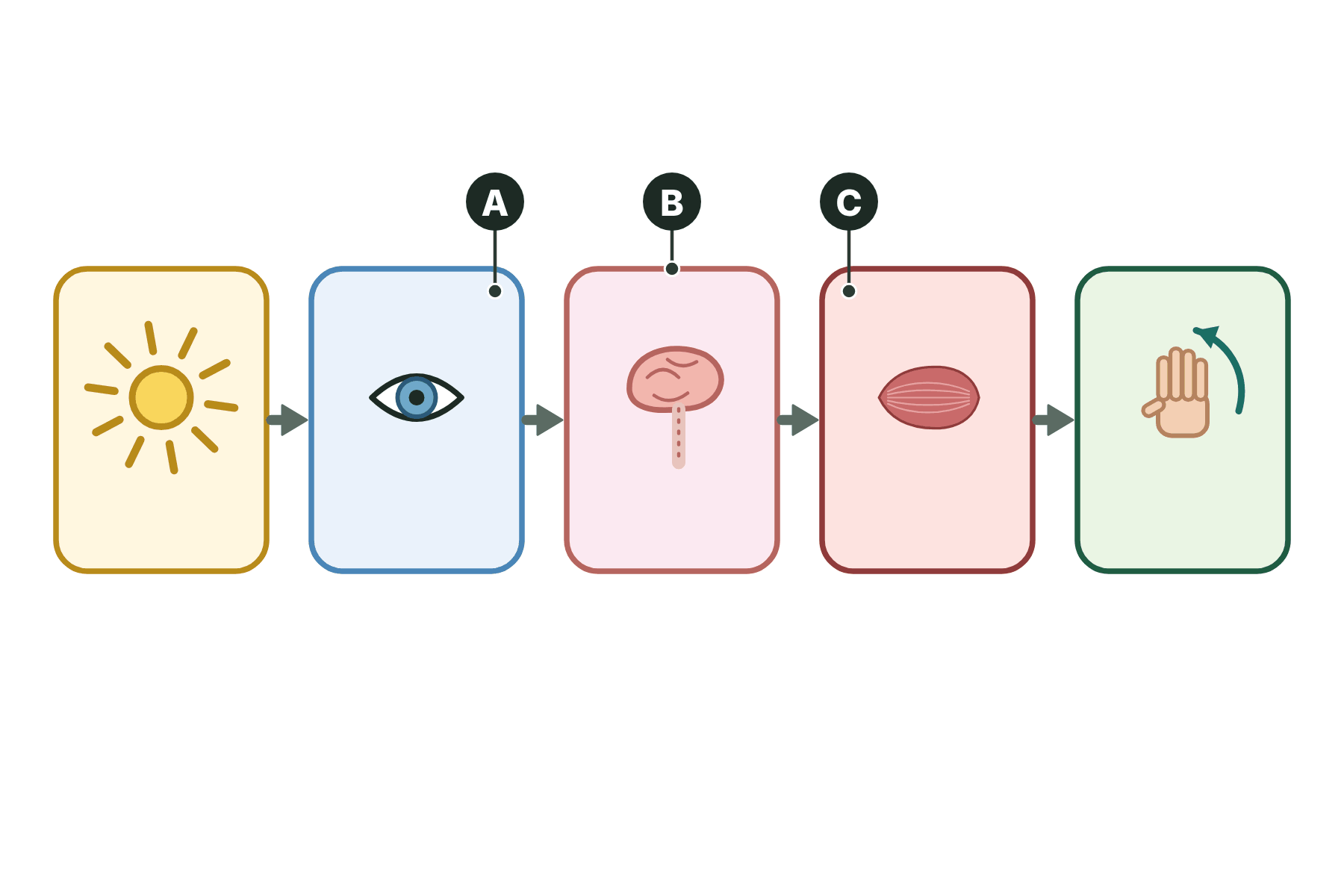
Figure 2 shows the path from a stimulus to a response. Name the parts shown at A, B and C.
Show answerHide answer
Model answer
A is a receptor. B is the central nervous system. C is an effector.
Mark scheme
- A: receptor — 1 mark
- B: central nervous system — 1 mark
- C: effector — 1 mark
-
4 Describe [3 marks]
Describe the functions of sensory neurones, relay neurones and motor neurones.
Show answerHide answer
Model answer
Sensory neurones carry impulses from receptors to the central nervous system. Relay neurones carry impulses inside the central nervous system. Motor neurones carry impulses from the central nervous system to effectors.
Mark scheme
- Sensory: receptor to the central nervous system — 1 mark
- Relay: within the central nervous system — 1 mark
- Motor: central nervous system to effectors — 1 mark
-
5 Explain [3 marks]
Explain how a nerve impulse crosses a synapse.
Show answerHide answer
Model answer
The impulse arrives at the nerve ending, which releases neurotransmitter. The neurotransmitter diffuses across the gap. It binds to receptors on the next neurone, which starts a new impulse.
Mark scheme
- Neurotransmitter released at the nerve ending — 1 mark
- Diffuses across the gap — 1 mark
- Binds to receptors on the next neurone to start an impulse — 1 mark
-
6 Explain [2 marks]
Explain why a myelin sheath is an advantage to a long neurone.
Show answerHide answer
Model answer
The myelin sheath insulates the axon. This makes the impulse travel much faster, so the response is quicker.
Mark scheme
- Insulates the axon — 1 mark
- Impulse travels faster — 1 mark
-
7 Explain [4 marks]
Explain how the nervous system produces a coordinated response.
Show answerHide answer
Model answer
Receptors of different types detect stimuli and send impulses. The central nervous system receives the impulses through many connections. It sends impulses along nerves, which reach all parts of the body, to the effectors. The effectors, muscles or glands, then carry out the response.
Mark scheme
- Different receptors detect stimuli — 1 mark
- Many links in the central nervous system — 1 mark
- Nerves reach all parts of the body — 1 mark
- Effectors carry out the response — 1 mark
Quick check
-
1
What is the job of a sensory neurone?
Show answerHide answer
B: To carry impulses from a receptor to the central nervous system
A sensory neurone carries impulses from a receptor to the central nervous system.
-
2
Which two structures make up the central nervous system?
Show answerHide answer
D: The brain and the spinal cord
The central nervous system is the brain and the spinal cord.
-
3
What is an effector?
Show answerHide answer
A: A muscle or a gland
Effectors are muscles and glands that carry out a response.
-
4
What is the function of the myelin sheath?
Show answerHide answer
C: To speed up the impulse
The myelin sheath insulates the axon and speeds up the impulse.
-
5
What is a synapse?
Show answerHide answer
B: A gap between two neurones
A synapse is the small gap between two neurones.
-
6
What crosses a synapse?
Show answerHide answer
D: Neurotransmitters
Neurotransmitter chemicals diffuse across the synapse.
-
7
Which cells detect a stimulus?
Show answerHide answer
A: Receptors
Receptors detect stimuli and start impulses.
-
8
Which of these carries impulses from the central nervous system to an effector?
Show answerHide answer
C: A motor neurone
Motor neurones carry impulses to effectors.