Exam questions · Biology · Cell Structure
Eukaryotic and Prokaryotic Cells
- 7 exam questions
- 20 marks
- 8 quick checks
-
1 Name [1 mark]
Name the type of cell that has no nucleus.
Show answerHide answer
Model answer
A prokaryotic cell, for example a bacterial cell.
Mark scheme
- Prokaryotic (cell) — 1 mark
-
2 Describe [2 marks]
Describe two differences between a bacterial cell and an animal cell.
Show answerHide answer
Model answer
Any two from: a bacterial cell has a cell wall but an animal cell does not; the DNA of a bacterial cell is a single loop in the cytoplasm but in an animal cell it is enclosed in a nucleus; a bacterial cell may have plasmids but an animal cell does not; a bacterial cell is much smaller than an animal cell.
Mark scheme
- Cell wall present in bacteria but not in animal cells — 1 mark
- DNA is a single loop (no nucleus) in bacteria, but enclosed in a nucleus in animal cells — 1 mark
- Plasmids in bacteria only — 1 mark
- Bacterial cell is smaller — 1 mark
-
3 Name [3 marks]
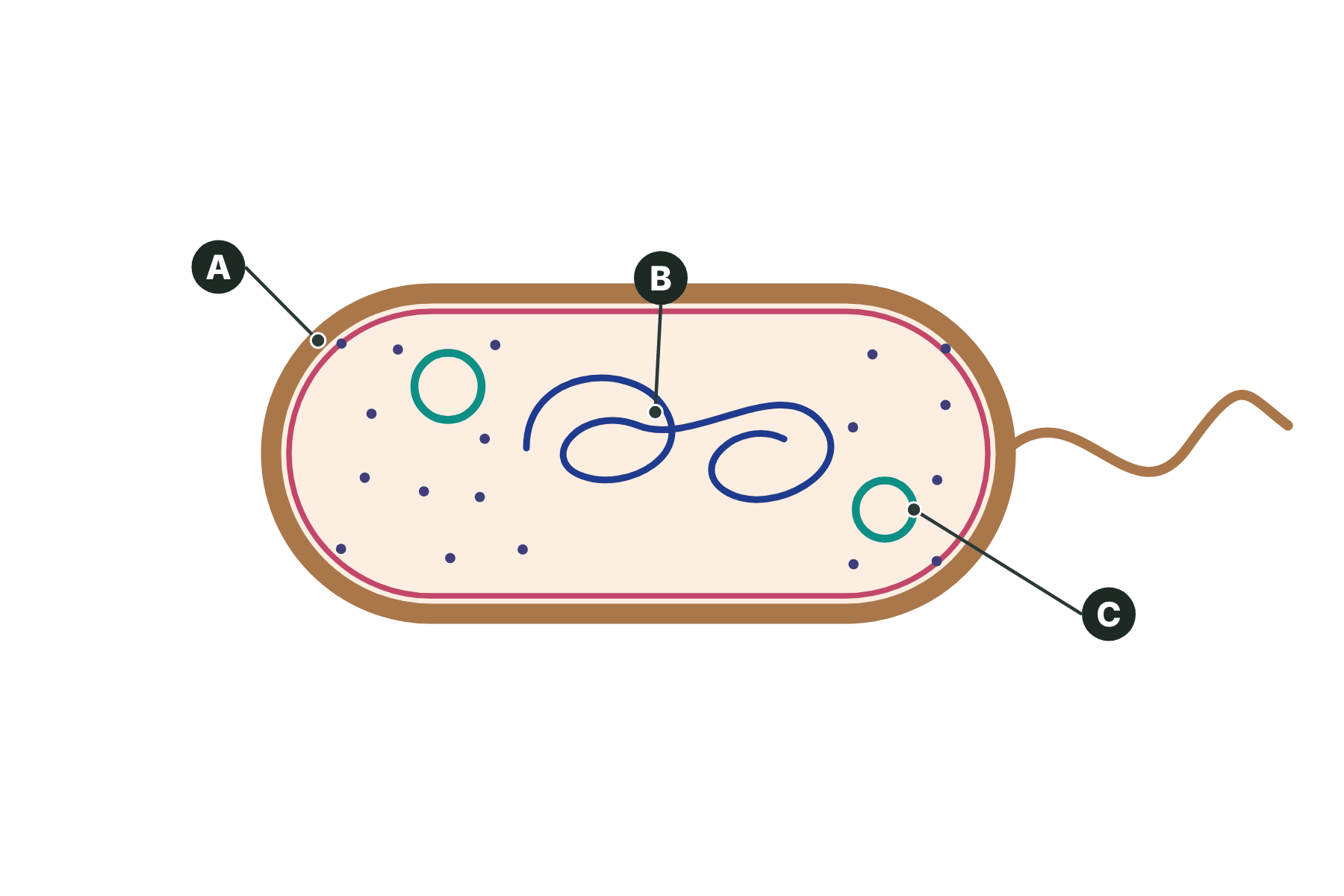
Figure 1 shows a bacterial cell. Name the structures labelled A, B and C.
Show answerHide answer
Model answer
A is the cell wall. B is the (single loop of) DNA. C is a plasmid.
Mark scheme
- A: cell wall — 1 mark
- B: DNA / single loop of DNA / genetic material — 1 mark
- C: plasmid — 1 mark
-
4 Calculate [2 marks]
A bacterial cell is 2 µm long. Calculate how many of these cells, laid end to end, would stretch 1 mm.
Show answerHide answer
Model answer
1 mm = 1000 µm. 1000 ÷ 2 = 500 cells.
Mark scheme
- Converts 1 mm to 1000 µm — 1 mark
- 1000 ÷ 2 = 500 — 1 mark
-
5 Calculate [2 marks]
The width of an animal cell is \(2 \times 10^{-5}\text{ m}\). The width of a bacterial cell is \(2 \times 10^{-6}\text{ m}\). Calculate how many times wider the animal cell is, and give the difference as an order of magnitude.
Show answerHide answer
Model answer
\(\dfrac{2 \times 10^{-5}}{2 \times 10^{-6}} = 10\). The animal cell is 10 times wider, which is one order of magnitude bigger.
Mark scheme
- Divides the two widths to give 10 — 1 mark
- One order of magnitude — 1 mark
-
6 Describe [4 marks]
Describe the structure of a bacterial cell.
Show answerHide answer
Model answer
A bacterial cell is a prokaryotic cell with no nucleus. Its genetic material is a single loop of DNA lying free in the cytoplasm, and it may also contain small rings of DNA called plasmids. The cytoplasm is surrounded by a cell membrane, and outside the membrane there is a cell wall.
Mark scheme
- Cytoplasm and cell membrane — 1 mark
- Cell wall (outside the membrane) — 1 mark
- Single loop of DNA, not in a nucleus — 1 mark
- Plasmids — 1 mark
-
7 Compare [6 marks]
Compare the structure of a bacterial cell with the structure of a plant cell.
Show answerHide answer
Model answer
Both cells have a cell membrane, cytoplasm, ribosomes and a cell wall. In a plant cell the wall is made of cellulose, but a bacterial wall is not. A plant cell has its DNA enclosed in a nucleus, whereas a bacterial cell has no nucleus and its DNA is a single loop in the cytoplasm. A plant cell has chloroplasts and a permanent vacuole, which a bacterial cell does not. A bacterial cell may have plasmids and a flagellum, which a plant cell does not. A bacterial cell is much smaller.
Mark scheme
- Both have a cell membrane, cytoplasm and a cell wall — 1 mark
- Plant cell DNA is in a nucleus; bacterial DNA is a loop in the cytoplasm — 1 mark
- Plant cells have chloroplasts — 1 mark
- Plant cells have a permanent vacuole — 1 mark
- Bacterial cells may have plasmids (and a flagellum) — 1 mark
- Bacterial cell is smaller / plant cell wall is cellulose — 1 mark
Quick check
-
1
Which type of cell has no nucleus?
Show answerHide answer
C: Bacterial cell
A prokaryotic cell, such as a bacterium, has no nucleus. Its DNA lies free in the cytoplasm.
-
2
What is a plasmid?
Show answerHide answer
B: A small ring of DNA in a bacterial cell
A plasmid is a small extra ring of DNA found in bacteria, separate from the main loop of DNA.
-
3
Which structure is found in both bacterial cells and plant cells?
Show answerHide answer
C: Cell wall
Both have a cell wall, although a plant cell wall is made of cellulose and a bacterial one is not. Neither the nucleus nor chloroplasts nor mitochondria are found in bacteria.
-
4
How is the genetic material arranged in a bacterial cell?
Show answerHide answer
A: As a single loop in the cytoplasm
Bacteria have a single loop of DNA in the cytoplasm, and sometimes plasmids too.
-
5
What is the value of 1 µm in metres?
Show answerHide answer
D: \(1 \times 10^{-6}\text{ m}\)
Micro means one millionth, so 1 µm is one millionth of a metre.
-
6
One cell is 1000 times wider than another. How many orders of magnitude bigger is it?
Show answerHide answer
C: 3
Each order of magnitude is a factor of 10, and \(1000 = 10^{3}\), so the difference is 3 orders of magnitude.
-
7
Which of these is the smallest?
Show answerHide answer
B: A virus
A virus is about 100 nm across, much smaller than a bacterium (about 2 µm), an animal cell or a plant cell.
-
8
Which organisms are made of prokaryotic cells?
Show answerHide answer
A: Bacteria
Bacteria are prokaryotes. Fungi, plants and animals are all made of eukaryotic cells.