Flashcards · Biology · Cell Structure
Eukaryotic and Prokaryotic Cells
-
What is the main difference between eukaryotic and prokaryotic cells?
Eukaryotic cells have a nucleus enclosing their DNA. Prokaryotic cells have no nucleus.
-
Which kinds of living things have eukaryotic cells?
Animals, plants, fungi and single-celled organisms such as Amoeba.
-
What type of cell is a bacterium?
A prokaryotic cell.
-
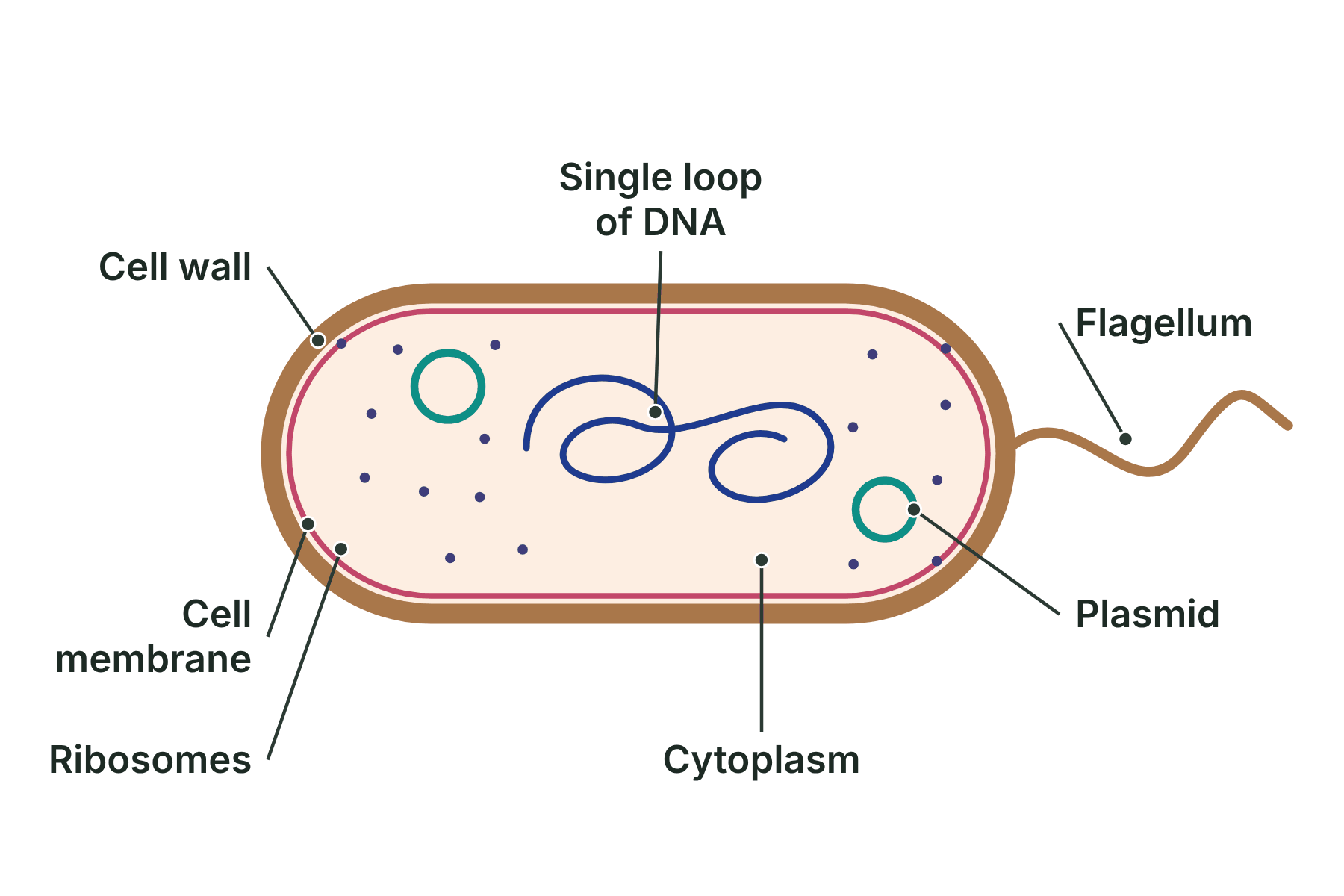
Where is the DNA in a bacterial cell?
In a single loop lying free in the cytoplasm.
-
What is a plasmid?
A small extra ring of DNA in a bacterial cell, often carrying genes such as antibiotic resistance.
-
What is the bacterial cell wall for?
It supports the cell and protects it. It is not made of cellulose.
-
Name three structures found in both bacterial and animal cells.
Cell membrane, cytoplasm and ribosomes.
-
Roughly how much bigger is an animal cell than a bacterium?
About 10 times: around 20 µm compared with around 2 µm.
-
What does the prefix micro mean?
One millionth, so \(1\ \mu\text{m} = 1 \times 10^{-6}\text{ m}\).
-
What does the prefix nano mean?
One billionth, so \(1\text{ nm} = 1 \times 10^{-9}\text{ m}\).
-
Write 0.000 03 m in standard form.
\(3 \times 10^{-5}\text{ m}\).
-
One cell is 100 times bigger than another. How many orders of magnitude is that?
Two, because \(100 = 10^{2}\).
-
How many micrometres are there in 1 mm?
1000.
-
What is the usual mistake about bacteria and DNA?
Thinking bacteria have no DNA. They do, but it is not enclosed in a nucleus.
-
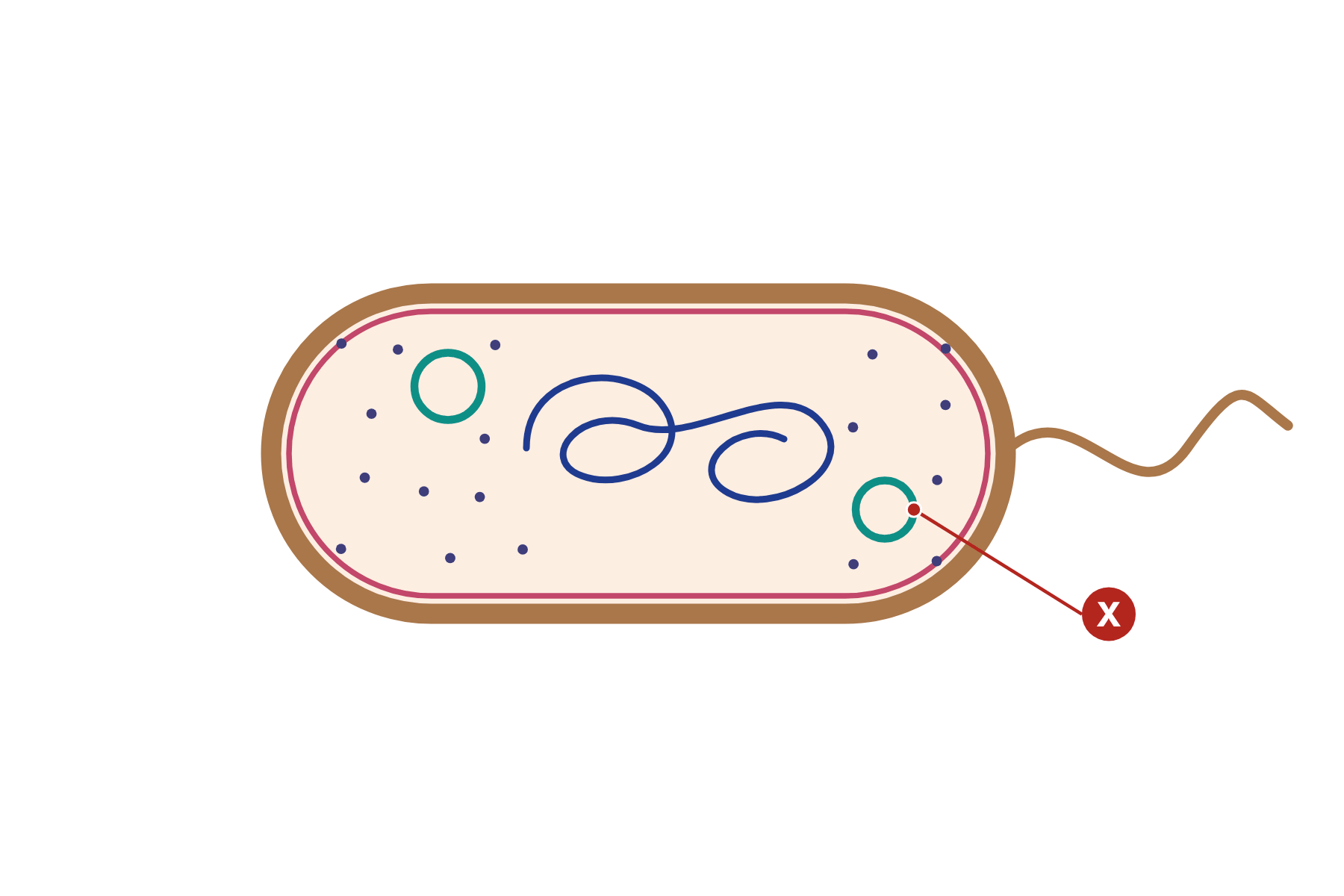 What is the structure marked X in this bacterial cell?
 A plasmid: a small extra ring of DNA that can carry genes such as antibiotic resistance.
-
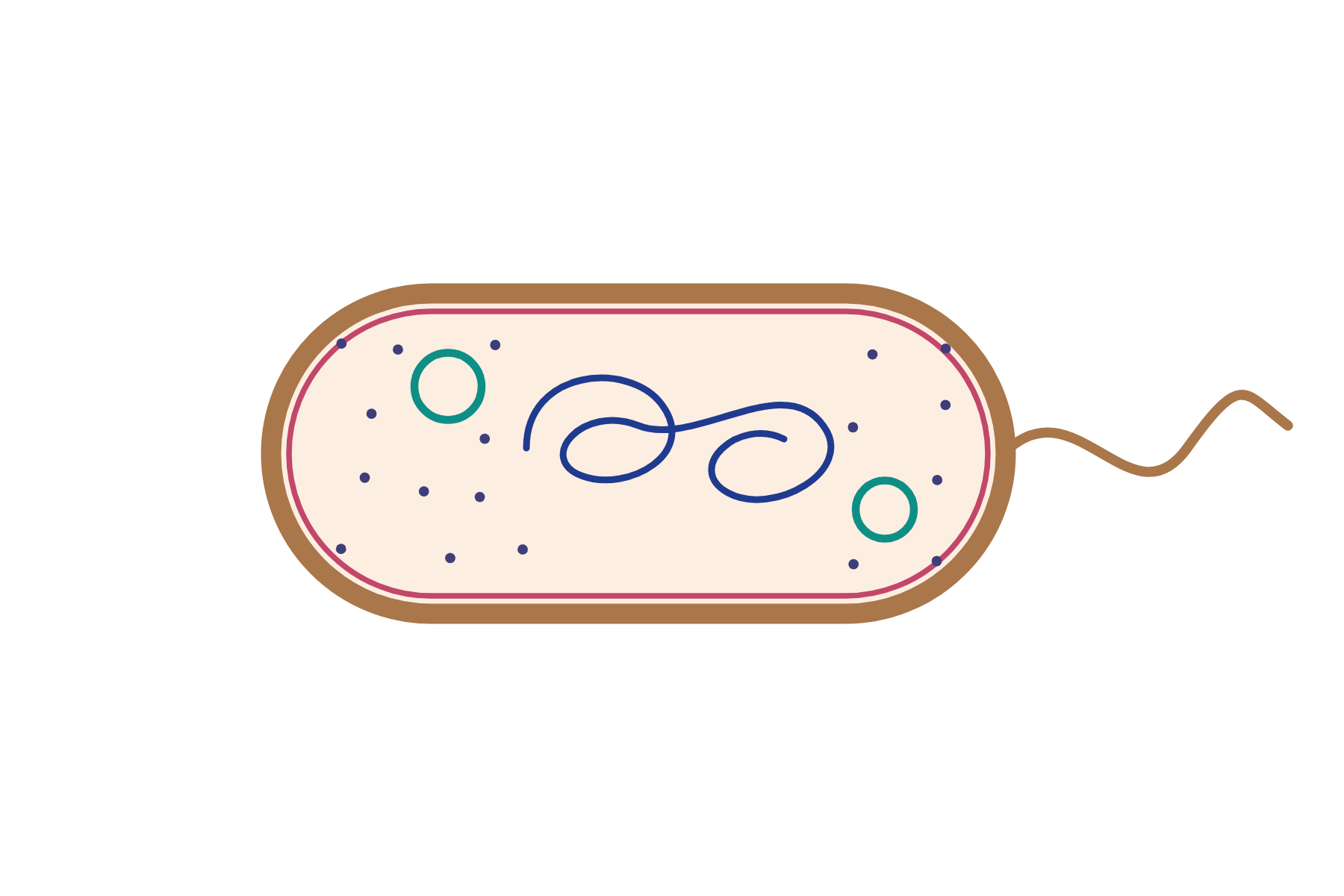 Label every structure of this bacterial cell.