Exam questions · Biology
Material Cycles
- 32 exam questions
- 103 marks
- 32 quick checks
The Carbon Cycle
Just this lesson-
1 Name [2 marks]
Name two processes that release carbon dioxide into the air.
Show answerHide answer
Model answer
Any two of: respiration, decay (decomposition), combustion (burning).
Mark scheme
- First correct process — 1 mark
- Second correct process — 1 mark
-
2 State [1 mark]
Name the process by which plants take carbon dioxide from the air.
Show answerHide answer
Model answer
Photosynthesis.
Mark scheme
- Photosynthesis — 1 mark
-
3 Describe [3 marks]
Describe the role of decomposers in the carbon cycle.
Show answerHide answer
Model answer
Decomposers, which are bacteria and fungi, break down dead plants and animals and waste. They release enzymes that digest the dead material and they absorb the products. They respire, which releases carbon dioxide into the air so that it can be used again by plants.
Mark scheme
- Bacteria and fungi break down dead material and waste — 1 mark
- They respire — 1 mark
- Carbon dioxide is released into the air, ready to be used by plants again — 1 mark
-
4 Explain [3 marks]
Explain why a forest does not become buried under dead leaves and fallen trees.
Show answerHide answer
Model answer
Decomposers such as bacteria and fungi feed on the dead leaves and wood. They break the material down with enzymes. This releases carbon dioxide and mineral ions, which are returned to the air and the soil, so the material does not build up.
Mark scheme
- Decomposers (bacteria and fungi) feed on the dead material — 1 mark
- They break it down using enzymes — 1 mark
- Carbon dioxide and mineral ions are returned to the environment — 1 mark
-
5 Explain [4 marks]
Explain how burning fossil fuels affects the carbon cycle and why this matters.
Show answerHide answer
Model answer
Fossil fuels contain carbon that was stored over millions of years. Burning them releases it as carbon dioxide into the air in a very short time. This is faster than photosynthesis can remove it, so the level of carbon dioxide in the air rises. Carbon dioxide is a greenhouse gas, so this contributes to global warming.
Mark scheme
- Fossil fuels store carbon locked away for millions of years — 1 mark
- Combustion releases carbon dioxide into the air — 1 mark
- Carbon dioxide is released faster than photosynthesis can remove it, so the level rises — 1 mark
- Carbon dioxide is a greenhouse gas that contributes to global warming — 1 mark
-
6 Calculate [2 marks]
Before the Industrial Revolution the air contained about 280 parts per million of carbon dioxide. By 2023 it contained 420 parts per million. Calculate the percentage increase.
Show answerHide answer
Model answer
Increase = 420 − 280 = 140. \(140 \div 280 \times 100 = 50\%\).
Mark scheme
- \(140 \div 280 \times 100\) — 1 mark
- 50% — 1 mark
-
7 Describe [4 marks]
A food chain is grass, rabbit, fox. Describe how a carbon atom in the carbon dioxide in the air becomes part of the fox.
Show answerHide answer
Model answer
The grass takes in carbon dioxide from the air by photosynthesis and uses it to make glucose, so the carbon becomes part of carbohydrates, proteins and fats in the grass. The rabbit eats the grass, and the carbon compounds pass to the rabbit. The fox eats the rabbit, so the carbon compounds pass to the fox and become part of its body.
Mark scheme
- Grass takes in carbon dioxide by photosynthesis — 1 mark
- Carbon is made into carbohydrates, proteins and fats in the plant — 1 mark
- The rabbit eats the grass — 1 mark
- The fox eats the rabbit, so carbon compounds pass to the fox — 1 mark
-
8 Explain [6 marks]
Explain the importance of the carbon cycle.
Show answerHide answer
Model answer
The carbon cycle recycles carbon, so there is always a supply of carbon to make the carbohydrates, proteins and fats of living things. Plants take carbon dioxide from the air by photosynthesis, and the carbon passes to animals by feeding. The carbon returns to the air by respiration, and by decomposers that break down dead organisms and waste and release carbon dioxide. These processes balance, so the carbon dioxide level in the air stays fairly steady. The decay also returns mineral ions to the soil, so plants can keep growing. If people burn fossil fuels or cut down forests, the balance is upset, carbon dioxide rises and global warming results.
Mark scheme
- A continuous supply of carbon for new organisms — 1 mark
- Photosynthesis removes carbon dioxide and feeding passes carbon along food chains — 1 mark
- Respiration returns carbon dioxide to the air — 1 mark
- Decomposers break down dead material and waste and release carbon dioxide — 1 mark
- Decay returns mineral ions to the soil, so plants continue to grow — 1 mark
- Human activity such as burning fossil fuels upsets the balance, raising the carbon dioxide level and causing global warming — 1 mark
Quick check
-
1
Which process removes carbon dioxide from the air?
Show answerHide answer
B: Photosynthesis
Photosynthesis takes in carbon dioxide and uses it to make glucose.
-
2
How does carbon pass from a plant to a rabbit?
Show answerHide answer
C: By feeding
Carbon compounds in the plant pass to the rabbit when it eats the plant.
-
3
Which of these is a decomposer?
Show answerHide answer
A: A fungus
Decomposers are bacteria and fungi, which break down dead material.
-
4
What do decomposers release into the air when they respire?
Show answerHide answer
D: Carbon dioxide
Respiration releases carbon dioxide, which plants can then use in photosynthesis.
-
5
How were fossil fuels such as coal and oil formed?
Show answerHide answer
B: From dead remains that did not fully decay
Dead remains that were buried without oxygen did not fully decay, and became fossil fuels over millions of years.
-
6
Which of these processes puts carbon dioxide into the air?
Show answerHide answer
C: Combustion
Combustion of fuels, like respiration and decay, releases carbon dioxide into the air.
-
7
Why is the carbon dioxide level in the air rising?
Show answerHide answer
A: More carbon dioxide is released than is removed
Burning fossil fuels and deforestation add carbon dioxide faster than it is removed.
-
8
Why do the carbon atoms in a plant eventually return to the air?
Show answerHide answer
D: Because respiration and decay release carbon dioxide
Carbon is released by respiration of the plant, of the animals that eat it and of the decomposers that break it down when it dies.
The Water Cycle and Potable Water
Just this lesson-
1 Name [2 marks]
Name two processes by which water enters the air as water vapour.
Show answerHide answer
Model answer
Evaporation and transpiration.
Mark scheme
- Evaporation — 1 mark
- Transpiration — 1 mark
-
2 Describe [3 marks]
Describe how rain forms from the water in the sea.
Show answerHide answer
Model answer
The Sun's energy makes water at the surface of the sea evaporate into water vapour, which rises. In the cold air higher up, the water vapour cools and condenses into droplets, which form clouds. When the droplets become big and heavy enough, they fall as rain, which is precipitation.
Mark scheme
- Water evaporates from the sea (using the Sun's energy) — 1 mark
- The vapour cools and condenses to form clouds — 1 mark
- Droplets get heavy and fall as precipitation — 1 mark
-
3 Explain [3 marks]
Explain why the water cycle is important to living things.
Show answerHide answer
Model answer
The water cycle supplies fresh water, because evaporation leaves the salt in the sea, so rain is fresh water for plants and animals to use. Organisms need water for the reactions in their cells and for photosynthesis. The cycle also moves materials, such as mineral ions, between the land and the sea.
Mark scheme
- It provides a supply of fresh water — 1 mark
- Organisms need water, for example for reactions in cells or photosynthesis — 1 mark
- It moves materials between the abiotic and biotic parts of ecosystems — 1 mark
-
4 Explain [2 marks]
Tap water in the UK is described as potable but it is not pure. Explain the difference between potable water and pure water.
Show answerHide answer
Model answer
Potable water is safe to drink and can contain low levels of dissolved substances, such as minerals. Pure water contains only water molecules and nothing dissolved in it.
Mark scheme
- Potable water is safe to drink and can contain dissolved substances — 1 mark
- Pure water contains only water molecules — 1 mark
-
5 Describe [3 marks]
Describe how potable water is produced from water in a reservoir.
Show answerHide answer
Model answer
A suitable source of fresh water with low levels of dissolved substances is chosen. The water is passed through screens and filter beds of sand and gravel to remove solid particles. It is then sterilised, using chlorine, ozone or ultraviolet light, to kill any microorganisms.
Mark scheme
- Choose a source with low levels of dissolved substances — 1 mark
- Filter it to remove solids — 1 mark
- Sterilise it to kill microorganisms — 1 mark
-
6 Explain [3 marks]
Explain how distillation can be used to make potable water from sea water.
Show answerHide answer
Model answer
The sea water is heated until it boils, so the water evaporates as steam and the salt is left behind. The steam is cooled in a condenser, where it condenses back into liquid water. This water has no salt in it, so it is safe to drink.
Mark scheme
- Sea water is boiled so the water evaporates (as steam) — 1 mark
- The salt is left behind — 1 mark
- The steam is condensed to liquid water — 1 mark
-
7 Calculate [2 marks]
A desalination plant treats 250 000 litres of sea water and makes 100 000 litres of potable water. Calculate the percentage of the sea water that becomes potable water.
Show answerHide answer
Model answer
\(100\,000 \div 250\,000 \times 100 = 40\%\)
Mark scheme
- \(100\,000 \div 250\,000\) (\(\times 100\)) — 1 mark
- 40% — 1 mark
-
8 Evaluate [6 marks]
A country with very little rain is thinking of building a desalination plant on its coast to supply potable water. Evaluate this idea.
Show answerHide answer
Model answer
A desalination plant would give the country a reliable supply of potable water that does not depend on the rain, because the sea will not run out. The plant could use reverse osmosis or distillation to take the salt out of the sea water. However, both methods need a large amount of energy, which makes the water expensive, and if the energy comes from fossil fuels it will release carbon dioxide and add to global warming. The plant also leaves a very salty brine that could harm sea life if it is returned to the sea. Overall, desalination is probably a good idea for a dry country on the coast that can afford the energy, ideally from renewable sources, because there are few other sources of water, but it should be combined with saving and recycling water.
Mark scheme
- Reliable supply of potable water, independent of rainfall — 1 mark
- The sea is an unlimited source — 1 mark
- Needs a lot of energy, so it is expensive — 1 mark
- Burning fossil fuels for the energy releases carbon dioxide — 1 mark
- Waste brine may harm sea life — 1 mark
- A reasoned conclusion that weighs the advantages and disadvantages — 1 mark
Quick check
-
1
Which process turns liquid water from the sea into water vapour?
Show answerHide answer
B: Evaporation
Evaporation, driven by energy from the Sun, changes liquid water to vapour.
-
2
What is transpiration?
Show answerHide answer
D: The loss of water vapour from leaves
Transpiration is the loss of water vapour from the leaves of a plant, mainly through the stomata.
-
3
Which process forms clouds?
Show answerHide answer
A: Condensation
Water vapour cools and condenses into tiny droplets, which form clouds.
-
4
What does potable water mean?
Show answerHide answer
C: Water that is safe to drink
Potable water is safe to drink, but it can still contain low levels of dissolved substances.
-
5
Which is used to kill microorganisms when making potable water?
Show answerHide answer
B: Chlorine
Chlorine, ozone and ultraviolet light sterilise the water.
-
6
In reverse osmosis, what happens to the salt in sea water?
Show answerHide answer
A: It stays behind the membrane
The salt ions cannot pass through the partially permeable membrane, so they are left behind.
-
7
What is a main disadvantage of desalination?
Show answerHide answer
D: It needs a lot of energy
Heating or pressurising sea water needs a large amount of energy, which makes the process expensive.
-
8
Why is rain fresh water although it evaporates from the sea?
Show answerHide answer
C: The salts are left behind
When water evaporates, the dissolved salts stay behind in the sea.
The Nitrogen Cycle
Just this lesson-
1 State [1 mark]
Name the ions that plants take in from the soil to make proteins.
Show answerHide answer
Model answer
Nitrate ions.
Mark scheme
- Nitrates (nitrate ions) — 1 mark
-
2 Explain [2 marks]
Explain why plants need nitrates.
Show answerHide answer
Model answer
Plants use nitrates to make amino acids. The amino acids are joined together to make proteins, which are needed for growth.
Mark scheme
- To make amino acids — 1 mark
- Which make proteins for growth — 1 mark
-
3 Name [3 marks]
Name the type of bacteria that (a) change nitrogen gas into ammonia, (b) change ammonium compounds into nitrates and (c) change nitrates into nitrogen gas.
Show answerHide answer
Model answer
(a) Nitrogen-fixing bacteria. (b) Nitrifying bacteria. (c) Denitrifying bacteria.
Mark scheme
- (a) Nitrogen-fixing bacteria — 1 mark
- (b) Nitrifying bacteria — 1 mark
- (c) Denitrifying bacteria — 1 mark
-
4 Describe [3 marks]
Describe the role of decomposers in the nitrogen cycle.
Show answerHide answer
Model answer
Decomposers, which are bacteria and fungi, break down dead plants and animals, faeces and urine. They break down the proteins and urea in these. This releases ammonium compounds into the soil, which nitrifying bacteria can then change into nitrates.
Mark scheme
- Bacteria and fungi break down dead organisms and waste — 1 mark
- They break down proteins and urea — 1 mark
- This releases ammonium compounds into the soil — 1 mark
-
5 Explain [3 marks]
A field becomes waterlogged after a long period of heavy rain, and the crop grows poorly. Explain why.
Show answerHide answer
Model answer
Waterlogged soil has little oxygen, so there are fewer nitrifying bacteria, which need oxygen, to make nitrates. Denitrifying bacteria thrive in these conditions and change the nitrates into nitrogen gas. The soil therefore has fewer nitrates, so the plants cannot make enough protein and grow poorly.
Mark scheme
- Little oxygen, so fewer nitrifying bacteria — 1 mark
- Denitrifying bacteria change nitrates into nitrogen gas — 1 mark
- Fewer nitrates, so less protein is made and the crop grows poorly — 1 mark
-
6 Explain [4 marks]
A farmer grows wheat, then potatoes, then peas and then barley in the same field in a four year cycle. Explain how growing peas in the cycle helps the farmer.
Show answerHide answer
Model answer
Peas are legumes. They have root nodules that contain nitrogen-fixing bacteria, which change nitrogen gas from the air into nitrogen compounds. When the peas are ploughed in or their roots decay, the compounds are released and nitrifying bacteria change them into nitrates. This increases the nitrates for the next crop, so the farmer needs to add less fertiliser, which saves money.
Mark scheme
- Peas are legumes with nitrogen-fixing bacteria in root nodules — 1 mark
- The bacteria change nitrogen from the air into nitrogen compounds — 1 mark
- This increases the nitrates in the soil for the next crop — 1 mark
- So less fertiliser is needed, which saves money — 1 mark
-
7 Explain [3 marks]
In a wild meadow the plants die and decay, and the soil stays fertile. In a field of wheat the farmer has to add fertiliser. Explain why.
Show answerHide answer
Model answer
In a meadow the dead plants decay where they fall, so decomposers return the nitrogen to the soil as ammonium compounds and nitrates for the next plants. When wheat is harvested the plants are taken away, so the nitrogen in their proteins is not returned to the soil. The farmer has to add fertiliser to replace the nitrates that were removed.
Mark scheme
- In a meadow the dead plants decay and the nitrogen returns to the soil — 1 mark
- In the field the crop is harvested and the nitrogen is removed — 1 mark
- Fertiliser replaces the nitrates that were removed — 1 mark
-
8 Describe [6 marks]
Describe how nitrogen from the air becomes part of the protein in a plant, and how the nitrogen returns to the air.
Show answerHide answer
Model answer
Nitrogen-fixing bacteria in the soil or in root nodules change nitrogen gas into ammonium compounds, and lightning can turn it into nitrates. Nitrifying bacteria change the ammonium compounds into nitrates. The plant roots take up the nitrates by active transport, and the plant uses them to make amino acids and then proteins. When the plant dies, decomposers break down the proteins and release ammonium compounds, which are again changed into nitrates. In waterlogged soil, denitrifying bacteria change nitrates into nitrogen gas, which returns to the air.
Mark scheme
- Nitrogen-fixing bacteria (or lightning) change nitrogen from the air into compounds — 1 mark
- Nitrifying bacteria change ammonium compounds into nitrates — 1 mark
- Roots take up the nitrates (by active transport) — 1 mark
- The plant makes amino acids and then proteins — 1 mark
- Decomposers break down dead plants and release ammonium compounds — 1 mark
- Denitrifying bacteria change nitrates into nitrogen gas, which returns to the air — 1 mark
Quick check
-
1
What percentage of the air is nitrogen gas?
Show answerHide answer
C: 78 percent
About 78 percent of the air is nitrogen, but plants cannot use it directly.
-
2
Which bacteria change ammonium compounds into nitrates?
Show answerHide answer
A: Nitrifying bacteria
Nitrifying bacteria change ammonium compounds into nitrates that plants can take up.
-
3
Where do the nitrogen-fixing bacteria that help legumes live?
Show answerHide answer
D: In root nodules
They live in nodules on the roots of legumes such as peas, beans and clover.
-
4
What do denitrifying bacteria do?
Show answerHide answer
B: Change nitrates into nitrogen gas
Denitrifying bacteria change nitrates into nitrogen gas, which reduces the fertility of the soil.
-
5
Why are legumes grown in a crop rotation?
Show answerHide answer
C: They add nitrogen compounds to the soil
Nitrogen-fixing bacteria in their root nodules add nitrogen compounds to the soil.
-
6
Which conditions favour denitrifying bacteria?
Show answerHide answer
A: Waterlogged soil with little oxygen
Denitrifying bacteria work best in waterlogged soil with little oxygen.
-
7
What do plants make using the nitrates they take up?
Show answerHide answer
D: Amino acids
Plants use nitrates to make amino acids, which are joined to make proteins.
-
8
How does lightning add nitrates to the soil?
Show answerHide answer
B: It makes nitrogen oxides that dissolve in rain
Lightning makes nitrogen and oxygen form nitrogen oxides, which dissolve in rain to form nitrates.
Decomposition, Food Preservation and Composting
Just this lesson-
1 State [3 marks]
Name three factors that affect the rate of decomposition of a dead plant.
Show answerHide answer
Model answer
Temperature, water content (moisture) and oxygen availability.
Mark scheme
- Temperature — 1 mark
- Water content — 1 mark
- Oxygen availability — 1 mark
-
2 Explain [3 marks]
Explain why food stays fresh for longer in a fridge than on a kitchen worktop.
Show answerHide answer
Model answer
The temperature in a fridge is lower than the room temperature. Low temperatures slow down the enzymes of bacteria and fungi, so they respire and grow more slowly. The food is therefore decomposed more slowly.
Mark scheme
- A fridge has a lower temperature — 1 mark
- The enzymes of the microorganisms work more slowly — 1 mark
- So they grow and decompose the food more slowly — 1 mark
-
3 Explain [3 marks]
Dried fruit and strawberry jam can be stored for months without going bad. Explain how each of these methods preserves food.
Show answerHide answer
Model answer
Drying removes the water, and microorganisms need water to grow. In jam the sugar solution is very concentrated, so water moves out of any microorganisms by osmosis and they dry out and cannot grow.
Mark scheme
- Drying removes the water that microorganisms need — 1 mark
- In jam, the high sugar concentration makes water leave the microorganisms by osmosis — 1 mark
- So the microorganisms cannot grow or decompose the food — 1 mark
-
4 Explain [4 marks]
A gardener turns a compost heap with a fork every two weeks and waters it in dry weather. Explain how this makes the compost form faster.
Show answerHide answer
Model answer
Turning the heap lets air into it, so the decomposers have oxygen and can respire aerobically, which releases more energy for growth. Watering keeps the heap damp, because the decomposers need water for their enzymes to work and to grow. With oxygen and water the decomposers work at a faster rate, so the waste decomposes more quickly.
Mark scheme
- Turning lets air (oxygen) in — 1 mark
- Aerobic respiration releases more energy, so the decomposers grow faster — 1 mark
- Watering keeps the heap damp, because decomposers need water — 1 mark
- So the rate of decay is faster — 1 mark
-
5 Calculate [3 marks]
A student placed 250 g of leaves in a compost bin. After 14 days the leaves had a mass of 190 g. Calculate the mean rate of decay in g per day and the percentage loss of mass. Give each answer to 2 significant figures.
Show answerHide answer
Model answer
Change in mass = 250 − 190 = 60 g. Rate = \(60 \div 14 = 4.3\) g per day. Percentage loss = \(60 \div 250 \times 100 = 24\%\).
Mark scheme
- \(250 - 190 = 60\) g — 1 mark
- \(60 \div 14 = 4.3\) g per day — 1 mark
- \(60 \div 250 \times 100 = 24\%\) — 1 mark
-
6 Calculate [4 marks]
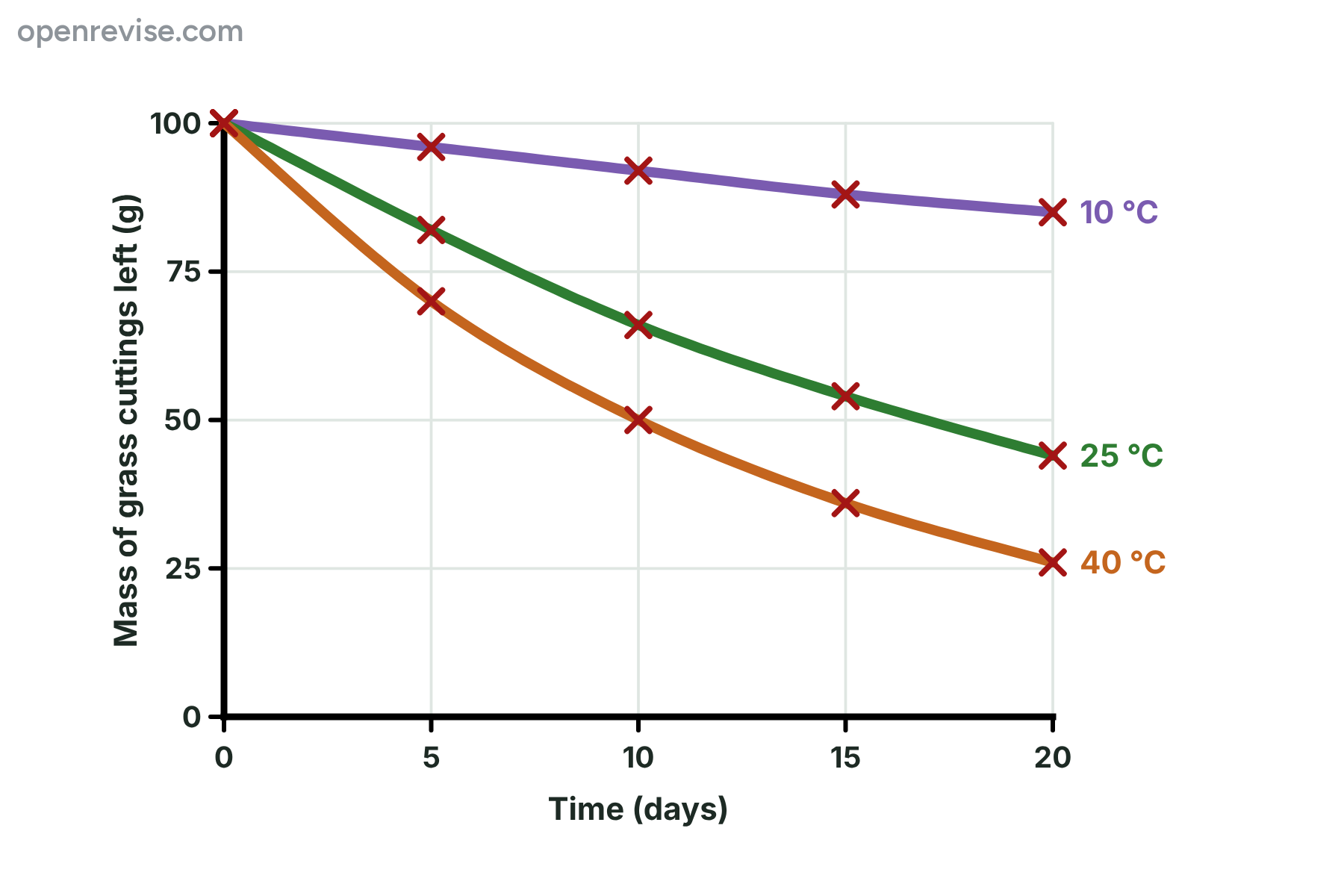
The graph shows the mass of grass cuttings left at three temperatures. (a) Calculate the mean rate of decay at 40 degrees Celsius over the first 10 days. (2) (b) The mean rate at 10 degrees Celsius over the first 10 days is 0.8 g per day. How many times faster is the decay at 40 degrees Celsius? (2)
Show answerHide answer
Model answer
(a) The mass falls from 100 g to 50 g in 10 days, so the rate is \(50 \div 10 = 5.0\) g per day. (b) \(5.0 \div 0.8 = 6.25\), so the decay is about 6.3 times faster.
Mark scheme
- (a) \(100 - 50 = 50\) g in 10 days — 1 mark
- (a) \(50 \div 10 = 5.0\) g per day — 1 mark
- (b) \(5.0 \div 0.8\) — 1 mark
- (b) 6.25 (about 6.3) times faster — 1 mark
-
7 Explain [3 marks]
Use the graph to explain why the mass of grass cuttings falls faster at 25 degrees Celsius than at 10 degrees Celsius, and describe how the rate of decay at 40 degrees Celsius changes over the 20 days.
Show answerHide answer
Model answer
At 25 degrees Celsius the enzymes of the decomposers work faster than at 10 degrees Celsius, so they respire and grow faster and break down the grass cuttings more quickly. At 40 degrees Celsius the line is steepest at the start and gets less steep, so the rate of decay slows as the days go by, because there is less material left for the decomposers to break down.
Mark scheme
- Enzymes of decomposers work faster at 25 degrees Celsius — 1 mark
- So the decomposers break down the grass faster — 1 mark
- At 40 degrees Celsius the rate is highest at the start and falls over time — 1 mark
-
8 Explain [6 marks]
A gardener's compost heap is cold, very wet and smells unpleasant. The waste is rotting slowly. Explain how the gardener could speed up decomposition.
Show answerHide answer
Model answer
The heap is very wet, so the water has filled the air spaces and driven out the oxygen. The gardener should turn the heap and mix in dry, coarse material such as twigs and cardboard, so that more air gets in. With oxygen the decomposers can respire aerobically, which releases more energy and makes them grow faster. The smell shows that anaerobic decay is taking place, and this will stop. The gardener should cover the heap with a lid to keep out the rain and keep in the heat. The heap will then be warmer, because the decomposers' respiration releases heat, and the enzymes of the decomposers work faster in warmth. The waste should be chopped up into smaller pieces, which gives the decomposers a larger surface area.
Mark scheme
- The heap is too wet and the water has driven out the oxygen — 1 mark
- Turn the heap or add coarse dry material to let air in — 1 mark
- Aerobic respiration releases more energy, so the decomposers work faster — 1 mark
- Cover with a lid to keep out rain and to keep in heat — 1 mark
- Warmth makes the enzymes of the decomposers work faster — 1 mark
- Chop up the waste so that there is a larger surface area — 1 mark
Quick check
-
1
Why does freezing food stop it from decaying?
Show answerHide answer
C: The microorganisms cannot grow in ice
The water in the food is frozen, so the microorganisms cannot grow, although freezing does not kill them.
-
2
How does adding a large amount of sugar preserve jam?
Show answerHide answer
B: It makes water leave the microorganisms by osmosis
The concentrated sugar draws water out of microorganisms by osmosis, so they dry out.
-
3
Why is meat vacuum packed?
Show answerHide answer
D: To remove oxygen
Removing the air means that aerobic microorganisms do not have the oxygen that they need to respire and grow.
-
4
Why does a compost heap warm up?
Show answerHide answer
A: The decomposers release heat by respiration
The decomposers respire as they break down the waste, and respiration releases heat.
-
5
What is the main reason that a waterlogged compost heap rots slowly?
Show answerHide answer
C: There is too little oxygen
The water fills the air spaces, so there is little oxygen and only slower anaerobic decay can take place.
-
6
What is the rate of decay of a sample that loses 30 g in 6 days?
Show answerHide answer
B: 5 g per day
Rate is the change in mass divided by the time, so 30 divided by 6 is 5 g per day.
-
7
A sample falls from 80 g to 60 g. What is the percentage loss of mass?
Show answerHide answer
D: 25 percent
The loss is 20 g, and 20 divided by 80, times 100, is 25 percent.
-
8
On a graph of mass left against time, what does a steeper line show?
Show answerHide answer
A: A faster rate of decay
A steeper line means that the mass is falling faster, so the rate of decay is higher.