Exam questions · Biology · Material Cycles
Decomposition, Food Preservation and Composting
- 8 exam questions
- 29 marks
- 8 quick checks
-
1 State [3 marks]
Name three factors that affect the rate of decomposition of a dead plant.
Show answerHide answer
Model answer
Temperature, water content (moisture) and oxygen availability.
Mark scheme
- Temperature — 1 mark
- Water content — 1 mark
- Oxygen availability — 1 mark
-
2 Explain [3 marks]
Explain why food stays fresh for longer in a fridge than on a kitchen worktop.
Show answerHide answer
Model answer
The temperature in a fridge is lower than the room temperature. Low temperatures slow down the enzymes of bacteria and fungi, so they respire and grow more slowly. The food is therefore decomposed more slowly.
Mark scheme
- A fridge has a lower temperature — 1 mark
- The enzymes of the microorganisms work more slowly — 1 mark
- So they grow and decompose the food more slowly — 1 mark
-
3 Explain [3 marks]
Dried fruit and strawberry jam can be stored for months without going bad. Explain how each of these methods preserves food.
Show answerHide answer
Model answer
Drying removes the water, and microorganisms need water to grow. In jam the sugar solution is very concentrated, so water moves out of any microorganisms by osmosis and they dry out and cannot grow.
Mark scheme
- Drying removes the water that microorganisms need — 1 mark
- In jam, the high sugar concentration makes water leave the microorganisms by osmosis — 1 mark
- So the microorganisms cannot grow or decompose the food — 1 mark
-
4 Explain [4 marks]
A gardener turns a compost heap with a fork every two weeks and waters it in dry weather. Explain how this makes the compost form faster.
Show answerHide answer
Model answer
Turning the heap lets air into it, so the decomposers have oxygen and can respire aerobically, which releases more energy for growth. Watering keeps the heap damp, because the decomposers need water for their enzymes to work and to grow. With oxygen and water the decomposers work at a faster rate, so the waste decomposes more quickly.
Mark scheme
- Turning lets air (oxygen) in — 1 mark
- Aerobic respiration releases more energy, so the decomposers grow faster — 1 mark
- Watering keeps the heap damp, because decomposers need water — 1 mark
- So the rate of decay is faster — 1 mark
-
5 Calculate [3 marks]
A student placed 250 g of leaves in a compost bin. After 14 days the leaves had a mass of 190 g. Calculate the mean rate of decay in g per day and the percentage loss of mass. Give each answer to 2 significant figures.
Show answerHide answer
Model answer
Change in mass = 250 − 190 = 60 g. Rate = \(60 \div 14 = 4.3\) g per day. Percentage loss = \(60 \div 250 \times 100 = 24\%\).
Mark scheme
- \(250 - 190 = 60\) g — 1 mark
- \(60 \div 14 = 4.3\) g per day — 1 mark
- \(60 \div 250 \times 100 = 24\%\) — 1 mark
-
6 Calculate [4 marks]
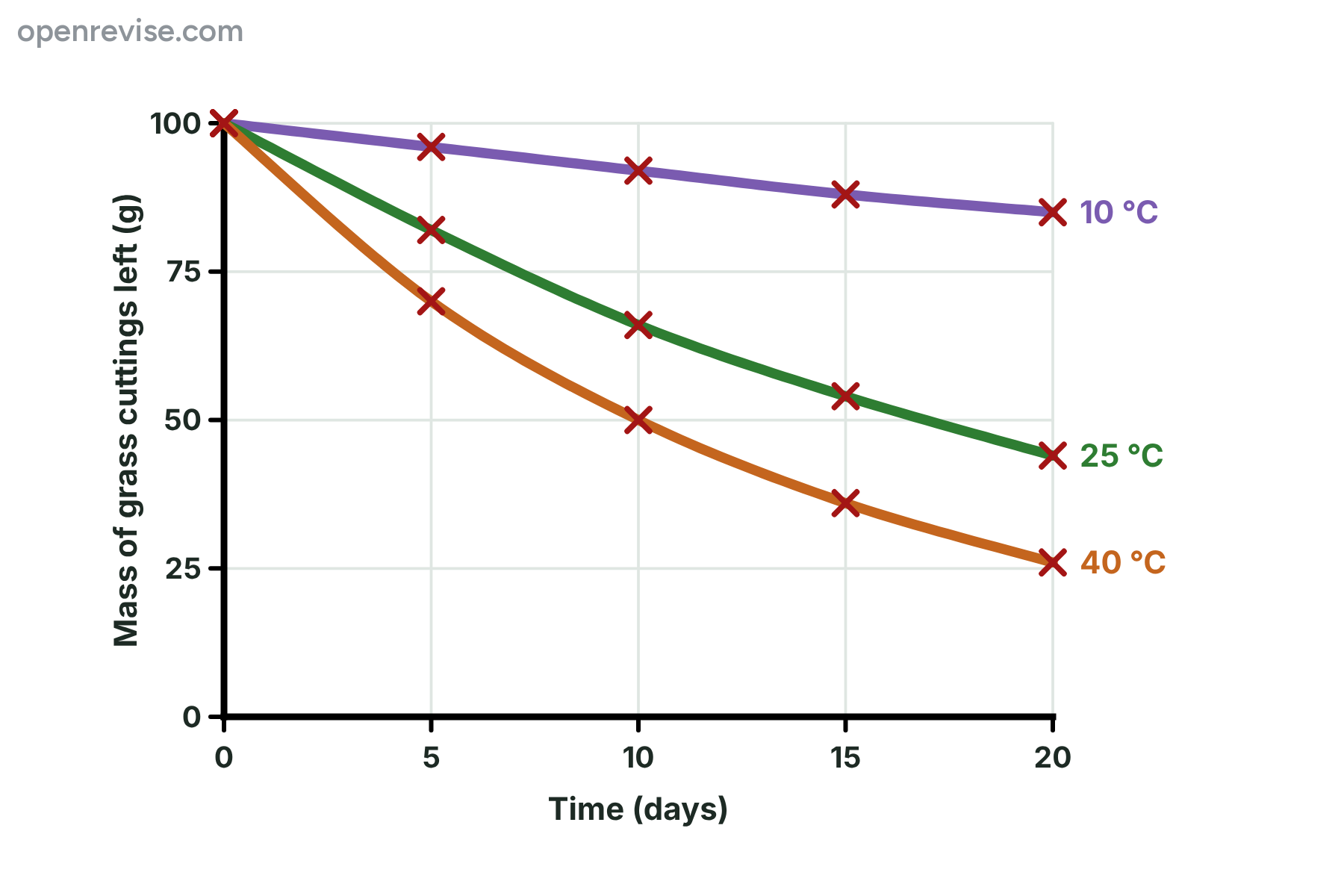
The graph shows the mass of grass cuttings left at three temperatures. (a) Calculate the mean rate of decay at 40 degrees Celsius over the first 10 days. (2) (b) The mean rate at 10 degrees Celsius over the first 10 days is 0.8 g per day. How many times faster is the decay at 40 degrees Celsius? (2)
Show answerHide answer
Model answer
(a) The mass falls from 100 g to 50 g in 10 days, so the rate is \(50 \div 10 = 5.0\) g per day. (b) \(5.0 \div 0.8 = 6.25\), so the decay is about 6.3 times faster.
Mark scheme
- (a) \(100 - 50 = 50\) g in 10 days — 1 mark
- (a) \(50 \div 10 = 5.0\) g per day — 1 mark
- (b) \(5.0 \div 0.8\) — 1 mark
- (b) 6.25 (about 6.3) times faster — 1 mark
-
7 Explain [3 marks]
Use the graph to explain why the mass of grass cuttings falls faster at 25 degrees Celsius than at 10 degrees Celsius, and describe how the rate of decay at 40 degrees Celsius changes over the 20 days.
Show answerHide answer
Model answer
At 25 degrees Celsius the enzymes of the decomposers work faster than at 10 degrees Celsius, so they respire and grow faster and break down the grass cuttings more quickly. At 40 degrees Celsius the line is steepest at the start and gets less steep, so the rate of decay slows as the days go by, because there is less material left for the decomposers to break down.
Mark scheme
- Enzymes of decomposers work faster at 25 degrees Celsius — 1 mark
- So the decomposers break down the grass faster — 1 mark
- At 40 degrees Celsius the rate is highest at the start and falls over time — 1 mark
-
8 Explain [6 marks]
A gardener's compost heap is cold, very wet and smells unpleasant. The waste is rotting slowly. Explain how the gardener could speed up decomposition.
Show answerHide answer
Model answer
The heap is very wet, so the water has filled the air spaces and driven out the oxygen. The gardener should turn the heap and mix in dry, coarse material such as twigs and cardboard, so that more air gets in. With oxygen the decomposers can respire aerobically, which releases more energy and makes them grow faster. The smell shows that anaerobic decay is taking place, and this will stop. The gardener should cover the heap with a lid to keep out the rain and keep in the heat. The heap will then be warmer, because the decomposers' respiration releases heat, and the enzymes of the decomposers work faster in warmth. The waste should be chopped up into smaller pieces, which gives the decomposers a larger surface area.
Mark scheme
- The heap is too wet and the water has driven out the oxygen — 1 mark
- Turn the heap or add coarse dry material to let air in — 1 mark
- Aerobic respiration releases more energy, so the decomposers work faster — 1 mark
- Cover with a lid to keep out rain and to keep in heat — 1 mark
- Warmth makes the enzymes of the decomposers work faster — 1 mark
- Chop up the waste so that there is a larger surface area — 1 mark
Quick check
-
1
Why does freezing food stop it from decaying?
Show answerHide answer
C: The microorganisms cannot grow in ice
The water in the food is frozen, so the microorganisms cannot grow, although freezing does not kill them.
-
2
How does adding a large amount of sugar preserve jam?
Show answerHide answer
B: It makes water leave the microorganisms by osmosis
The concentrated sugar draws water out of microorganisms by osmosis, so they dry out.
-
3
Why is meat vacuum packed?
Show answerHide answer
D: To remove oxygen
Removing the air means that aerobic microorganisms do not have the oxygen that they need to respire and grow.
-
4
Why does a compost heap warm up?
Show answerHide answer
A: The decomposers release heat by respiration
The decomposers respire as they break down the waste, and respiration releases heat.
-
5
What is the main reason that a waterlogged compost heap rots slowly?
Show answerHide answer
C: There is too little oxygen
The water fills the air spaces, so there is little oxygen and only slower anaerobic decay can take place.
-
6
What is the rate of decay of a sample that loses 30 g in 6 days?
Show answerHide answer
B: 5 g per day
Rate is the change in mass divided by the time, so 30 divided by 6 is 5 g per day.
-
7
A sample falls from 80 g to 60 g. What is the percentage loss of mass?
Show answerHide answer
D: 25 percent
The loss is 20 g, and 20 divided by 80, times 100, is 25 percent.
-
8
On a graph of mass left against time, what does a steeper line show?
Show answerHide answer
A: A faster rate of decay
A steeper line means that the mass is falling faster, so the rate of decay is higher.