Exam questions · Biology · Respiration and Biological Molecules
Aerobic and Anaerobic Respiration
- 9 exam questions
- 23 marks
- 10 quick checks
-
1 State [1 mark]
Respiration is described as an exothermic reaction. State what exothermic means.
Show answerHide answer
Model answer
It transfers energy to the surroundings.
Mark scheme
- Transfers energy to the surroundings — 1 mark
-
2 Name [3 marks]
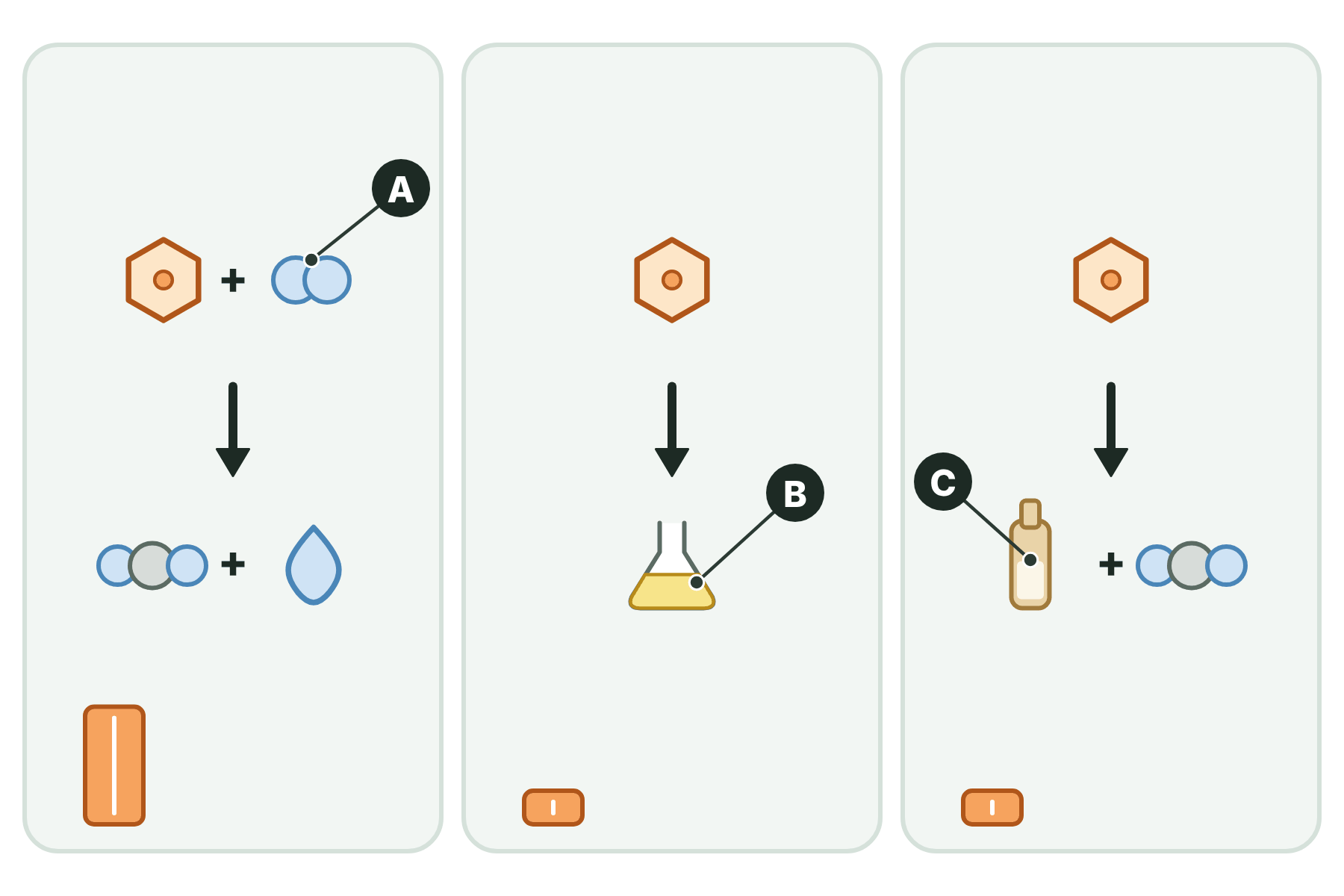
Figure 1 shows three types of respiration. Name the substances shown at A, B and C.
Show answerHide answer
Model answer
A is oxygen. B is lactic acid. C is ethanol.
Mark scheme
- A: oxygen — 1 mark
- B: lactic acid — 1 mark
- C: ethanol — 1 mark
-
3 Write [2 marks]
Write the word equation for aerobic respiration.
Show answerHide answer
Model answer
Glucose + oxygen → carbon dioxide + water.
Mark scheme
- Glucose + oxygen as reactants — 1 mark
- Carbon dioxide + water as products — 1 mark
-
4 State [3 marks]
Give three uses of the energy that organisms transfer by respiration.
Show answerHide answer
Model answer
To build larger molecules from smaller ones, for movement and to keep warm.
Mark scheme
- Building larger molecules — 1 mark
- Movement — 1 mark
- Keeping warm — 1 mark
-
5 Compare [4 marks]
Compare aerobic respiration and anaerobic respiration in muscles.
Show answerHide answer
Model answer
Aerobic respiration uses oxygen, but anaerobic respiration does not. Aerobic respiration makes carbon dioxide and water, but anaerobic respiration in muscles makes lactic acid. Aerobic respiration transfers much more energy than anaerobic respiration.
Mark scheme
- Aerobic needs oxygen, anaerobic does not — 1 mark
- Aerobic makes carbon dioxide and water — 1 mark
- Anaerobic makes lactic acid in muscles — 1 mark
- Aerobic transfers much more energy — 1 mark
-
6 Explain [2 marks]
Explain why anaerobic respiration transfers much less energy than aerobic respiration.
Show answerHide answer
Model answer
In anaerobic respiration the glucose is only partly oxidised. The oxidation of glucose is incomplete, so less energy is transferred.
Mark scheme
- Glucose is only partly oxidised — 1 mark
- So much less energy is transferred — 1 mark
-
7 Explain [3 marks]
Yeast is added to bread dough. Explain why the dough rises.
Show answerHide answer
Model answer
The yeast respires anaerobically, using sugar in the dough. This releases carbon dioxide. The carbon dioxide makes bubbles in the dough, which makes it rise.
Mark scheme
- Yeast respires anaerobically — 1 mark
- Carbon dioxide is released — 1 mark
- Bubbles of gas make the dough rise — 1 mark
-
8 Compare [3 marks]
Compare anaerobic respiration in animal cells with anaerobic respiration in yeast cells.
Show answerHide answer
Model answer
Both start with glucose and both make only a small yield of ATP, 2 ATP per glucose. Animal cells make lactic acid. Yeast cells make ethanol and carbon dioxide.
Mark scheme
- Both use glucose and make 2 ATP per glucose — 1 mark
- Animal cells make lactic acid — 1 mark
- Yeast cells make ethanol and carbon dioxide — 1 mark
-
9 Explain [2 marks]
Respiration is described as a universal chemical process. Explain what this means and what it supplies.
Show answerHide answer
Model answer
It happens continuously in all living cells, including plants, animals and fungi. It supplies ATP, which carries energy to where it is needed.
Mark scheme
- It happens in all living cells — 1 mark
- It supplies ATP — 1 mark
Quick check
-
1
What type of reaction is respiration?
Show answerHide answer
C: Exothermic
Respiration transfers energy to the surroundings, so it is exothermic.
-
2
Which of these is the word equation for aerobic respiration?
Show answerHide answer
B: Glucose + oxygen → carbon dioxide + water
Glucose reacts with oxygen to make carbon dioxide and water.
-
3
What is made when muscles respire anaerobically?
Show answerHide answer
D: Lactic acid
Anaerobic respiration in muscles makes lactic acid.
-
4
What is made when yeast respires anaerobically?
Show answerHide answer
A: Ethanol and carbon dioxide
Yeast makes ethanol and carbon dioxide. This is called fermentation.
-
5
Why does anaerobic respiration transfer less energy than aerobic respiration?
Show answerHide answer
B: Glucose is only partly oxidised
The oxidation of glucose is incomplete, so less energy is transferred.
-
6
Where do most of the reactions of aerobic respiration take place?
Show answerHide answer
C: In the mitochondria
Aerobic respiration takes place mainly in the mitochondria.
-
7
Which of these is NOT a use of the energy transferred by respiration?
Show answerHide answer
A: Producing light
Organisms use the energy to build larger molecules, to move and to keep warm. Respiration does not make light.
-
8
Which statement about respiration is correct?
Show answerHide answer
D: It happens in all living cells all the time
Respiration is continuously occurring in all living cells, both plant and animal.
-
9
What does respiration supply in all living cells?
Show answerHide answer
B: ATP
Respiration transfers the energy from glucose to make ATP, which carries energy to where it is needed.
-
10
Roughly how much ATP does aerobic respiration make per glucose compared with anaerobic respiration?
Show answerHide answer
D: Many times more
Aerobic respiration makes about 30 ATP per glucose and anaerobic respiration only 2, so the yield is many times greater.