Exam questions · Biology
Respiration and Biological Molecules
- 26 exam questions
- 73 marks
- 28 quick checks
Aerobic and Anaerobic Respiration
Just this lesson-
1 State [1 mark]
Respiration is described as an exothermic reaction. State what exothermic means.
Show answerHide answer
Model answer
It transfers energy to the surroundings.
Mark scheme
- Transfers energy to the surroundings — 1 mark
-
2 Name [3 marks]
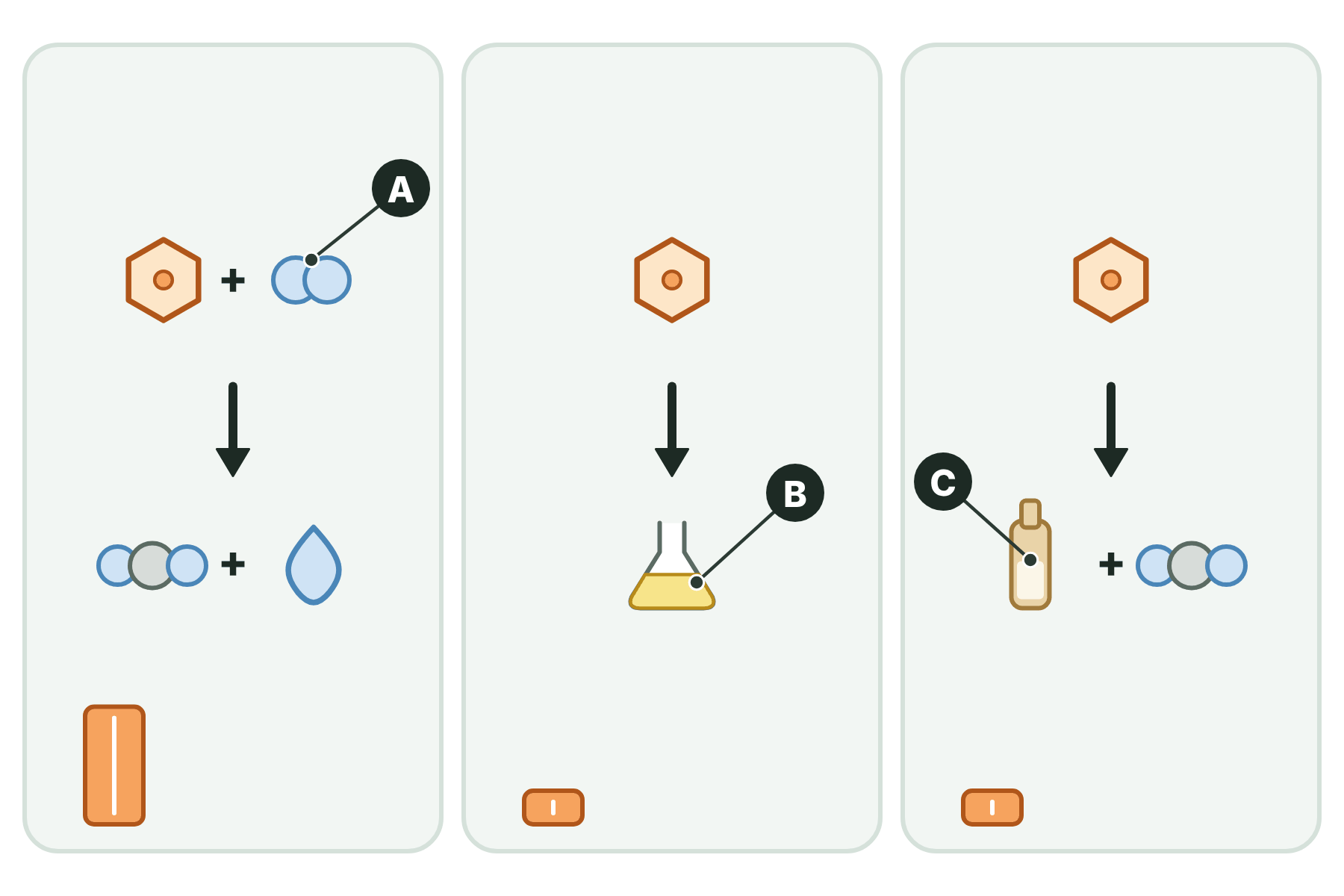
Figure 1 shows three types of respiration. Name the substances shown at A, B and C.
Show answerHide answer
Model answer
A is oxygen. B is lactic acid. C is ethanol.
Mark scheme
- A: oxygen — 1 mark
- B: lactic acid — 1 mark
- C: ethanol — 1 mark
-
3 Write [2 marks]
Write the word equation for aerobic respiration.
Show answerHide answer
Model answer
Glucose + oxygen → carbon dioxide + water.
Mark scheme
- Glucose + oxygen as reactants — 1 mark
- Carbon dioxide + water as products — 1 mark
-
4 State [3 marks]
Give three uses of the energy that organisms transfer by respiration.
Show answerHide answer
Model answer
To build larger molecules from smaller ones, for movement and to keep warm.
Mark scheme
- Building larger molecules — 1 mark
- Movement — 1 mark
- Keeping warm — 1 mark
-
5 Compare [4 marks]
Compare aerobic respiration and anaerobic respiration in muscles.
Show answerHide answer
Model answer
Aerobic respiration uses oxygen, but anaerobic respiration does not. Aerobic respiration makes carbon dioxide and water, but anaerobic respiration in muscles makes lactic acid. Aerobic respiration transfers much more energy than anaerobic respiration.
Mark scheme
- Aerobic needs oxygen, anaerobic does not — 1 mark
- Aerobic makes carbon dioxide and water — 1 mark
- Anaerobic makes lactic acid in muscles — 1 mark
- Aerobic transfers much more energy — 1 mark
-
6 Explain [2 marks]
Explain why anaerobic respiration transfers much less energy than aerobic respiration.
Show answerHide answer
Model answer
In anaerobic respiration the glucose is only partly oxidised. The oxidation of glucose is incomplete, so less energy is transferred.
Mark scheme
- Glucose is only partly oxidised — 1 mark
- So much less energy is transferred — 1 mark
-
7 Explain [3 marks]
Yeast is added to bread dough. Explain why the dough rises.
Show answerHide answer
Model answer
The yeast respires anaerobically, using sugar in the dough. This releases carbon dioxide. The carbon dioxide makes bubbles in the dough, which makes it rise.
Mark scheme
- Yeast respires anaerobically — 1 mark
- Carbon dioxide is released — 1 mark
- Bubbles of gas make the dough rise — 1 mark
-
8 Compare [3 marks]
Compare anaerobic respiration in animal cells with anaerobic respiration in yeast cells.
Show answerHide answer
Model answer
Both start with glucose and both make only a small yield of ATP, 2 ATP per glucose. Animal cells make lactic acid. Yeast cells make ethanol and carbon dioxide.
Mark scheme
- Both use glucose and make 2 ATP per glucose — 1 mark
- Animal cells make lactic acid — 1 mark
- Yeast cells make ethanol and carbon dioxide — 1 mark
-
9 Explain [2 marks]
Respiration is described as a universal chemical process. Explain what this means and what it supplies.
Show answerHide answer
Model answer
It happens continuously in all living cells, including plants, animals and fungi. It supplies ATP, which carries energy to where it is needed.
Mark scheme
- It happens in all living cells — 1 mark
- It supplies ATP — 1 mark
Quick check
-
1
What type of reaction is respiration?
Show answerHide answer
C: Exothermic
Respiration transfers energy to the surroundings, so it is exothermic.
-
2
Which of these is the word equation for aerobic respiration?
Show answerHide answer
B: Glucose + oxygen → carbon dioxide + water
Glucose reacts with oxygen to make carbon dioxide and water.
-
3
What is made when muscles respire anaerobically?
Show answerHide answer
D: Lactic acid
Anaerobic respiration in muscles makes lactic acid.
-
4
What is made when yeast respires anaerobically?
Show answerHide answer
A: Ethanol and carbon dioxide
Yeast makes ethanol and carbon dioxide. This is called fermentation.
-
5
Why does anaerobic respiration transfer less energy than aerobic respiration?
Show answerHide answer
B: Glucose is only partly oxidised
The oxidation of glucose is incomplete, so less energy is transferred.
-
6
Where do most of the reactions of aerobic respiration take place?
Show answerHide answer
C: In the mitochondria
Aerobic respiration takes place mainly in the mitochondria.
-
7
Which of these is NOT a use of the energy transferred by respiration?
Show answerHide answer
A: Producing light
Organisms use the energy to build larger molecules, to move and to keep warm. Respiration does not make light.
-
8
Which statement about respiration is correct?
Show answerHide answer
D: It happens in all living cells all the time
Respiration is continuously occurring in all living cells, both plant and animal.
-
9
What does respiration supply in all living cells?
Show answerHide answer
B: ATP
Respiration transfers the energy from glucose to make ATP, which carries energy to where it is needed.
-
10
Roughly how much ATP does aerobic respiration make per glucose compared with anaerobic respiration?
Show answerHide answer
D: Many times more
Aerobic respiration makes about 30 ATP per glucose and anaerobic respiration only 2, so the yield is many times greater.
Monomers and Polymers
Just this lesson-
1 State [2 marks]
State what is meant by the terms monomer and polymer.
Show answerHide answer
Model answer
A monomer is a small molecule that can join with others. A polymer is a large molecule made of many monomers joined together.
Mark scheme
- Monomer: small molecule that joins with others — 1 mark
- Polymer: large molecule made of many monomers — 1 mark
-
2 Name [3 marks]
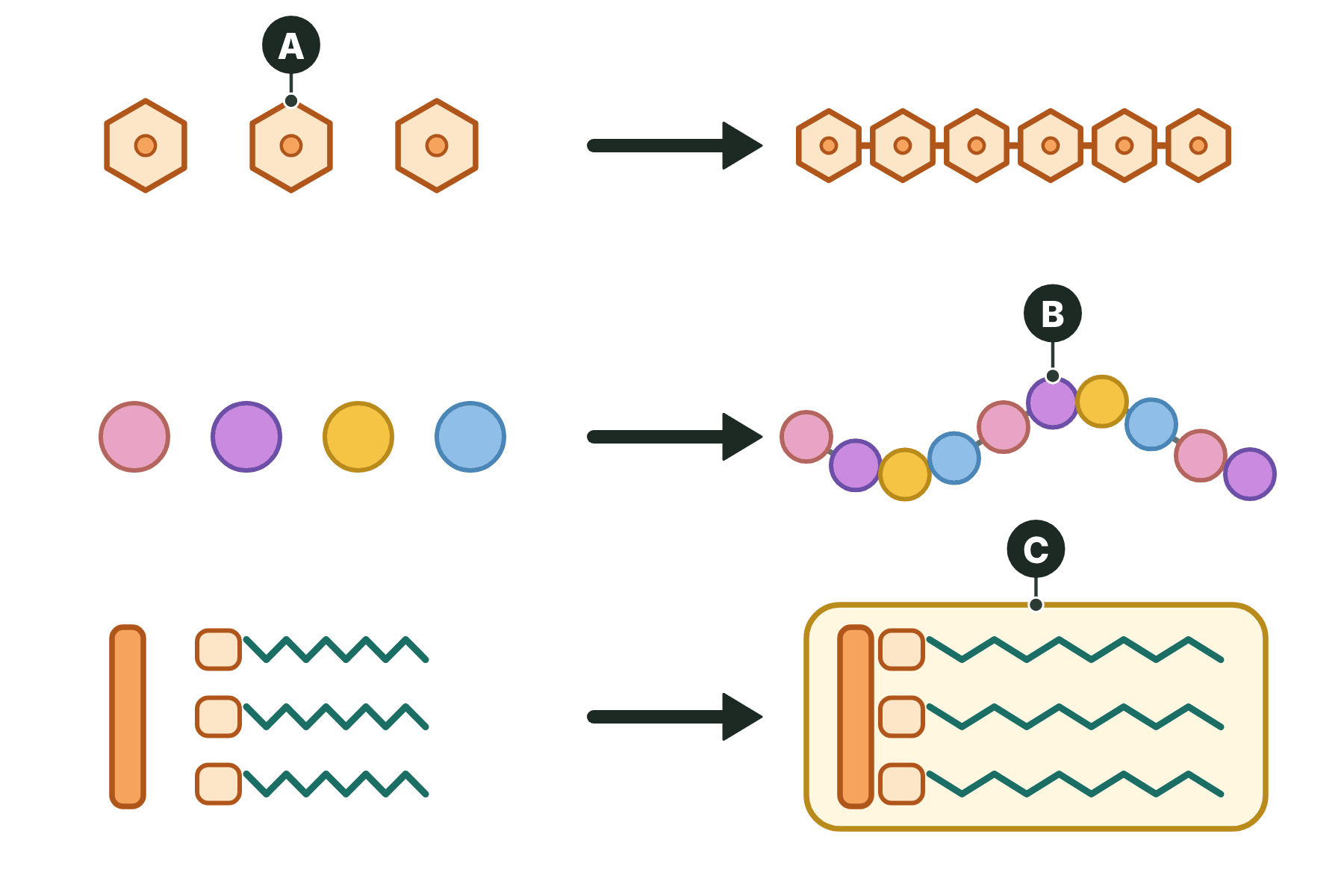
Figure 1 shows how large molecules are made from small ones. Name the molecules shown at A, B and C.
Show answerHide answer
Model answer
A is sugars (glucose). B is a protein. C is a lipid.
Mark scheme
- A: sugars / glucose — 1 mark
- B: protein — 1 mark
- C: lipid — 1 mark
-
3 State [3 marks]
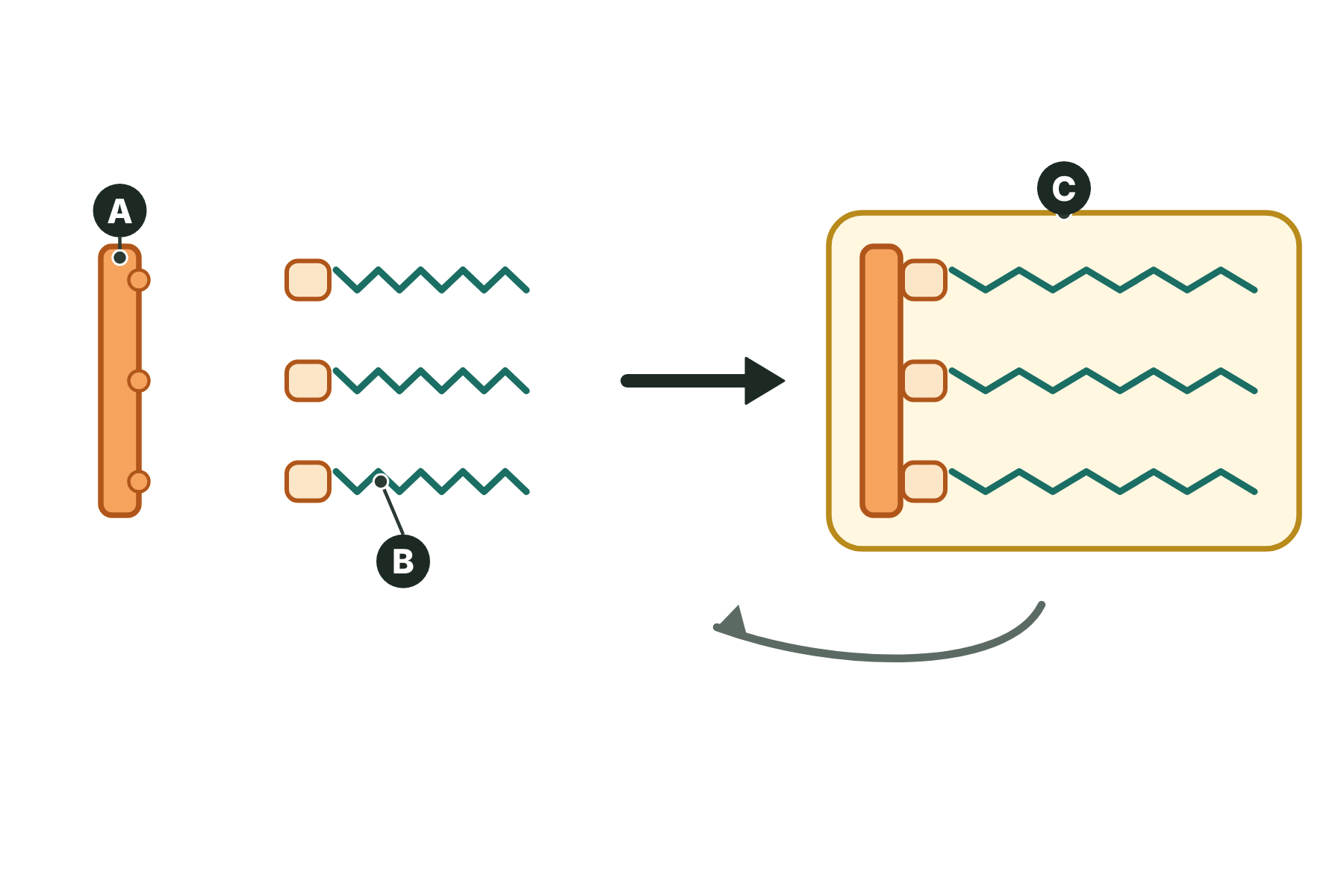
Figure 2 shows how a lipid molecule is made. Name the parts shown at A, B and C.
Show answerHide answer
Model answer
A is glycerol. B is a fatty acid. C is a lipid (molecule).
Mark scheme
- A: glycerol — 1 mark
- B: fatty acid — 1 mark
- C: lipid — 1 mark
-
4 Describe [3 marks]
Describe how proteins are made in a cell and how they are broken down.
Show answerHide answer
Model answer
Amino acids are joined together in a chain to make a protein. This needs energy from respiration and is controlled by enzymes. Protease enzymes break proteins down into amino acids.
Mark scheme
- Amino acids are joined to make proteins — 1 mark
- Uses energy / controlled by enzymes — 1 mark
- Protease breaks proteins down into amino acids — 1 mark
-
5 Explain [3 marks]
Explain why the starch in a slice of bread is broken down before the body can use it.
Show answerHide answer
Model answer
Starch is a polymer, a large molecule made of many sugars. It is too large to be absorbed. Amylase, a carbohydrase, breaks it down into sugars, which can be absorbed and used in respiration.
Mark scheme
- Starch is a large molecule / polymer — 1 mark
- Amylase breaks it down into sugars — 1 mark
- Sugars can be absorbed and used in respiration — 1 mark
-
6 Describe [4 marks]
Describe how you would test a food sample for starch, sugars, protein and lipids.
Show answerHide answer
Model answer
Starch: add iodine solution, which turns blue-black. Sugars: heat with Benedict's reagent, which turns green, yellow, orange or brick-red. Protein: add biuret reagent, which turns purple. Lipids: shake with ethanol, then add water, and a cloudy white emulsion forms.
Mark scheme
- Starch with iodine, blue-black — 1 mark
- Sugars with Benedict's reagent and heat — 1 mark
- Protein with biuret, purple — 1 mark
- Lipids with ethanol then water, cloudy emulsion — 1 mark
-
7 Explain [4 marks]
Explain the importance of sugars, amino acids, fatty acids and glycerol in the body.
Show answerHide answer
Model answer
Sugars are joined to make carbohydrates such as glycogen and starch. Amino acids are joined to make proteins. Fatty acids and glycerol are joined to make lipids. They are also released when the large molecules are broken down, so they can be used again or in respiration.
Mark scheme
- Sugars make carbohydrates — 1 mark
- Amino acids make proteins — 1 mark
- Fatty acids and glycerol make lipids — 1 mark
- They are released again when the molecules are broken down — 1 mark
Quick check
-
1
What are the monomers that make a protein?
Show answerHide answer
C: Amino acids
Proteins are polymers made of amino acids.
-
2
Which of these is a carbohydrate polymer used by plants to strengthen cell walls?
Show answerHide answer
B: Cellulose
Cellulose is made from sugars and strengthens plant cell walls.
-
3
What is a lipid made from?
Show answerHide answer
D: One glycerol and three fatty acids
A lipid is made from one molecule of glycerol and three molecules of fatty acids.
-
4
Which enzyme breaks down proteins?
Show answerHide answer
A: Protease
Protease breaks proteins down into amino acids.
-
5
What do animals use to store glucose?
Show answerHide answer
C: Glycogen
Animals store glucose as glycogen in the liver and muscles.
-
6
What is the colour change in the biuret test when protein is present?
Show answerHide answer
B: Blue to purple
Biuret reagent changes from blue to purple when protein is present.
-
7
What does the synthesis of polymers need?
Show answerHide answer
D: Enzymes and energy from respiration
Joining monomers is controlled by enzymes and uses energy from respiration.
-
8
Which pair of molecules is made when a lipid is broken down?
Show answerHide answer
A: Fatty acids and glycerol
Lipase breaks a lipid down into fatty acids and glycerol.
Food Tests
Just this lesson-
1 Name [1 mark]
Name the reagent used to test for starch.
Show answerHide answer
Model answer
Iodine solution.
Mark scheme
- Iodine (solution) — 1 mark
-
2 State [2 marks]
State the colour change that shows that starch is present in a food sample.
Show answerHide answer
Model answer
Orange-brown to blue-black.
Mark scheme
- Starts orange-brown / yellow-brown — 1 mark
- Changes to blue-black — 1 mark
-
3 Interpret [4 marks]
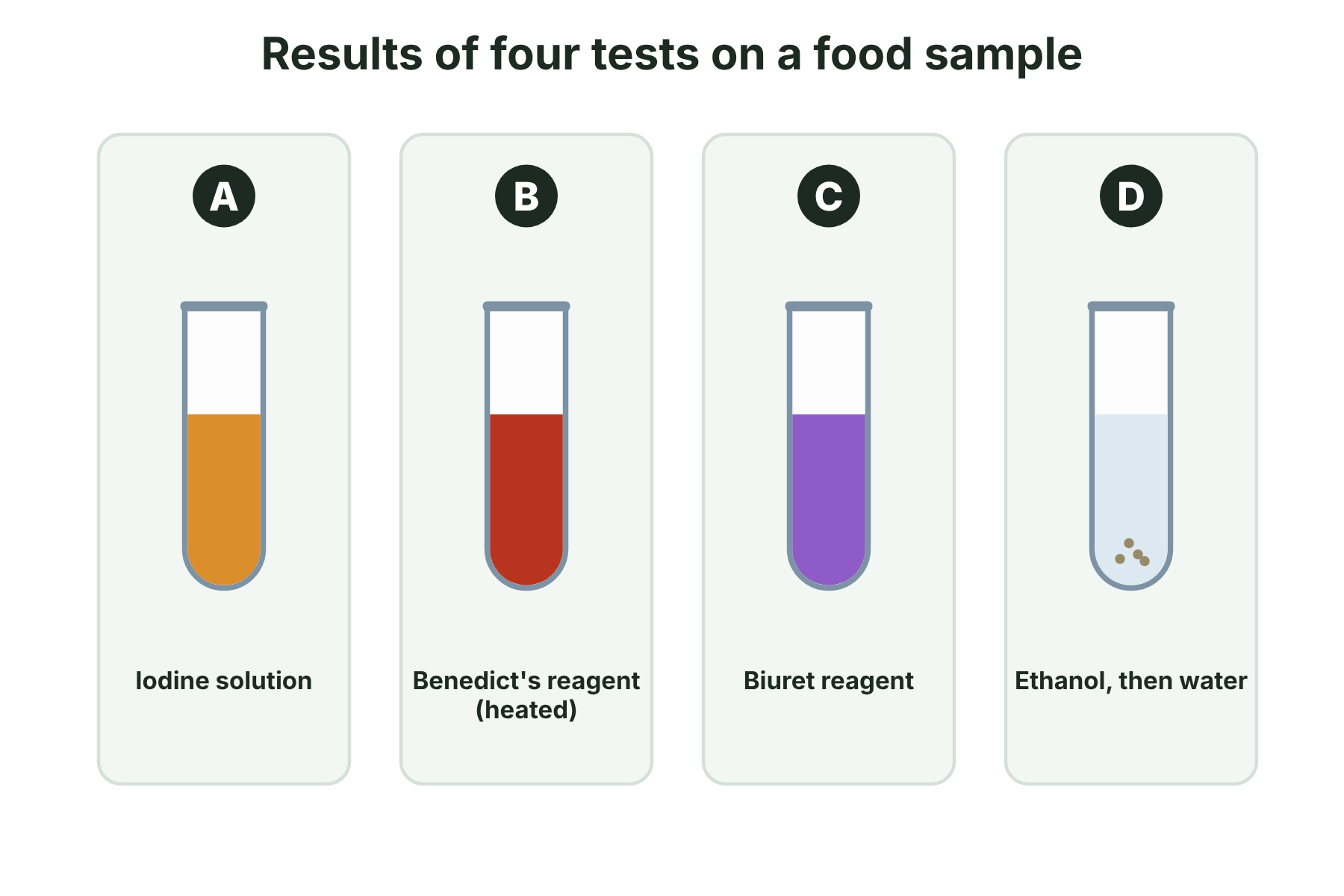
Figure 1 shows four tests on a sample of food. Tube A contains iodine solution, tube B contains Benedict's reagent after heating, tube C contains Biuret reagent, and in tube D the food was shaken with ethanol and poured into water. Use Figure 1 to say whether the sample contains starch, sugar, protein and lipid.
Show answerHide answer
Model answer
Starch is not present, because the iodine stayed orange-brown. Sugar is present, because Benedict's turned brick red. Protein is present, because Biuret turned purple. Lipid is not present, because the liquid stayed clear.
Mark scheme
- Starch absent: iodine stayed orange-brown — 1 mark
- Sugar present: Benedict's brick red — 1 mark
- Protein present: Biuret purple — 1 mark
- Lipid absent: no cloudy emulsion — 1 mark
-
4 Describe [3 marks]
Describe how you would test a food sample for sugar.
Show answerHide answer
Model answer
Add Benedict's reagent to the sample and heat it in a water bath. If sugar is present, the blue colour changes to green, yellow, orange or brick red.
Mark scheme
- Add Benedict's reagent — 1 mark
- Heat in a (hot) water bath — 1 mark
- Blue changes to green / yellow / orange / brick red if sugar is present — 1 mark
-
5 Suggest [2 marks]
A student heats a test tube containing Benedict's reagent in a hot water bath, and not in a Bunsen burner flame. Suggest two reasons for this.
Show answerHide answer
Model answer
The liquid cannot boil over or spit out of the tube, so there is less risk of burns. The temperature is more even and easier to control.
Mark scheme
- Less risk of the liquid boiling over / spitting / burns — 1 mark
- More even / controlled temperature — 1 mark
-
6 Describe [3 marks]
Describe how you would test a food for lipids, and what you would see if the result is positive.
Show answerHide answer
Model answer
Shake the food with ethanol and pour the liquid into a test tube of water. If lipid is present, a cloudy white emulsion forms.
Mark scheme
- Shake the food with ethanol — 1 mark
- Pour into water — 1 mark
- A cloudy white emulsion forms if lipid is present — 1 mark
-
7 Explain [2 marks]
A student also tests some distilled water with iodine solution. Explain why.
Show answerHide answer
Model answer
Distilled water contains no starch, so it acts as a control. It shows what a negative result looks like, so the student can tell that a colour change in the food sample is a real result.
Mark scheme
- It is a control / shows a negative result — 1 mark
- To compare with the food sample / so a colour change can be recognised — 1 mark
-
8 Interpret [3 marks]
Food X gave these results: the iodine solution turned blue-black, Benedict's reagent stayed blue after heating, Biuret reagent stayed blue, and the emulsion test stayed clear. Say what food X contains and does not contain.
Show answerHide answer
Model answer
Food X contains starch. It does not contain sugar, protein or lipid.
Mark scheme
- Contains starch — 1 mark
- No sugar (Benedict's stayed blue) — 1 mark
- No protein (Biuret stayed blue) and no lipid (stayed clear) — 1 mark
-
9 Describe [2 marks]
Describe two safety precautions that should be taken when doing the food tests.
Show answerHide answer
Model answer
Wear eye protection (goggles). Use a hot water bath instead of a flame, and keep the ethanol away from flames.
Mark scheme
- Wear goggles / eye protection — 1 mark
- Use a water bath / keep ethanol away from flames / hold hot tubes with a holder — 1 mark
-
10 Describe [6 marks]
A student has three foods, P, Q and R. Describe how the student could use Benedict's reagent to find out which food contains the most sugar.
Show answerHide answer
Model answer
Prepare a solution of each food in the same way. Put the same volume of each sample in a test tube and add the same volume of Benedict's reagent. Heat all the tubes in the same hot water bath for the same length of time. Compare the colours. The food that goes closest to brick red contains the most sugar. Test distilled water as a control and repeat to check the results.
Mark scheme
- Prepare a solution of each food in the same way — 1 mark
- Same volume of each sample and of Benedict's reagent — 1 mark
- Heat in a water bath for the same time and temperature — 1 mark
- Compare the colours — 1 mark
- Closest to brick red = most sugar — 1 mark
- Control with distilled water / repeat the test — 1 mark
Quick check
-
1
Which reagent turns purple when protein is present?
Show answerHide answer
C: Biuret reagent
Biuret reagent changes from blue to purple when protein is present.
-
2
A food is tested with iodine solution and the solution turns blue-black. What does the food contain?
Show answerHide answer
A: Starch
Iodine turns blue-black when starch is present.
-
3
What must be done after adding Benedict's reagent to a sample?
Show answerHide answer
D: Heat it in a water bath
The mixture must be heated in a water bath. Without heating, the colour change will not happen.
-
4
In Benedict's test, a sample turns brick red. What does this show?
Show answerHide answer
B: There is a large amount of sugar
Brick red is the last colour in the series from blue, and it shows a large amount of sugar.
-
5
What is the positive result for the emulsion test for lipids?
Show answerHide answer
C: A cloudy white emulsion
If lipid is present, the ethanol mixture forms a cloudy white emulsion when it is poured into water.
-
6
Why is the lipid test done with ethanol?
Show answerHide answer
A: Lipids dissolve in ethanol
Lipids dissolve in ethanol, but not in water, so the ethanol carries them into solution.
-
7
Why should a student use a water bath instead of a flame to heat Benedict's reagent?
Show answerHide answer
D: The liquid is less likely to boil over
The liquid is less likely to boil over, and the temperature is more even and safer.
-
8
A food gives no colour change with any of the four tests. What can you conclude?
Show answerHide answer
B: It contains none of the four groups tested for
All four tests were negative, so the food contains none of starch, sugar, protein or lipid.
-
9
Why is it useful to test a food that you know contains starch with iodine solution?
Show answerHide answer
A: It shows what a positive result looks like
It is a positive control, which shows what a positive result looks like for comparison.
-
10
These tests are qualitative. What does this mean?
Show answerHide answer
C: They show whether a substance is present, not exactly how much
Qualitative tests show whether a substance is present, but they do not measure exactly how much there is.