Exam questions · Biology · The Endocrine System
The Menstrual Cycle
- 7 exam questions
- 20 marks
- 8 quick checks
-
1 State [2 marks]
State the roles of oestrogen and progesterone in the menstrual cycle.
Show answerHide answer
Model answer
Oestrogen repairs and thickens the lining of the uterus. Progesterone maintains the lining of the uterus.
Mark scheme
- Oestrogen repairs the lining — 1 mark
- Progesterone maintains the lining — 1 mark
-
2 Name [3 marks]
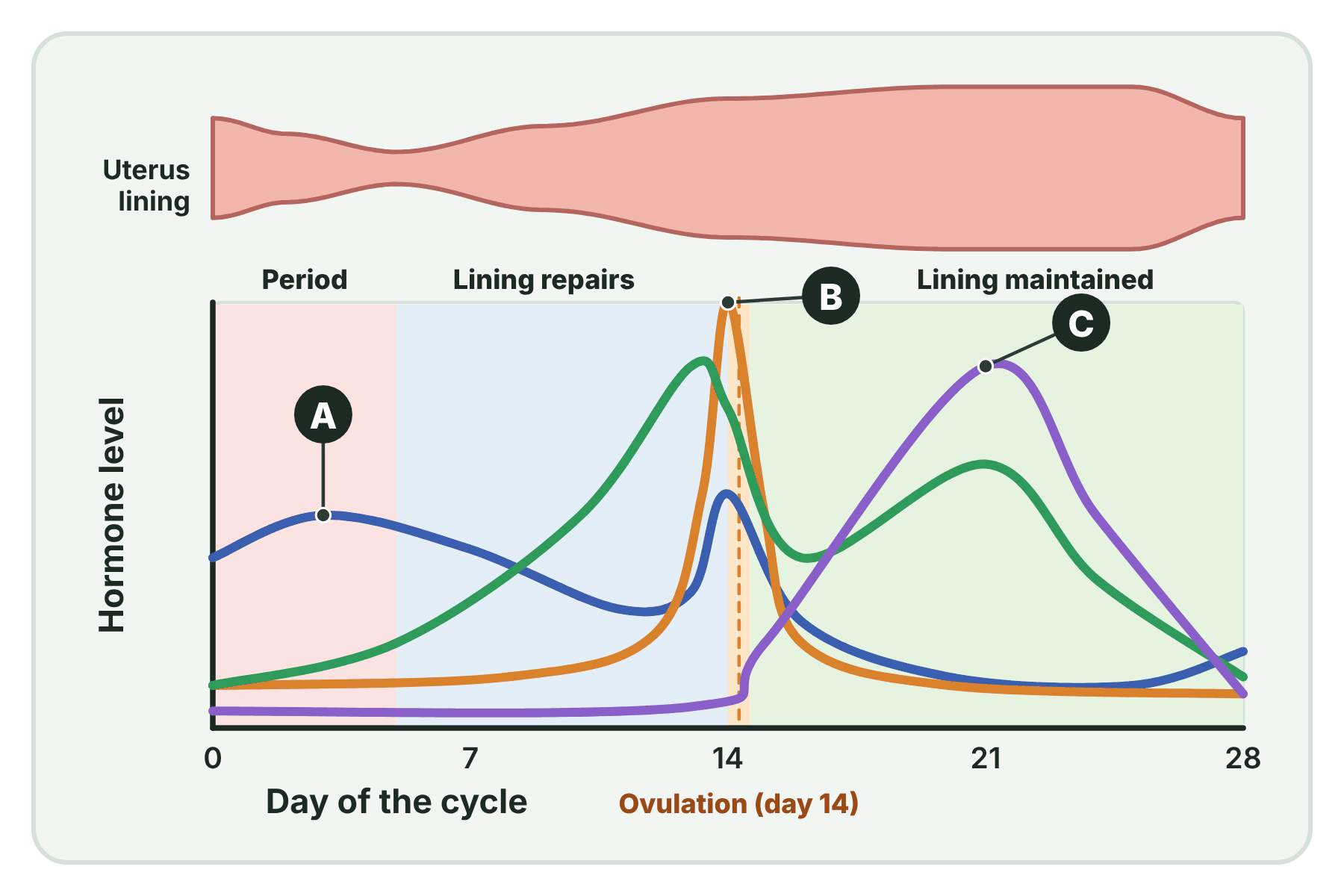
Figure 1 shows the levels of four hormones during the menstrual cycle. Name the hormones shown by the curves A, B and C.
Show answerHide answer
Model answer
A is FSH. B is LH. C is progesterone.
Mark scheme
- A: FSH — 1 mark
- B: LH — 1 mark
- C: progesterone — 1 mark
-
3 Describe [3 marks]
Describe what happens to the lining of the uterus during the menstrual cycle.
Show answerHide answer
Model answer
The lining breaks down on days 1 to 5, which is the period. It repairs and thickens between day 5 and day 14. It is maintained from day 14 to day 28 unless the woman becomes pregnant.
Mark scheme
- Breaks down in days 1 to 5 — 1 mark
- Repairs and thickens to day 14 — 1 mark
- Maintained until day 28 — 1 mark
-
4 Explain [2 marks]
The level of LH peaks on day 14. Explain what the peak causes.
Show answerHide answer
Model answer
The surge of LH causes ovulation, which is the release of a mature egg from the ovary.
Mark scheme
- Causes ovulation — 1 mark
- The release of a mature egg from the ovary — 1 mark
-
5 Explain [3 marks]
Explain why the lining of the uterus breaks down at the end of the cycle if the woman is not pregnant.
Show answerHide answer
Model answer
After ovulation progesterone maintains the lining. If there is no pregnancy, the progesterone level falls. The lining is no longer maintained, so it breaks down.
Mark scheme
- Progesterone maintains the lining — 1 mark
- If there is no pregnancy the progesterone level falls — 1 mark
- The lining breaks down — 1 mark
-
6 Explain [4 marks]
Explain how FSH, oestrogen and LH interact to cause ovulation.
Show answerHide answer
Model answer
FSH makes an egg mature and stimulates the ovary to release oestrogen. The oestrogen level rises and stops the release of more FSH, so only one egg matures. A high oestrogen level also stimulates the pituitary gland to release a surge of LH. The LH causes ovulation.
Mark scheme
- FSH matures the egg and stimulates oestrogen — 1 mark
- Oestrogen stops further FSH release — 1 mark
- High oestrogen stimulates the LH surge — 1 mark
- LH causes ovulation — 1 mark
-
7 Explain [3 marks]
Explain the part played by progesterone after ovulation.
Show answerHide answer
Model answer
Progesterone is released by the empty follicle after ovulation. It maintains the lining of the uterus, ready for an embryo. It also stops the pituitary releasing FSH and LH, so no other eggs mature.
Mark scheme
- Released after ovulation — 1 mark
- Maintains the lining — 1 mark
- Stops FSH and LH release so no new egg matures — 1 mark
Quick check
-
1
Which hormone causes ovulation?
Show answerHide answer
B: LH
A surge of LH causes ovulation.
-
2
Which hormone makes an egg mature in an ovary?
Show answerHide answer
A: FSH
FSH makes an egg mature in a follicle.
-
3
Which hormone maintains the lining of the uterus after ovulation?
Show answerHide answer
D: Progesterone
Progesterone maintains the lining.
-
4
On which day of a 28-day cycle does ovulation usually happen?
Show answerHide answer
C: Day 14
Ovulation usually happens on about day 14.
-
5
Which gland releases FSH and LH?
Show answerHide answer
B: The pituitary gland
The pituitary gland releases FSH and LH.
-
6
Which hormone is released by the testes?
Show answerHide answer
A: Testosterone
The testes release testosterone.
-
7
What does a rise in oestrogen do to FSH?
Show answerHide answer
C: It stops further FSH release
A rising oestrogen level stops the pituitary releasing more FSH.
-
8
What causes the lining of the uterus to break down at the end of a cycle?
Show answerHide answer
D: A fall in progesterone
The level of progesterone falls, so the lining is no longer maintained.