Exam questions · Biology · The Nervous System
Reflex Arcs
- 7 exam questions
- 20 marks
- 8 quick checks
-
1 State [1 mark]
State what a reflex action is.
Show answerHide answer
Model answer
A rapid, automatic response to a stimulus.
Mark scheme
- Rapid, automatic response — 1 mark
-
2 Name [3 marks]
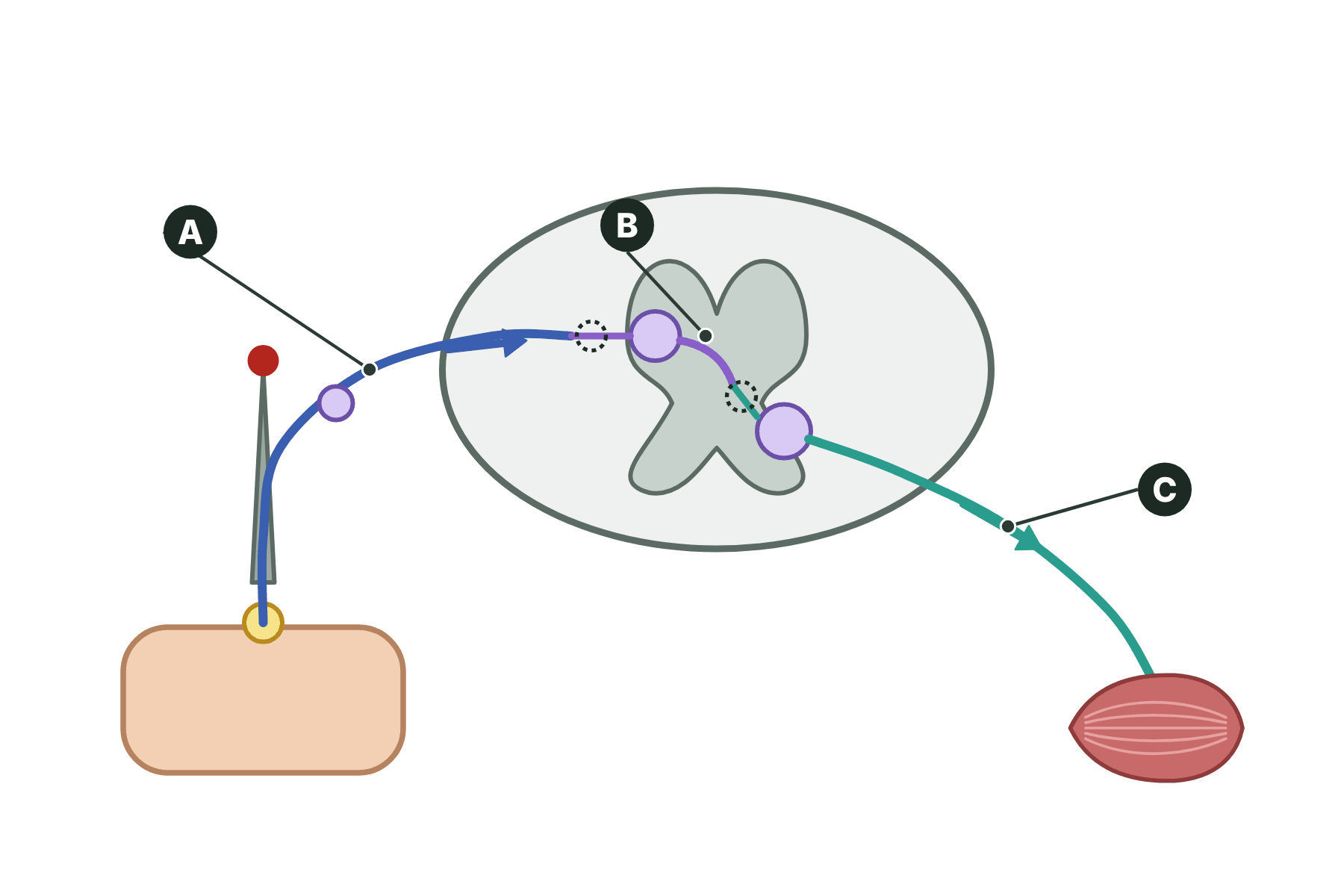
Figure 1 shows a reflex arc. Name the neurones shown at A, B and C.
Show answerHide answer
Model answer
A is the sensory neurone. B is the relay neurone. C is the motor neurone.
Mark scheme
- A: sensory neurone — 1 mark
- B: relay neurone — 1 mark
- C: motor neurone — 1 mark
-
3 Name [3 marks]
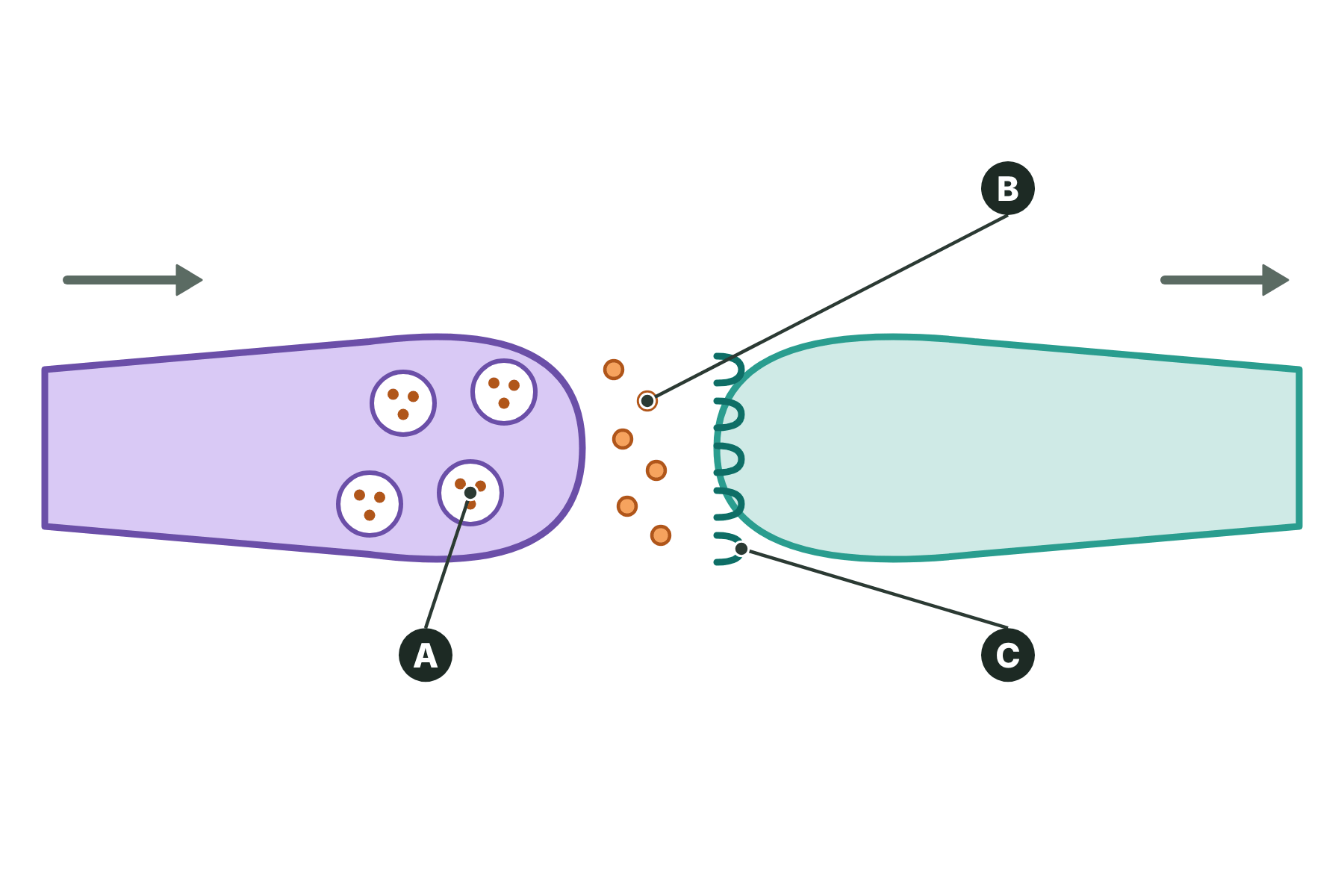
Figure 2 shows a synapse. Name the parts shown at A, B and C.
Show answerHide answer
Model answer
A is a vesicle (containing neurotransmitter). B is a neurotransmitter (molecule). C is a receptor.
Mark scheme
- A: vesicle — 1 mark
- B: neurotransmitter — 1 mark
- C: receptor — 1 mark
-
4 Describe [5 marks]
Describe the pathway taken by the impulse when a person touches a sharp pin and pulls their hand away.
Show answerHide answer
Model answer
The receptors in the skin detect the pin. An impulse passes along a sensory neurone to the spinal cord. A relay neurone passes it to a motor neurone. The motor neurone carries the impulse to a muscle in the arm, the effector. The muscle contracts and the hand is pulled away.
Mark scheme
- Receptor detects the stimulus — 1 mark
- Sensory neurone to the spinal cord — 1 mark
- Relay neurone — 1 mark
- Motor neurone to the effector — 1 mark
- Muscle contracts — 1 mark
-
5 Explain [3 marks]
Explain why a reflex action is faster than a voluntary action.
Show answerHide answer
Model answer
The reflex arc is a short pathway with few neurones and synapses. The impulse goes through the spinal cord without going to the brain. No conscious thought is needed, so the response is faster.
Mark scheme
- Short pathway with few neurones and synapses — 1 mark
- Does not go through the brain — 1 mark
- No conscious thought — 1 mark
-
6 Explain [3 marks]
Explain how the structure of a reflex arc is related to its function.
Show answerHide answer
Model answer
The sensory and motor neurones are long, so they can reach from the skin to the spinal cord and back to the muscle. The myelin sheath makes the impulse fast. The relay neurone in the spinal cord makes the pathway short, so the response is rapid and protects the body.
Mark scheme
- Long neurones reach receptors and effectors — 1 mark
- Myelin sheath speeds up the impulse — 1 mark
- Short pathway through the spinal cord gives a rapid response — 1 mark
-
7 Calculate [2 marks]
A student catches a dropped ruler at 12 cm, 15 cm and 18 cm. Calculate the mean distance. Give a unit.
Show answerHide answer
Model answer
15 cm
Mark scheme
- \(12 + 15 + 18 = 45\), then \(45 \div 3\) — 1 mark
- 15 cm — 1 mark
Quick check
-
1
What is a reflex action?
Show answerHide answer
C: A rapid, automatic response to a stimulus
A reflex is a rapid, automatic response to a stimulus.
-
2
Where is the relay neurone in a reflex arc?
Show answerHide answer
A: In the spinal cord
The relay neurone is in the spinal cord.
-
3
Which of these is the correct order for a reflex arc?
Show answerHide answer
D: Receptor, sensory neurone, relay neurone, motor neurone, effector
The impulse passes from the receptor along a sensory neurone, relay neurone and motor neurone to the effector.
-
4
What crosses the gap at a synapse?
Show answerHide answer
B: Neurotransmitter
Neurotransmitter diffuses across the synapse.
-
5
Why is a reflex action so fast?
Show answerHide answer
C: The pathway is short
The pathway is short, with few neurones and synapses, and does not go through the brain.
-
6
Which is an example of a reflex action?
Show answerHide answer
B: Pulling a hand away from a hot object
Pulling a hand away from a hot object is a reflex.
-
7
In the ruler drop test, what does a smaller distance caught mean?
Show answerHide answer
D: A faster reaction
A shorter distance means the person reacted faster.
-
8
What does the effector in a reflex arc do?
Show answerHide answer
A: Produces the response
The effector, a muscle or gland, produces the response.