Exam questions · Biology
Transport in Plants
- 28 exam questions
- 71 marks
- 32 quick checks
Plant Tissues and Organs
Just this lesson-
1 State [1 mark]
Name the tissue in a leaf where most photosynthesis takes place.
Show answerHide answer
Model answer
Palisade mesophyll.
Mark scheme
- Palisade (mesophyll) — 1 mark
-
2 Name [3 marks]
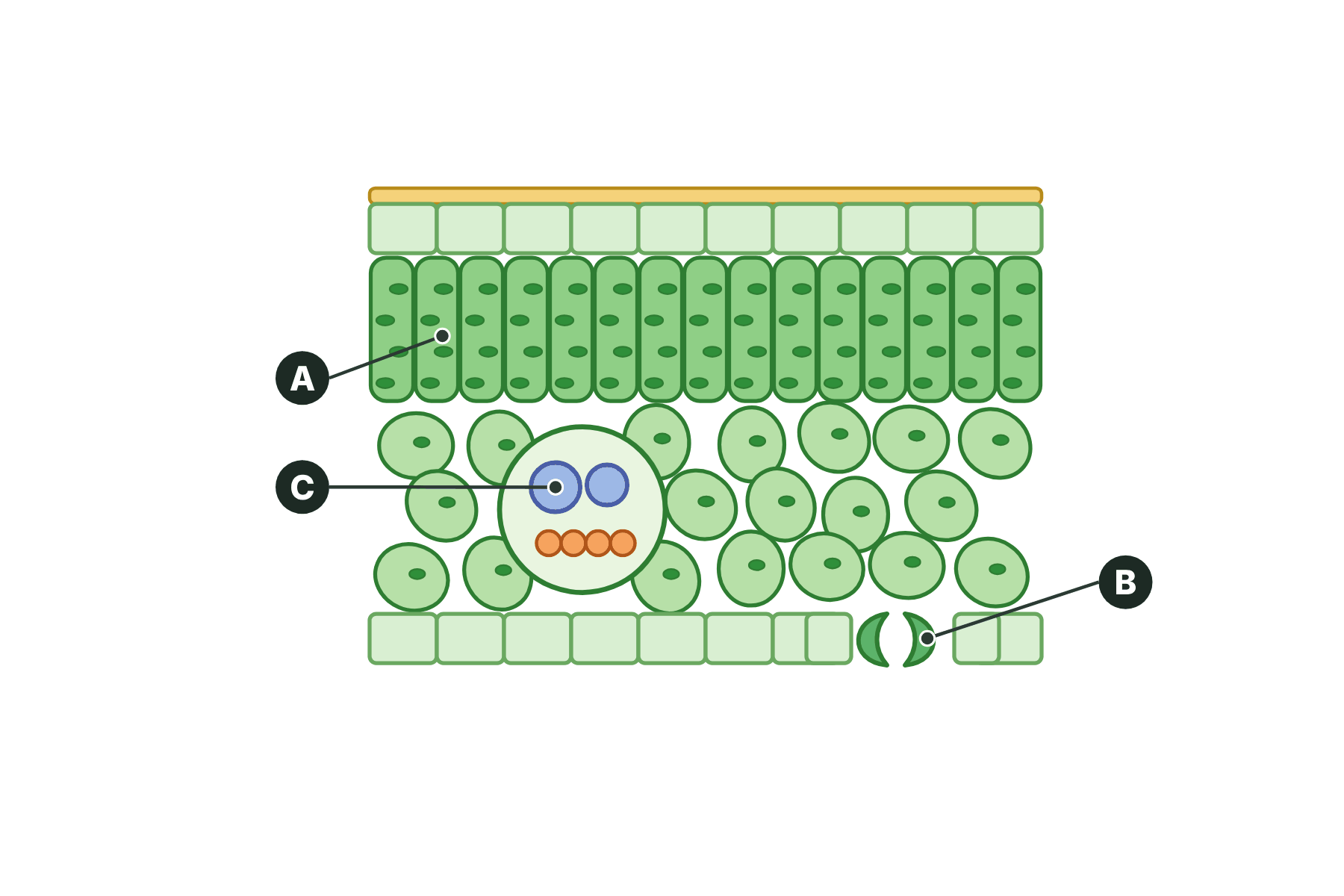
Figure 1 shows a section through a leaf. Name the parts labelled A, B and C.
Show answerHide answer
Model answer
A is the palisade mesophyll. B is a guard cell. C is the xylem.
Mark scheme
- A: palisade mesophyll — 1 mark
- B: guard cell — 1 mark
- C: xylem — 1 mark
-
3 Explain [3 marks]
Explain how the structure of the palisade mesophyll is related to its function.
Show answerHide answer
Model answer
The palisade cells contain many chloroplasts, which absorb light for photosynthesis. They are tall and tightly packed, so many cells fit near the top of the leaf. They are just below the transparent upper epidermis, where most light arrives.
Mark scheme
- Many chloroplasts to absorb light — 1 mark
- Tightly packed near the top of the leaf — 1 mark
- Where most light arrives / under a transparent epidermis — 1 mark
-
4 Explain [2 marks]
Explain why the spongy mesophyll has air spaces between its cells.
Show answerHide answer
Model answer
The air spaces allow carbon dioxide and oxygen to diffuse through the leaf. They also give the cells a large surface area for gas exchange.
Mark scheme
- Gases diffuse through the leaf — 1 mark
- Large surface area for gas exchange — 1 mark
-
5 Describe [3 marks]
Describe how guard cells control the opening of the stomata.
Show answerHide answer
Model answer
When the plant has plenty of water, water enters the guard cells by osmosis and they become turgid, which opens the stoma. When the plant is short of water, the guard cells lose water and become flaccid, which closes the stoma. This stops more water being lost.
Mark scheme
- Turgid guard cells open the stoma — 1 mark
- Flaccid guard cells close the stoma — 1 mark
- Closing reduces water loss — 1 mark
-
6 Explain [2 marks]
Suggest why most stomata are found in the lower epidermis of a leaf.
Show answerHide answer
Model answer
The lower surface is cooler and shadier than the upper surface. Less water is lost by evaporation, but gases can still be exchanged.
Mark scheme
- Cooler / less light — 1 mark
- Less water lost — 1 mark
-
7 Describe [4 marks]
Describe the functions of the upper epidermis, the palisade mesophyll, the spongy mesophyll and the guard cells.
Show answerHide answer
Model answer
The upper epidermis covers and protects the leaf and is transparent so light can pass through. The palisade mesophyll carries out most of the photosynthesis. The spongy mesophyll has air spaces, which allow gases to diffuse through the leaf. The guard cells open and close the stomata to control gas exchange and water loss.
Mark scheme
- Epidermis covers / protects / transparent — 1 mark
- Palisade does photosynthesis — 1 mark
- Spongy mesophyll allows gas exchange — 1 mark
- Guard cells control the stomata — 1 mark
Quick check
-
1
Which layer of a leaf is covered by a waxy cuticle?
Show answerHide answer
B: Upper epidermis
The upper epidermis has a waxy cuticle that reduces water loss.
-
2
Which tissue has the most chloroplasts?
Show answerHide answer
C: Palisade mesophyll
Palisade mesophyll cells are packed with chloroplasts and do most of the photosynthesis.
-
3
What do guard cells do?
Show answerHide answer
A: Open and close the stomata
Guard cells change shape to open and close the stomata.
-
4
What are the air spaces in the spongy mesophyll for?
Show answerHide answer
D: Gas exchange
They allow gases to diffuse through the leaf and give a large surface area for gas exchange.
-
5
What happens to the guard cells when a plant is short of water?
Show answerHide answer
B: They become flaccid and close the stoma
The guard cells become flaccid and close the stomata, which reduces water loss.
-
6
Where are meristem cells found?
Show answerHide answer
C: At the tips of roots and shoots
Meristem tissue is at the growing tips of the roots and shoots.
-
7
Why is the upper epidermis transparent?
Show answerHide answer
A: To let light through to the palisade cells
Light has to pass through it to reach the palisade cells.
-
8
Which tissue carries sugars away from the leaf?
Show answerHide answer
D: Phloem
Phloem transports dissolved sugars. Xylem brings water.
Transpiration and the Xylem
Just this lesson-
1 State [1 mark]
Name the process by which water vapour is lost from the leaves of a plant.
Show answerHide answer
Model answer
Transpiration.
Mark scheme
- Transpiration — 1 mark
-
2 Name [3 marks]
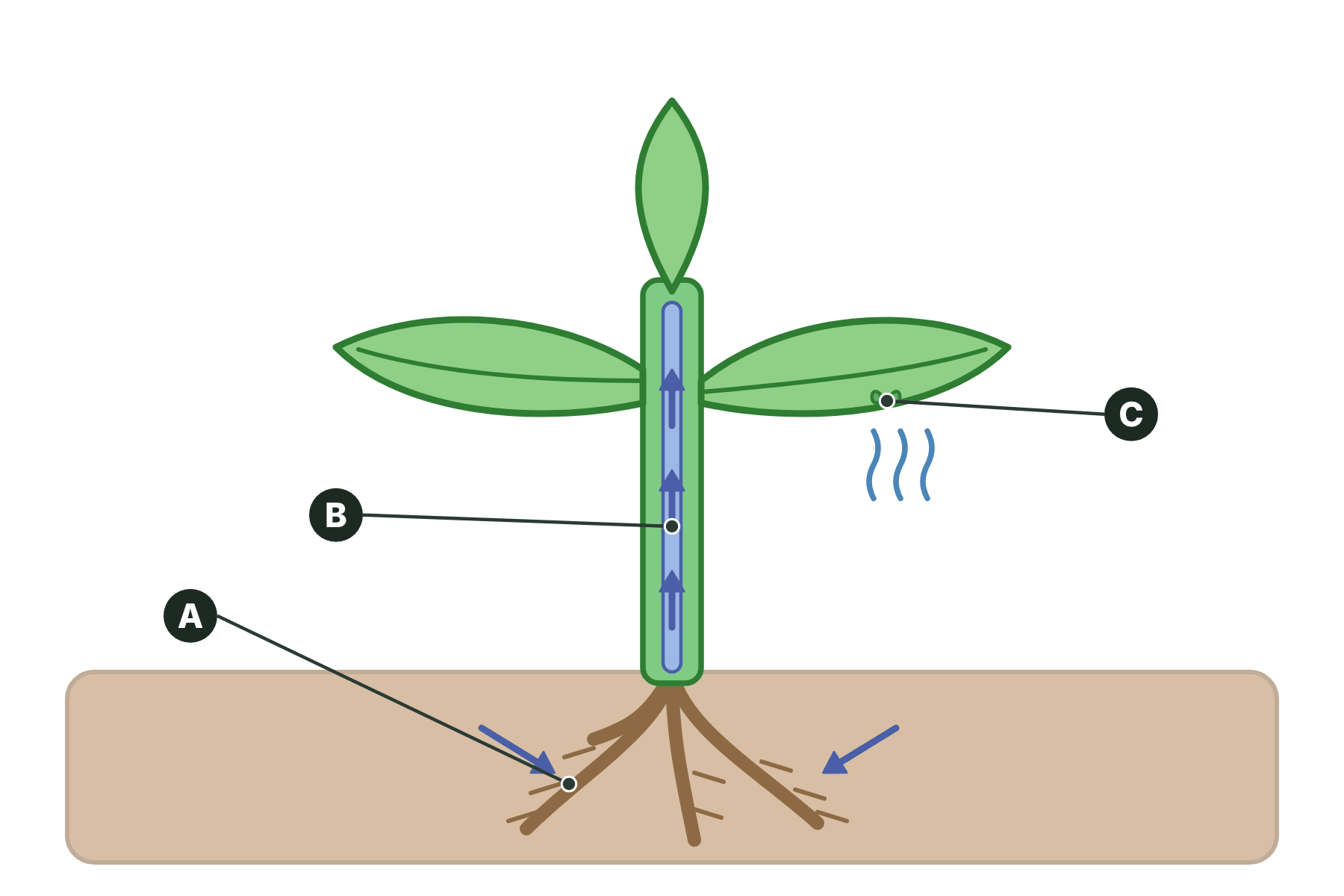
Figure 1 shows a plant. Name the parts labelled A, B and C.
Show answerHide answer
Model answer
A is a root hair cell. B is the xylem. C is a stoma.
Mark scheme
- A: root hair cell — 1 mark
- B: xylem — 1 mark
- C: stoma — 1 mark
-
3 Explain [3 marks]
Explain how a root hair cell is adapted to take up water and mineral ions.
Show answerHide answer
Model answer
It has a long, thin extension that gives a large surface area. Water enters by osmosis. Mineral ions are taken up by active transport, using energy released by the many mitochondria in the cell.
Mark scheme
- Large surface area from the extension — 1 mark
- Water by osmosis — 1 mark
- Ions by active transport using energy from mitochondria — 1 mark
-
4 Explain [3 marks]
Explain how the structure of xylem is related to its function.
Show answerHide answer
Model answer
Xylem is made of dead cells with no cross-walls, which form hollow tubes so that water can flow through easily. The walls are strengthened with lignin, which stops the tubes collapsing. The tubes carry water and mineral ions from the roots to the leaves.
Mark scheme
- Hollow tubes, no cross-walls — 1 mark
- Lignin strengthens the walls — 1 mark
- Carries water and minerals up the plant — 1 mark
-
5 Describe [3 marks]
Describe how water is lost from a leaf by transpiration.
Show answerHide answer
Model answer
Water evaporates from the surface of cells inside the leaf. The water vapour diffuses through the air spaces and out through the stomata. This pulls more water up the xylem to replace it.
Mark scheme
- Evaporation from the cells in the leaf — 1 mark
- Diffusion out through the stomata — 1 mark
- Pulls more water up the xylem — 1 mark
-
6 Explain [4 marks]
Explain why the rate of transpiration is faster on a hot, dry, windy day.
Show answerHide answer
Model answer
The higher temperature gives the water molecules more energy, so they evaporate and diffuse faster. The dry air has a low concentration of water vapour, so the concentration gradient from the leaf to the air is steeper. The wind blows the water vapour away from the leaf, which keeps the gradient steep.
Mark scheme
- Higher temperature speeds evaporation and diffusion — 1 mark
- Dry air gives a steeper gradient — 1 mark
- Wind removes the water vapour — 1 mark
- Gradient kept steep so a faster rate — 1 mark
-
7 Explain [2 marks]
A plant in a very dry soil closes its stomata. Explain how this helps the plant to survive.
Show answerHide answer
Model answer
Closing the stomata reduces water loss by transpiration. The plant keeps more of the water that it has, so it does not wilt as quickly.
Mark scheme
- Reduces water loss — 1 mark
- Prevents wilting / saves water — 1 mark
Quick check
-
1
How do mineral ions enter root hair cells?
Show answerHide answer
C: By active transport
The ions are at a lower concentration in the soil, so they are taken up by active transport, using energy.
-
2
Which tissue carries water up a plant?
Show answerHide answer
A: Xylem
Xylem carries water and mineral ions from the roots to the leaves.
-
3
What strengthens the walls of the xylem?
Show answerHide answer
B: Lignin
Lignin strengthens the xylem walls so that they do not collapse.
-
4
Which condition would decrease the rate of transpiration?
Show answerHide answer
D: High humidity
High humidity means less difference in water vapour concentration, so transpiration is slower.
-
5
Where does most water vapour leave a leaf?
Show answerHide answer
C: Through the stomata
Most water vapour diffuses out through the stomata.
-
6
Why do root hair cells contain many mitochondria?
Show answerHide answer
A: To release energy for active transport
Mitochondria release energy from respiration, which is needed for active transport of ions.
-
7
What is the movement of water up the xylem called?
Show answerHide answer
D: The transpiration stream
The movement of water from the roots to the leaves is the transpiration stream.
-
8
Why does a bright light increase the rate of transpiration?
Show answerHide answer
B: It opens the stomata wider
In bright light the guard cells open the stomata wider, so more water vapour can escape.
Translocation and the Phloem
Just this lesson-
1 State [1 mark]
Name the process by which dissolved sugars are moved round a plant.
Show answerHide answer
Model answer
Translocation.
Mark scheme
- Translocation — 1 mark
-
2 Name [2 marks]
Name the tissue in a plant that transports water, and the tissue that transports sugars.
Show answerHide answer
Model answer
Xylem transports water. Phloem transports sugars.
Mark scheme
- Xylem for water — 1 mark
- Phloem for sugars — 1 mark
-
3 Describe [3 marks]
Describe what happens to the sugars made in the leaves of a plant.
Show answerHide answer
Model answer
The sugars are carried in the phloem to other parts of the plant. Some are used immediately for respiration and growth. Some are carried to storage organs and stored.
Mark scheme
- Carried in the phloem — 1 mark
- Used for respiration or growth — 1 mark
- Stored — 1 mark
-
4 Explain [2 marks]
Explain why the roots of a plant need sugars to be transported to them.
Show answerHide answer
Model answer
The roots are underground and cannot photosynthesise. They need sugars for respiration to release energy for growth and active transport.
Mark scheme
- Cannot photosynthesise — 1 mark
- Need sugars for respiration / energy / growth — 1 mark
-
5 Describe [2 marks]
Describe how the structure of phloem allows sugars to move from one cell to the next.
Show answerHide answer
Model answer
Phloem is made of tubes of elongated cells joined end to end. There are pores in the end walls, so the cell sap can pass from one cell to the next.
Mark scheme
- Elongated cells joined end to end — 1 mark
- Pores in the end walls — 1 mark
-
6 Compare [4 marks]
Compare the structure and function of xylem and phloem.
Show answerHide answer
Model answer
Xylem is made of dead cells that form hollow tubes strengthened with lignin, while phloem is made of living cells with pores in the end walls. Xylem carries water and mineral ions from the roots to the leaves, while phloem carries dissolved sugars from the leaves to the rest of the plant. Xylem carries substances in one direction (up), while phloem can carry them up and down.
Mark scheme
- Xylem dead, phloem living — 1 mark
- Xylem hollow with lignin, phloem pores in end walls — 1 mark
- Xylem carries water and ions, phloem carries sugars — 1 mark
- Xylem upwards only, phloem both directions — 1 mark
-
7 Explain [3 marks]
A ring of bark and phloem is removed from around a tree trunk. The xylem is not damaged. Explain why the tree eventually dies.
Show answerHide answer
Model answer
The sugars made in the leaves cannot be carried down the trunk in the phloem. The roots do not receive sugars, so they cannot respire and release energy. The roots die, so the tree can no longer take up water and minerals.
Mark scheme
- Phloem cut so sugars cannot reach the roots — 1 mark
- Roots cannot respire / starved of food — 1 mark
- Roots die so the tree cannot take up water — 1 mark
Quick check
-
1
What is carried in the phloem?
Show answerHide answer
B: Dissolved sugars
Phloem carries dissolved sugars from the leaves to the rest of the plant.
-
2
What is the movement of food through the phloem called?
Show answerHide answer
C: Translocation
Translocation is the movement of dissolved sugars in the phloem.
-
3
Which statement about phloem is correct?
Show answerHide answer
A: It is made of living cells
Phloem is made of living cells with pores in the end walls.
-
4
In which direction can phloem carry sugars?
Show answerHide answer
D: Up and down
Sugars move from where they are made to where they are needed, which can be up or down the plant.
-
5
Which tissue is strengthened with lignin?
Show answerHide answer
B: Xylem
Xylem walls contain lignin, which stops the tubes collapsing.
-
6
Where might sugars be stored in a plant?
Show answerHide answer
C: In a root
Roots, tubers and fruits can all store sugars, often as starch.
-
7
Why can't roots make their own sugars?
Show answerHide answer
A: They get no light
Roots are underground, so they get no light for photosynthesis.
-
8
How does cell sap move from one phloem cell to the next?
Show answerHide answer
D: Through pores in the end walls
There are pores in the end walls of the phloem cells.
Measuring Transpiration
Just this lesson-
1 State [1 mark]
Name the apparatus used to measure the rate of water uptake by a plant shoot.
Show answerHide answer
Model answer
A potometer.
Mark scheme
- Potometer — 1 mark
-
2 Name [3 marks]
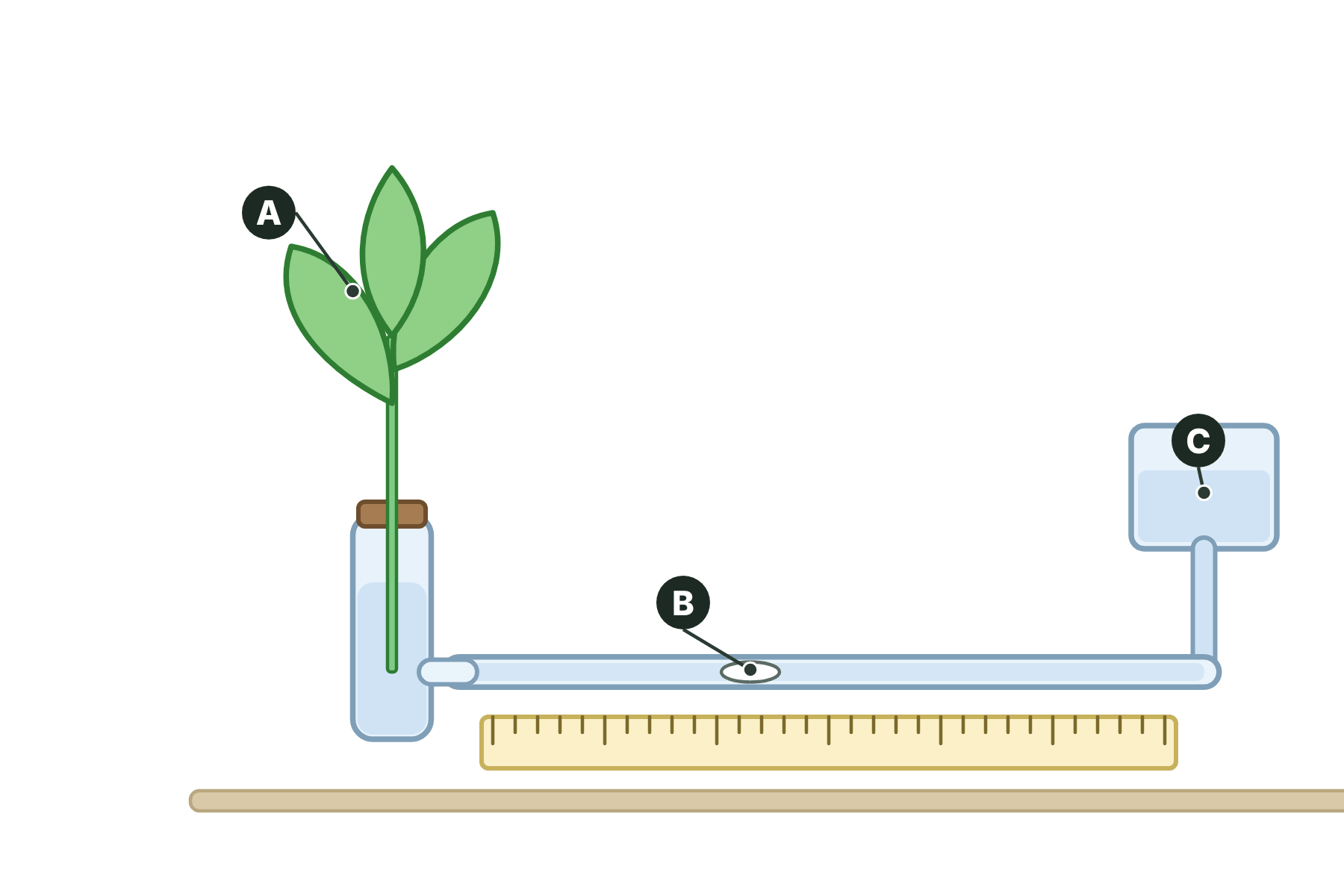
Figure 1 shows a potometer. Name the parts labelled A, B and C.
Show answerHide answer
Model answer
A is the (leafy) shoot. B is the (air) bubble. C is the (water) reservoir.
Mark scheme
- A: shoot — 1 mark
- B: air bubble — 1 mark
- C: water reservoir — 1 mark
-
3 Calculate [2 marks]
In a potometer, an air bubble moves 45 mm in 15 minutes. Calculate the rate of water uptake in mm per minute.
Show answerHide answer
Model answer
45 ÷ 15 = 3 mm per minute.
Mark scheme
- 45 ÷ 15 — 1 mark
- 3 mm per minute — 1 mark
-
4 Calculate [3 marks]
The bubble in a potometer moves 24 mm along a capillary tube of radius 0.6 mm. Calculate the volume of water taken up. Use \(\pi = 3.14\). Give your answer to 3 significant figures.
Show answerHide answer
Model answer
Volume = π r² × distance = 3.14 × 0.6² × 24 = 3.14 × 0.36 × 24 = 27.1 mm³.
Mark scheme
- Uses π r² × distance — 1 mark
- 3.14 × 0.36 × 24 — 1 mark
- 27.1 mm³ — 1 mark
-
5 Explain [2 marks]
Explain why the shoot must be cut under water and the apparatus set up under water.
Show answerHide answer
Model answer
This stops air entering the xylem and the apparatus. Air bubbles would block the flow of water, so the readings would not show the real rate of uptake.
Mark scheme
- Prevents air entering the xylem — 1 mark
- Air would block the water / give false results — 1 mark
-
6 Describe [3 marks]
A student investigates the effect of light intensity on the rate of water uptake. Describe how the student could make the investigation a fair test.
Show answerHide answer
Model answer
Change only the distance of the lamp from the shoot. Keep the same shoot, the same temperature, the same wind conditions and the same length of time for each reading. Repeat each distance several times and calculate a mean.
Mark scheme
- Change only one variable (lamp distance) — 1 mark
- Control other variables, e.g. temperature, shoot, time — 1 mark
- Repeat and calculate a mean — 1 mark
-
7 Calculate [3 marks]
A student counts the stomata in three fields of view, each of area 0.4 mm². The counts are 22, 18 and 20. Calculate the mean number of stomata per mm².
Show answerHide answer
Model answer
Mean count = (22 + 18 + 20) ÷ 3 = 20. Stomatal density = 20 ÷ 0.4 = 50 stomata per mm².
Mark scheme
- Mean count of 20 — 1 mark
- 20 ÷ 0.4 — 1 mark
- 50 per mm² — 1 mark
Quick check
-
1
What does the air bubble in a potometer show?
Show answerHide answer
C: The water taken up
The bubble is pulled along the tube as the shoot takes up water, so its movement shows the water uptake.
-
2
Which of these is a control variable when changing the wind speed?
Show answerHide answer
A: The temperature
The temperature must be kept the same so that only the wind speed changes.
-
3
The bubble moves 30 mm in 10 minutes. What is the rate of uptake?
Show answerHide answer
B: 3 mm per minute
30 ÷ 10 = 3 mm per minute.
-
4
Why should you repeat the readings?
Show answerHide answer
D: To check reliability and find a mean
Repeating lets you calculate a mean, which is more reliable.
-
5
How can the humidity around a shoot be increased?
Show answerHide answer
A: Cover it with a clear plastic bag
A clear plastic bag traps water vapour around the leaves.
-
6
Why is the volume of water taken up an estimate of transpiration?
Show answerHide answer
C: Because some water is used by the plant
Some of the water is used for photosynthesis and growth, so uptake is slightly higher than water lost.
-
7
How are stomata seen under a microscope in this investigation?
Show answerHide answer
B: Using a nail varnish impression
A nail varnish impression of the leaf surface shows the stomata and guard cells.
-
8
18 stomata are counted in an area of 0.6 mm². What is the stomatal density?
Show answerHide answer
D: 30 per mm²
18 ÷ 0.6 = 30 stomata per mm².