Exam questions · Biology · Transport in Plants
Transpiration and the Xylem
- 7 exam questions
- 19 marks
- 8 quick checks
-
1 State [1 mark]
Name the process by which water vapour is lost from the leaves of a plant.
Show answerHide answer
Model answer
Transpiration.
Mark scheme
- Transpiration — 1 mark
-
2 Name [3 marks]
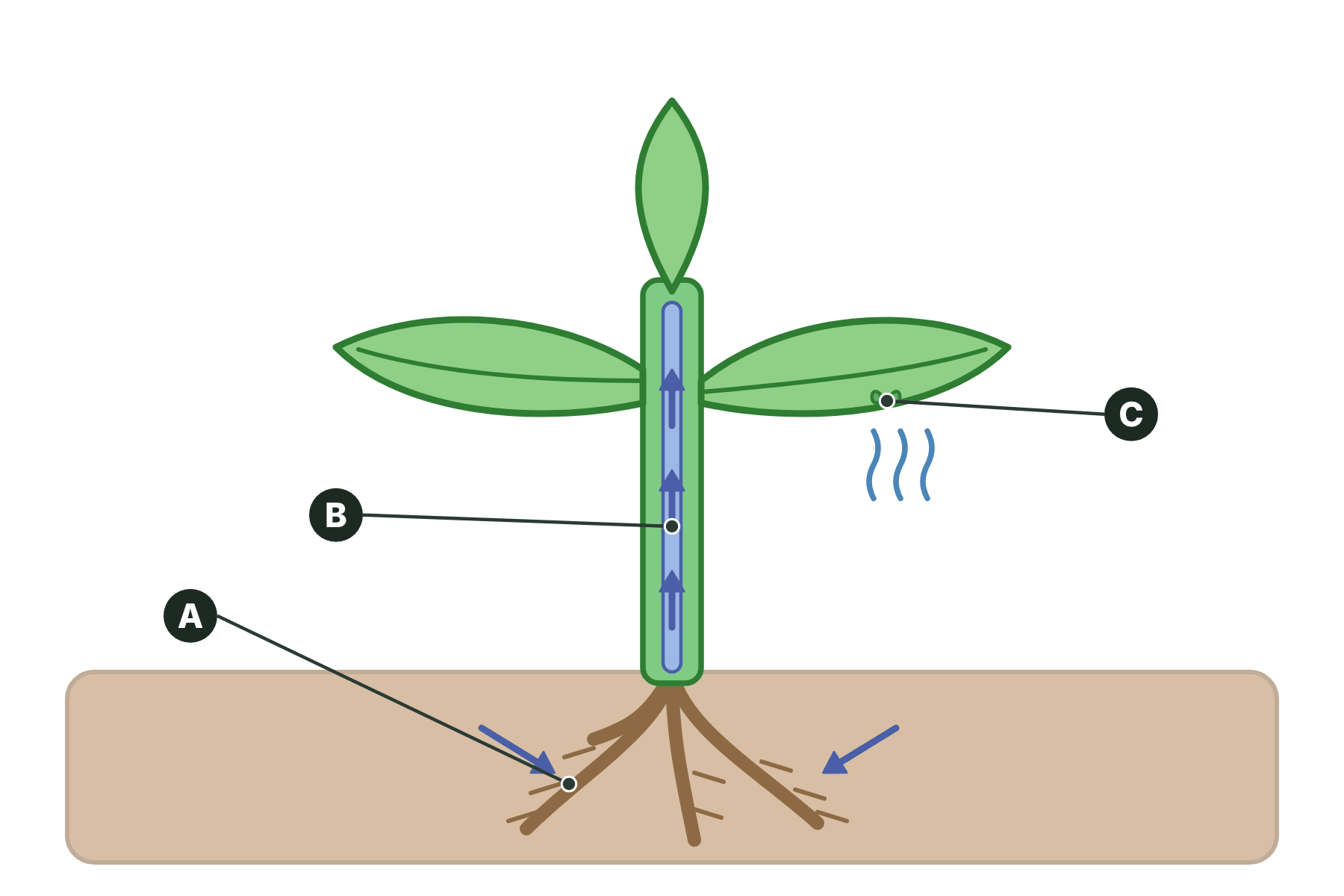
Figure 1 shows a plant. Name the parts labelled A, B and C.
Show answerHide answer
Model answer
A is a root hair cell. B is the xylem. C is a stoma.
Mark scheme
- A: root hair cell — 1 mark
- B: xylem — 1 mark
- C: stoma — 1 mark
-
3 Explain [3 marks]
Explain how a root hair cell is adapted to take up water and mineral ions.
Show answerHide answer
Model answer
It has a long, thin extension that gives a large surface area. Water enters by osmosis. Mineral ions are taken up by active transport, using energy released by the many mitochondria in the cell.
Mark scheme
- Large surface area from the extension — 1 mark
- Water by osmosis — 1 mark
- Ions by active transport using energy from mitochondria — 1 mark
-
4 Explain [3 marks]
Explain how the structure of xylem is related to its function.
Show answerHide answer
Model answer
Xylem is made of dead cells with no cross-walls, which form hollow tubes so that water can flow through easily. The walls are strengthened with lignin, which stops the tubes collapsing. The tubes carry water and mineral ions from the roots to the leaves.
Mark scheme
- Hollow tubes, no cross-walls — 1 mark
- Lignin strengthens the walls — 1 mark
- Carries water and minerals up the plant — 1 mark
-
5 Describe [3 marks]
Describe how water is lost from a leaf by transpiration.
Show answerHide answer
Model answer
Water evaporates from the surface of cells inside the leaf. The water vapour diffuses through the air spaces and out through the stomata. This pulls more water up the xylem to replace it.
Mark scheme
- Evaporation from the cells in the leaf — 1 mark
- Diffusion out through the stomata — 1 mark
- Pulls more water up the xylem — 1 mark
-
6 Explain [4 marks]
Explain why the rate of transpiration is faster on a hot, dry, windy day.
Show answerHide answer
Model answer
The higher temperature gives the water molecules more energy, so they evaporate and diffuse faster. The dry air has a low concentration of water vapour, so the concentration gradient from the leaf to the air is steeper. The wind blows the water vapour away from the leaf, which keeps the gradient steep.
Mark scheme
- Higher temperature speeds evaporation and diffusion — 1 mark
- Dry air gives a steeper gradient — 1 mark
- Wind removes the water vapour — 1 mark
- Gradient kept steep so a faster rate — 1 mark
-
7 Explain [2 marks]
A plant in a very dry soil closes its stomata. Explain how this helps the plant to survive.
Show answerHide answer
Model answer
Closing the stomata reduces water loss by transpiration. The plant keeps more of the water that it has, so it does not wilt as quickly.
Mark scheme
- Reduces water loss — 1 mark
- Prevents wilting / saves water — 1 mark
Quick check
-
1
How do mineral ions enter root hair cells?
Show answerHide answer
C: By active transport
The ions are at a lower concentration in the soil, so they are taken up by active transport, using energy.
-
2
Which tissue carries water up a plant?
Show answerHide answer
A: Xylem
Xylem carries water and mineral ions from the roots to the leaves.
-
3
What strengthens the walls of the xylem?
Show answerHide answer
B: Lignin
Lignin strengthens the xylem walls so that they do not collapse.
-
4
Which condition would decrease the rate of transpiration?
Show answerHide answer
D: High humidity
High humidity means less difference in water vapour concentration, so transpiration is slower.
-
5
Where does most water vapour leave a leaf?
Show answerHide answer
C: Through the stomata
Most water vapour diffuses out through the stomata.
-
6
Why do root hair cells contain many mitochondria?
Show answerHide answer
A: To release energy for active transport
Mitochondria release energy from respiration, which is needed for active transport of ions.
-
7
What is the movement of water up the xylem called?
Show answerHide answer
D: The transpiration stream
The movement of water from the roots to the leaves is the transpiration stream.
-
8
Why does a bright light increase the rate of transpiration?
Show answerHide answer
B: It opens the stomata wider
In bright light the guard cells open the stomata wider, so more water vapour can escape.