Exam questions · Biology · Transport in Plants
Measuring Transpiration
- 7 exam questions
- 17 marks
- 8 quick checks
-
1 State [1 mark]
Name the apparatus used to measure the rate of water uptake by a plant shoot.
Show answerHide answer
Model answer
A potometer.
Mark scheme
- Potometer — 1 mark
-
2 Name [3 marks]
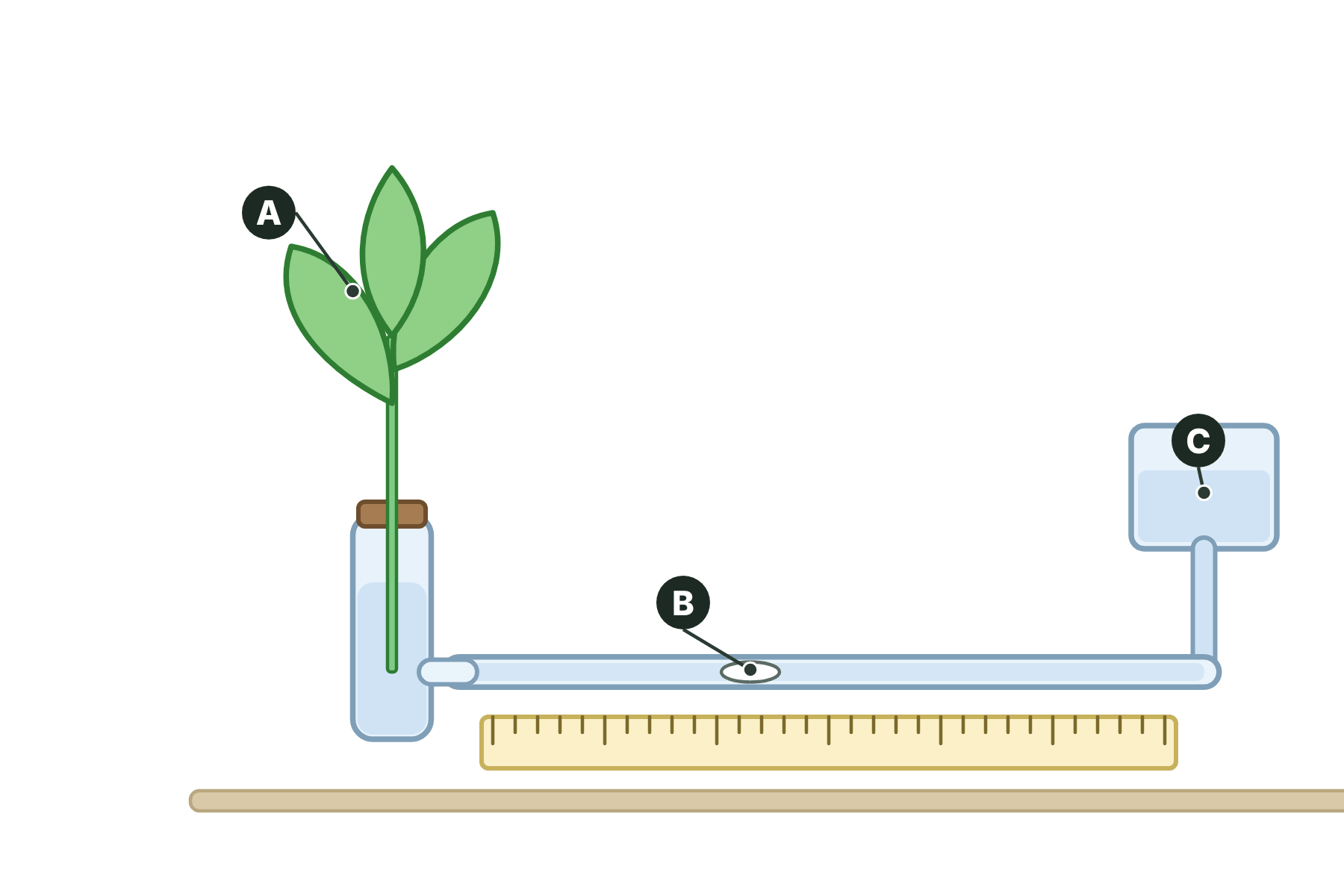
Figure 1 shows a potometer. Name the parts labelled A, B and C.
Show answerHide answer
Model answer
A is the (leafy) shoot. B is the (air) bubble. C is the (water) reservoir.
Mark scheme
- A: shoot — 1 mark
- B: air bubble — 1 mark
- C: water reservoir — 1 mark
-
3 Calculate [2 marks]
In a potometer, an air bubble moves 45 mm in 15 minutes. Calculate the rate of water uptake in mm per minute.
Show answerHide answer
Model answer
45 ÷ 15 = 3 mm per minute.
Mark scheme
- 45 ÷ 15 — 1 mark
- 3 mm per minute — 1 mark
-
4 Calculate [3 marks]
The bubble in a potometer moves 24 mm along a capillary tube of radius 0.6 mm. Calculate the volume of water taken up. Use \(\pi = 3.14\). Give your answer to 3 significant figures.
Show answerHide answer
Model answer
Volume = π r² × distance = 3.14 × 0.6² × 24 = 3.14 × 0.36 × 24 = 27.1 mm³.
Mark scheme
- Uses π r² × distance — 1 mark
- 3.14 × 0.36 × 24 — 1 mark
- 27.1 mm³ — 1 mark
-
5 Explain [2 marks]
Explain why the shoot must be cut under water and the apparatus set up under water.
Show answerHide answer
Model answer
This stops air entering the xylem and the apparatus. Air bubbles would block the flow of water, so the readings would not show the real rate of uptake.
Mark scheme
- Prevents air entering the xylem — 1 mark
- Air would block the water / give false results — 1 mark
-
6 Describe [3 marks]
A student investigates the effect of light intensity on the rate of water uptake. Describe how the student could make the investigation a fair test.
Show answerHide answer
Model answer
Change only the distance of the lamp from the shoot. Keep the same shoot, the same temperature, the same wind conditions and the same length of time for each reading. Repeat each distance several times and calculate a mean.
Mark scheme
- Change only one variable (lamp distance) — 1 mark
- Control other variables, e.g. temperature, shoot, time — 1 mark
- Repeat and calculate a mean — 1 mark
-
7 Calculate [3 marks]
A student counts the stomata in three fields of view, each of area 0.4 mm². The counts are 22, 18 and 20. Calculate the mean number of stomata per mm².
Show answerHide answer
Model answer
Mean count = (22 + 18 + 20) ÷ 3 = 20. Stomatal density = 20 ÷ 0.4 = 50 stomata per mm².
Mark scheme
- Mean count of 20 — 1 mark
- 20 ÷ 0.4 — 1 mark
- 50 per mm² — 1 mark
Quick check
-
1
What does the air bubble in a potometer show?
Show answerHide answer
C: The water taken up
The bubble is pulled along the tube as the shoot takes up water, so its movement shows the water uptake.
-
2
Which of these is a control variable when changing the wind speed?
Show answerHide answer
A: The temperature
The temperature must be kept the same so that only the wind speed changes.
-
3
The bubble moves 30 mm in 10 minutes. What is the rate of uptake?
Show answerHide answer
B: 3 mm per minute
30 ÷ 10 = 3 mm per minute.
-
4
Why should you repeat the readings?
Show answerHide answer
D: To check reliability and find a mean
Repeating lets you calculate a mean, which is more reliable.
-
5
How can the humidity around a shoot be increased?
Show answerHide answer
A: Cover it with a clear plastic bag
A clear plastic bag traps water vapour around the leaves.
-
6
Why is the volume of water taken up an estimate of transpiration?
Show answerHide answer
C: Because some water is used by the plant
Some of the water is used for photosynthesis and growth, so uptake is slightly higher than water lost.
-
7
How are stomata seen under a microscope in this investigation?
Show answerHide answer
B: Using a nail varnish impression
A nail varnish impression of the leaf surface shows the stomata and guard cells.
-
8
18 stomata are counted in an area of 0.6 mm². What is the stomatal density?
Show answerHide answer
D: 30 per mm²
18 ÷ 0.6 = 30 stomata per mm².