Exam questions · Biology · What Happens in Cells
Nucleotides and Protein Synthesis
- 8 exam questions
- 22 marks
- 8 quick checks
-
1 State [1 mark]
State which base pairs with adenine in DNA.
Show answerHide answer
Model answer
Thymine.
Mark scheme
- Thymine — 1 mark
-
2 Name [3 marks]
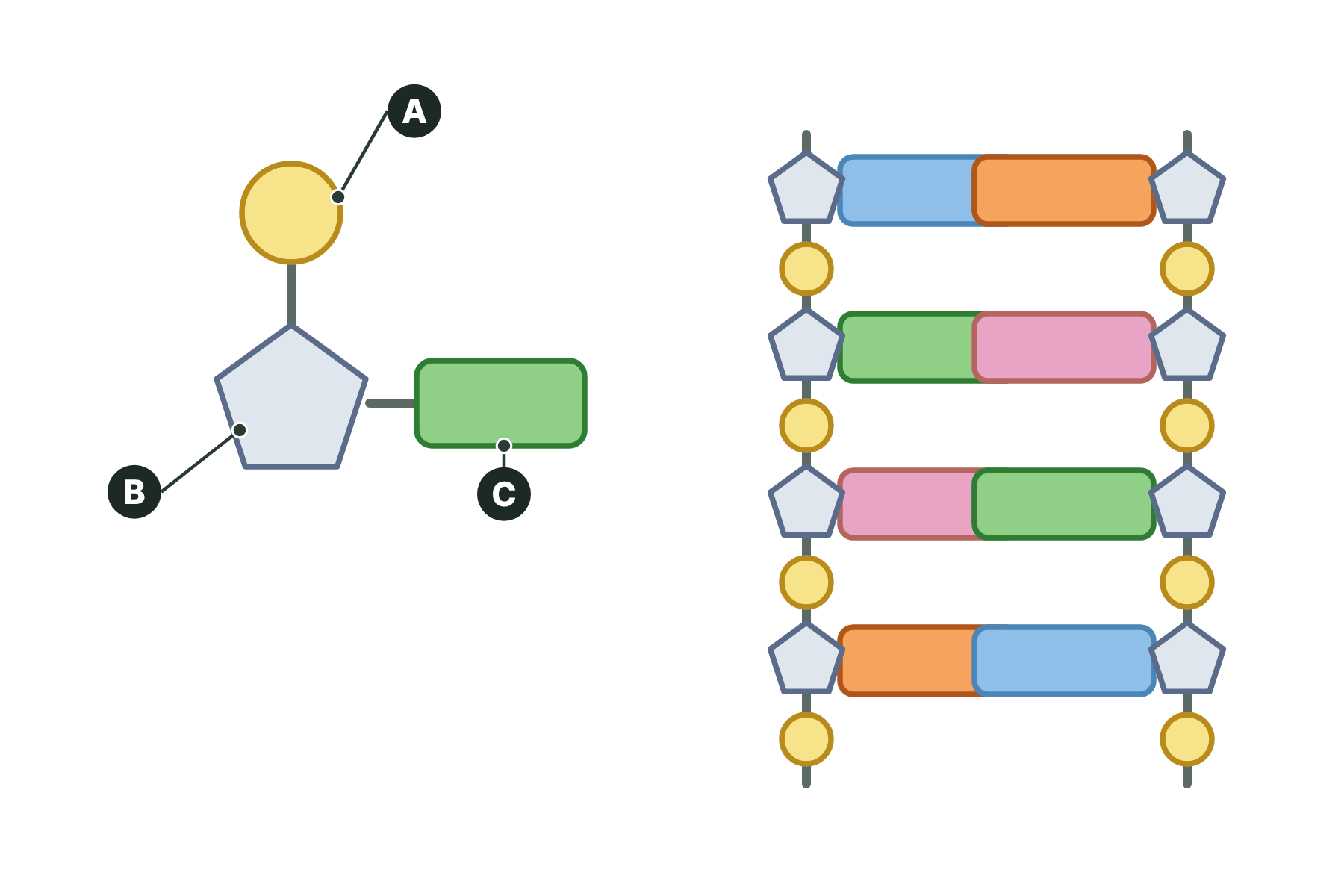
Figure 1 shows a nucleotide. Name the parts shown at A, B and C.
Show answerHide answer
Model answer
A is the phosphate group. B is the sugar. C is the base.
Mark scheme
- A: phosphate group — 1 mark
- B: sugar — 1 mark
- C: base — 1 mark
-
3 Describe [3 marks]
Describe the structure of a nucleotide in DNA.
Show answerHide answer
Model answer
A nucleotide has a phosphate group, a sugar and a base. The phosphate and sugar are the same in every nucleotide. The base is one of four, A, T, G or C.
Mark scheme
- Phosphate group and sugar — 1 mark
- A base — 1 mark
- Four different bases, so four different nucleotides — 1 mark
-
4 Write [2 marks]
One strand of a DNA molecule has the base sequence G A T T C. Write the base sequence of the complementary strand.
Show answerHide answer
Model answer
C T A A G
Mark scheme
- Pairs G with C, A with T and T with A — 1 mark
- C T A A G — 1 mark
-
5 Explain [3 marks]
Explain why the two strands of DNA can be copied accurately.
Show answerHide answer
Model answer
The strands are held together by weak bonds between bases, so they can separate. Each base only pairs with one other base, A with T and G with C. So each strand determines the bases on its complementary strand.
Mark scheme
- Strands can separate because of weak bonds — 1 mark
- A pairs only with T and G only with C — 1 mark
- One strand decides the order of bases on the other — 1 mark
-
6 Describe [4 marks]
Describe how the information in a gene is used to make a protein.
Show answerHide answer
Model answer
The gene is copied as mRNA in the nucleus. The mRNA leaves the nucleus and goes to a ribosome. At the ribosome, tRNA brings amino acids. The amino acids are joined in the order specified by the order of bases on the mRNA.
Mark scheme
- mRNA is copied from the gene in the nucleus — 1 mark
- mRNA moves to a ribosome — 1 mark
- tRNA carries amino acids to the ribosome — 1 mark
- Amino acids are joined in the order given by the bases — 1 mark
-
7 Name [3 marks]
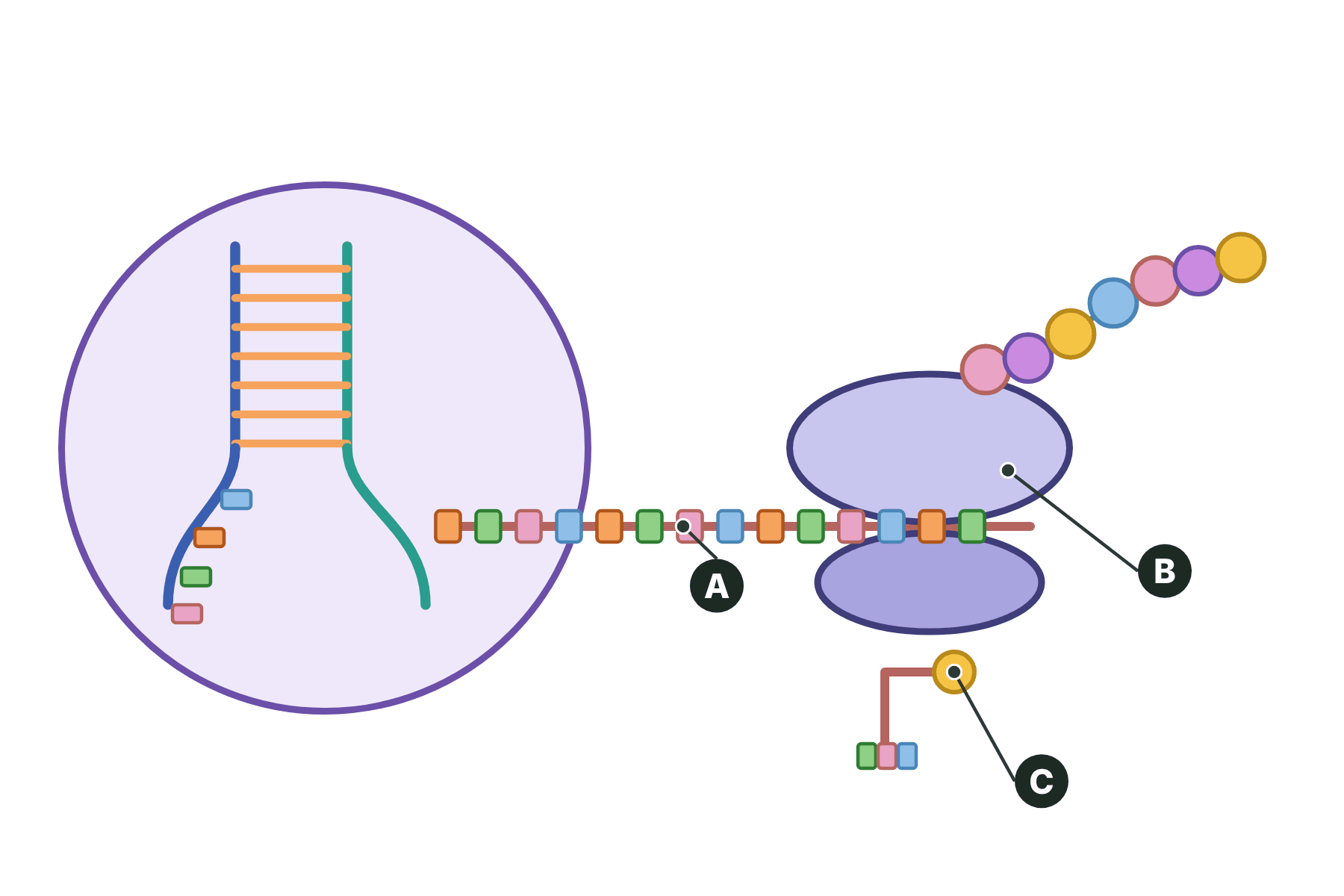
Figure 2 shows how a protein is made. Name the parts shown at A, B and C.
Show answerHide answer
Model answer
A is mRNA. B is a ribosome. C is tRNA.
Mark scheme
- A: mRNA — 1 mark
- B: ribosome — 1 mark
- C: tRNA — 1 mark
-
8 Explain [3 marks]
Explain how a change in the order of bases in a gene could change the protein that is made.
Show answerHide answer
Model answer
Each triplet of bases codes for one amino acid. If a base changes, a different amino acid may be added. This changes the order of the amino acids, so the protein folds into a different shape and may not work.
Mark scheme
- Triplet codes for an amino acid — 1 mark
- A different amino acid may be added — 1 mark
- The protein has a different shape and may not work — 1 mark
Quick check
-
1
Which of these is not part of a nucleotide?
Show answerHide answer
C: An amino acid
A nucleotide has a phosphate group, a sugar and a base. It does not contain an amino acid.
-
2
Which base pairs with guanine?
Show answerHide answer
B: Cytosine
G always pairs with C.
-
3
How many different bases are there in DNA?
Show answerHide answer
D: Four
There are four bases: A, T, G and C.
-
4
What forms the backbone of a DNA strand?
Show answerHide answer
A: Sugars and phosphate groups
The sugars and phosphate groups alternate to form the backbone.
-
5
One strand of DNA reads T T A G. What does the complementary strand read?
Show answerHide answer
B: A A T C
T pairs with A, and A pairs with T, and G pairs with C, so the strand reads A A T C.
-
6
Where is mRNA made?
Show answerHide answer
C: In the nucleus
The gene is copied as mRNA in the nucleus.
-
7
How many amino acids does a gene of 60 bases code for, if one triplet codes for one amino acid?
Show answerHide answer
A: 20
60 ÷ 3 = 20 amino acids.
-
8
What does tRNA do?
Show answerHide answer
D: It carries amino acids to the ribosome
tRNA carries amino acids to the ribosome.