Exam questions · Biology · Cycles in Ecosystems
The Carbon Cycle
- 7 exam questions
- 21 marks
- 8 quick checks
-
1 Name [3 marks]
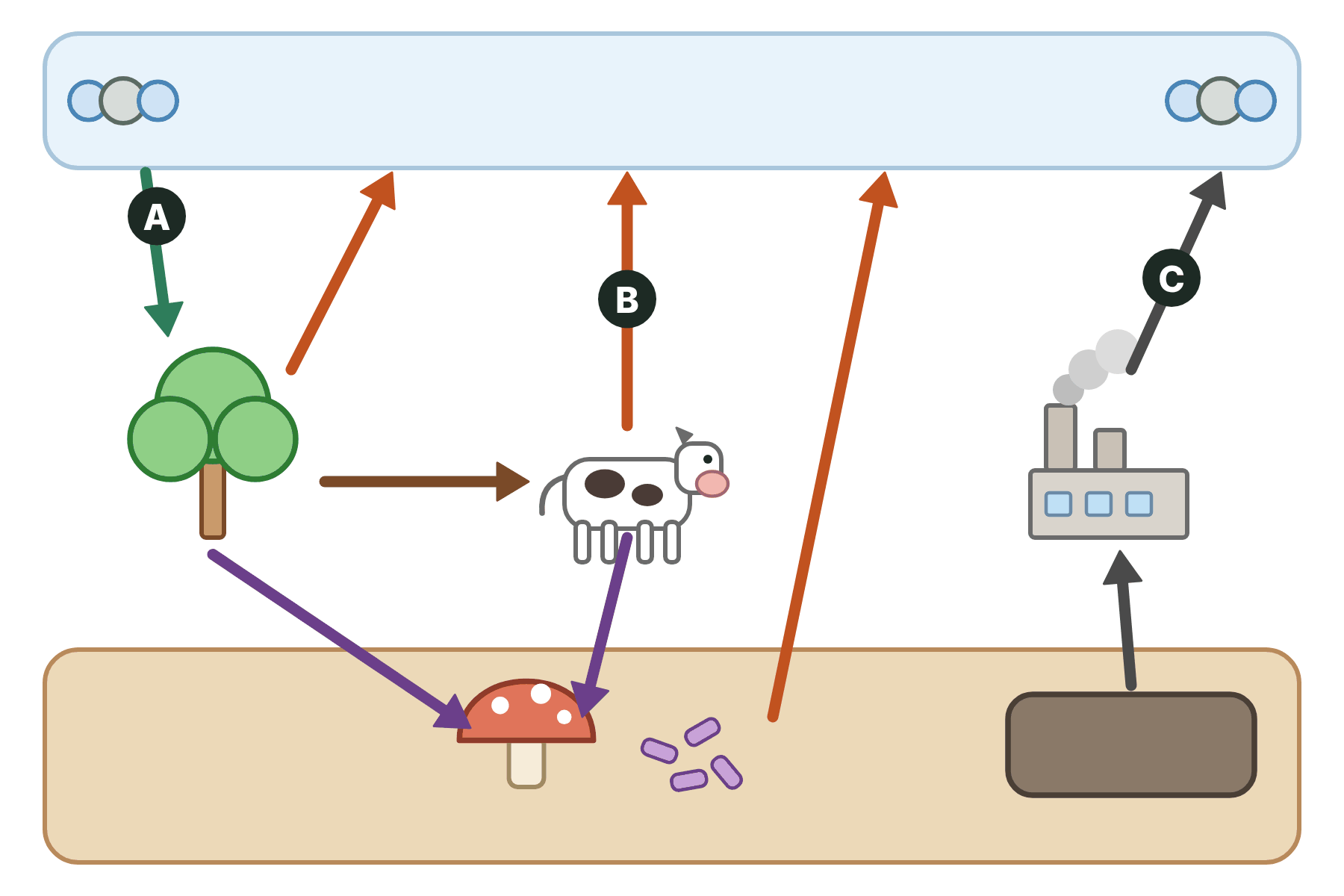
Figure 1 shows the carbon cycle. Name the processes shown at A, B and C.
Show answerHide answer
Model answer
A is photosynthesis. B is respiration. C is combustion.
Mark scheme
- A: photosynthesis — 1 mark
- B: respiration — 1 mark
- C: combustion — 1 mark
-
2 State [2 marks]
State two processes that return carbon dioxide to the air.
Show answerHide answer
Model answer
Any two of: respiration, decay (by decomposers), combustion.
Mark scheme
- Process 1 — 1 mark
- Process 2 — 1 mark
-
3 Describe [3 marks]
Describe how carbon dioxide in the air becomes part of a rabbit.
Show answerHide answer
Model answer
Plants take in carbon dioxide by photosynthesis and use it to make glucose and other compounds, which become part of the plant. The rabbit eats the plant. The carbon compounds in the plant become part of the rabbit's body.
Mark scheme
- Photosynthesis takes carbon dioxide into plants — 1 mark
- The rabbit eats the plant — 1 mark
- Carbon compounds become part of the rabbit — 1 mark
-
4 Explain [3 marks]
Explain why the decay of a dead animal releases carbon dioxide.
Show answerHide answer
Model answer
Decomposers, such as bacteria and fungi, feed on the dead animal. The decomposers respire. Respiration releases carbon dioxide into the air.
Mark scheme
- Decomposers feed on the dead animal — 1 mark
- The decomposers respire — 1 mark
- Respiration releases carbon dioxide — 1 mark
-
5 Explain [4 marks]
Explain why the level of carbon dioxide in the air stays fairly constant in a natural ecosystem.
Show answerHide answer
Model answer
Plants remove carbon dioxide from the air by photosynthesis. Plants, animals and decomposers return carbon dioxide to the air by respiration. Decomposers also return carbon dioxide when they break down dead material. The amount removed is about the same as the amount returned.
Mark scheme
- Photosynthesis removes carbon dioxide — 1 mark
- Respiration returns carbon dioxide — 1 mark
- Decay returns carbon dioxide — 1 mark
- The amounts removed and returned are about equal — 1 mark
-
6 Explain [3 marks]
Explain why burning fossil fuels increases the amount of carbon dioxide in the air.
Show answerHide answer
Model answer
Fossil fuels contain carbon that was locked up from the remains of plants and animals millions of years ago. When they are burnt in combustion, the carbon combines with oxygen and is released as carbon dioxide. This adds carbon dioxide to the air faster than photosynthesis removes it.
Mark scheme
- Fossil fuels contain locked-up carbon — 1 mark
- Burning releases carbon dioxide — 1 mark
- It is added faster than photosynthesis removes it — 1 mark
-
7 Explain [3 marks]
Explain why the carbon cycle is important to living organisms.
Show answerHide answer
Model answer
Living things are made of carbon compounds such as carbohydrates, proteins and fats, so they need a supply of carbon. The carbon cycle means that the same carbon is used again and again. It also keeps the level of carbon dioxide in the air available for photosynthesis.
Mark scheme
- Living things need carbon for their compounds — 1 mark
- The carbon is reused again and again — 1 mark
- Carbon dioxide is available for photosynthesis — 1 mark
Quick check
-
1
Which process removes carbon dioxide from the air?
Show answerHide answer
B: Photosynthesis
Photosynthesis takes carbon dioxide from the air and makes glucose.
-
2
How does carbon pass from a plant to a rabbit?
Show answerHide answer
C: By feeding
Carbon passes along the food chain by feeding.
-
3
Which of these organisms release carbon dioxide by respiration?
Show answerHide answer
D: Plants, animals and decomposers
Plants, animals and decomposers all respire.
-
4
What is released when coal is burnt?
Show answerHide answer
A: Carbon dioxide
Burning releases the carbon in the coal as carbon dioxide.
-
5
Why do decomposers release carbon dioxide?
Show answerHide answer
C: They respire
Decomposers respire as they break down dead material.
-
6
Which process locks carbon up for millions of years?
Show answerHide answer
B: The formation of fossil fuels
The formation of fossil fuels from the remains of living things locks carbon up for millions of years.
-
7
What is the main store of carbon in the air?
Show answerHide answer
D: Carbon dioxide
Carbon is in the air as carbon dioxide.
-
8
What happens to the carbon dioxide level if fossil fuels are burnt faster than photosynthesis removes it?
Show answerHide answer
A: It rises
More carbon dioxide is added than removed, so the level rises.