Exam questions · Biology
Cycles in Ecosystems
- 29 exam questions
- 82 marks
- 32 quick checks
Cycling of Materials and Decomposers
Just this lesson-
1 Name [3 marks]
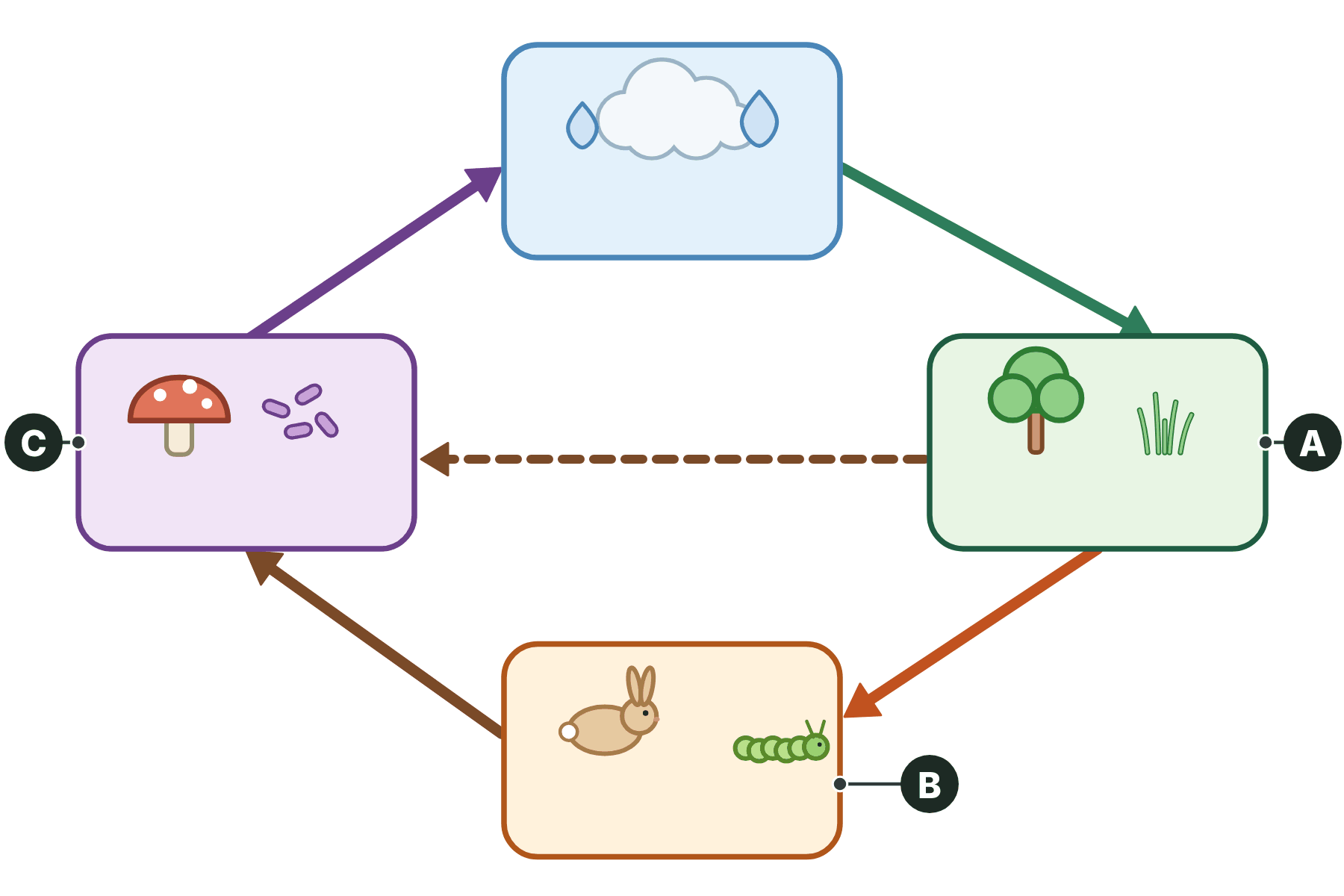
Figure 1 shows how materials are cycled in an ecosystem. Name the groups of organisms shown at A, B and C.
Show answerHide answer
Model answer
A is the producers (plants). B is the consumers (animals). C is the decomposers (fungi and bacteria).
Mark scheme
- A: producers — 1 mark
- B: consumers — 1 mark
- C: decomposers — 1 mark
-
2 State [1 mark]
State two materials that are cycled through ecosystems.
Show answerHide answer
Model answer
Any two of: carbon, nitrogen, water.
Mark scheme
- Two materials — 1 mark
-
3 Explain [2 marks]
Explain why materials have to be cycled in an ecosystem.
Show answerHide answer
Model answer
The supply of materials on Earth is limited. If they were not cycled, the producers would run out of the materials that they need.
Mark scheme
- The supply is limited — 1 mark
- Producers would run out of materials — 1 mark
-
4 Describe [3 marks]
Describe how decomposers break down a dead leaf.
Show answerHide answer
Model answer
Bacteria and fungi release enzymes onto the leaf. The enzymes break the leaf down into small, soluble molecules. The microorganisms absorb these molecules.
Mark scheme
- Bacteria and fungi release enzymes — 1 mark
- The enzymes break down the leaf into soluble molecules — 1 mark
- The microorganisms absorb the molecules — 1 mark
-
5 Explain [3 marks]
Explain why decomposers are important to plants.
Show answerHide answer
Model answer
Decomposers break down dead material and waste. This releases mineral ions, such as nitrates, into the soil. The plants take up the mineral ions through their roots, and use them to grow.
Mark scheme
- Decomposers break down dead material and waste — 1 mark
- Mineral ions are released into the soil — 1 mark
- Plants take up the ions to grow — 1 mark
-
6 Explain [3 marks]
A farmer spreads manure on a field before planting a crop. Explain how the manure helps the crop to grow.
Show answerHide answer
Model answer
Decomposers in the soil break down the manure. They release mineral ions, such as nitrates, into the soil. The crop plants take up the ions through their roots and use them to make proteins and to grow.
Mark scheme
- Decomposers break down the manure — 1 mark
- Mineral ions are released into the soil — 1 mark
- The crop takes up the ions to grow — 1 mark
-
7 Suggest [3 marks]
Earthworms feed on dead leaves in the soil. Suggest how earthworms help the decomposers to break down the leaves.
Show answerHide answer
Model answer
The earthworms break the leaves into smaller pieces. The smaller pieces have a larger surface area. This lets the bacteria and fungi release their enzymes onto more of the leaf, so the leaf decays faster.
Mark scheme
- Earthworms break the leaves into smaller pieces — 1 mark
- A larger surface area — 1 mark
- Microorganisms can act on more of the leaf, so it decays faster — 1 mark
Quick check
-
1
Which of these is an abiotic part of an ecosystem?
Show answerHide answer
C: Water
Water is non-living, so it is abiotic.
-
2
Which group of organisms breaks down dead plants and animals?
Show answerHide answer
B: Decomposers
Decomposers, mainly bacteria and fungi, break down dead material.
-
3
What do decomposers release onto dead material?
Show answerHide answer
A: Enzymes
They release enzymes that break the material down into small, soluble molecules.
-
4
Which gas do decomposers release when they respire?
Show answerHide answer
D: Carbon dioxide
Respiration releases carbon dioxide.
-
5
Why do materials have to be cycled?
Show answerHide answer
C: Because the supply of materials is limited
The supply of materials on Earth is limited, so they must be used again.
-
6
What do plant roots take up from the soil that decomposers have released?
Show answerHide answer
A: Mineral ions
Plants take up mineral ions such as nitrates.
-
7
What do nitrogen-fixing bacteria do?
Show answerHide answer
B: They turn nitrogen from the air into usable compounds
They turn nitrogen from the air into compounds that plants can use.
-
8
Which of these is a decomposer?
Show answerHide answer
D: A fungus
Fungi, such as mushrooms, feed on dead material.
The Carbon Cycle
Just this lesson-
1 Name [3 marks]
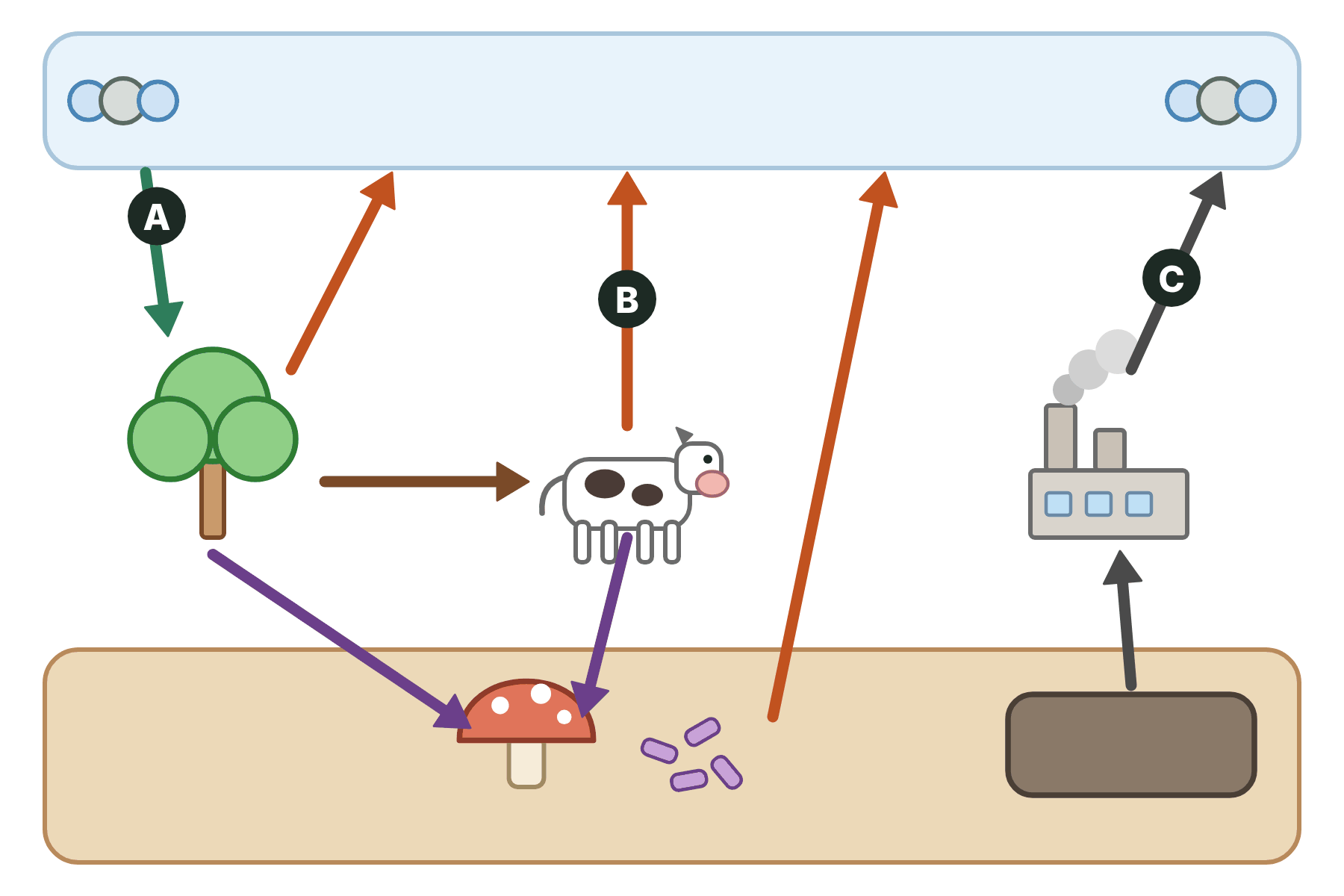
Figure 1 shows the carbon cycle. Name the processes shown at A, B and C.
Show answerHide answer
Model answer
A is photosynthesis. B is respiration. C is combustion.
Mark scheme
- A: photosynthesis — 1 mark
- B: respiration — 1 mark
- C: combustion — 1 mark
-
2 State [2 marks]
State two processes that return carbon dioxide to the air.
Show answerHide answer
Model answer
Any two of: respiration, decay (by decomposers), combustion.
Mark scheme
- Process 1 — 1 mark
- Process 2 — 1 mark
-
3 Describe [3 marks]
Describe how carbon dioxide in the air becomes part of a rabbit.
Show answerHide answer
Model answer
Plants take in carbon dioxide by photosynthesis and use it to make glucose and other compounds, which become part of the plant. The rabbit eats the plant. The carbon compounds in the plant become part of the rabbit's body.
Mark scheme
- Photosynthesis takes carbon dioxide into plants — 1 mark
- The rabbit eats the plant — 1 mark
- Carbon compounds become part of the rabbit — 1 mark
-
4 Explain [3 marks]
Explain why the decay of a dead animal releases carbon dioxide.
Show answerHide answer
Model answer
Decomposers, such as bacteria and fungi, feed on the dead animal. The decomposers respire. Respiration releases carbon dioxide into the air.
Mark scheme
- Decomposers feed on the dead animal — 1 mark
- The decomposers respire — 1 mark
- Respiration releases carbon dioxide — 1 mark
-
5 Explain [4 marks]
Explain why the level of carbon dioxide in the air stays fairly constant in a natural ecosystem.
Show answerHide answer
Model answer
Plants remove carbon dioxide from the air by photosynthesis. Plants, animals and decomposers return carbon dioxide to the air by respiration. Decomposers also return carbon dioxide when they break down dead material. The amount removed is about the same as the amount returned.
Mark scheme
- Photosynthesis removes carbon dioxide — 1 mark
- Respiration returns carbon dioxide — 1 mark
- Decay returns carbon dioxide — 1 mark
- The amounts removed and returned are about equal — 1 mark
-
6 Explain [3 marks]
Explain why burning fossil fuels increases the amount of carbon dioxide in the air.
Show answerHide answer
Model answer
Fossil fuels contain carbon that was locked up from the remains of plants and animals millions of years ago. When they are burnt in combustion, the carbon combines with oxygen and is released as carbon dioxide. This adds carbon dioxide to the air faster than photosynthesis removes it.
Mark scheme
- Fossil fuels contain locked-up carbon — 1 mark
- Burning releases carbon dioxide — 1 mark
- It is added faster than photosynthesis removes it — 1 mark
-
7 Explain [3 marks]
Explain why the carbon cycle is important to living organisms.
Show answerHide answer
Model answer
Living things are made of carbon compounds such as carbohydrates, proteins and fats, so they need a supply of carbon. The carbon cycle means that the same carbon is used again and again. It also keeps the level of carbon dioxide in the air available for photosynthesis.
Mark scheme
- Living things need carbon for their compounds — 1 mark
- The carbon is reused again and again — 1 mark
- Carbon dioxide is available for photosynthesis — 1 mark
Quick check
-
1
Which process removes carbon dioxide from the air?
Show answerHide answer
B: Photosynthesis
Photosynthesis takes carbon dioxide from the air and makes glucose.
-
2
How does carbon pass from a plant to a rabbit?
Show answerHide answer
C: By feeding
Carbon passes along the food chain by feeding.
-
3
Which of these organisms release carbon dioxide by respiration?
Show answerHide answer
D: Plants, animals and decomposers
Plants, animals and decomposers all respire.
-
4
What is released when coal is burnt?
Show answerHide answer
A: Carbon dioxide
Burning releases the carbon in the coal as carbon dioxide.
-
5
Why do decomposers release carbon dioxide?
Show answerHide answer
C: They respire
Decomposers respire as they break down dead material.
-
6
Which process locks carbon up for millions of years?
Show answerHide answer
B: The formation of fossil fuels
The formation of fossil fuels from the remains of living things locks carbon up for millions of years.
-
7
What is the main store of carbon in the air?
Show answerHide answer
D: Carbon dioxide
Carbon is in the air as carbon dioxide.
-
8
What happens to the carbon dioxide level if fossil fuels are burnt faster than photosynthesis removes it?
Show answerHide answer
A: It rises
More carbon dioxide is added than removed, so the level rises.
The Water Cycle
Just this lesson-
1 Name [3 marks]
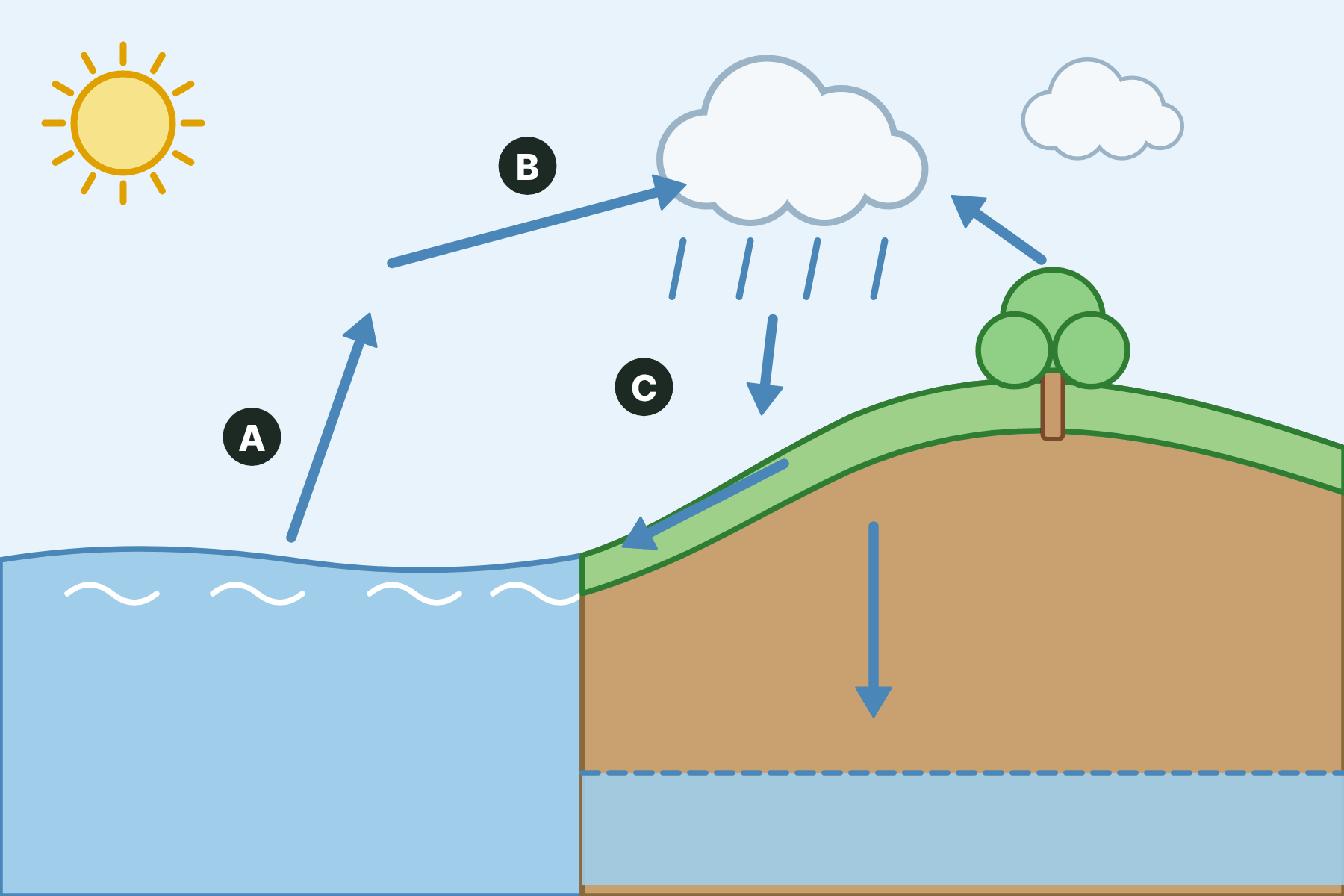
Figure 1 shows the water cycle. Name the processes shown at A, B and C.
Show answerHide answer
Model answer
A is evaporation. B is condensation. C is precipitation.
Mark scheme
- A: evaporation — 1 mark
- B: condensation — 1 mark
- C: precipitation — 1 mark
-
2 State [2 marks]
State two ways in which water vapour gets into the air.
Show answerHide answer
Model answer
Evaporation (from the sea, lakes and soil) and transpiration (from plants).
Mark scheme
- Evaporation — 1 mark
- Transpiration — 1 mark
-
3 Describe [3 marks]
Describe how clouds form.
Show answerHide answer
Model answer
The Sun heats water, which evaporates and rises as water vapour. The air higher up is colder, so the vapour cools. It condenses into tiny droplets of liquid water, which form clouds.
Mark scheme
- Water evaporates and rises as vapour — 1 mark
- The vapour cools — 1 mark
- It condenses into droplets that form clouds — 1 mark
-
4 Explain [3 marks]
Explain why the rain that falls on land is fresh water even though most of the water that evaporates comes from the sea.
Show answerHide answer
Model answer
When sea water evaporates, only the water turns into vapour. The salt and other dissolved substances are left behind in the sea. The vapour condenses to make clouds of pure water, so the rain is fresh water.
Mark scheme
- Only the water evaporates — 1 mark
- The salt is left behind — 1 mark
- The vapour condenses into fresh water — 1 mark
-
5 Explain [3 marks]
Explain why the water cycle is important in maintaining habitats.
Show answerHide answer
Model answer
Rain refills rivers, lakes and ponds, which are the habitats of aquatic organisms. It also keeps the soil moist, which land plants and animals need. Without it, the habitats would dry up.
Mark scheme
- Rain refills rivers, lakes and ponds — 1 mark
- It keeps the soil moist — 1 mark
- Habitats would dry up without it — 1 mark
-
6 Explain [3 marks]
Explain how the water cycle helps the flow of nutrients in an ecosystem.
Show answerHide answer
Model answer
Water dissolves mineral ions in the soil. The water in the soil carries the mineral ions to the roots of plants, so the plants can take them up. Rain and run-off also carry nutrients from the land into rivers and lakes.
Mark scheme
- Water dissolves mineral ions — 1 mark
- Plants take up the dissolved ions through their roots — 1 mark
- Run-off carries nutrients into rivers and lakes — 1 mark
-
7 Suggest [3 marks]
A forest is cut down. Suggest how this could change the water cycle in the area.
Show answerHide answer
Model answer
The trees no longer take up water or lose water vapour by transpiration, so less water vapour enters the air and there may be less rain. More rain runs off the surface instead of soaking into the soil, which can cause floods and wash away nutrients.
Mark scheme
- Less transpiration, so less water vapour in the air — 1 mark
- More run-off, less infiltration — 1 mark
- Nutrients may be washed away / floods — 1 mark
Quick check
-
1
What is the source of energy for the water cycle?
Show answerHide answer
C: The Sun
Heat from the Sun makes water evaporate and drives the cycle.
-
2
What is transpiration?
Show answerHide answer
A: Water vapour lost from plant leaves
Transpiration is the loss of water vapour from the leaves of plants.
-
3
What happens in condensation?
Show answerHide answer
D: Water vapour turns into droplets
Water vapour cools and turns into liquid water droplets.
-
4
Which of these is precipitation?
Show answerHide answer
B: Snow
Rain, snow, sleet and hail are all precipitation.
-
5
What is run-off?
Show answerHide answer
C: Water flowing over the land surface
Run-off is water flowing over the surface of the land into rivers and the sea.
-
6
Why is the rain fresh water?
Show answerHide answer
A: The salt is left behind when water evaporates
The salt is left behind in the sea when the water evaporates.
-
7
How does the water cycle help plants?
Show answerHide answer
D: It supplies water to the soil
It supplies water to the soil, which plants take up through their roots.
-
8
Which two processes put water vapour into the air?
Show answerHide answer
B: Evaporation and transpiration
Evaporation and transpiration both put water vapour into the air.
The Rate of Decomposition
Just this lesson-
1 State [2 marks]
State two conditions that make decomposition faster.
Show answerHide answer
Model answer
Any two of: warm temperature (up to the optimum), moisture, plenty of oxygen.
Mark scheme
- Condition 1 — 1 mark
- Condition 2 — 1 mark
-
2 Explain [3 marks]
Explain why food lasts longer in a freezer than on a kitchen worktop.
Show answerHide answer
Model answer
The low temperature in the freezer slows the microorganisms that cause decay. The enzymes in the microorganisms work very slowly, and the microorganisms respire and grow very slowly, so the food decays more slowly.
Mark scheme
- The temperature is low — 1 mark
- The microorganisms work or respire more slowly — 1 mark
- So the food decays more slowly — 1 mark
-
3 Explain [3 marks]
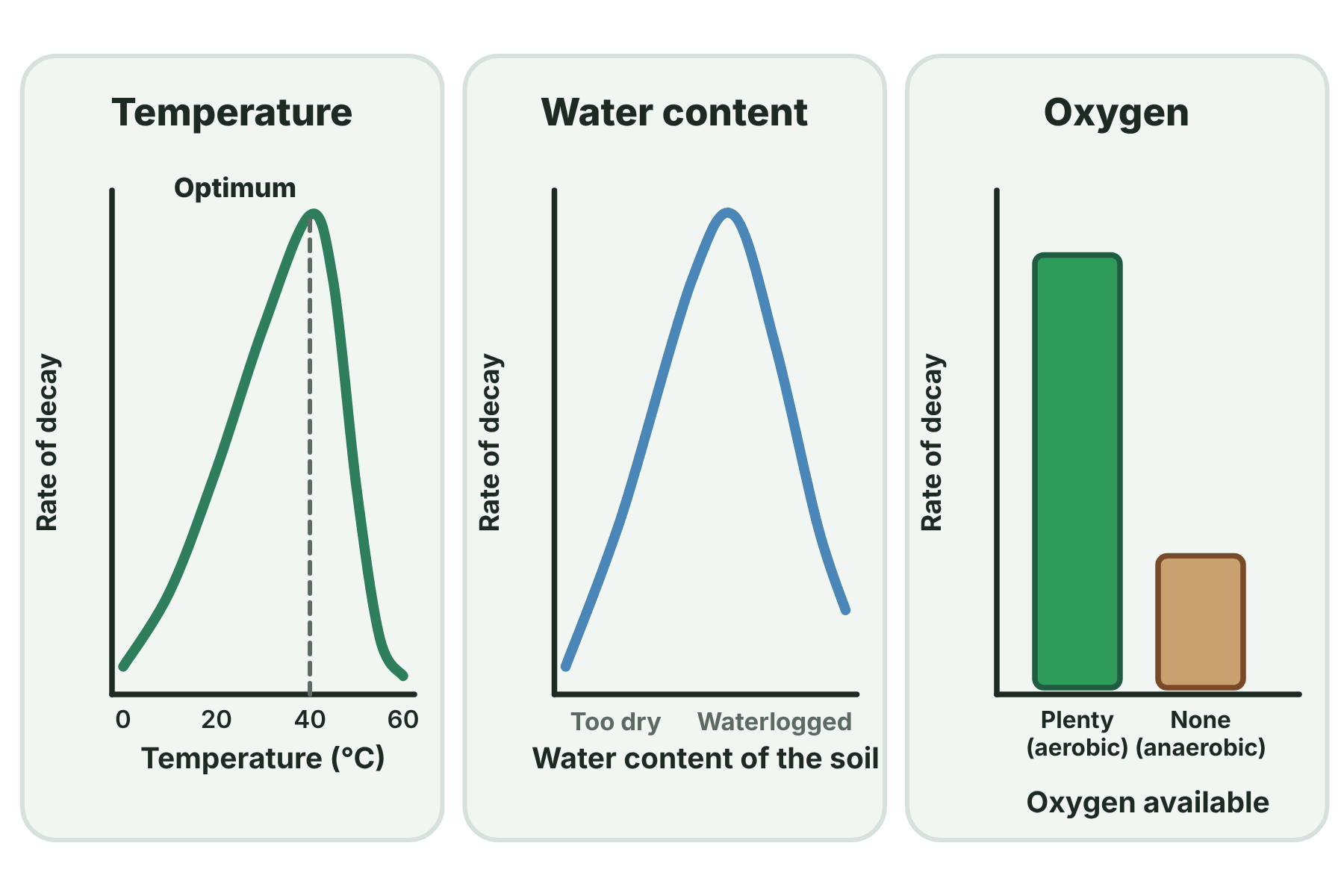
Use Figure 1 to explain why the rate of decay falls when the temperature rises above 40 °C.
Show answerHide answer
Model answer
The enzymes in the decomposers are denatured at higher temperatures. The microorganisms stop working, or die. So the rate of decay falls.
Mark scheme
- Enzymes are denatured — 1 mark
- Decomposers stop working or die — 1 mark
- Rate of decay falls — 1 mark
-
4 Explain [3 marks]
Explain why the rate of decay of dead leaves is very slow in waterlogged soil.
Show answerHide answer
Model answer
The water fills the spaces between the soil particles and pushes out the air. There is little oxygen, so the decomposers can only respire anaerobically. This releases less energy, so decay is slow.
Mark scheme
- Water pushes out the air, so there is little oxygen — 1 mark
- Decomposers respire anaerobically — 1 mark
- Less energy is released, so decay is slow — 1 mark
-
5 Describe [4 marks]
A student wants to find the best temperature for composting grass clippings. Describe how the student could do this.
Show answerHide answer
Model answer
Put the same mass of grass clippings into several identical containers, and keep each at a different temperature, for example in water baths. Keep the moisture and the amount of air the same. Measure the mass of the grass clippings at the start and after the same time. Repeat and calculate a mean, and find the temperature with the biggest change in mass.
Mark scheme
- Same mass in identical containers at different temperatures — 1 mark
- Keep the other factors, such as moisture and air, the same — 1 mark
- Measure the mass at the start and after a set time — 1 mark
- Repeat and calculate a mean — 1 mark
-
6 Calculate [3 marks]
A student measures 80 g of dead leaves in a compost bin. After 20 days the mass of the leaves is 62 g. Calculate the mean rate of decay in g per day, and the percentage decrease in mass.
Show answerHide answer
Model answer
The mean rate is 0.9 g per day. The percentage decrease is 22.5%.
Mark scheme
- \(80 - 62 = 18\) g — 1 mark
- \(18 \div 20 = 0.9\) g per day — 1 mark
- \(\frac{18}{80} \times 100 = 22.5\%\) — 1 mark
-
7 Explain [3 marks]
Explain why turning a compost heap makes the material decay faster.
Show answerHide answer
Model answer
Turning lets air into the heap, so that there is more oxygen. The decomposers can then respire aerobically, which releases more energy. They grow and work faster, so the material decays faster.
Mark scheme
- Air gets in, so more oxygen — 1 mark
- Decomposers respire aerobically, releasing more energy — 1 mark
- They work faster, so the decay is faster — 1 mark
-
8 Suggest [2 marks]
Dead plants in a cold, waterlogged peat bog do not decay completely. Suggest two reasons for this.
Show answerHide answer
Model answer
The low temperature slows the decomposers. The waterlogging means there is little oxygen, so aerobic decay cannot happen.
Mark scheme
- Low temperature slows the decomposers — 1 mark
- Waterlogged, so little oxygen — 1 mark
Quick check
-
1
At which temperature is decay fastest in a compost heap?
Show answerHide answer
C: 40 °C
The optimum temperature for the microorganisms in compost is about 40 °C.
-
2
Why does decay slow down above the optimum temperature?
Show answerHide answer
B: The enzymes are denatured
The enzymes of the decomposers are denatured.
-
3
What does aerobic mean?
Show answerHide answer
A: With oxygen
Aerobic means with oxygen.
-
4
Which gas can be made by anaerobic decay?
Show answerHide answer
D: Methane
Anaerobic decay can produce methane.
-
5
Why is aerobic decay faster than anaerobic decay?
Show answerHide answer
C: It releases more energy
Aerobic respiration releases more energy, so the decomposers work faster.
-
6
Why does waterlogging slow down decay?
Show answerHide answer
B: It pushes out the air
Water pushes out the air, so oxygen runs out.
-
7
In the investigation, what should be kept the same?
Show answerHide answer
D: The conditions other than the one being tested
Only one factor is changed, so everything else is kept the same.
-
8
A leaf loses 6 g in 12 days. What is the mean rate of decay?
Show answerHide answer
A: 0.5 g per day
6 g divided by 12 days is 0.5 g per day.