Exam questions · Biology · Feeding the Human Race
Agricultural Solutions to the Demands of the Growing Population
- 8 exam questions
- 26 marks
- 8 quick checks
-
1 Describe [2 marks]
Describe what is meant by biological control.
Show answerHide answer
Model answer
The use of living organisms to control a pest. For example, a predator such as a ladybird is released to eat aphids, or a parasite is used to kill the pest.
Mark scheme
- Using a living organism (not a chemical) — 1 mark
- To reduce the numbers of a pest, with an example such as a predator or parasite — 1 mark
-
2 Name [3 marks]
The diagram shows a hydroponics system. Name the parts labelled A, B and C.
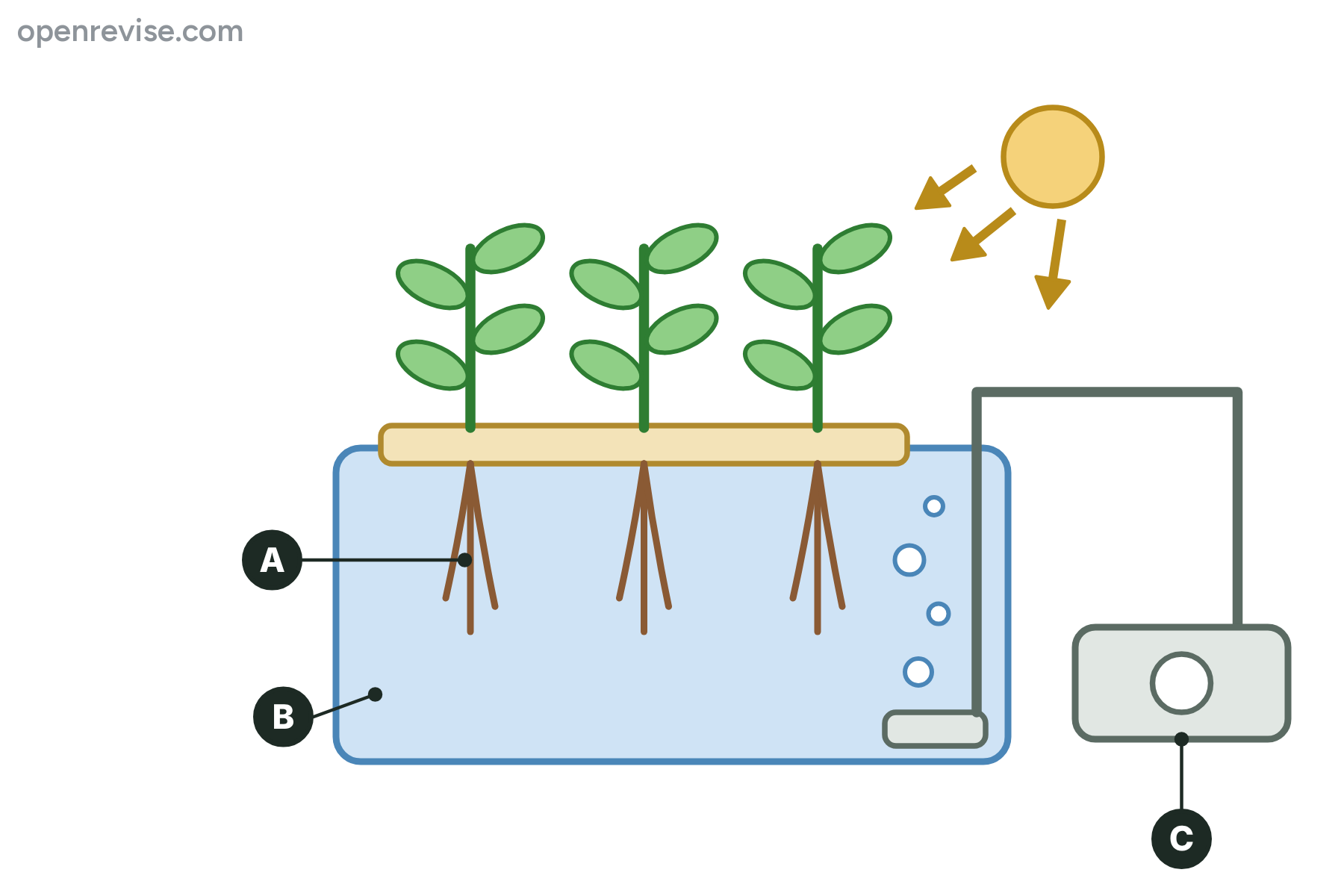
Show answerHide answer
Model answer
A is the roots. B is the nutrient solution. C is the air pump.
Mark scheme
- A: roots — 1 mark
- B: nutrient solution (water containing mineral ions) — 1 mark
- C: air pump — 1 mark
-
3 Give [2 marks]
Give two advantages of growing crops by hydroponics instead of in soil.
Show answerHide answer
Model answer
The farmer can control the amount of each mineral ion, the pH and the temperature, so that the plants grow as fast as possible. Crops can be grown all year round or in places where the soil is poor, because the plants do not need soil.
Mark scheme
- Exact control of minerals, pH and temperature gives high yields — 1 mark
- Can be grown where soil is poor or there is little space — 1 mark
- (Also accept: no soil pests, less water used, grown all year round) — Any two different advantages
-
4 Explain [3 marks]
Explain why a farmer adds nitrate fertiliser to a field of wheat.
Show answerHide answer
Model answer
Wheat needs nitrate to make amino acids, which are joined together to make proteins for growth. The soil may not contain enough nitrate because the previous crop has taken it out. So the fertiliser makes the wheat grow larger and faster, and increases the yield.
Mark scheme
- Nitrate is needed to make amino acids and proteins — 1 mark
- The soil is short of nitrate, because crops remove it — 1 mark
- So the plants grow faster and the yield is higher — 1 mark
-
5 Explain [4 marks]
Fertiliser from a farmer's field is washed into a nearby lake. Explain how this can cause the fish in the lake to die.
Show answerHide answer
Model answer
The mineral ions in the fertiliser make algae grow very fast, forming a layer over the surface of the water. This blocks the light, so the plants below cannot photosynthesise and they die. Bacteria decompose the dead plants and use up oxygen in respiration. The fish do not get enough oxygen, so they die.
Mark scheme
- Extra minerals make the algae grow quickly (an algal bloom) — 1 mark
- The light is blocked, so the plants die — 1 mark
- Bacteria decompose the dead matter and use up the oxygen — 1 mark
- The fish suffocate, because of the lack of oxygen — 1 mark
-
6 Explain [3 marks]
A farmer used the same insecticide on a field for ten years. It now kills far fewer insects. Explain why it has become less effective.
Show answerHide answer
Model answer
Some insects in the population had a variation that made them resistant to the insecticide. These insects survived the spray and reproduced, and they passed the resistance on to their offspring. Over the years the proportion of resistant insects increased, so the insecticide killed fewer of them.
Mark scheme
- Some insects were resistant (variation) — 1 mark
- The resistant insects survive, breed and pass on the resistance — 1 mark
- The proportion of resistant insects increases over time — 1 mark
-
7 Calculate [3 marks]
Source: A farm grew lettuce in two ways for one year. In the soil, 1200 kg of lettuce were harvested from 400 square metres. In a hydroponics unit, 1500 kg of lettuce were harvested from 50 square metres. Calculate the mass of lettuce produced per square metre by each method, and the number of times greater the yield is with hydroponics.
Show answerHide answer
Model answer
Soil: \(1200 \div 400 = 3\) kg per square metre. Hydroponics: \(1500 \div 50 = 30\) kg per square metre. The hydroponic yield is \(30 \div 3 = 10\) times greater.
Mark scheme
- 3 kg per square metre in soil — 1 mark
- 30 kg per square metre with hydroponics — 1 mark
- 10 times greater — 1 mark
-
8 Evaluate [6 marks]
A greenhouse farmer has a problem with aphids on a tomato crop. The farmer can spray with an insecticide or release ladybirds. Evaluate the two methods of control.
Show answerHide answer
Model answer
The insecticide acts quickly and kills nearly all of the aphids, so the tomato crop is protected at once. However, it may kill harmless insects such as pollinators, it can leave residues on the tomatoes, and the aphids can become resistant to it, so it will have to be sprayed again and a new chemical may be needed. The ladybirds are a natural predator, so there are no chemical residues, nothing is poisoned and the aphids do not become resistant. But the ladybirds work more slowly, they do not completely remove the aphids, and they may fly away or have to be bought again. In a closed greenhouse the ladybirds are likely to stay with the crop, so biological control is the better choice if the farmer can wait for it to work, with a spray used only if the infestation becomes severe.
Mark scheme
- Level 3 (5 to 6 marks): advantages and disadvantages of both methods are explained, and a justified conclusion is reached — A balanced comparison with a clear judgement
- Level 2 (3 to 4 marks): advantages and disadvantages of one method or limited points for both — Some explanation but not balanced
- Level 1 (1 to 2 marks): simple statements about one or both methods — Statements without reasoning
- Possible points: speed; residues; resistance; effect on other organisms; cost; sustainability — Content that can earn credit at any level
Quick check
-
1
Which ions are in an NPK fertiliser?
Show answerHide answer
B: Nitrate, phosphate and potassium
NPK fertilisers supply nitrate, phosphate and potassium.
-
2
What is the first step in eutrophication?
Show answerHide answer
D: Minerals run off into the water and algae grow quickly
Minerals from fertiliser run off the field into the water, and then cause the algae to grow very fast.
-
3
Why is air bubbled through the nutrient solution in a hydroponics tank?
Show answerHide answer
C: To give the roots oxygen for respiration
The roots need oxygen for respiration, and the bubbles supply it.
-
4
Which of these is a disadvantage of hydroponics?
Show answerHide answer
A: It is expensive to set up and run
Hydroponics needs expensive equipment, power and skill, so the costs are high.
-
5
Which of these is an example of biological control?
Show answerHide answer
D: Releasing ladybirds to eat aphids
Ladybirds eat aphids, so they reduce the pest using a living organism instead of a chemical.
-
6
Why are some pesticides a problem for food chains?
Show answerHide answer
B: They build up in animals along the food chain
Some are not broken down, so they build up in the bodies of animals at the top of the chain.
-
7
What was the main problem with releasing cane toads in Australia?
Show answerHide answer
C: They spread widely and poisoned native animals
They did not control the beetles but bred and spread, and their poison kills native animals that eat them.
-
8
What is the Bt gene used for in genetically engineered maize?
Show answerHide answer
A: To make the plant produce a protein that kills caterpillars
The Bt gene makes the maize produce a protein that kills caterpillars, so less pesticide is needed.