Exam questions · Biology · Health and Communicable Disease
Reducing and Preventing the Spread of Disease
- 8 exam questions
- 26 marks
- 8 quick checks
-
1 State [1 mark]
State one personal hygiene measure that reduces the spread of communicable diseases.
Show answerHide answer
Model answer
Washing hands with soap (also accept covering the mouth when coughing or sneezing).
Mark scheme
- Any suitable measure, such as washing hands — 1 mark
-
2 Explain [3 marks]
Explain how draining standing water and using bed nets can reduce the spread of malaria.
Show answerHide answer
Model answer
Mosquitoes, which are vectors, breed in standing water, so draining it reduces the number of mosquitoes. There are then fewer mosquitoes to pick up the protist from infected people. Bed nets stop the mosquitoes from biting people, so the protist cannot be passed to them.
Mark scheme
- Mosquitoes breed in standing water, so draining it reduces their numbers — 1 mark
- Fewer vectors means fewer infected people are bitten and the pathogen is passed on less — 1 mark
- Bed nets stop people from being bitten — 1 mark
-
3 Explain [3 marks]
A farmer grows potatoes in the same field every year, and the field is infected with a soil pathogen. Explain how crop rotation could reduce the disease.
Show answerHide answer
Model answer
In crop rotation a different crop is grown in the field each year. The pathogen of potatoes cannot infect the other crop, so there are no potato plants for it to feed on. The numbers of the pathogen in the soil therefore fall, and the potatoes in later years are less likely to be infected.
Mark scheme
- A different crop is grown each year — 1 mark
- The pathogen cannot infect the new crop and has nothing to feed on — 1 mark
- So its numbers in the soil fall and the next crop is protected — 1 mark
-
4 Describe [3 marks]
Describe how an antigen test can be used to detect a pathogen.
Show answerHide answer
Model answer
A sample, such as a swab or a drop of blood, is added to the test. The test contains antibodies that bind to an antigen from the pathogen. If the pathogen is present, the antibodies stick to its antigen and cause a visible colour change, such as a line. This shows that the person is infected.
Mark scheme
- A sample is added to the test — 1 mark
- Antibodies in the test bind to the pathogen's antigen — 1 mark
- A colour change or line is seen if the antigen is present — 1 mark
-
5 Compare [3 marks]
Compare the use of DNA testing with visual identification to detect a disease in a crop.
Show answerHide answer
Model answer
DNA testing is very sensitive and accurate, and it can detect the pathogen before symptoms appear and can identify the exact strain. However, it needs a laboratory, trained staff and time. Visual identification is quick, cheap and can be done in the field, but it may miss early infections, and different diseases can look similar.
Mark scheme
- DNA testing is more sensitive and accurate, or can identify the strain — 1 mark
- DNA testing needs a laboratory and is slower and more costly — 1 mark
- Visual identification is quick and cheap, but less reliable — 1 mark
-
6 Calculate [3 marks]
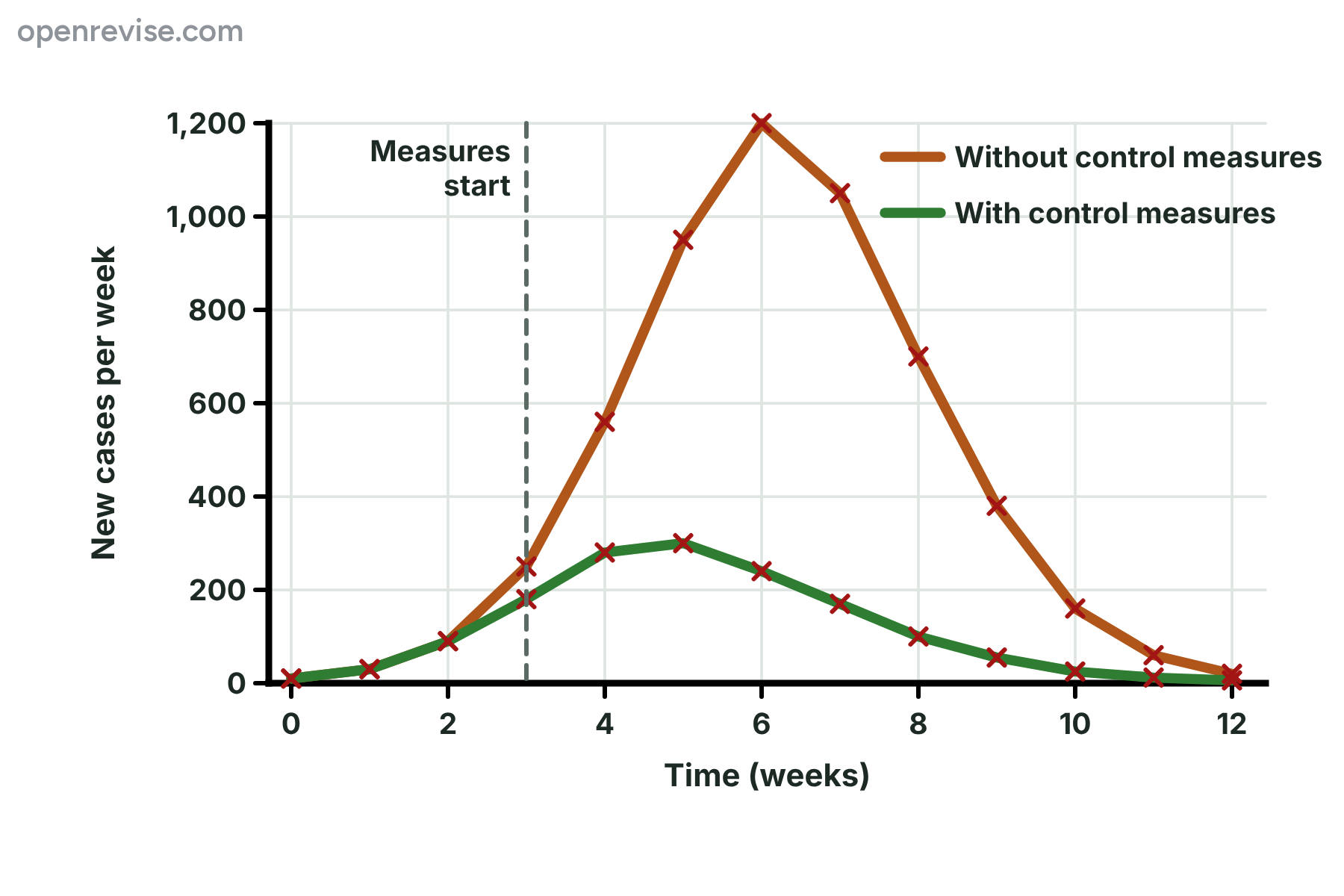
The graph shows the number of new cases of an infection per week, with and without control measures. Calculate the percentage reduction in the highest number of new cases per week caused by the control measures.
Show answerHide answer
Model answer
Without control measures the highest number is 1200 (week 6). With control measures the highest number is 300 (week 5). The reduction is \(1200 - 300 = 900\). The percentage reduction is \(\frac{900}{1200} \times 100 = 75\%\).
Mark scheme
- Reads 1200 and 300 — 1 mark
- \(900 \div 1200 \times 100\) — 1 mark
- 75% — 1 mark
-
7 Explain [4 marks]
A gardener finds a rose plant covered with black spots that are caused by a fungus. Explain why the gardener should remove and burn the leaves that fall from the plant, and give two other actions that would reduce the spread of the fungus.
Show answerHide answer
Model answer
The fallen leaves carry spores of the fungus, which could be spread by wind or splashed by rain onto other roses. Burning them destroys the spores, so that they cannot infect other plants. The gardener could also use a fungicide on the plants and could leave a space between the plants, so that air can circulate and spores are not splashed from one to another.
Mark scheme
- The fallen leaves carry spores — 1 mark
- Burning destroys them, so they cannot infect other plants — 1 mark
- One other action, such as using a fungicide — 1 mark
- A second action, such as spacing the plants or cleaning tools — 1 mark
-
8 Evaluate [6 marks]
A village has a lot of cases of malaria. The villagers could use bed nets, spray insecticide, drain swamps or take drugs. Evaluate the methods for reducing the spread of malaria in the village.
Show answerHide answer
Model answer
Bed nets are cheap and stop mosquitoes from biting people at night, which is when the Anopheles mosquito feeds, but they do not reduce the number of mosquitoes, and they have to be used properly and replaced. Spraying insecticide kills many mosquitoes and is fast, but it is costly, it can harm other insects, and mosquitoes can become resistant to the insecticide. Draining swamps removes the breeding sites and reduces the number of mosquitoes for a long time, but it is expensive and hard work and may harm the habitat. Using drugs treats people who are infected and reduces the amount of protist that mosquitoes can pick up, but it does not stop people being bitten and the protist can become resistant. The best approach is to use several methods together, such as bed nets, which are cheap and effective, and draining standing water, to reduce the number of mosquitoes.
Mark scheme
- Level 3 (5 to 6 marks): several methods evaluated with strengths and weaknesses, and a supported conclusion — A balanced, well-reasoned answer
- Level 2 (3 to 4 marks): two or three methods described with some strengths or weaknesses — Some explanation but limited balance
- Level 1 (1 to 2 marks): one or two methods named with little explanation — A list of methods
- Possible points: bed nets; insecticide; drainage; drugs; cost; resistance; harm to other species; using several methods together — Content that can earn credit at any level
Quick check
-
1
What is the purpose of isolating a person with a serious infection?
Show answerHide answer
B: To stop them passing on the pathogen
Isolation stops the infected person from passing the pathogen to others.
-
2
What is herd immunity?
Show answerHide answer
D: Protection of a population because most people are immune
When enough of the population is immune, the pathogen cannot spread easily, which protects people who are not immune.
-
3
Why does draining standing water reduce malaria?
Show answerHide answer
A: Mosquitoes breed there, so there are fewer mosquitoes
Mosquitoes breed in standing water, so there are fewer vectors.
-
4
How does crop rotation reduce plant disease?
Show answerHide answer
C: The pathogen has no host to feed on the next year
The pathogen has no host plant to feed on in the next year, so its numbers fall.
-
5
Which test detects a molecule from the surface of a pathogen?
Show answerHide answer
B: An antigen test
An antigen test uses antibodies to detect an antigen on the pathogen.
-
6
Which is a strength of DNA testing?
Show answerHide answer
D: It can identify the exact strain
DNA testing is very sensitive and can identify the exact pathogen or strain.
-
7
The number of cases fell from 500 to 100. What is the percentage reduction?
Show answerHide answer
A: 80%
The reduction is 400, and 400 divided by 500, multiplied by 100, is 80%.
-
8
A town of 50 000 people has 100 cases. How many cases per 100 000 people is this?
Show answerHide answer
C: 200
100 divided by 50 000, multiplied by 100 000, is 200.