Flashcards · Biology · Health and Communicable Disease
Reducing and Preventing the Spread of Disease
-
What are the three links in the chain of infection?
The source, the route and the host.
-
Give two hygiene measures that reduce the spread of disease.
Washing hands with soap, and cooking and storing food properly.
-
Why are people with a serious infection isolated?
So that they cannot pass the pathogen on to other people.
-
What is herd immunity?
When enough of a population is immune, the pathogen cannot spread easily, so those who are not immune are protected too.
-
How can mosquito numbers be reduced?
Drain standing water where they breed, and use insecticides or natural predators.
-
How do bed nets help to prevent malaria?
They stop mosquitoes from biting people while they sleep.
-
Why do condoms reduce the spread of HIV?
They act as a barrier, so body fluids do not pass between people.
-
Why is a diseased plant destroyed?
So that it cannot release spores or viruses that infect other plants.
-
What is crop rotation?
Growing a different crop in a field each year.
-
How does crop rotation reduce disease?
The pathogen or pest has nothing to feed on in the next year, so its numbers fall.
-
Name two other ways of preventing plant disease.
Growing resistant varieties and using disease-free seed (or control of insect vectors).
-
How does an antigen test work?
Antibodies in the test stick to an antigen from the pathogen, and give a visible result.
-
What is a strength of an antigen test?
It is quick, cheap and easy to use.
-
What does DNA testing do?
It copies and analyses the pathogen's DNA to detect and identify it.
-
What is a strength of DNA testing?
It is very sensitive and accurate, and can identify the exact strain.
-
Why is visual identification not always reliable?
Symptoms may not show early, and different diseases can look alike.
-
How is a percentage reduction calculated?
The decrease divided by the original value, multiplied by 100.
-
Why use cases per 100 000 people?
It allows places with different populations to be compared fairly.
-
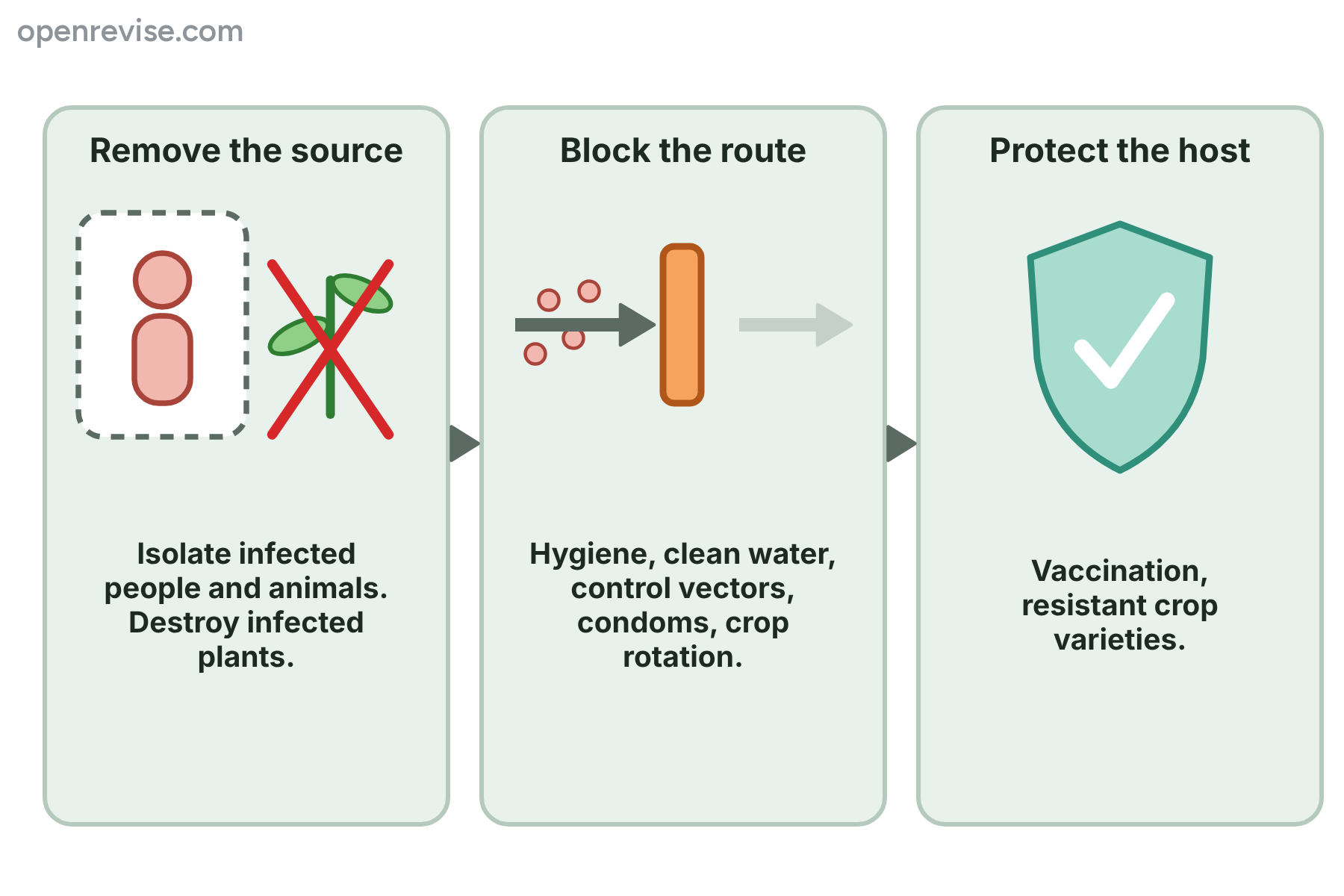 For each stage of the diagram, give two ways of breaking the chain of infection.
 Source: isolate infected people and animals, destroy infected plants. Route: hygiene and clean water, control vectors, condoms, crop rotation. Host: vaccination, and resistant crop varieties.
-
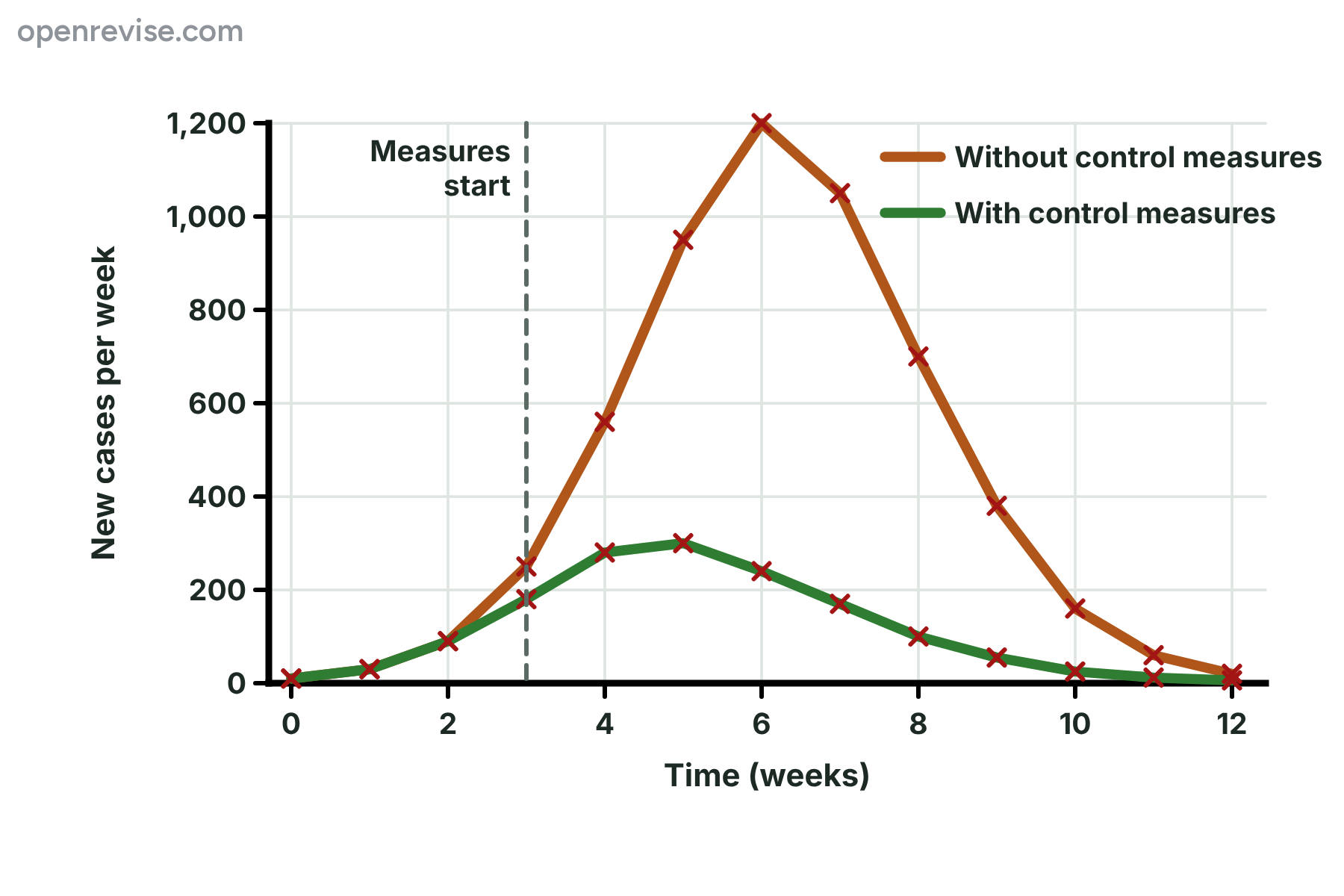 Describe the effect of the control measures shown on the graph.
 The control measures lower the peak, from 1200 to 300 new cases per week, and the outbreak ends sooner. Fewer people are infected.