Biology · Health and Communicable Disease
Reducing and Preventing the Spread of Disease
Stopping a disease from spreading is often cheaper and safer than treating it afterwards. This lesson is for both Combined Science and separate Biology. It covers how the spread of communicable diseases can be reduced or prevented in animals and in plants, how infections are detected by antigen tests, DNA testing and visual identification, and how to use numbers of cases to judge a control measure.
Learning Objectives
- 1Explain how hygiene, isolation, vector control and vaccination reduce the spread of communicable diseases in humans and other animals.
- 2Explain how destroying infected plants, crop rotation and other methods reduce the spread of disease in plants.
- 3Describe how diseases can be detected using antigen tests, DNA testing and visual identification.
- 4Use quantities and numbers of cases to evaluate a measure that controls the spread of disease.
Retrieval practice
-
1
What is a vector?
Show answerHide answer
An organism that carries a pathogen from one host to another without being harmed.
-
2
Name the five routes by which disease spreads in animals.
Show answerHide answer
Direct contact, air, water, ingestion of food and vectors.
-
3
What is an antigen?
Show answerHide answer
A molecule on the surface of a pathogen that the immune system recognises as foreign.
-
4
What is a communicable disease?
Show answerHide answer
A disease caused by a pathogen that can be passed from one organism to another.
Break the chain
A disease can only spread if there is a source of infection, a route and a new host that can be infected. To stop it, you only have to break one link in this chain. You can remove the source, by isolating infected people or by destroying infected plants. You can block the route, by washing hands, cleaning the water or controlling vectors. Or you can protect the host, by vaccination or by growing resistant crops. The best control uses several of these together.
Breaking the chain of infection
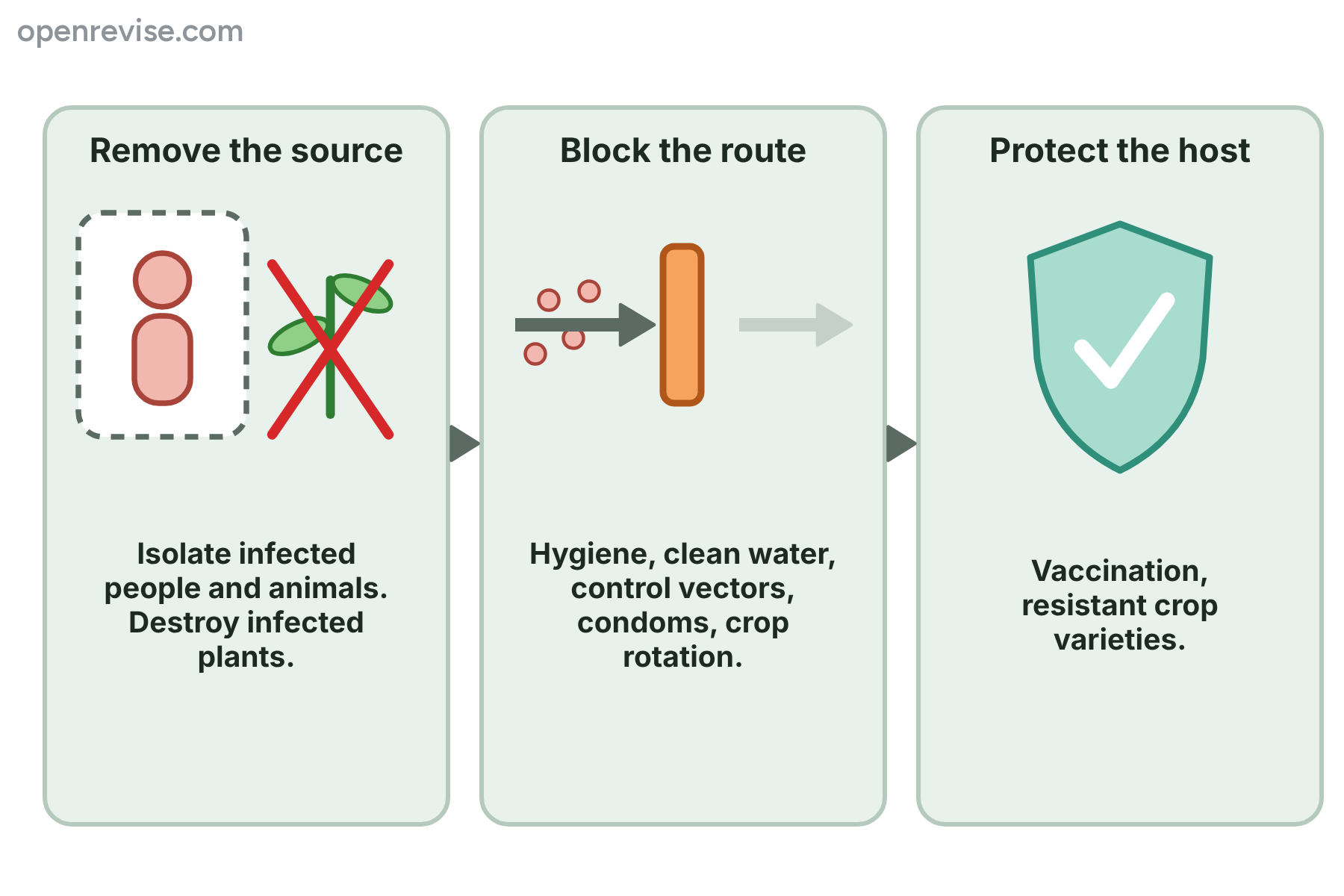
Each control measure breaks one link in the chain of infection.
Hygiene, isolation and vaccination in humans and animals
Most of these measures work for people and for farm animals.
-
Hygiene
Washing hands with soap, covering the mouth when coughing, disinfecting surfaces and sterilising medical equipment remove pathogens before they can reach a new host. Cooking food thoroughly and keeping it cool stops Salmonella from multiplying, and sewage treatment and clean water prevent cholera.
-
Isolation
People with a serious infection, such as TB or Ebola, are kept apart from others so that they cannot pass the pathogen on, and people who may have been exposed are quarantined. Infected farm animals are separated, and their movements are restricted.
-
Vaccination
A vaccinated person is protected, and if enough people in a population are vaccinated the pathogen cannot spread easily, which also protects the people who cannot be vaccinated. This is called herd immunity. How vaccines work is covered later in the course.
-
Barriers and safe behaviour
Condoms reduce the spread of HIV and other sexually transmitted infections, and screening donated blood and not sharing needles stop the spread of blood-borne pathogens.
Controlling vectors
If a vector carries the pathogen, killing or avoiding the vector breaks the chain.
-
Reduce breeding sites
Mosquitoes lay their eggs in standing water, so draining swamps, covering water tanks and clearing containers cuts the number of mosquitoes.
-
Kill the vector
Insecticides can be sprayed in homes and on breeding sites, and biological control, such as fish that eat mosquito larvae, can also be used.
-
Avoid being bitten
Insecticide-treated bed nets, window screens and repellents stop mosquitoes from biting people, especially at night when the Anopheles mosquito feeds.
-
In plants
Insecticides and natural predators are used to control aphids and other insects that spread plant viruses.
Case study
Smallpox, the disease that was wiped out
Smallpox is the only human disease to have been completely eradicated. The World Health Organization used surveillance to find outbreaks, isolated the people who were infected and vaccinated everyone who had been in contact with them, in a method called ring vaccination. The last natural case was in Somalia in 1977, and the disease was declared eradicated in 1980. It worked because the virus only infects humans, so it had no other animal in which to hide.
Preventing the spread of disease in plants
Farmers and gardeners cannot cure most plant diseases, so they work hard to stop them spreading.
-
Destroy infected plants
An infected plant is pulled up and burnt or removed, so that it cannot release spores or virus particles to infect others. The crop that remains is protected.
-
Crop rotation
Growing a different crop in a field each year means that a pathogen or a pest that feeds on one type of plant has nothing to feed on the next year, so its numbers fall in the soil.
-
Resistant varieties
Plants that have been selectively bred, or genetically engineered, to resist a disease are grown, so that they do not become infected.
-
Hygiene and quarantine
Cleaning tools and boots, using disease-free seed, controlling imports of plants and keeping a space between plants all limit the spread.
-
Fungicides and vectors
Fungicides kill fungi on crops, and insecticides control insect vectors such as aphids.
Controlling disease in animals and in plants
In humans and other animals
- Hygiene, including clean water and cooked food
- Isolation and quarantine of infected animals
- Vector control, such as bed nets
- Vaccination, giving herd immunity
In plants
- Destroy infected plants
- Crop rotation, so the pathogen loses its host
- Control vectors such as aphids
- Grow resistant varieties and use disease-free seed
Detecting disease
A disease has to be found before it can be stopped, so doctors and farmers need quick, reliable tests.
-
Visual identification
Symptoms such as a rash, a fever, leaf spots, white powder or galls are looked for, sometimes with a microscope. It is quick and cheap, but the symptoms may be missed early on, and different diseases can look alike.
-
Antigen detection
A test contains antibodies that stick to an antigen from the pathogen. If the sample contains the antigen, the test shows a colour change, such as a line on a lateral flow test. It gives a result in minutes, but it is less sensitive than DNA testing.
-
DNA testing
Techniques such as PCR copy a tiny amount of the pathogen's DNA so that it can be detected and identified. It is very sensitive and accurate, and shows which strain it is, but it needs equipment, trained staff and more time.
-
Plants
Disease in a crop is spotted by inspecting fields for symptoms. Samples can be tested in the laboratory for the pathogen's antigen or DNA, and portable test kits can be used in the field.
Judging a control measure with numbers
The graph shows new cases per week of an infection. At week 6 there were 1200 new cases per week with no control measures and 240 new cases per week with control measures. Calculate the percentage reduction in cases at week 6 that was due to the control measures.
Show the solutionHide the solution
- 1 Find the reduction \(1200 - 240 = 960\)
- 2 Divide by the number without control measures \(\frac{960}{1200} = 0.8\)
- 3 Multiply by 100 \(0.8 \times 100 = 80\%\)
AnswerThe control measures reduced the new cases at week 6 by 80%.
Cases per 100 000 people
A town with 24 000 people has 36 cases of an infection. Calculate the number of cases per 100 000 people.
Show the solutionHide the solution
- 1 Divide the cases by the population \(36 \div 24\,000 = 0.0015\)
- 2 Multiply by 100 000 \(0.0015 \times 100\,000 = 150\)
- 3 Why use this measure A rate per 100 000 lets towns of different sizes be compared fairly.
AnswerThere are 150 cases per 100 000 people.
An outbreak with and without control measures
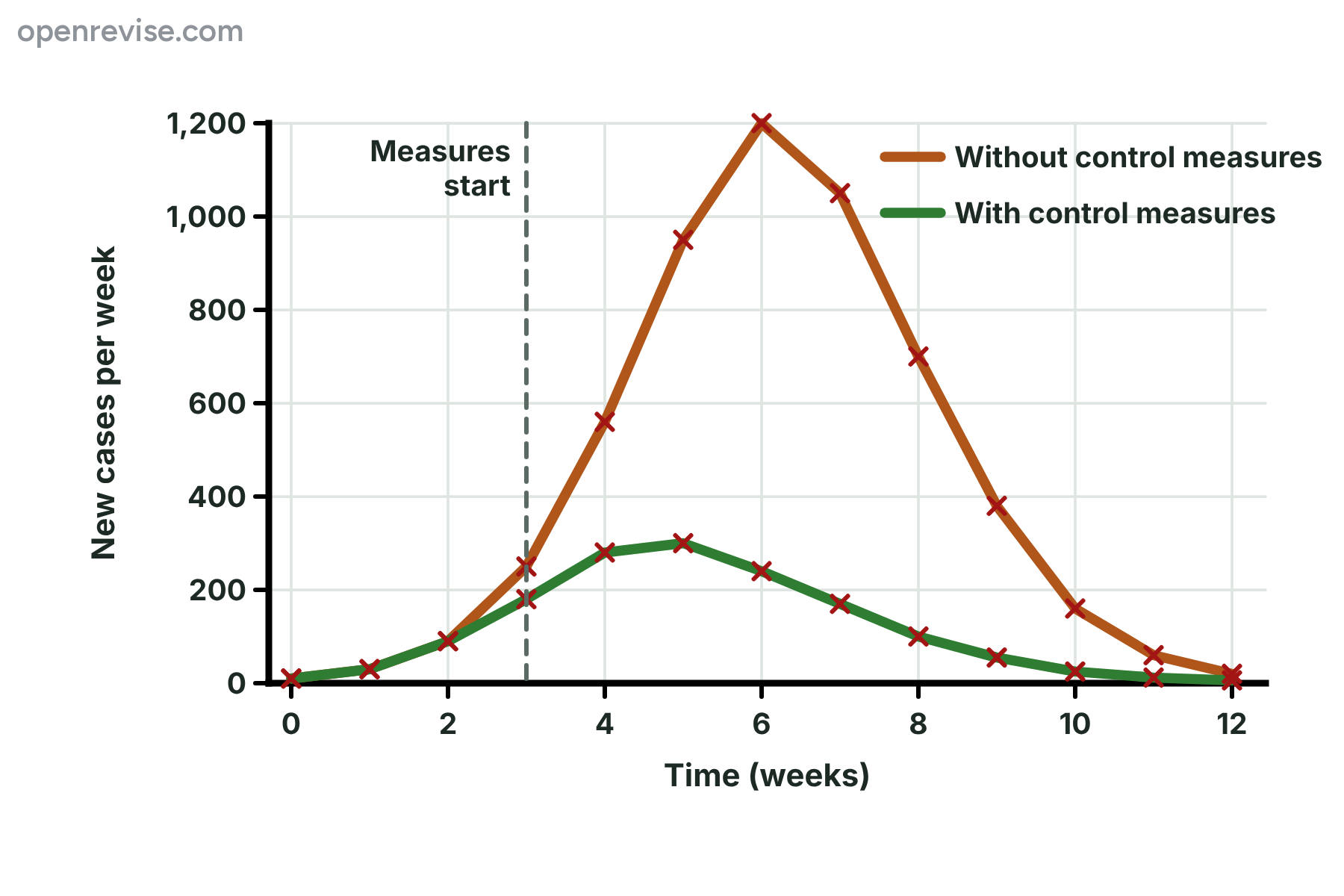
Control measures that start early lower and shorten an outbreak.
The big idea
To control an infection, find it early and break the chain: remove the source, block the route or protect the host.
Reducing the spread
Reducing the spread
-
Humans and animals
- hygiene
- isolation
- vaccination
- condoms
-
Vectors
- drain water
- bed nets
- insecticide
-
Plants
- destroy infected plants
- crop rotation
- resistant varieties
-
Detection
- visual
- antigen test
- DNA testing
-
Evidence
- cases per 100 000
- percentage reduction
- graphs
-
Chain of infection
- source
- route
- host
Summary and exam focus
- Hygiene, isolation, vaccination and safe behaviour reduce the spread of disease in humans and animals.
- Vector control reduces the number of vectors or stops them biting.
- In plants, infected plants are destroyed, crops are rotated, and resistant varieties and clean seed are used.
- Disease can be detected by visual identification, by antigen tests, which are quick, and by DNA testing, which is very sensitive.
- Numbers such as percentage reduction and cases per 100 000 are used to judge control measures.
Exam focus
Explain how the spread of malaria in a village could be reduced. (4 marks) (4 marks)
Name the vector and break the chain at the vector: mosquitoes breed in standing water, so drain it, and use insecticide-treated bed nets so that people are not bitten. Say why each one works, instead of just listing the methods.
Key terms
The words this lesson expects you to use. Each one is linked from the first place it appears above.
- Hygiene
- Measures such as washing hands and cleaning surfaces that remove pathogens and stop them spreading.
- Isolation
- Keeping infected people or animals apart from others so that they cannot pass on the pathogen.
- Quarantine
- Keeping people, animals or plants that may be infected apart for a time, to see if they are ill.
- Vector control
- Reducing the number of vectors, or stopping them from spreading a pathogen.
- Vaccination
- Giving a person or animal a vaccine, so that they are protected against a pathogen.
- Herd immunity
- Protection of a whole population from a disease when enough people are immune, so that it cannot spread easily.
- Crop rotation
- Growing a different crop in a field each year so that a pathogen or a pest is not able to build up.
- Antigen
- A molecule on the surface of a pathogen that is recognised as foreign by the immune system.
- Antigen test
- A test that uses antibodies to detect an antigen from a pathogen in a sample.
- DNA testing
- Detecting and identifying a pathogen by copying and analysing its DNA.
You've finished the notes
Check your understanding
Test yourself while it is fresh. Start with the flashcards, then try the exam questions.
Something here looks wrong?
Tell us what and we will go and look. It goes to whoever writes these pages, nobody else, and we do not ask who you are — so there is nothing to sign and nothing comes back to you.