Slides · PPTX · 194 KB · 15 slides
Sampling.pptx
Built from the lesson script on 30 September 2026.
EDEXCEL GCSE MATHS · FOUNDATION & HIGHER
Sampling
Further statistics
Lesson 1 of 6
openrevise.com
EDEXCEL GCSE MATHS · FOUNDATION & HIGHER
Warm-up
Further statistics
Lesson 1 of 6
Answer each one, then check.
1
What is a percentage of an amount, e.g. 10% of 300?
2
What is the mean of 4, 6 and 8?
3
Simplify the ratio 20 : 30.
4
What does "random" mean?
5
What is a fraction of a total, e.g. ¼ of 80?
openrevise.com
EDEXCEL GCSE MATHS · FOUNDATION & HIGHER
Warm-up - Answers
Further statistics
Lesson 1 of 6
1
What is a percentage of an amount, e.g. 10% of 300?
30
2
What is the mean of 4, 6 and 8?
6
3
Simplify the ratio 20 : 30.
2 : 3
4
What does "random" mean?
Every item has an equal chance of being chosen
5
What is a fraction of a total, e.g. ¼ of 80?
20
openrevise.com
EDEXCEL GCSE MATHS · FOUNDATION & HIGHER
Learning Objectives
Further statistics
Lesson 1 of 6
1
Explain the difference between a population and a sample.
2
Recognise and describe bias in a sample.
3
Take a random, a systematic and a stratified sample.
4
Estimate a population size using capture-recapture (Higher).
openrevise.com
EDEXCEL GCSE MATHS · FOUNDATION & HIGHER
Further statistics
Lesson 1 of 6
SAMPLING
A sample should be a small group that fairly represents the whole population.
A bigger, random sample is more likely to be representative and give reliable results.
openrevise.com
EDEXCEL GCSE MATHS · FOUNDATION & HIGHER
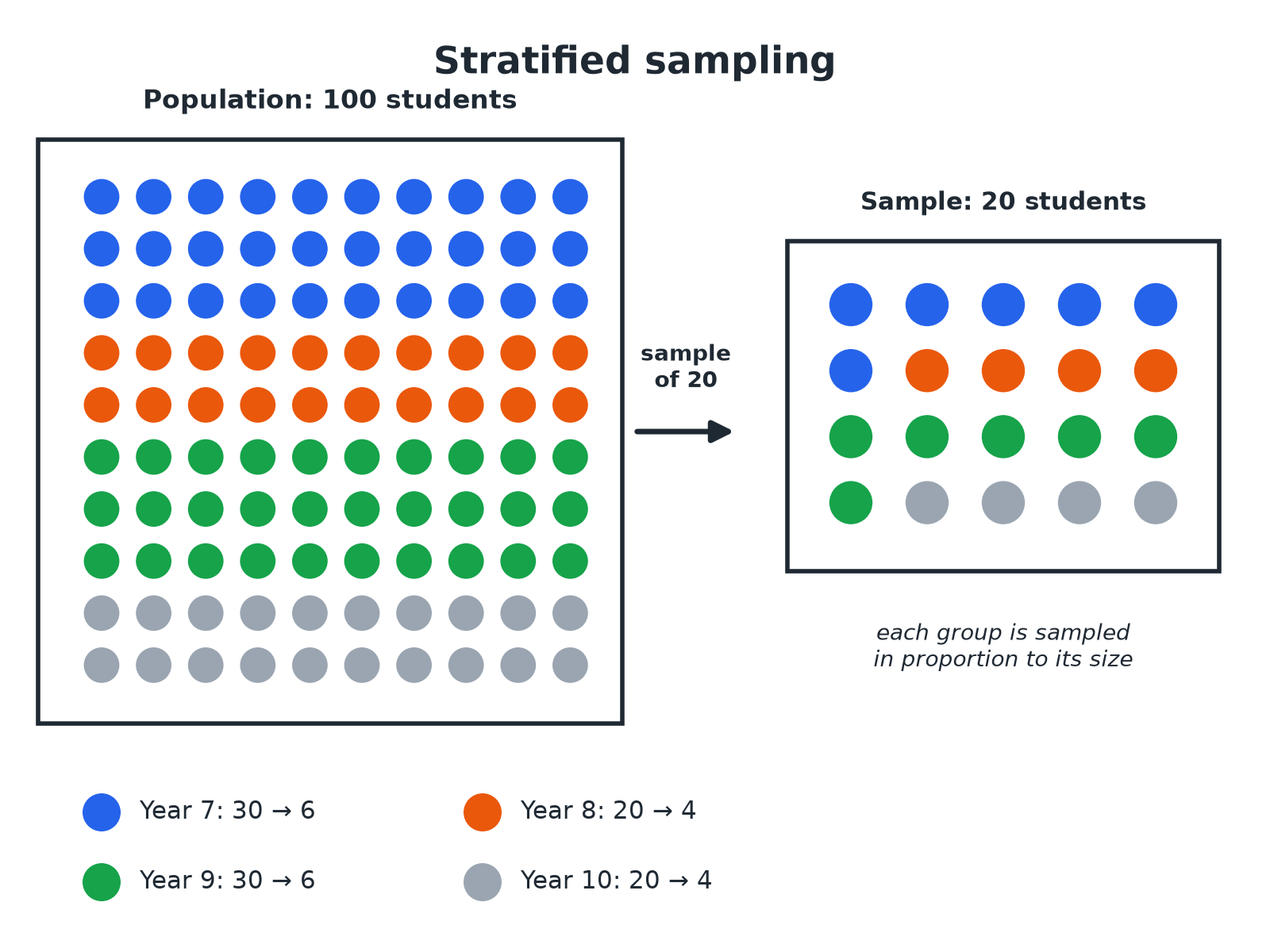
Population and Stratified Sample
Further statistics
Lesson 1 of 6

A stratified sample keeps the same proportions as the population.
openrevise.com
EDEXCEL GCSE MATHS · FOUNDATION & HIGHER
Types of Sample
Further statistics
Lesson 1 of 6
Know how each one is chosen.
Sample
How it is chosen
Good point
Random
Every member has an equal chance, e.g. numbers from a random number generator
Not biased
Systematic
Every kth member from a list, after a random start
Easy and quick
Stratified
Groups sampled in proportion to their size
Represents every group
Convenience
The people who are easiest to reach
Cheap, but often biased
openrevise.com
EDEXCEL GCSE MATHS · FOUNDATION & HIGHER
A Stratified Sample
Further statistics
Lesson 1 of 6
A school has 200 pupils in Year 9, 160 in Year 10 and 240 in Year 11. A stratified sample of 60 pupils is taken. How many pupils come from each year?
1
Total pupils
200 + 160 + 240 = 600
2
Fraction sampled
60/600 = 1/10
3
Year 9
200 ÷ 10 = 20
4
Year 10
160 ÷ 10 = 16
5
Year 11
240 ÷ 10 = 24
ANSWER
20 from Year 9, 16 from Year 10 and 24 from Year 11.
openrevise.com
EDEXCEL GCSE MATHS · FOUNDATION & HIGHER
A Systematic Sample
Further statistics
Lesson 1 of 6
A list has 800 names. A systematic sample of 40 names is needed. Describe how to take it.
1
Interval
800 ÷ 40 = 20
2
Random start
Pick a random number from 1 to 20, e.g. 7
3
Then
Take every 20th name: 7, 27, 47, and so on
ANSWER
Choose a random start between 1 and 20, then take every 20th name.
openrevise.com
EDEXCEL GCSE MATHS · FOUNDATION & HIGHER
Capture-Recapture (Higher)
Further statistics
Lesson 1 of 6
50 fish are caught, tagged and released. Later, 40 fish are caught and 8 of them are tagged. Estimate the number of fish in the lake.
1
Proportion tagged in the second sample
8/40
2
Set equal to the proportion tagged in the lake
8/40 = 50/N
3
Rearrange
N = (50 × 40)/8 = 250
ANSWER
There are about 250 fish in the lake.
openrevise.com
EDEXCEL GCSE MATHS · FOUNDATION & HIGHER
Bias
Further statistics
Lesson 1 of 6
A sample is biased if some members are more likely to be chosen than others.
Where you ask
Asking only people at a football match about sport is biased.
Who answers
Only those who reply to an online poll may hold stronger views.
Sample too small
Small samples can be unrepresentative just by chance.
Fix it
Use a random method and a large enough sample.
openrevise.com
EDEXCEL GCSE MATHS · FOUNDATION & HIGHER
Key Terms
Further statistics
Lesson 1 of 6
Population
The whole group you want to know about.
Sample
A smaller group taken from the population.
Bias
Unfairness that makes a sample unrepresentative.
Random sample
Every member has an equal chance of selection.
Stratified sample
A sample split into groups in proportion to the population.
Capture-recapture
A method to estimate the size of a wild population.
openrevise.com
EDEXCEL GCSE MATHS · FOUNDATION & HIGHER
Further statistics
Lesson 1 of 6
YOUR TASK
Fair or Biased?
10 minutes
Decide whether each sample is fair or biased and explain why. (a) Asking 20 people leaving a gym how much they exercise. (b) Choosing 30 pupils at random from the register. (c) Asking the first 10 people to arrive at school about school start times.
1
Ask who might be missing.
2
Suggest a fairer method.
WHAT A GOOD ANSWER SHOWS
(a) Biased: gym users exercise more than most people. (b) Fair: random. (c) Biased: early arrivals may have different views (for example they may travel by bus).
openrevise.com
EDEXCEL GCSE MATHS · FOUNDATION & HIGHER
Can I...?
Further statistics
Lesson 1 of 6
Define population and sample.
Spot bias.
Take a random sample.
Take a systematic sample.
Work out a stratified sample.
Explain why bigger is better.
Use capture-recapture.
Give a reason for my choice.
openrevise.com
EDEXCEL GCSE MATHS · FOUNDATION & HIGHER
Summary & Exam Focus
Sample = part of the population.
Random samples avoid bias.
Stratified: number in each group = group/population × sample size.
Capture-recapture: N = (first × second)/(tagged in second).
EXAM FOCUS
A school has 200 pupils in Year 9, 160 in Year 10 and 240 in Year 11. Alex takes a stratified sample of 60 pupils. How many pupils should he take from each year? (3 marks)
Find the fraction sampled, then multiply each group by it.
openrevise.com
← → to move, F to present full screen, G for every slide at once.