Slides · PPTX · 360 KB · 33 slides
Properties of waves - Teacher Slides.pptx
The lesson slides with the teacher's notes on each slide, and every question and mark scheme built in. Built from the lesson script on 1 October 2026.
AQA GCSE PHYSICS · PAPER 2 · FOUNDATION & HIGHER
Properties of waves
Waves
Lesson 2 of 12
openrevise.com
AQA GCSE PHYSICS · PAPER 2 · FOUNDATION & HIGHER

Warm-up
Waves
Lesson 2 of 12
Answer each one, then check.
1
What is the unit of frequency?
2
What is the unit of wavelength?
3
What is the speed of sound in air?
4
What is a crest?
5
What is period?
openrevise.com
AQA GCSE PHYSICS · PAPER 2 · FOUNDATION & HIGHER

Warm-up - Answers
Waves
Lesson 2 of 12
1
What is the unit of frequency?
Hertz (Hz)
2
What is the unit of wavelength?
Metres (m)
3
What is the speed of sound in air?
About 330 m/s
4
What is a crest?
The highest point of a transverse wave
5
What is period?
The time for one wave to pass
openrevise.com
AQA GCSE PHYSICS · PAPER 2 · FOUNDATION & HIGHER

Learning Objectives
Waves
Lesson 2 of 12
1
Define amplitude, wavelength, frequency and period.
2
Recall and apply T = 1 ÷ f and v = fλ.
3
Identify amplitude and wavelength from diagrams.
4
Describe methods to measure the speed of sound and of ripples, and Required Practical 8.
5
Explain how v, f and λ change when sound passes from one medium to another (Physics only).
openrevise.com
AQA GCSE PHYSICS · PAPER 2 · FOUNDATION & HIGHER
Waves
Lesson 2 of 12

THE WAVE EQUATION
wave speed = frequency × wavelength v = fλ
Period T = 1/f. v = fλ is given on the equation sheet. Wave speed is in m/s, frequency in Hz, wavelength in m and period in s.
openrevise.com
AQA GCSE PHYSICS · PAPER 2 · FOUNDATION & HIGHER

Labelling a Wave
Waves
Lesson 2 of 12
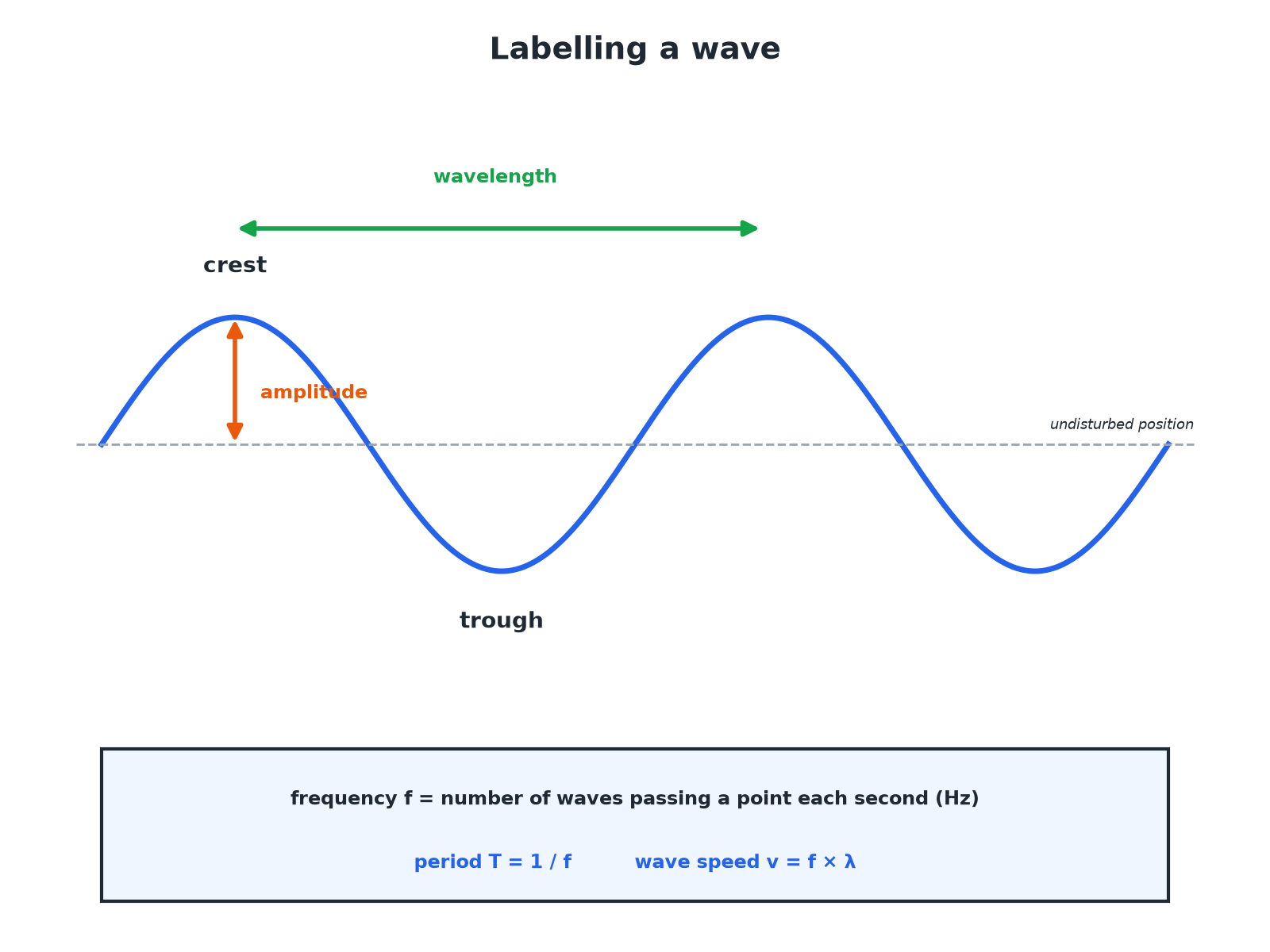
Amplitude is measured from the undisturbed position, not from trough to crest.
openrevise.com
AQA GCSE PHYSICS · PAPER 2 · FOUNDATION & HIGHER

Required Practical 8: Waves in a Ripple Tank
Waves
Lesson 2 of 12
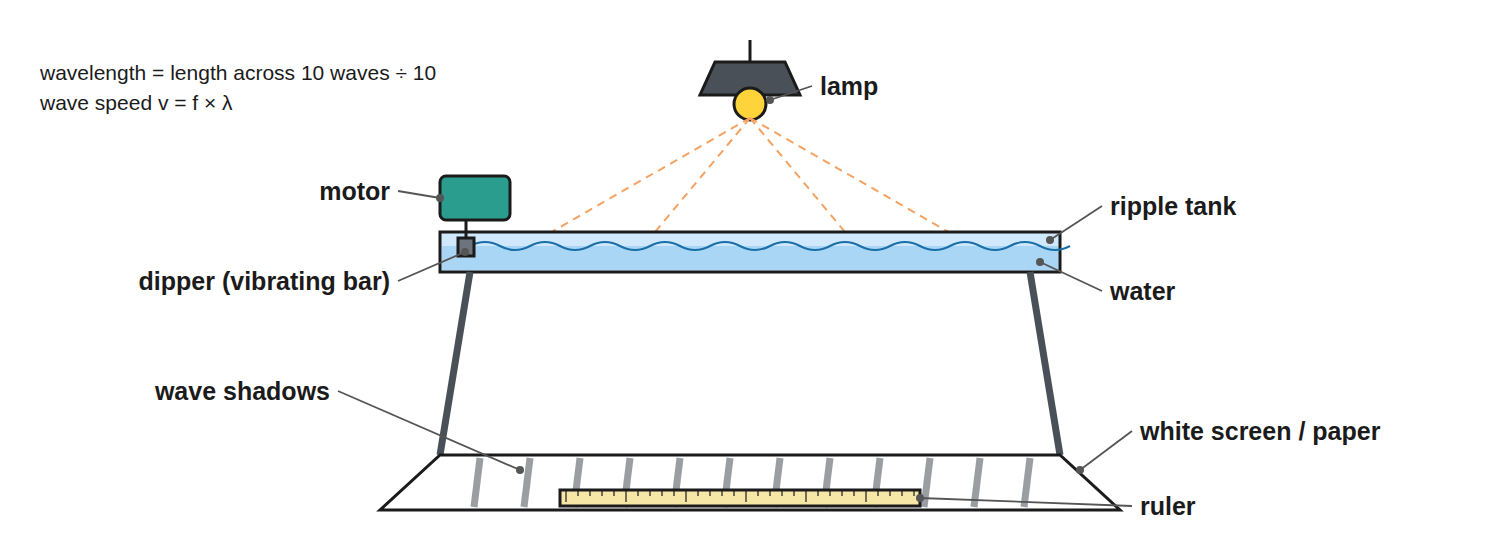
Measure the wavelength from the pattern and the frequency from the motor.
openrevise.com
AQA GCSE PHYSICS · PAPER 2 · FOUNDATION & HIGHER

Wave Quantities
Waves
Lesson 2 of 12
Learn the definitions and units.
Quantity
Symbol
Unit
Meaning
Amplitude
A
m
Maximum displacement from the undisturbed position
Wavelength
λ
m
Distance between equivalent points on adjacent waves
Frequency
f
Hz
Number of waves passing a point each second
Period
T
s
Time for one complete wave
Wave speed
v
m/s
Speed at which the wave moves or transfers energy
openrevise.com
AQA GCSE PHYSICS · PAPER 2 · FOUNDATION & HIGHER

Using the Wave Equation
Waves
Lesson 2 of 12
Sound waves of frequency 50 Hz travel at 330 m/s. Calculate the wavelength.
1
Rearrange
λ= v ÷ f
2
Substitute
λ= 330 ÷ 50
3
Answer
λ= 6.6 m
ANSWER
6.6 m
openrevise.com
AQA GCSE PHYSICS · PAPER 2 · FOUNDATION & HIGHER

Finding Speed
Waves
Lesson 2 of 12
Water waves have a frequency of 2.0 Hz and a wavelength of 0.50 m. Calculate the wave speed.
1
Write the equation
v = fλ
2
Substitute
v = 2.0 × 0.50
3
Answer
v = 1.0 m/s
ANSWER
1.0 m/s
openrevise.com
AQA GCSE PHYSICS · PAPER 2 · FOUNDATION & HIGHER

Period
Waves
Lesson 2 of 12
A wave has a frequency of 250 Hz. Calculate the period.
1
Write the equation
T = 1 ÷ f
2
Substitute
T = 1 ÷ 250
3
Answer
T = 0.0040 s
ANSWER
0.0040 s
openrevise.com
AQA GCSE PHYSICS · PAPER 2 · FOUNDATION & HIGHER

Speed of Sound by Echo
Waves
Lesson 2 of 12
Describe a method to measure the speed of sound in air.
1
Set up
Stand a measured distance (for example 100 m) from a large wall and clap
2
Time
Start a stopwatch at the clap and stop at the echo
3
Calculate
v = distance there and back ÷ time
4
Repeat
Take several readings and find a mean
ANSWER
Speed = 2d ÷ t, with repeats to reduce error.
openrevise.com
AQA GCSE PHYSICS · PAPER 2 · FOUNDATION & HIGHER

Changing Medium (Physics only)
Waves
Lesson 2 of 12
A sound wave of frequency 500 Hz travels from air (330 m/s) into water (1500 m/s). What happens to f, v and λ?
1
Frequency
Unchanged: it is set by the source
2
Speed
Increases to 1500 m/s
3
Wavelength
λ= v ÷ f increases: from 0.66 m to 3.0 m
ANSWER
f stays the same; v and λ both increase.
openrevise.com
AQA GCSE PHYSICS · PAPER 2 · FOUNDATION & HIGHER

Required Practical 8: Ripple Tank Method
Waves
Lesson 2 of 12
Measuring frequency, wavelength and speed of water waves.
1
Set up
Fill a ripple tank and set the signal generator so the dipper makes steady waves; a lamp above casts shadows on paper below.
2
Wavelength
Measure across 10 wavelengths with a ruler on the shadow pattern and divide by 10.
3
Frequency
Count the waves passing a point in 10 seconds and divide by 10, or read the generator.
4
Speed
Calculate v = fλ.
5
Improve
A strobe or a photo with a ruler in shot freezes the pattern for easier measuring.
openrevise.com
AQA GCSE PHYSICS · PAPER 2 · FOUNDATION & HIGHER

Measuring Waves on a String
Waves
Lesson 2 of 12
The second part of Required Practical 8.
Set up
A string runs over a pulley with masses hung on the end, and a vibration generator near the other end.
Standing wave
Adjust the frequency until a clear, stationary pattern of loops appears. Measure across several half-wavelengths with a metre ruler.
Calculate
Read the frequency from the signal generator and use v = fλ. Changing the frequency changes the wavelength, but the speed stays the same for the same string and tension.
openrevise.com
AQA GCSE PHYSICS · PAPER 2 · FOUNDATION & HIGHER

Reading a Wave Diagram
Waves
Lesson 2 of 12
Where marks are lost on labelled diagrams.
Amplitude
Measure from the middle line (undisturbed position) to a crest, not from trough to crest.
Wavelength
Measure from one crest to the next crest, or between any two matching points.
Time axis
If the x-axis is time instead of distance, the gap between crests is the period, not the wavelength.
openrevise.com
AQA GCSE PHYSICS · PAPER 2 · FOUNDATION & HIGHER

Key Terms
Waves
Lesson 2 of 12
Amplitude
The maximum displacement of a point on a wave from its undisturbed position.
Wavelength
The distance from a point on one wave to the same point on the next wave.
Frequency
The number of waves passing a point each second.
Period
The time for one complete wave.
Wave speed
The speed at which energy is transferred through a medium.
Ripple tank
A shallow tray of water used to show wave behaviour.
openrevise.com
AQA GCSE PHYSICS · PAPER 2 · FOUNDATION & HIGHER

Key Terms (cont.)
Waves
Lesson 2 of 12
Hertz
The unit of frequency: one wave per second.
Undisturbed position
The position of the medium when no wave is passing.
Signal generator
A device that produces a vibration at a set frequency.
openrevise.com
AQA GCSE PHYSICS · PAPER 2 · FOUNDATION & HIGHER
Waves
Lesson 2 of 12

YOUR TASK
Wave Sums
12 minutes
Ripples have a wavelength of 4.0 cm and a frequency of 5.0 Hz. Calculate the speed in m/s. What is the period?
1
Convert cm to m.
2
Use v = fλ and T = 1/f.
WHAT A GOOD ANSWER SHOWS
λ = 0.040 m; v = 5.0 × 0.040 = 0.20 m/s. T = 1 ÷ 5.0 = 0.20 s.
openrevise.com
AQA GCSE PHYSICS · PAPER 2 · FOUNDATION & HIGHER

Can I...?
Waves
Lesson 2 of 12
Define amplitude.
Define wavelength.
Define frequency and period.
Use v = fλ.
Use T = 1 ÷ f.
Read a wave diagram.
Describe measuring wave speed.
Explain changes at a boundary.
openrevise.com
AQA GCSE PHYSICS · PAPER 2 · FOUNDATION & HIGHER
Summary & Exam Focus
v = fλ and T = 1 ÷ f.
Amplitude from the undisturbed position to a crest.
Wavelength between equivalent points.
Frequency stays constant when a wave changes medium.
Measure amplitude from the middle line, not trough to crest.
Measure across several waves and divide for accuracy.
EXAM FOCUS
Sound of frequency 50 Hz travels at 330 m/s. Calculate the wavelength. (2 marks)
Rearrange v = fλ to λ = v ÷ f, substitute 330 ÷ 50 and give 6.6 m. If the frequency is given in kHz, multiply by 1000 first.
openrevise.com
AQA GCSE PHYSICS · PAPER 2 · FOUNDATION & HIGHER

Exam Practice: Properties of waves
Waves
Lesson 2 of 12
Answer all questions. Use the mark allocation as a guide to how much to write. · 17 minutes
Question 1 · 2 marks · Calculate
Sound waves travel through air at 330 m/s. A sound has a frequency of 50 Hz. Calculate the wavelength of the sound waves. Use the equation…
Question 2 · 4 marks · Use the diagram
The diagram shows a water wave. (a) State the amplitude of the wave. (b) State the wavelength. (c) The wave passes a point 5 times each…
Question 3 · 2 marks · Calculate
A wave has a frequency of 250 Hz. Calculate its period.
openrevise.com
AQA GCSE PHYSICS · PAPER 2 · FOUNDATION & HIGHER

Exam Practice: Properties of waves (cont.)
Waves
Lesson 2 of 12
Question 4 · 4 marks · Describe
Describe how you would measure the speed of sound in air using a wall and a stopwatch.
Question 5 · 4 marks · Explain
A sound wave travels from air into water. Its frequency is 500 Hz. The speed of sound is 330 m/s in air and 1500 m/s in water. Explain what…
openrevise.com
AQA GCSE PHYSICS · PAPER 2 · FOUNDATION & HIGHER

Question 1 · 2 marks · Calculate
Waves
Lesson 2 of 12
“
Sound waves travel through air at 330 m/s. A sound has a frequency of 50 Hz. Calculate the wavelength of the sound waves. Use the equation: wave speed = frequency × wavelength
HOW TO ANSWER IT
Command word: Calculate. Worth 2 marks, so plan before writing.
openrevise.com
AQA GCSE PHYSICS · PAPER 2 · FOUNDATION & HIGHER

Question 1 · mark scheme
Waves
Lesson 2 of 12
2 marks available. Award a mark for each point made.
Rearranges to λ = v ÷ f
1 mark
6.6 m
1 mark
openrevise.com
AQA GCSE PHYSICS · PAPER 2 · FOUNDATION & HIGHER

Question 2 · 4 marks · Use the diagram
Waves
Lesson 2 of 12
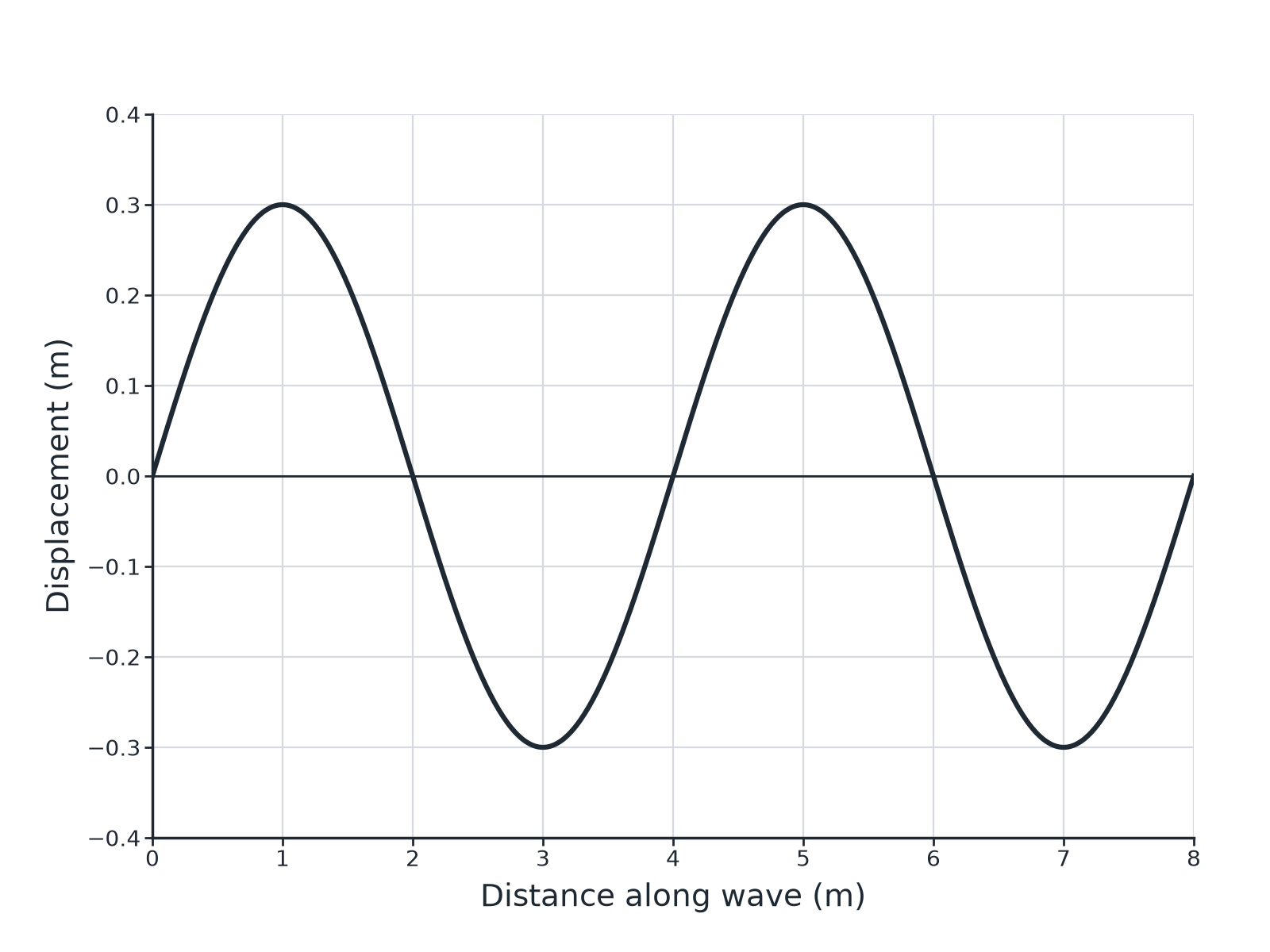
The diagram shows a water wave. (a) State the amplitude of the wave. (b) State the wavelength. (c) The wave passes a point 5 times each second. Calculate the wave speed. (4 marks)
openrevise.com
AQA GCSE PHYSICS · PAPER 2 · FOUNDATION & HIGHER

Question 2 · mark scheme
Waves
Lesson 2 of 12
4 marks available. Award a mark for each point made.
Amplitude 0.30 m
1 mark
Wavelength 4.0 m
1 mark
Correct substitution
1 mark
20 m/s
1 mark
openrevise.com
AQA GCSE PHYSICS · PAPER 2 · FOUNDATION & HIGHER

Question 3 · 2 marks · Calculate
Waves
Lesson 2 of 12
“
A wave has a frequency of 250 Hz. Calculate its period.
HOW TO ANSWER IT
Command word: Calculate. Worth 2 marks, so plan before writing.
openrevise.com
AQA GCSE PHYSICS · PAPER 2 · FOUNDATION & HIGHER

Question 3 · mark scheme
Waves
Lesson 2 of 12
2 marks available. Award a mark for each point made.
Correct substitution
1 mark
0.0040 s
1 mark
openrevise.com
AQA GCSE PHYSICS · PAPER 2 · FOUNDATION & HIGHER

Question 4 · 4 marks · Describe
Waves
Lesson 2 of 12
“
Describe how you would measure the speed of sound in air using a wall and a stopwatch.
HOW TO ANSWER IT
Command word: Describe. Worth 4 marks, so plan before writing.
openrevise.com
AQA GCSE PHYSICS · PAPER 2 · FOUNDATION & HIGHER

Question 4 · mark scheme
Waves
Lesson 2 of 12
4 marks available. Award a mark for each point made.
Measured distance to a wall
1 mark
Timing clap to echo
1 mark
Distance travelled is there and back
1 mark
Repeat and mean
1 mark
openrevise.com
AQA GCSE PHYSICS · PAPER 2 · FOUNDATION & HIGHER

Question 5 · 4 marks · Explain
Waves
Lesson 2 of 12
“
A sound wave travels from air into water. Its frequency is 500 Hz. The speed of sound is 330 m/s in air and 1500 m/s in water. Explain what happens to the frequency, speed and wavelength, and calculate the wavelength in water.
HOW TO ANSWER IT
Command word: Explain. Worth 4 marks, so plan before writing.
openrevise.com
AQA GCSE PHYSICS · PAPER 2 · FOUNDATION & HIGHER

Question 5 · mark scheme
Waves
Lesson 2 of 12
4 marks available. Award a mark for each point made.
Frequency unchanged
1 mark
Speed increases
1 mark
Wavelength increases
1 mark
3.0 m
1 mark
openrevise.com
← → to move, F to present full screen, G for every slide at once.