Flashcards · Biology
Ecosystems and Communities
-
What is an individual organism?
One single living thing.
-
What is a population?
All the organisms of the same species living in the same place at the same time.
-
What is a community?
All the populations of the different species living in the same place.
-
What is an ecosystem?
A community of living organisms together with the non-living parts of their surroundings.
-
Name the four levels of organisation, smallest first.
Individual organism, population, community, ecosystem.
-
A pond contains frogs, fish and plants. Is that a population or a community?
A community, because it has several species.
-
What does interdependence mean?
Organisms in a community depend on each other, for example for food, shelter and pollination.
-
Why might losing one species damage a whole community?
Other species depend on it for food or other needs, so the effects spread.
-
What is parasitism?
A relationship in which the parasite benefits and the host is harmed.
-
Name two animal parasites.
Tapeworms and fleas.
-
How does mistletoe harm its host tree?
It takes water and mineral ions from the tree, weakening it.
-
What is mutualism?
A relationship in which both organisms benefit.
-
What do nitrogen-fixing bacteria in root nodules gain from the plant?
Sugars (a food supply) and a home.
-
What does the plant gain from nitrogen-fixing bacteria?
Nitrogen compounds that it can use to make proteins.
-
How do cleaner fish and the larger fish both benefit?
The cleaner gets food, and the larger fish loses its parasites.
-
What does a flower gain from a pollinating bee, and what does the bee gain?
The flower is pollinated, and the bee gets nectar and pollen.
-
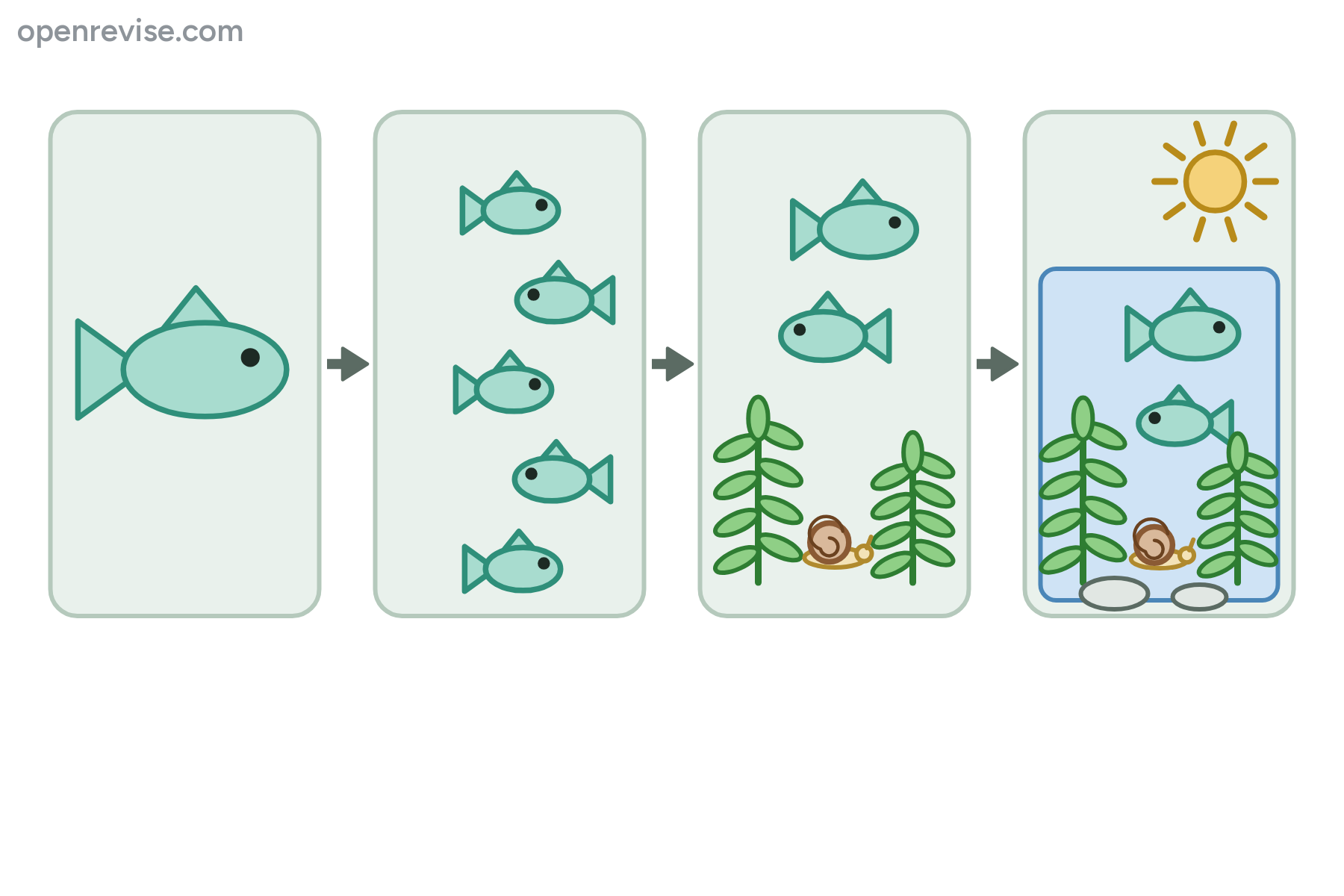 Name each level of organisation shown, and say what each contains.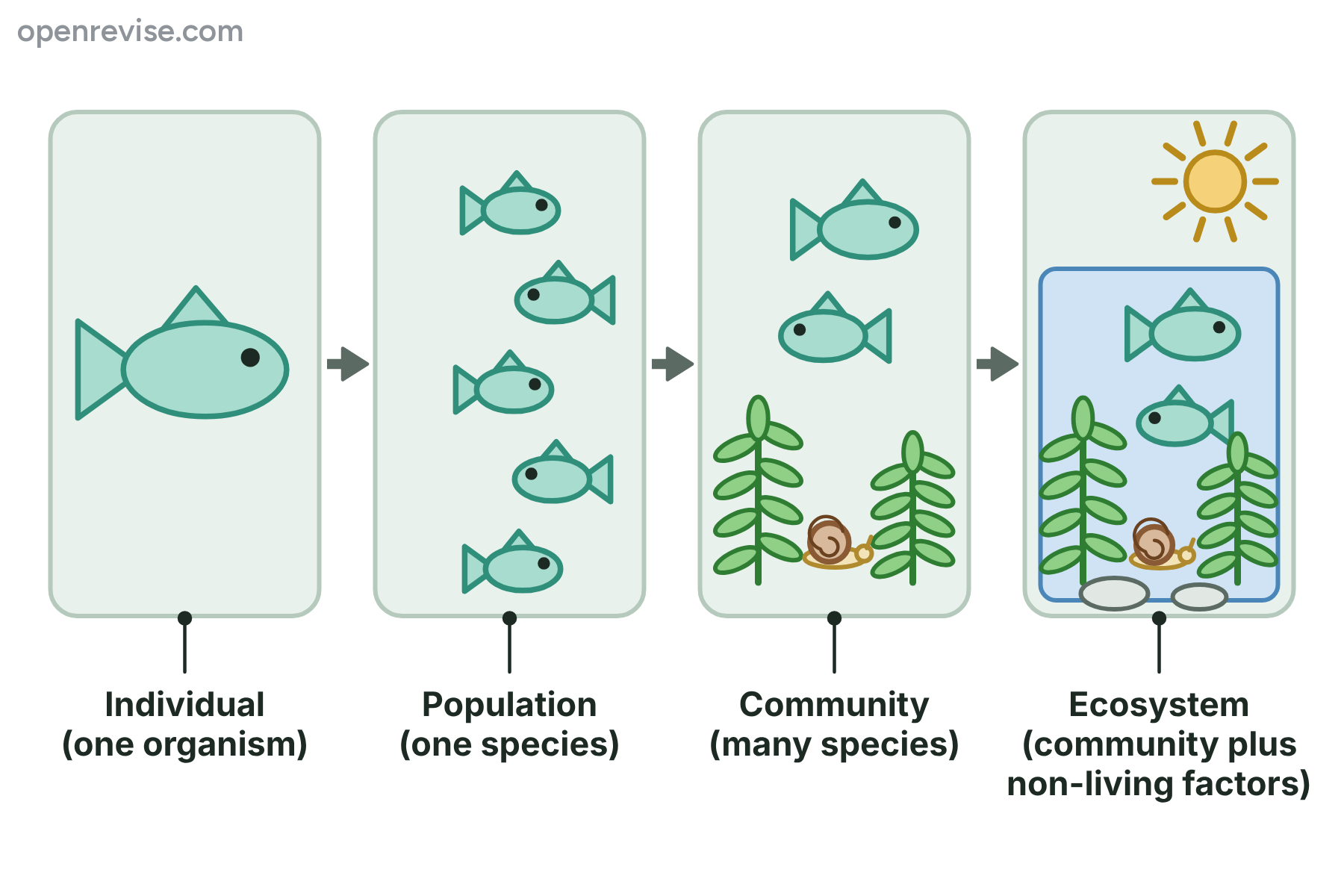
Individual: one organism. Population: all the organisms of one species in the same place. Community: all the populations of the different species in the same place. Ecosystem: the community plus the non-living factors such as light, water and temperature.
-
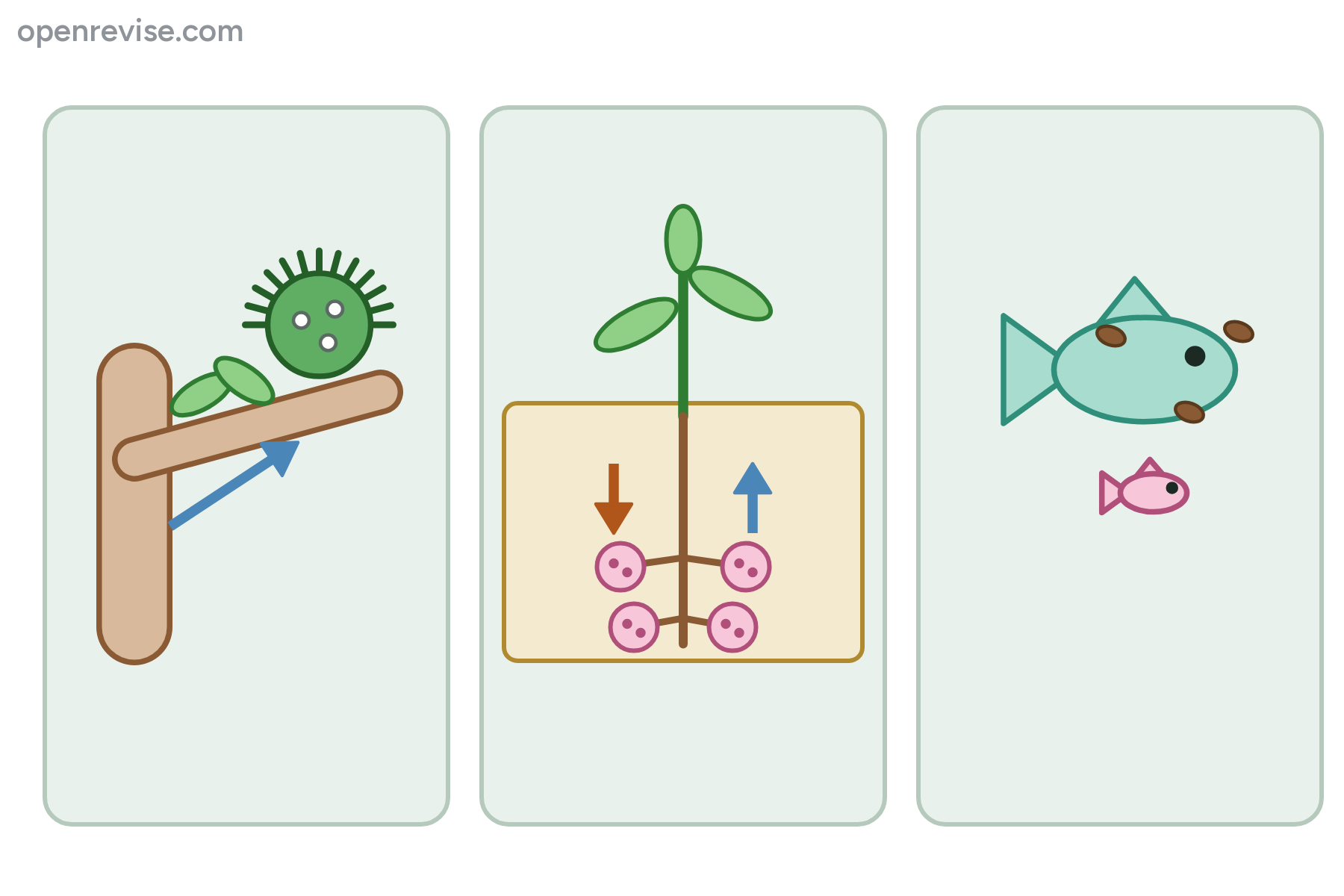 Name each relationship, and say which organisms benefit and which are harmed.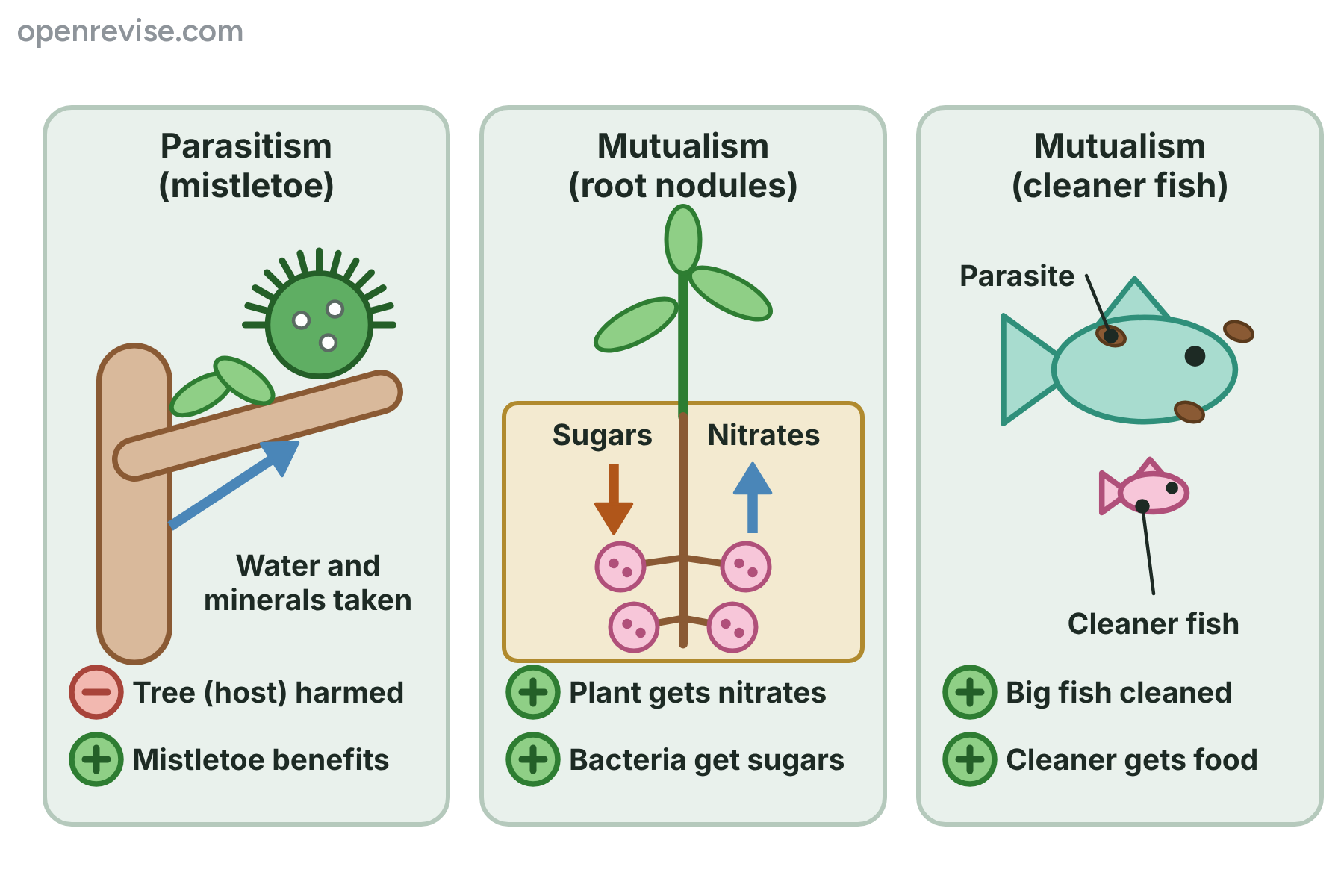
Mistletoe on a tree is parasitism: the mistletoe benefits and the tree is harmed. Root nodules are mutualism: the plant gets nitrates and the bacteria get sugars. A cleaner fish and a big fish are mutualism: the big fish is cleaned and the cleaner gets food.
-
What is an abiotic factor?
A non-living part of the environment.
-
What is a biotic factor?
A living part of the environment, such as a predator or a competitor.
-
Name the four abiotic factors on the specification.
Temperature, light, water and pollutants.
-
Name two biotic factors on the specification.
Competition and predation.
-
Why does light affect the number of consumers in an ecosystem?
Light limits photosynthesis and so the number of producers, and consumers depend on producers.
-
How can a pollutant change a community?
Sensitive species die, so the number of species falls.
-
What do plants compete for?
Light, water, mineral ions and space.
-
What do animals compete for?
Food, water, mates, territory and shelter.
-
What usually happens to the weaker of two competing species?
Its population declines and it may die out from the area.
-
What is a predator?
An animal that kills and eats other animals.
-
In a predator-prey cycle, which population peaks first?
The prey population.
-
Why does the predator peak come after the prey peak?
Predators need time to breed and increase once the food supply has increased.
-
Why are there usually fewer predators than prey?
Energy is lost at each trophic level, so the prey cannot support as many predators.
-
Why do prey numbers fall after predators increase?
More predators eat more prey.
-
What is the formula for percentage change?
Change divided by the original value, multiplied by 100.
-
Why do the populations in a stable community stay roughly constant?
Factors that increase them balance the ones that decrease them.
-
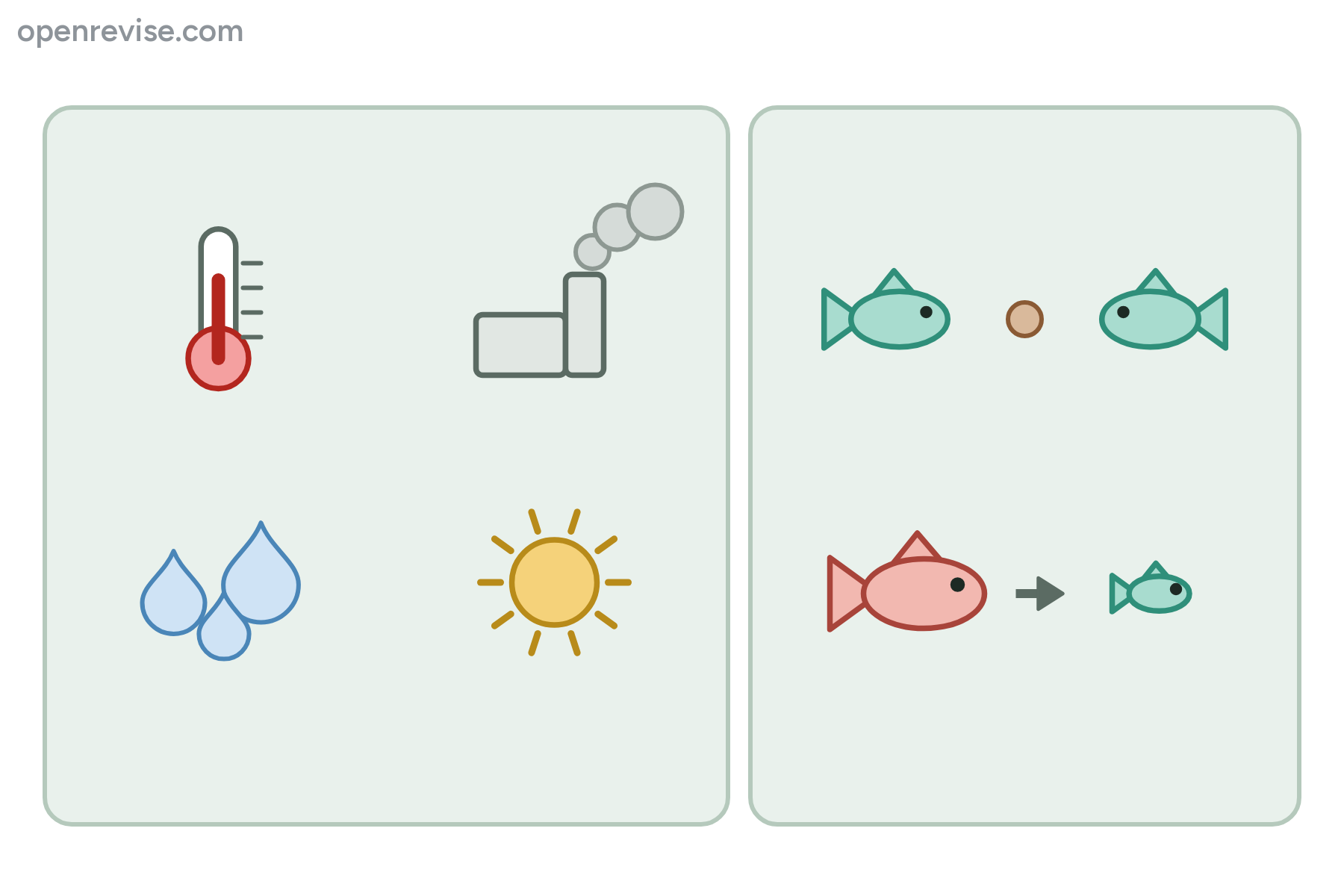 Sort the factors in the picture into abiotic and biotic, and name each one.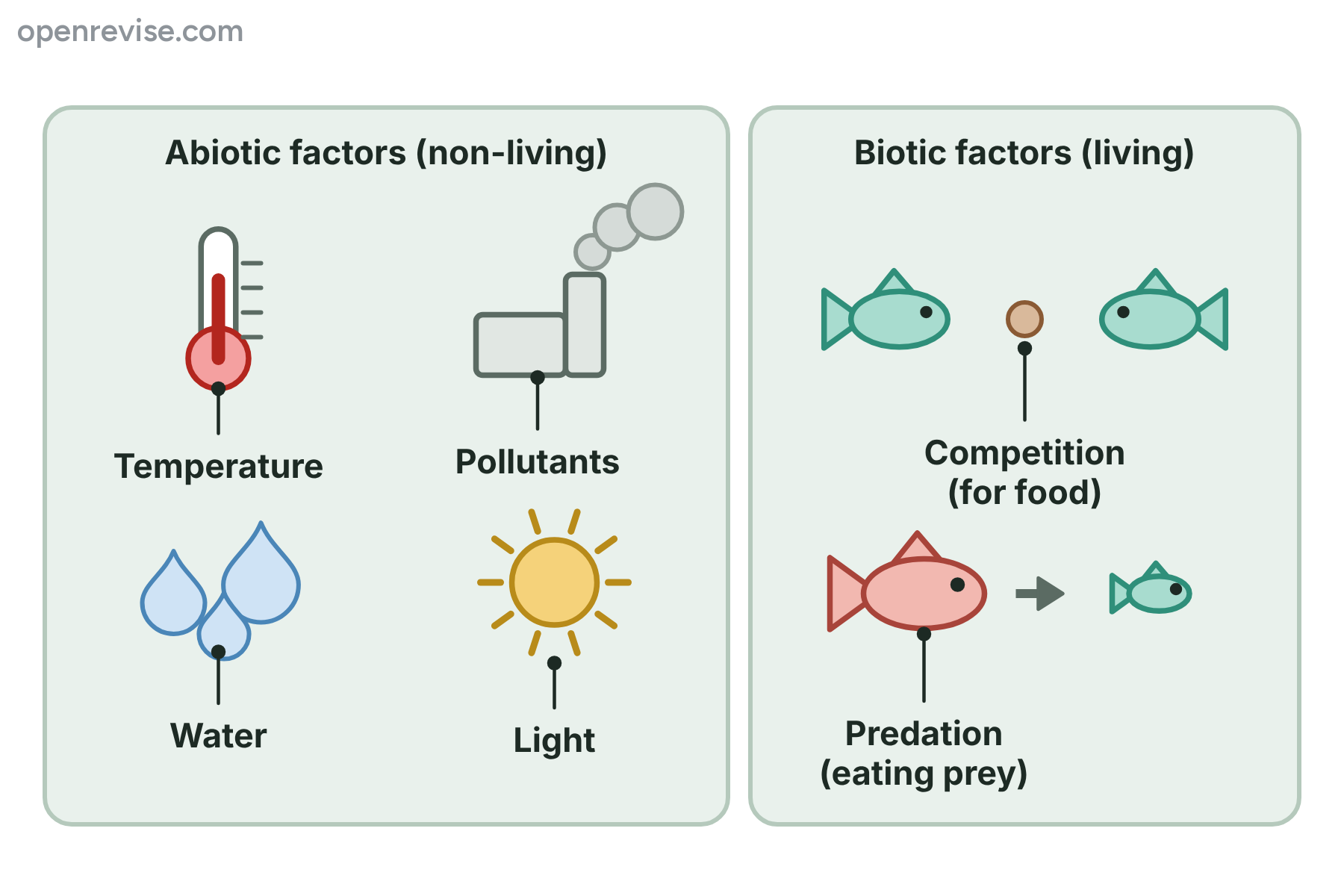
Abiotic (non-living): temperature, pollutants, water and light. Biotic (living): competition (for food) and predation (a predator eating prey).
-
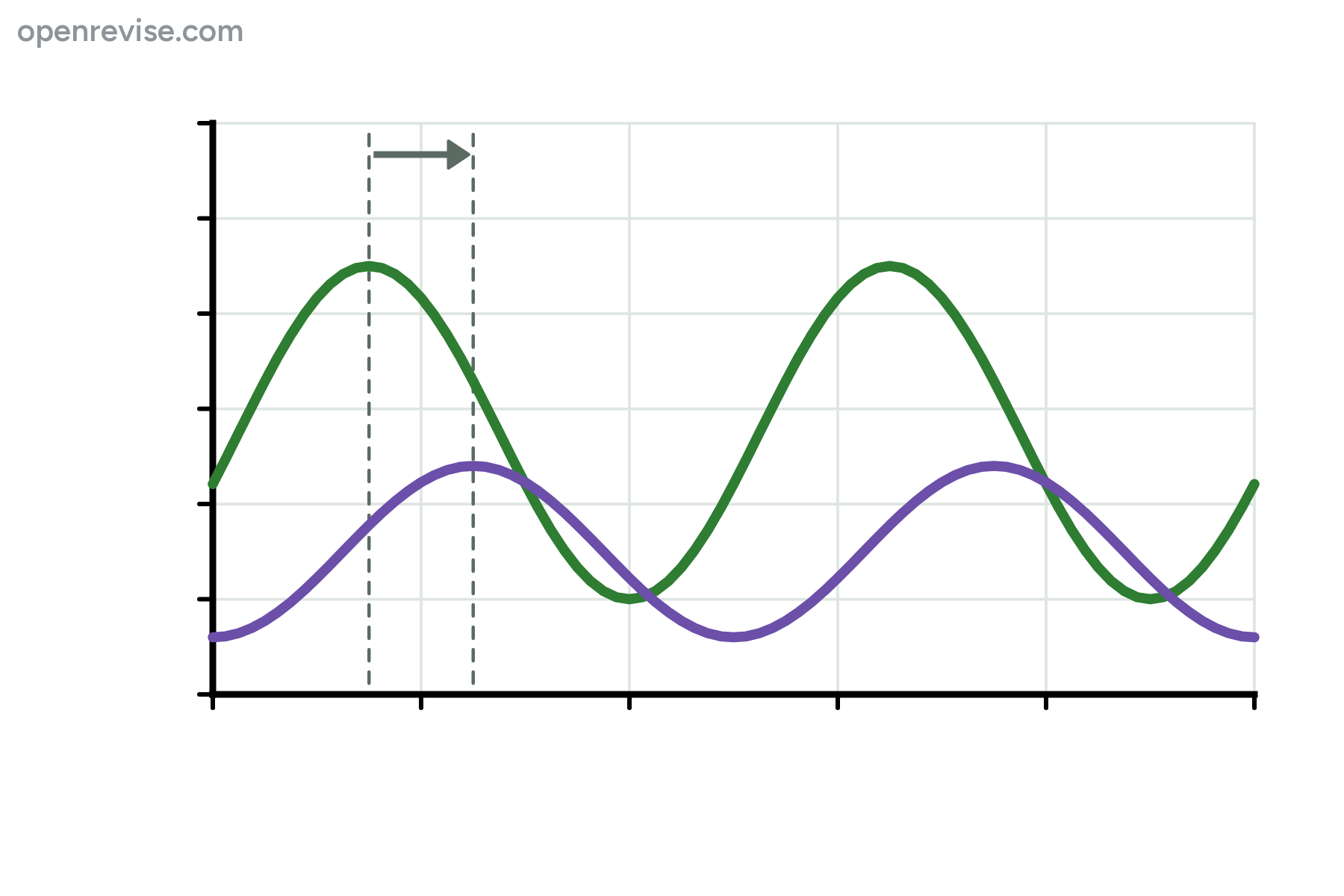 Describe and explain the pattern in the graph.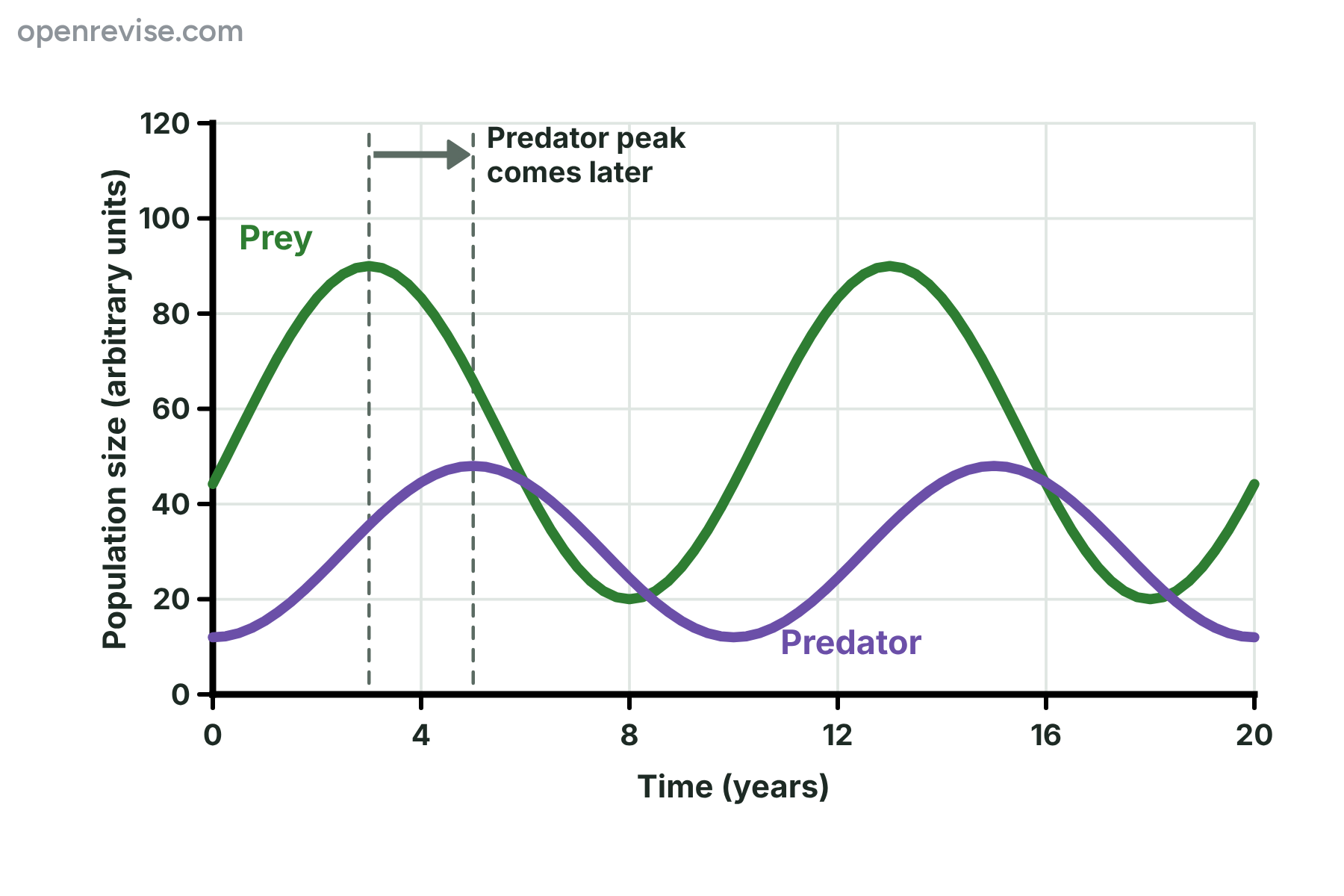
The prey peak comes first and the predator peak comes later, because predators increase once there is plenty of prey. More predators then eat more prey, so the prey fall, and then the predators fall as food runs short. The cycle repeats, and there are fewer predators than prey.
-
What is a quadrat?
A square frame that marks out a known area to sample.
-
Why do ecologists sample instead of counting everything?
Counting every organism would take too long and damage the habitat.
-
How do you place a quadrat at random?
Use random numbers as coordinates along two tape measures laid at right angles.
-
Why use random sampling?
To avoid bias, so every part of the area has the same chance of being sampled.
-
Why use many quadrats?
A larger sample is more representative, so the results are more reliable.
-
When do you use a belt transect?
When conditions change gradually across a habitat, such as from shade to light.
-
How are quadrats placed along a belt transect?
At regular intervals along a line, such as every 5 m.
-
Name two ways to measure an abiotic factor along a transect.
A light meter for light intensity, and a moisture meter for soil moisture.
-
What is percentage cover?
The percentage of the quadrat that a species covers.
-
How do you calculate a mean?
The total divided by the number of values.
-
How do you estimate the number of organisms in a field?
Mean per quadrat multiplied by the field area divided by the quadrat area.
-
A 0.5 m by 0.5 m quadrat is placed in a 100 m\(^2\) field. How many quadrats fit in the field?
\(100 \div 0.25 = 400\).
-
Why is the population you work out only an estimate?
It is based on a sample, not on counting every organism.
-
Name one source of error in quadrat work.
Any of: too few quadrats, bias in placing them, misidentifying species, or uncontrolled variables.
-
How can you make quadrat results more reliable?
Use more quadrats, repeat the transect, and control the variables.
-
What does a positive correlation look like on a scatter graph?
The crosses rise from the lower left to the upper right.
-
Does a correlation prove that one variable causes the other?
No, other factors may be involved.
-
What is the benefit of a quadrat with 100 squares?
Each square is 1% of the area, so percentage cover is easy to count.
-
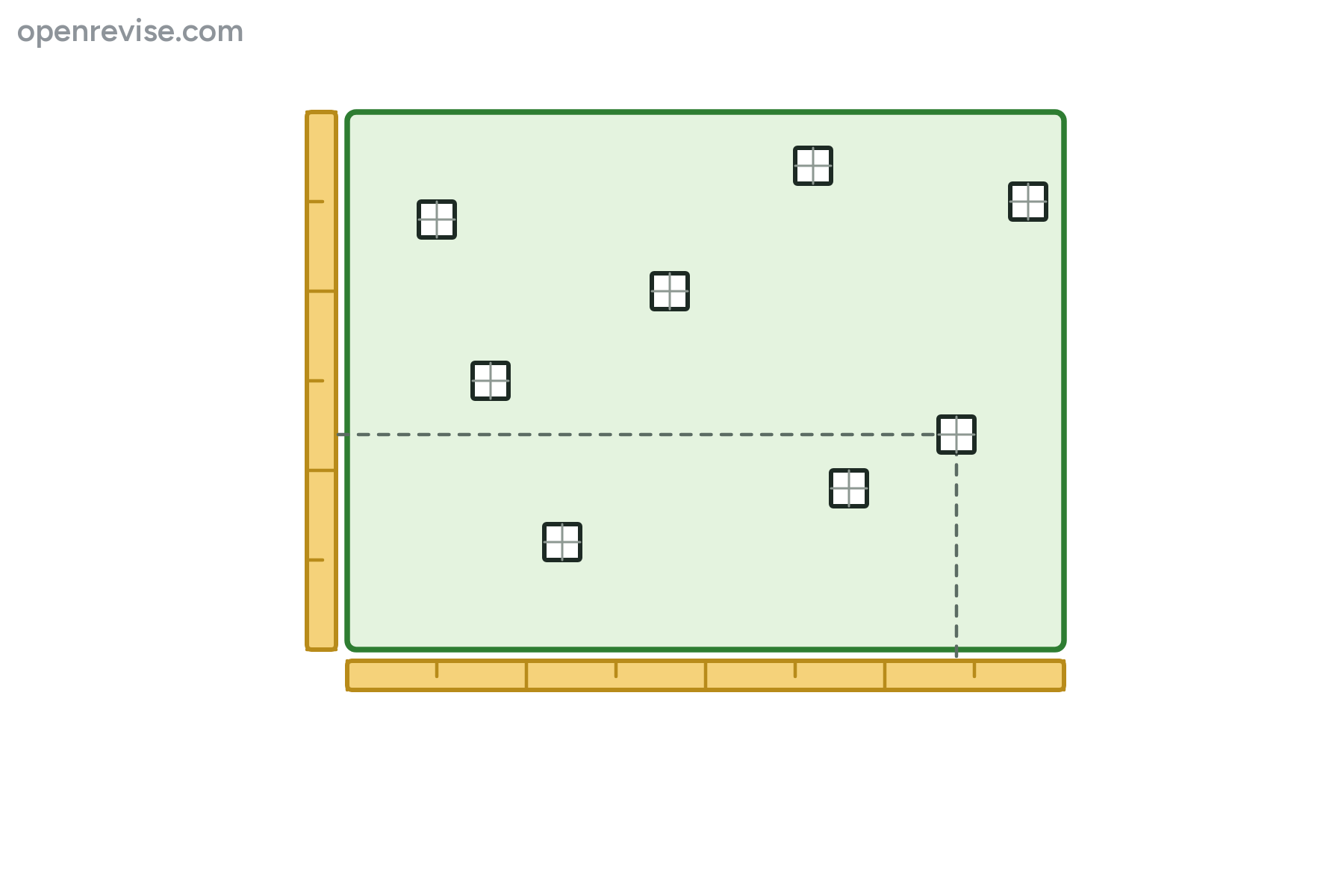 Describe how to place quadrats at random in a study area.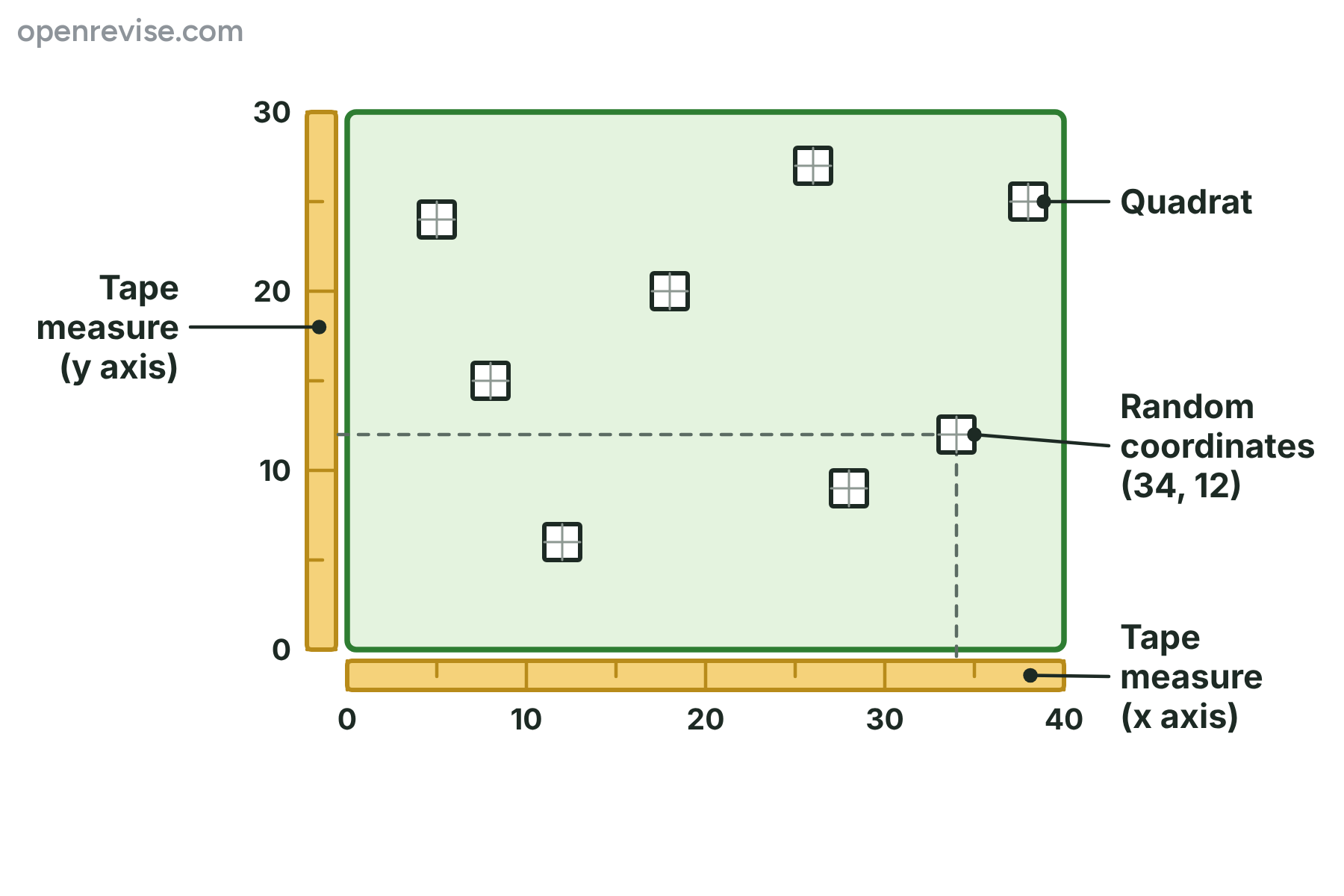
Lay a tape measure along each of two sides at right angles. Use random numbers as coordinates along each tape, place a quadrat where they meet, and record what is in it. Repeat for many quadrats.
-
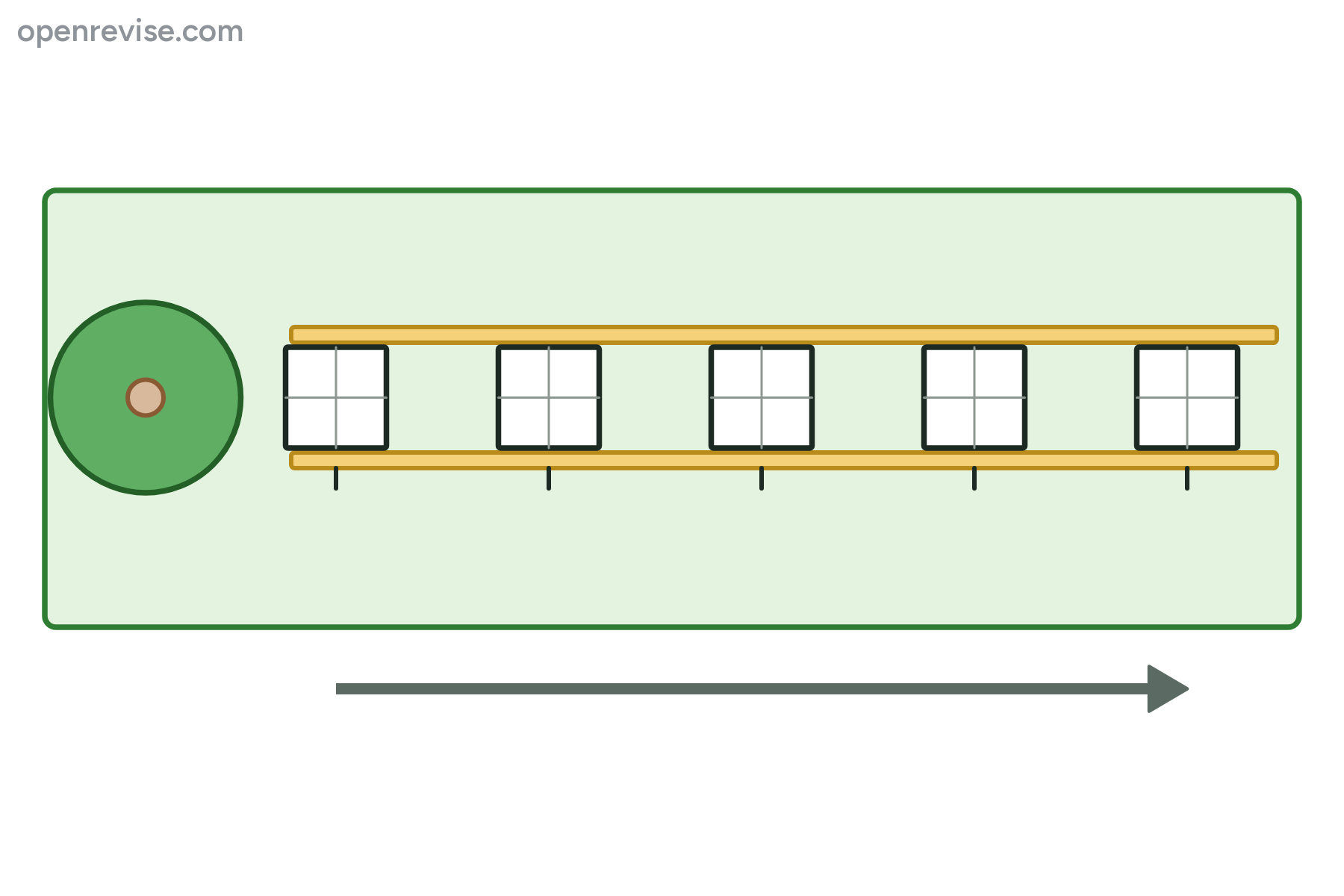 Describe what this belt transect shows, and why it is used.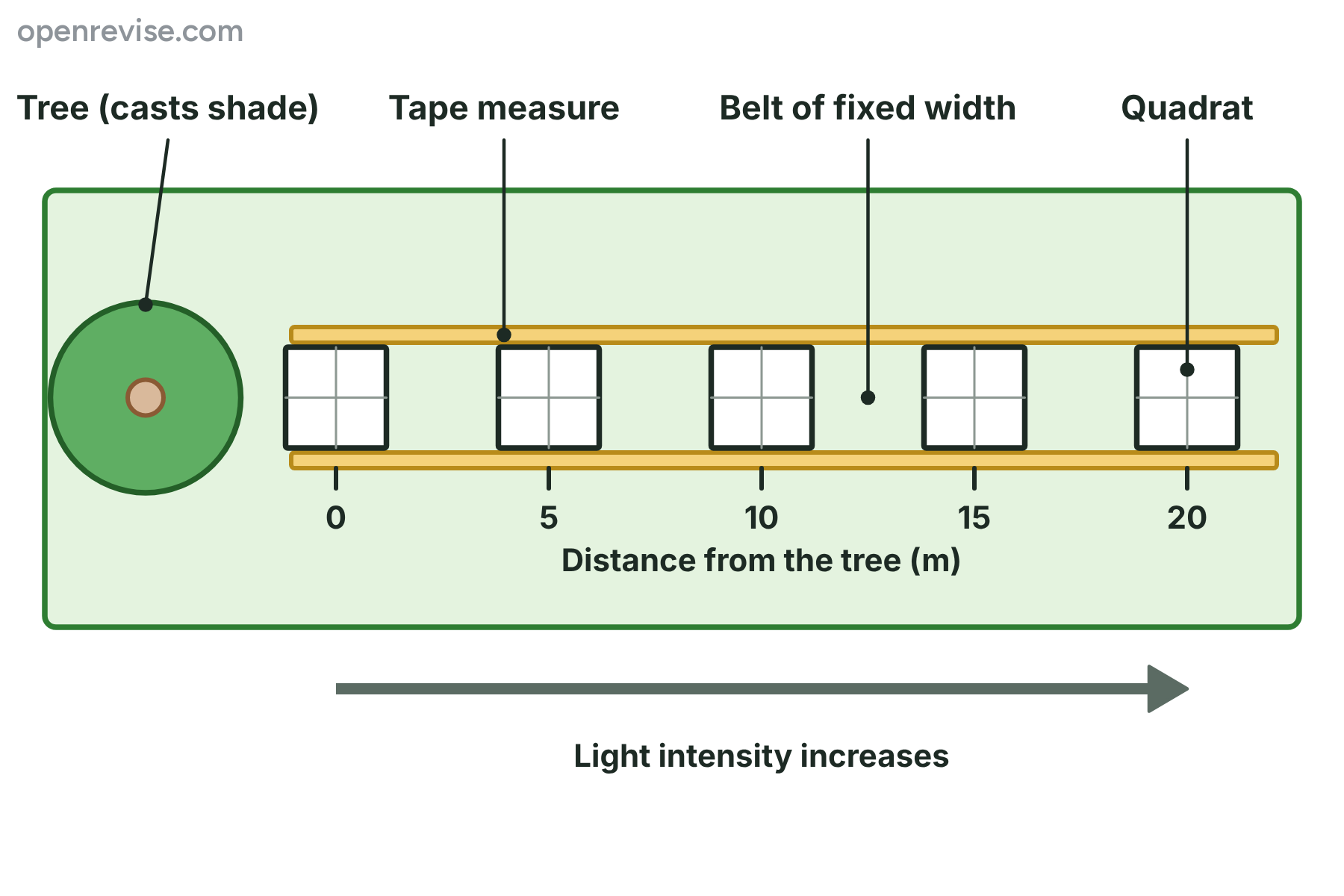
Quadrats are placed at regular intervals along a line running away from the tree. It shows how the organisms change as the light intensity increases from the shade into the open, so each quadrat can be linked to an abiotic factor.
-
What is a trophic level?
A feeding stage in a food chain.
-
Which organisms are at trophic level 1?
The producers.
-
What is biomass?
The mass of living material in organisms.
-
Why is biomass measured as dry mass?
The water content of organisms varies, so dry mass gives a fair comparison.
-
Name three ways energy is lost between trophic levels.
Heat from respiration, waste (faeces and urine), and parts that are not eaten.
-
What is the biggest loss of energy at each trophic level?
Heat released by respiration.
-
What typical percentage of energy is transferred to the next trophic level?
About 10%, although it varies.
-
Why is energy loss to heat described as a transfer to a less useful form?
Organisms cannot use heat in the surroundings to build biomass.
-
Why do birds and mammals lose a lot of energy as heat?
They keep a constant body temperature higher than their surroundings.
-
Why are there fewer organisms at higher trophic levels?
Less energy and less biomass are available at each higher level.
-
Why are food chains rarely longer than five trophic levels?
Too little energy is left to support another population.
-
Why is a pyramid of biomass wider at the bottom?
There is more biomass at each lower level, because energy is lost at every step.
-
What is the equation for efficiency of energy transfer?
(energy transferred to the next level \(\div\) energy available) \(\times\) 100.
-
A level has 5 000 kJ and the next has 400 kJ. What is the efficiency?
\(400 \div 5000 \times 100 = 8\%\).
-
Calculate the percentage of biomass transferred: 250 g to 30 g.
\(30 \div 250 \times 100 = 12\%\).
-
Why can a field of crops feed more people than a field of beef cattle?
The crops are a shorter food chain with fewer energy losses.
-
Which trophic level has the least energy in a food chain?
The top (tertiary or final) consumer.
-
Where does the energy that is lost from a food chain end up?
In the surroundings as heat, with some in the dead material that decomposers break down.
-
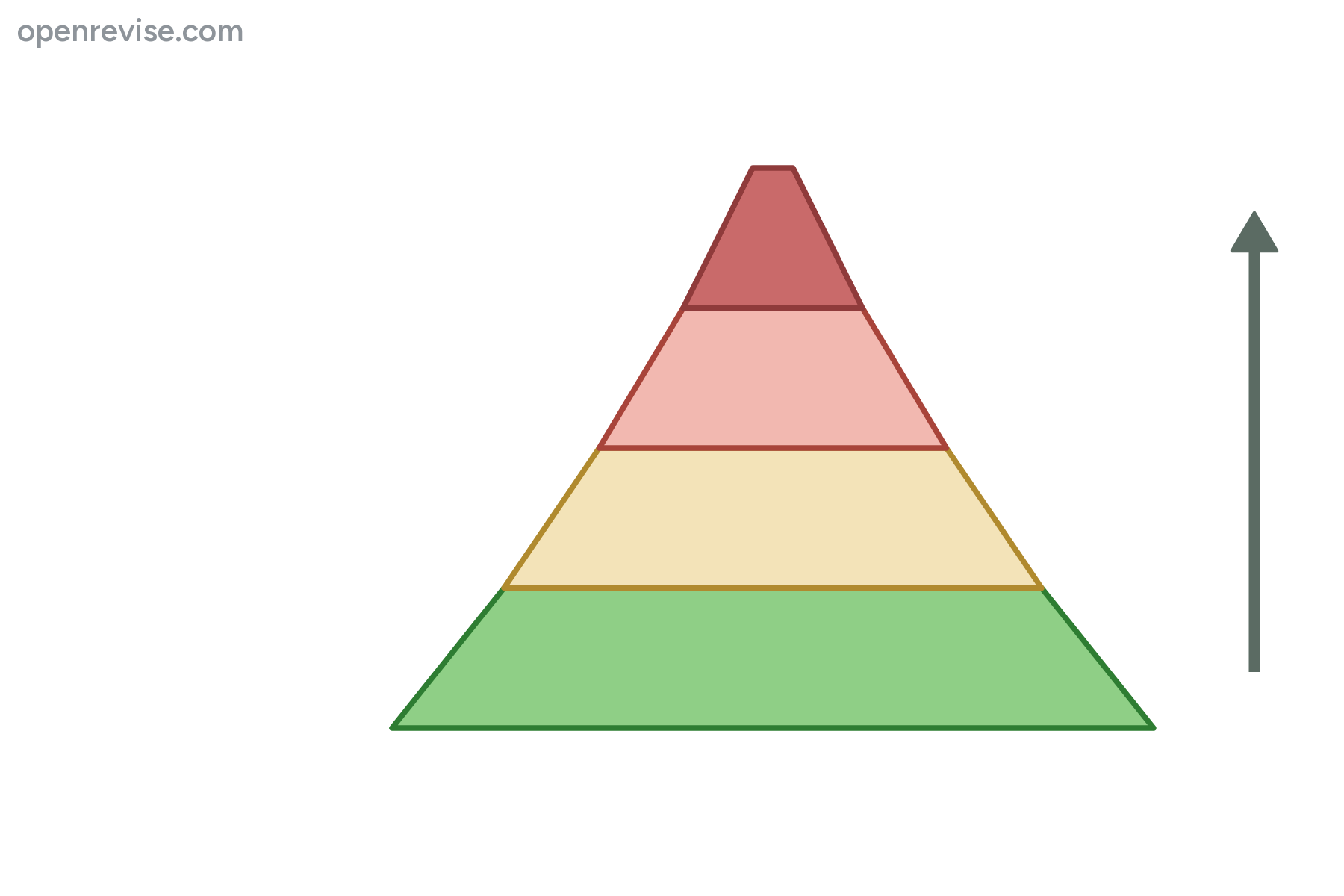 Name each trophic level, and say why the pyramid is this shape.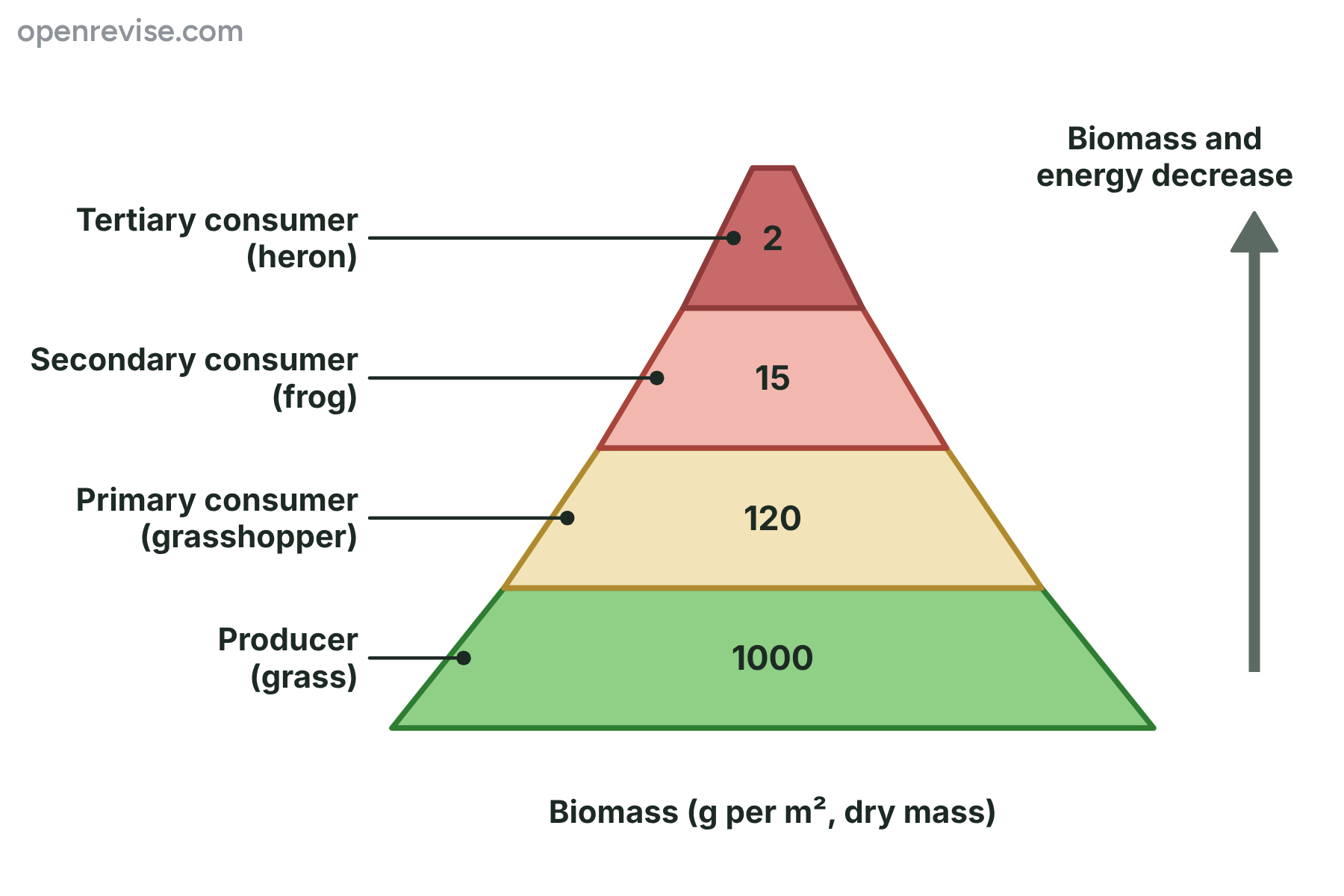
From the bottom: producer, primary consumer, secondary consumer and tertiary consumer. It narrows because energy is lost at each trophic level (as heat, waste and uneaten parts), so there is less biomass at each higher level.
-
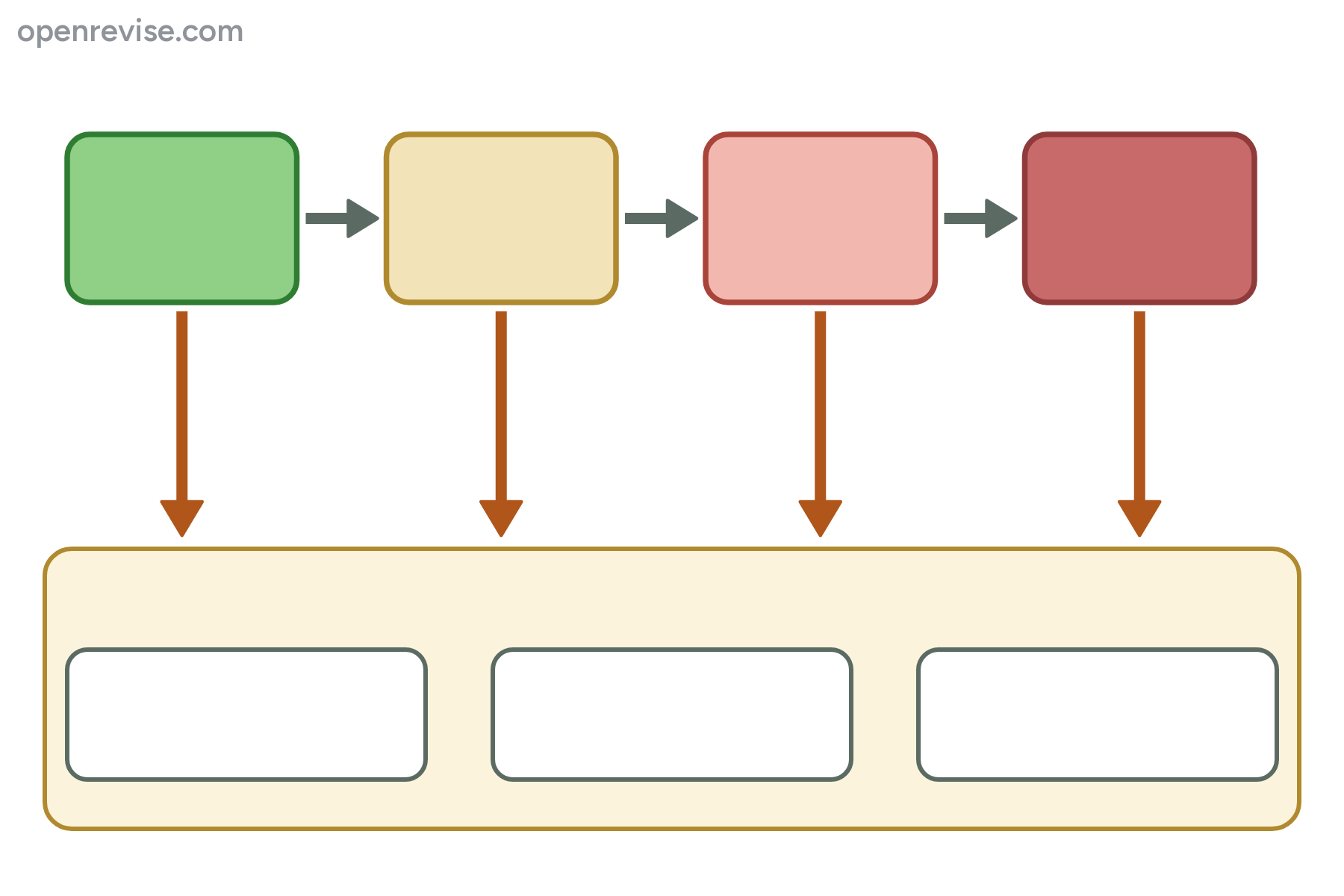 Describe what happens to the energy at each stage in this food chain.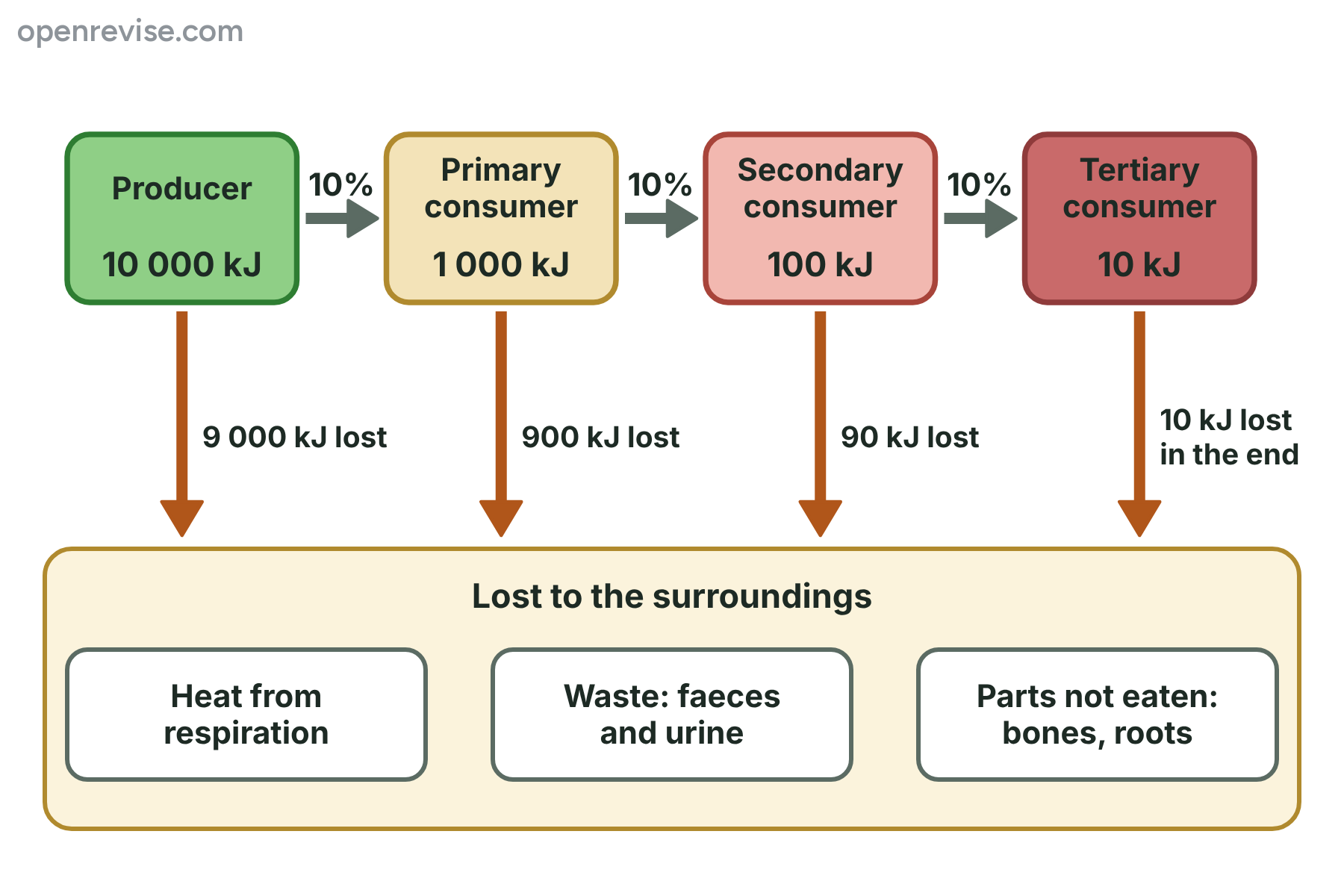
About 10% of the energy is passed on at each step, and the other 90% is lost to the surroundings. It is lost as heat from respiration, in waste such as faeces and urine, and in parts that are not eaten, such as bones and roots.