Viewing as
Teaching this? The teacher view adds 2 files, the mark schemes and the model answers.
History · Crime and punishment in medieval England
Crime and Punishment in Anglo-Saxon England
How a kingdom with no police force, no prisons and no professional judges kept order - and why the whole village was expected to do it.
What Do You Already Think?
Answer before the lesson, then check your ideas at the end.
-
Who would catch a thief in a village with no police?
The villagers themselves, through the hue and cry and the tithing.
-
How could a court decide guilt with no evidence?
Oaths from respected neighbours, or trial by ordeal - letting God decide.
-
Were there prisons?
Hardly any. Gaols held people awaiting trial; prison was not a punishment.
-
Who made the laws?
The king, through written law codes, with local custom alongside.
Learning Objectives
- 1Identify crimes against the person, property and authority in Anglo-Saxon England.
- 2Explain how tithings, the hue and cry and the local courts kept order without a police force.
- 3Describe how guilt was decided, including oaths and trial by ordeal.
- 4Explain the aims of Anglo-Saxon punishments, including wergild.
Setting the Scene
Around 1000, England was a Christian kingdom of small villages where almost everyone knew everyone. The king kept the King's Peace by issuing law codes, but he had no police force and few officials. Law and order depended on the community: villagers were expected to catch, accuse and bring wrongdoers to court themselves.
- c1000 England is divided into shires, and each shire into hundreds, each with its own court.
- c1008 King Aethelred's law codes set out the duties of free men and the penalties for crime.
- c1020 King Cnut's law codes restate the tithing, the hue and cry and wergild.
- 1066 The Norman conquest - the end of the Anglo-Saxon system as a system of its own.
Types of Crime
Historians sort medieval crime into three kinds - the exam expects you to use them.
-
Crimes against the person
Murder, assault, rape. Treated as harm done to a family, who expected compensation.
-
Crimes against property
Theft, robbery, arson, poaching. Theft was by far the most common crime.
-
Crimes against authority
Treason - betraying the king or your lord - and rebellion. The most serious crime of all.
-
Moral crimes
Adultery, drunkenness, failing to attend church. Dealt with by the Church.
-
Why theft dominated
Most people were poor farmers; a stolen animal or tools could ruin a family.
-
The King's Peace
A crime was increasingly seen as a breach of the king's peace, not only harm to a victim.
Keeping Order Without a Police Force
Every free man was part of a system that made his neighbours responsible for him.
-
Tithings
Groups of ten men over the age of twelve who were responsible for each other's behaviour. If one broke the law, the others had to bring him to court or pay a fine.
-
Hue and cry
A victim or witness raised the alarm and every man in the village had to stop work and chase the suspect. A village that failed to join in could be fined.
-
The reeve
The king's local official. The shire-reeve - later the sheriff - brought suspects to court and collected fines.
-
Collective responsibility
Because the whole community paid if it failed, everyone had a reason to keep watch on everyone else.
From Crime to Court
Every stage depended on ordinary people, not officials.
-
1
Hue and cry
The alarm is raised and the village chases the suspect.
-
2
Tithing answers
If he escapes, his tithing must produce him at court or pay.
-
3
Court meets
The hundred court (monthly) or shire court (twice a year) hears the accusation in the open.
-
4
Oath-helpers
Respected men swear to the accused's good character - enough oaths could clear him.
-
5
Ordeal
If oaths could not settle it, the case went to God through trial by ordeal.
Trial by Ordeal
When a court could not decide, it asked God. Ordeals took place in or near a church, after the accused had fasted and heard Mass, and a priest blessed the water or the iron.
The four ordeals
- Hot iron Carry a red-hot iron bar three paces. If the bandaged burn healed cleanly after three days, innocent.
- Hot water Pick a stone out of boiling water. Judged by the healing of the hand, as with hot iron.
- Cold water Lowered into blessed water: sinking meant innocent, floating meant the water had rejected you.
- Consecrated bread For priests. Choke on the blessed bread and you were guilty.
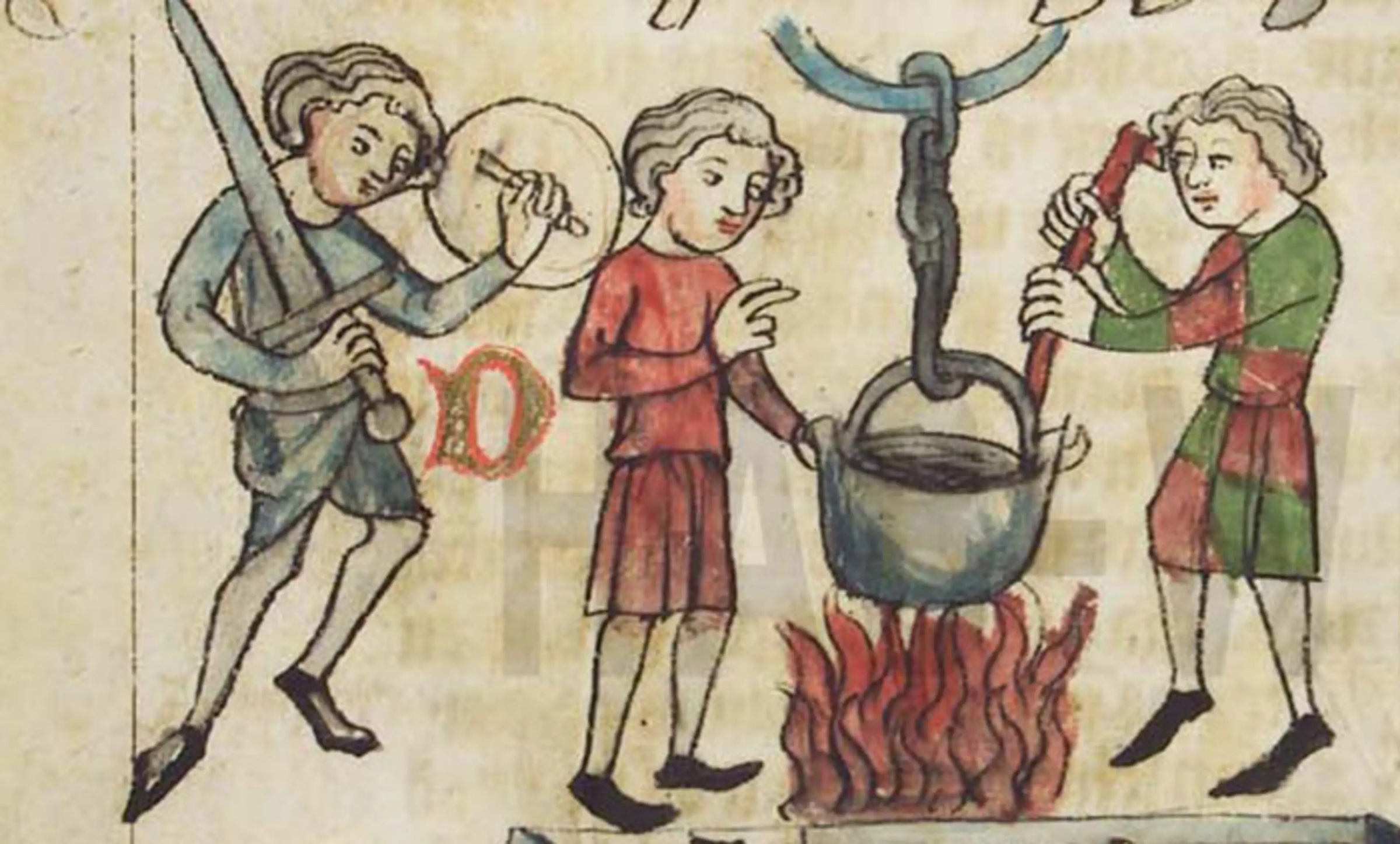
Guilt was left for God to reveal.
How Offenders Were Punished
Punishment aimed at compensation and deterrence, not reform.
-
Wergild
Used for: Murder and injury. Why: Compensation to the family, set by the victim's rank, to stop blood feuds
-
Fines
Used for: Most minor crimes. Why: Paid to the victim, and increasingly to the king
-
Stocks and pillory
Used for: Petty crimes. Why: Public humiliation as a warning to others
-
Mutilation
Used for: Repeat offenders. Why: Cutting off a hand, ear or nose - a lasting mark and deterrent
-
Execution
Used for: Treason, repeat theft. Why: Hanging, for crimes that threatened the king or the community
The Law in the King's Own Words
Even the king's written law works through the tithing and the hue and cry - Anglo-Saxon justice depended on the community rather than on royal officials.
And if anyone flees from the hue and cry, let him pay the wergild of the man he has slain, and let his tithing answer for him.
Summary & Exam Focus
- Theft was the most common crime; treason the most serious.
- Order depended on the community: tithings, the hue and cry and local courts.
- Where oaths could not decide guilt, trial by ordeal left it to God.
- Punishments aimed at compensation (wergild) and deterrence, not prison.
Exam focus
Explain why the community played such an important role in law enforcement in Anglo-Saxon England. (12 marks) (12 marks)
Give at least three reasons, each explained with specific detail - and include one that goes beyond the stimulus points.
Key terms
The vocabulary this lesson expects you to use. Each one is linked from the first place it appears above.
- Tithing
- A group of ten men over twelve who were responsible for each other's behaviour.
- Hue and cry
- The duty of every villager to chase a suspect once the alarm was raised.
- Wergild
- "Man price": compensation paid to a victim's family, set by the victim's rank.
- Trial by ordeal
- A religious test asking God to show whether the accused was guilty.
- Oath-helpers
- Men who swore to the good character of the accused.
- King's Peace
- The idea that the king was responsible for keeping order across his kingdom.
- Reeve
- A local royal official; the shire-reeve became the sheriff.
Downloads
Free to keep, print and annotate.
- Crime and Punishment in Anglo-Saxon England.pptx Built from the lesson script on 23 September 2026. View
- Crime and Punishment in Anglo-Saxon England - Completed Notes.docx The full notes for the lesson, every gap filled in - to check against, or to revise from. Built from the lesson script on 23 September 2026. View
- Crime and Punishment in Anglo-Saxon England - Exam Questions.docx Built from the lesson script on 23 September 2026. View
Something here looks wrong?
Tell us what and we will go and look. It goes to whoever writes these pages, nobody else, and we do not ask who you are — so there is nothing to sign and nothing comes back to you.