Maths · Vectors, Constructions and Loci
Viewing as
Teacher view: every answer and mark scheme set out in full.
Loci
Drawing and shading regions defined by distances from points and lines, using bisectors and circles.
Learning Objectives
- 1Draw the locus of points at a fixed distance from a point, from a line and from two points.
- 2Draw the locus of points equidistant from two points and from two lines.
- 3Combine loci to find a region that meets several conditions.
- 4Describe a region from a scale drawing and shade it correctly.
Where can the point be
A locus is the set of all points that follow a rule, such as being 3 cm from a point. The plural is loci. A locus can be a curve, a line or a region, and an exam question usually gives a rule in words and asks for a drawing, or gives a drawing and asks you to shade the region where several rules are true at once. All the constructions from the previous lesson are used here, and the working must show the arcs. The sentences used for the rules are fairly standard, so it is worth learning what each one means as a drawing.
The four basic loci
Each rule in words gives a standard drawing.
-
A fixed distance from a point
A circle, centred on the point, with that radius.
-
A fixed distance from a line
A pair of parallel lines on either side, with rounded ends at the ends of the line (like a racetrack).
-
Equidistant from two points
The perpendicular bisector of the line joining them.
-
Equidistant from two lines
The angle bisector of the angle between the lines.
A circle and a bisector
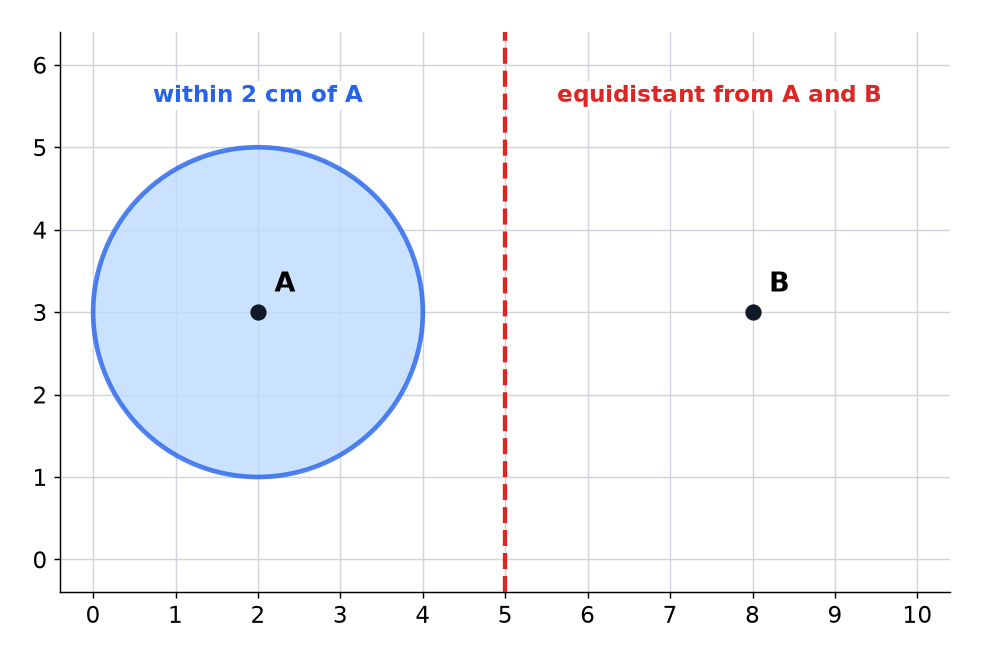
The shaded circle shows all the points no more than 2 cm from \(A\). The dashed line at \(x = 5\) is the perpendicular bisector of \(AB\), made of the points that are the same distance from \(A\) and \(B\).
Reading the drawing
- Inside the circle "Less than 2 cm from \(A\)" is the shaded region.
- On the circle "Exactly 2 cm" is the circle itself.
- Left of the line Points on the \(A\) side of the bisector are closer to \(A\) than to \(B\).
- Right of the line Points on the \(B\) side are closer to \(B\).
Describing a region
A treasure is buried less than 3 cm from \(A\) and closer to \(B\) than to \(A\). Describe how to find the region on a drawing where \(AB = 5\) cm.
Show the solutionHide the solution
- 1 First rule Draw a circle of radius 3 cm around \(A\), because less than 3 cm means inside it.
- 2 Second rule Construct the perpendicular bisector of \(AB\), which is 2.5 cm from \(A\).
- 3 Which side Closer to \(B\) means the side with \(B\) on it.
- 4 Combine The circle reaches 3 cm from \(A\), which is 0.5 cm past the bisector, so the region is the small piece of the circle on the \(B\) side of the bisector.
AnswerInside the circle of radius 3 cm around \(A\), and on the \(B\) side of the perpendicular bisector of \(AB\)
Using a scale drawing
Many loci questions give a real situation, so you draw it to scale first.
-
Choose the scale
1 cm for every 1 m, or whatever the question says.
-
Draw the shape
Use a ruler for the walls, fences or paths.
-
Add the loci
Draw arcs, parallel lines and bisectors as needed.
-
Shade
Shade the region where all the rules are true, and say which rules you used.
A garden problem
A rectangular garden \(ABCD\) has \(AB = 8\) m and \(BC = 5\) m. A bush must be planted closer to \(AB\) than to \(AD\), and less than 6 m from \(A\). Describe how to find the region on a scale drawing using 1 cm for 1 m.
Show the solutionHide the solution
- 1 Draw the garden A rectangle 8 cm by 5 cm.
- 2 Closer to \(AB\) than \(AD\) Bisect the angle at \(A\), which is \(45^\circ\) to each side, and take the side nearer \(AB\).
- 3 Less than 6 m from \(A\) Draw an arc of radius 6 cm centred on \(A\).
- 4 Shade The region inside the garden, inside the arc, and on the \(AB\) side of the bisector.
AnswerBisect angle \(A\), draw an arc of radius 6 cm from \(A\), and shade inside the arc on the \(AB\) side of the bisector
Test yourself
-
1
What is the locus of points 3 cm from a point?
Show answerHide answer
A circle of radius 3 cm.
-
2
What is the locus of points equidistant from two points?
Show answerHide answer
The perpendicular bisector of the line joining them.
-
3
What is the locus of points equidistant from two lines?
Show answerHide answer
The bisector of the angle between them.
-
4
What does "less than 3 cm" mean on a drawing?
Show answerHide answer
The inside of the circle.
-
5
What shape is the locus of points 2 cm from a line segment?
Show answerHide answer
A racetrack shape: parallel lines with rounded ends.
Exam technique: loci
Draw carefully, leave the arcs, and shade clearly.
-
Use a sharp pencil and ruler
Accuracy matters.
-
Show construction arcs
They earn the method marks.
-
Shade the final region only
Do not shade the loci that are only used along the way.
-
Read the wording
"Closer to" and "nearer than" choose a side, and "within" means inside.
Summary and exam focus
- A locus is the set of all points that follow a rule.
- The standard loci are the circle, parallel lines, the perpendicular bisector and the angle bisector.
- To find a region, draw each locus and shade where all the rules are true.
- Leave all construction arcs on the drawing.
Exam focus
Describe the locus of points that are 4 cm from a fixed point \(P\). (1 mark) (1 marks)
Write "a circle with centre \(P\) and radius 4 cm". Saying only "a circle" or only "4 cm away" does not score the mark.
Key terms
The words this lesson expects you to use. Each one is linked from the first place it appears above.
- Locus
- The set of all points that follow a given rule.
- Loci
- More than one locus.
- Equidistant
- The same distance from two or more things.
- Region
- An area of the drawing where the rules are true.
- Perpendicular bisector
- A line that cuts another line in half at right angles.
- Angle bisector
- A line that divides an angle into two equal parts.
- Radius
- The distance from the centre of a circle to its edge.
- Scale drawing
- A drawing in which all lengths are in proportion to the real ones.
- Arc
- Part of a circle drawn with compasses.
Questions and answers
15 questions set on this lesson, with the mark schemes and model answers open.
Draw the locus of all the points that are 4 cm from a point \(P\). [2 marks]
Mark scheme — 2 marks available
- A circle — M1
- With centre \(P\) and radius 4 cm — A1
Model answer
The locus is a circle with centre \(P\) and radius 4 cm.
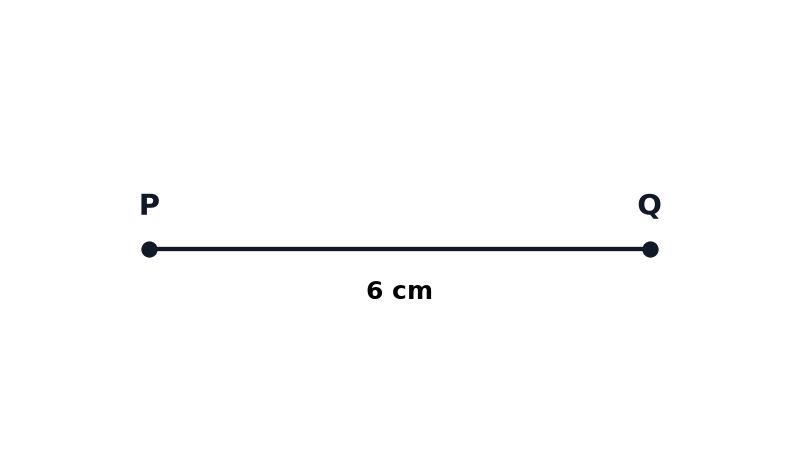
The diagram shows two points \(P\) and \(Q\) that are 6 cm apart. Shade the region of points that are closer to \(P\) than to \(Q\) and are less than 4 cm from \(Q\). [4 marks]
Mark scheme — 4 marks available
- Perpendicular bisector of PQ with arcs — M1
- The \(P\) side chosen — A1
- Circle of radius 4 cm centred on \(Q\) — M1
- The correct region shaded — A1
Model answer
Construct the perpendicular bisector of \(PQ\), which is 3 cm from each point, and draw a circle of radius 4 cm around \(Q\). The region is inside the circle and on the \(P\) side of the bisector.
A rectangle \(ABCD\) has \(AB = 8\) cm and \(AD = 5\) cm. Describe the locus of points inside the rectangle that are the same distance from \(AB\) and from \(AD\). [3 marks]
Mark scheme — 3 marks available
- The bisector of the angle at A — M1
- At \(45^\circ\) to \(AB\) and \(AD\) — A1
- Stopping at the side DC, 5 cm along — B1
Model answer
The locus is the bisector of angle \(A\). It is a straight line from \(A\) at \(45^\circ\) to both sides, up to where it meets \(DC\) at 5 cm along.
A tree is at the point \(T\). A scale drawing uses 1 cm to 1 m. Describe the locus of all the points that are exactly 2 m from the tree, and say how it is drawn. [3 marks]
Mark scheme — 3 marks available
- A circle — M1
- Centre \(T\) — A1
- Radius 2 cm on the drawing — B1
Model answer
The locus is a circle with centre \(T\). On the drawing the radius is 2 cm.
\(A\) and \(B\) are two points 10 cm apart. Show how to find the region of points that are less than 6 cm from \(A\) and less than 6 cm from \(B\). [4 marks]
Mark scheme — 4 marks available
- Circle of radius 6 cm centred on \(A\) — M1
- Circle of radius 6 cm centred on \(B\) — M1
- The overlap shaded — A1
- Symmetrical about the perpendicular bisector — B1
Model answer
Draw a circle of radius 6 cm around \(A\) and a circle of radius 6 cm around \(B\). The region is where the two circles overlap, which is a lens-shaped region centred on the perpendicular bisector of \(AB\), which is 5 cm from each.
\(P\) and \(Q\) are 10 cm apart. Is there a point that is closer to \(Q\) than to \(P\) and less than 4 cm from \(P\)? Explain your answer. [3 marks]
Mark scheme — 3 marks available
- No — B1
- The bisector is 5 cm from \(P\) — M1
- The circle of radius 4 cm does not reach it — A1
Model answer
No. The perpendicular bisector is 5 cm from \(P\), and the points closer to \(Q\) are on the far side of it. A point less than 4 cm from \(P\) is inside a circle that does not reach the bisector.
What is the locus of points 3 cm from a point \(P\)?
Why: All points the same distance from \(P\) form a circle.
What is the locus of points that are the same distance from two points \(A\) and \(B\)?
Why: Every point on the perpendicular bisector is equidistant from \(A\) and \(B\).
What is the locus of points that are the same distance from two lines that meet at a point?
Why: The angle bisector is equidistant from both arms.
On a drawing, which region is “less than 3 cm from \(P\)”?
Why: Less than 3 cm means closer than the circle, so inside it.
What is the locus of points 2 cm from a line segment?
Why: Near the ends, the points 2 cm away form semicircles.
\(A\) and \(B\) are two points. Which side of the perpendicular bisector is “closer to \(A\) than \(B\)”?
Why: Points nearer to \(A\) are on \(A\)'s side of the bisector.
On a scale drawing with 1 cm for 1 m, a tree must be within 4 m of a post. What do you draw?
Why: 4 m is 4 cm on the drawing.
A rectangle \(ABCD\) has \(A\) at the bottom left and \(B\) to its right. Which line separates the points closer to \(AB\) from those closer to \(AD\)?
Why: The angle bisector at \(A\) is the same distance from \(AB\) and \(AD\).
\(A\) and \(B\) are 8 cm apart. Is there a point closer to \(B\) than \(A\) that is less than 3 cm from \(A\)?
Why: The bisector is 4 cm from \(A\), and a circle of radius 3 cm around \(A\) does not reach it.