Maths · Vectors, Constructions and Loci
Viewing as
Teaching this? The teacher view opens every answer and mark scheme.
Vector Geometry and Proof
Finding vectors by routes around a diagram, dividing lines in a ratio, and proving lines parallel or points collinear.
Learning Objectives
- 1Write one vector in terms of others using paths around a diagram.
- 2Find the vector to a midpoint, and (Higher tier) to a point that divides a line in a given ratio.
- 3Prove that lines are parallel, and that three points are on a straight line (Higher tier).
- 4Find the magnitude of a vector in a geometric problem (Higher tier).
Proving things with vectors
In vector geometry you are not given the numbers, only letters such as \(\mathbf{a}\) and \(\mathbf{b}\). The skill is to get from one point to another along a path of known vectors, adding them up with the right signs, and then to compare two results. If one result is a multiple of the other, the lines are parallel, and if they also share a point, the three points are on a straight line. Finding a vector by a route in a diagram appears at both tiers, while dividing lines in a ratio and proving that lines are parallel or that points are collinear are Higher tier. The questions are written so that the algebra is short, but each step needs a reason.
Finding vectors by routes
To find a vector, go from the start to the finish along paths you know, adding vectors that go the right way and subtracting those that go the wrong way.
-
Any route
\(\overrightarrow{AB}\) can be reached by going from \(A\) to \(O\) and then from \(O\) to \(B\), so \(\overrightarrow{AB} = \overrightarrow{AO} + \overrightarrow{OB}\).
-
Going backwards
If \(\overrightarrow{OA} = \mathbf{a}\), then \(\overrightarrow{AO} = -\mathbf{a}\).
-
A key result
If \(\overrightarrow{OA} = \mathbf{a}\) and \(\overrightarrow{OB} = \mathbf{b}\), then \(\overrightarrow{AB} = -\mathbf{a} + \mathbf{b} = \mathbf{b} - \mathbf{a}\).
-
Simplify at the end
Collect the terms in \(\mathbf{a}\) and the terms in \(\mathbf{b}\).
A triangle of vectors
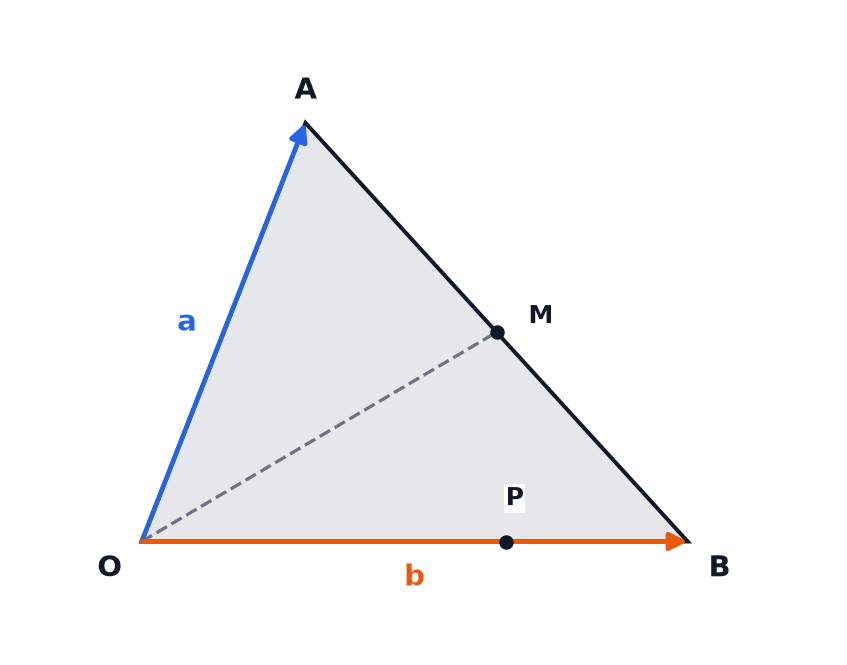
The vector \(\overrightarrow{AB}\) goes from \(A\) back to \(O\) and then out to \(B\), so \(\overrightarrow{AB} = -\mathbf{a} + \mathbf{b}\). The midpoint \(M\) is halfway along \(AB\), so \(\overrightarrow{AM} = \dfrac{1}{2}(\mathbf{b} - \mathbf{a})\), and \(\overrightarrow{OM} = \mathbf{a} + \dfrac{1}{2}(\mathbf{b} - \mathbf{a}) = \dfrac{1}{2}\mathbf{a} + \dfrac{1}{2}\mathbf{b}\).
Using the diagram
- Vector \(\overrightarrow{AB}\) \(\mathbf{b} - \mathbf{a}\).
- Midpoint \(M\) \(\overrightarrow{OM} = \dfrac{1}{2}(\mathbf{a} + \mathbf{b})\).
- Point \(P\) on \(OB\) (Higher tier) \(OP : PB = 2 : 1\), so \(\overrightarrow{OP} = \dfrac{2}{3}\mathbf{b}\).
- Vector \(\overrightarrow{PM}\) \(\overrightarrow{PM} = -\dfrac{2}{3}\mathbf{b} + \dfrac{1}{2}\mathbf{a} + \dfrac{1}{2}\mathbf{b} = \dfrac{1}{2}\mathbf{a} - \dfrac{1}{6}\mathbf{b}\).
Vectors in a triangle
\(OAB\) is a triangle with \(\overrightarrow{OA} = \mathbf{a}\) and \(\overrightarrow{OB} = \mathbf{b}\). \(M\) is the midpoint of \(AB\). Find \(\overrightarrow{OM}\) in terms of \(\mathbf{a}\) and \(\mathbf{b}\).
Show the solutionHide the solution
- 1 Find \(\overrightarrow{AB}\) \(\overrightarrow{AB} = -\mathbf{a} + \mathbf{b}\).
- 2 Half way \(\overrightarrow{AM} = \dfrac{1}{2}\overrightarrow{AB} = \dfrac{1}{2}(\mathbf{b} - \mathbf{a})\).
- 3 Go via \(A\) \(\overrightarrow{OM} = \overrightarrow{OA} + \overrightarrow{AM} = \mathbf{a} + \dfrac{1}{2}\mathbf{b} - \dfrac{1}{2}\mathbf{a}\).
- 4 Simplify \(\overrightarrow{OM} = \dfrac{1}{2}\mathbf{a} + \dfrac{1}{2}\mathbf{b}\).
Answer\(\overrightarrow{OM} = \dfrac{1}{2}\mathbf{a} + \dfrac{1}{2}\mathbf{b}\)
Points that divide a line in a ratio (Higher tier)
A point that divides a line in the ratio \(m : n\) is \(\dfrac{m}{m + n}\) of the way along.
-
Ratio to fraction
A point \(P\) with \(AP : PB = 2 : 3\) is \(\dfrac{2}{5}\) of the way from \(A\) to \(B\).
-
Vector to the point
\(\overrightarrow{AP} = \dfrac{2}{5}\overrightarrow{AB}\).
-
Then add the route
\(\overrightarrow{OP} = \overrightarrow{OA} + \overrightarrow{AP}\).
-
Check with the midpoint
The ratio \(1 : 1\) gives \(\dfrac{1}{2}\), which matches the midpoint.
Proving lines are parallel or points are collinear (Higher tier)
Compare two vectors written in the same letters.
-
Parallel
If \(\overrightarrow{PQ} = k\overrightarrow{RS}\) for a number \(k\), then \(PQ\) and \(RS\) are parallel.
-
Collinear
Three points \(A\), \(B\) and \(C\) are on a straight line if \(\overrightarrow{AB} = k\overrightarrow{BC}\), because the vectors are parallel and share the point \(B\).
-
Say it in words
"\(\overrightarrow{AB}\) is a multiple of \(\overrightarrow{BC}\), so they are parallel, and \(B\) is a common point, so \(A\), \(B\) and \(C\) are collinear."
-
Length
The length of a vector in column form is \(\sqrt{x^2 + y^2}\), as in Pythagoras.
Proving points are collinear (Higher tier)
\(\overrightarrow{OA} = \mathbf{a}\), \(\overrightarrow{OB} = \mathbf{b}\) and \(\overrightarrow{OC} = 3\mathbf{b} - 2\mathbf{a}\). Prove that \(A\), \(B\) and \(C\) lie on a straight line.
Show the solutionHide the solution
- 1 Find \(\overrightarrow{AB}\) \(\overrightarrow{AB} = -\mathbf{a} + \mathbf{b}\).
- 2 Find \(\overrightarrow{BC}\) \(\overrightarrow{BC} = -\mathbf{b} + 3\mathbf{b} - 2\mathbf{a} = 2\mathbf{b} - 2\mathbf{a}\).
- 3 Compare \(\overrightarrow{BC} = 2(\mathbf{b} - \mathbf{a}) = 2\overrightarrow{AB}\).
- 4 Conclude The vectors are parallel and share the point \(B\), so \(A\), \(B\) and \(C\) are on a straight line.
Answer\(\overrightarrow{AB} = \mathbf{b} - \mathbf{a}\) and \(\overrightarrow{BC} = 2\mathbf{b} - 2\mathbf{a} = 2\overrightarrow{AB}\), so they are collinear
Test yourself
-
1
If \(\overrightarrow{OA} = \mathbf{a}\) and \(\overrightarrow{OB} = \mathbf{b}\), what is \(\overrightarrow{AB}\)?
Show answerHide answer
\(\mathbf{b} - \mathbf{a}\).
-
2
What is \(\overrightarrow{AO}\) if \(\overrightarrow{OA} = \mathbf{a}\)?
Show answerHide answer
\(-\mathbf{a}\).
-
3
What fraction of \(AB\) is \(AP\) if \(AP : PB = 2 : 3\)?
Show answerHide answer
\(\dfrac{2}{5}\).
-
4
How do you show two lines are parallel?
Show answerHide answer
Show that one vector is a multiple of the other.
-
5
How do you show three points are collinear?
Show answerHide answer
Show that two of the vectors are multiples, with a common point.
Exam technique: vector proofs
Show every step, because the answer is given or obvious.
-
Draw a diagram
Mark all the known vectors, with arrows.
-
Choose a route
Go from the start to the finish along known vectors.
-
Simplify fully
Collect the \(\mathbf{a}\) terms and the \(\mathbf{b}\) terms.
-
Write the conclusion
Say that the vectors are parallel and that there is a common point.
Summary and exam focus
- Find a vector by adding known vectors along a route, reversing the sign when going backwards.
- A point dividing \(AB\) in the ratio \(m : n\) is \(\dfrac{m}{m + n}\) of the way from \(A\) to \(B\).
- Parallel vectors are multiples of each other.
- Points are collinear if two vectors between them are parallel and share a point.
Exam focus
\(OAB\) is a triangle with \(\overrightarrow{OA} = \mathbf{a}\) and \(\overrightarrow{OB} = \mathbf{b}\). \(P\) is the point on \(AB\) with \(AP : PB = 1 : 2\). Find \(\overrightarrow{OP}\) in terms of \(\mathbf{a}\) and \(\mathbf{b}\). (3 marks) (3 marks)
\(\overrightarrow{AB} = \mathbf{b} - \mathbf{a}\), and \(AP\) is \(\dfrac{1}{3}\) of it. Then \(\overrightarrow{OP} = \mathbf{a} + \dfrac{1}{3}(\mathbf{b} - \mathbf{a}) = \dfrac{2}{3}\mathbf{a} + \dfrac{1}{3}\mathbf{b}\). Show the route \(\overrightarrow{OA} + \overrightarrow{AP}\) for the method mark.
Key terms
The words this lesson expects you to use. Each one is linked from the first place it appears above.
- Vector proof
- A proof that uses vectors to show a geometric fact.
- Route
- A path from one point to another made from known vectors.
- Collinear
- Lying on the same straight line.
- Midpoint
- The point halfway along a line.
- Ratio
- A comparison of two parts of a line, such as \(2 : 3\).
- Position vector
- The vector from the origin to a point.
- Scalar multiple
- A vector multiplied by a number.
- Magnitude
- The length of a vector.
- Parallel
- Having the same direction, so one vector is a multiple of the other.
You've finished the notes
Check your understanding
Test yourself while it is fresh. Start with the flashcards, then try the exam questions.
Something here looks wrong?
Tell us what and we will go and look. It goes to whoever writes these pages, nobody else, and we do not ask who you are — so there is nothing to sign and nothing comes back to you.