Maths · Vectors, Constructions and Loci
Viewing as
Teacher view: every answer and mark scheme set out in full.
Vector Geometry and Proof
Finding vectors by routes around a diagram, dividing lines in a ratio, and proving lines parallel or points collinear.
Learning Objectives
- 1Write one vector in terms of others using paths around a diagram.
- 2Find the vector to a midpoint, and (Higher tier) to a point that divides a line in a given ratio.
- 3Prove that lines are parallel, and that three points are on a straight line (Higher tier).
- 4Find the magnitude of a vector in a geometric problem (Higher tier).
Proving things with vectors
In vector geometry you are not given the numbers, only letters such as \(\mathbf{a}\) and \(\mathbf{b}\). The skill is to get from one point to another along a path of known vectors, adding them up with the right signs, and then to compare two results. If one result is a multiple of the other, the lines are parallel, and if they also share a point, the three points are on a straight line. Finding a vector by a route in a diagram appears at both tiers, while dividing lines in a ratio and proving that lines are parallel or that points are collinear are Higher tier. The questions are written so that the algebra is short, but each step needs a reason.
Finding vectors by routes
To find a vector, go from the start to the finish along paths you know, adding vectors that go the right way and subtracting those that go the wrong way.
-
Any route
\(\overrightarrow{AB}\) can be reached by going from \(A\) to \(O\) and then from \(O\) to \(B\), so \(\overrightarrow{AB} = \overrightarrow{AO} + \overrightarrow{OB}\).
-
Going backwards
If \(\overrightarrow{OA} = \mathbf{a}\), then \(\overrightarrow{AO} = -\mathbf{a}\).
-
A key result
If \(\overrightarrow{OA} = \mathbf{a}\) and \(\overrightarrow{OB} = \mathbf{b}\), then \(\overrightarrow{AB} = -\mathbf{a} + \mathbf{b} = \mathbf{b} - \mathbf{a}\).
-
Simplify at the end
Collect the terms in \(\mathbf{a}\) and the terms in \(\mathbf{b}\).
A triangle of vectors
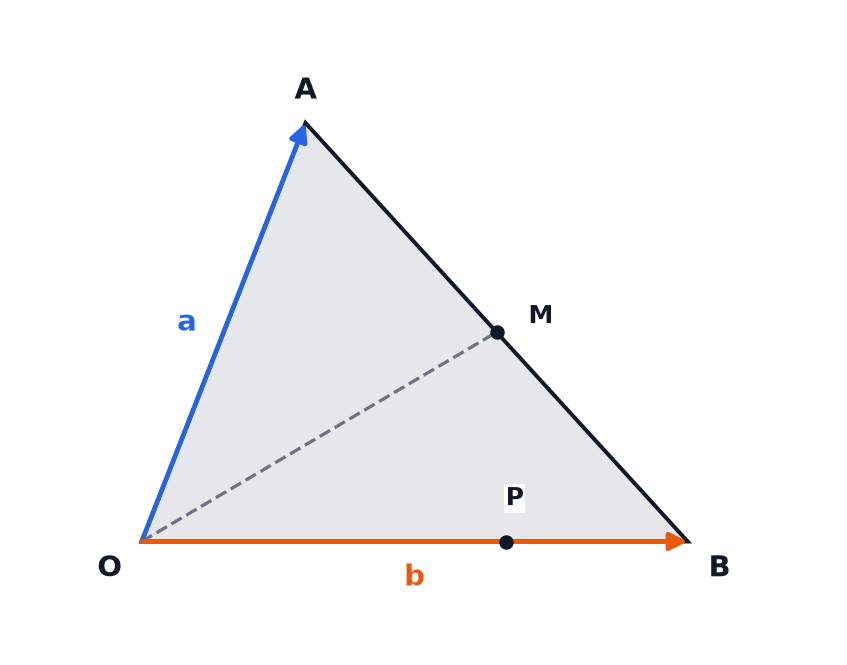
The vector \(\overrightarrow{AB}\) goes from \(A\) back to \(O\) and then out to \(B\), so \(\overrightarrow{AB} = -\mathbf{a} + \mathbf{b}\). The midpoint \(M\) is halfway along \(AB\), so \(\overrightarrow{AM} = \dfrac{1}{2}(\mathbf{b} - \mathbf{a})\), and \(\overrightarrow{OM} = \mathbf{a} + \dfrac{1}{2}(\mathbf{b} - \mathbf{a}) = \dfrac{1}{2}\mathbf{a} + \dfrac{1}{2}\mathbf{b}\).
Using the diagram
- Vector \(\overrightarrow{AB}\) \(\mathbf{b} - \mathbf{a}\).
- Midpoint \(M\) \(\overrightarrow{OM} = \dfrac{1}{2}(\mathbf{a} + \mathbf{b})\).
- Point \(P\) on \(OB\) (Higher tier) \(OP : PB = 2 : 1\), so \(\overrightarrow{OP} = \dfrac{2}{3}\mathbf{b}\).
- Vector \(\overrightarrow{PM}\) \(\overrightarrow{PM} = -\dfrac{2}{3}\mathbf{b} + \dfrac{1}{2}\mathbf{a} + \dfrac{1}{2}\mathbf{b} = \dfrac{1}{2}\mathbf{a} - \dfrac{1}{6}\mathbf{b}\).
Vectors in a triangle
\(OAB\) is a triangle with \(\overrightarrow{OA} = \mathbf{a}\) and \(\overrightarrow{OB} = \mathbf{b}\). \(M\) is the midpoint of \(AB\). Find \(\overrightarrow{OM}\) in terms of \(\mathbf{a}\) and \(\mathbf{b}\).
Show the solutionHide the solution
- 1 Find \(\overrightarrow{AB}\) \(\overrightarrow{AB} = -\mathbf{a} + \mathbf{b}\).
- 2 Half way \(\overrightarrow{AM} = \dfrac{1}{2}\overrightarrow{AB} = \dfrac{1}{2}(\mathbf{b} - \mathbf{a})\).
- 3 Go via \(A\) \(\overrightarrow{OM} = \overrightarrow{OA} + \overrightarrow{AM} = \mathbf{a} + \dfrac{1}{2}\mathbf{b} - \dfrac{1}{2}\mathbf{a}\).
- 4 Simplify \(\overrightarrow{OM} = \dfrac{1}{2}\mathbf{a} + \dfrac{1}{2}\mathbf{b}\).
Answer\(\overrightarrow{OM} = \dfrac{1}{2}\mathbf{a} + \dfrac{1}{2}\mathbf{b}\)
Points that divide a line in a ratio (Higher tier)
A point that divides a line in the ratio \(m : n\) is \(\dfrac{m}{m + n}\) of the way along.
-
Ratio to fraction
A point \(P\) with \(AP : PB = 2 : 3\) is \(\dfrac{2}{5}\) of the way from \(A\) to \(B\).
-
Vector to the point
\(\overrightarrow{AP} = \dfrac{2}{5}\overrightarrow{AB}\).
-
Then add the route
\(\overrightarrow{OP} = \overrightarrow{OA} + \overrightarrow{AP}\).
-
Check with the midpoint
The ratio \(1 : 1\) gives \(\dfrac{1}{2}\), which matches the midpoint.
Proving lines are parallel or points are collinear (Higher tier)
Compare two vectors written in the same letters.
-
Parallel
If \(\overrightarrow{PQ} = k\overrightarrow{RS}\) for a number \(k\), then \(PQ\) and \(RS\) are parallel.
-
Collinear
Three points \(A\), \(B\) and \(C\) are on a straight line if \(\overrightarrow{AB} = k\overrightarrow{BC}\), because the vectors are parallel and share the point \(B\).
-
Say it in words
"\(\overrightarrow{AB}\) is a multiple of \(\overrightarrow{BC}\), so they are parallel, and \(B\) is a common point, so \(A\), \(B\) and \(C\) are collinear."
-
Length
The length of a vector in column form is \(\sqrt{x^2 + y^2}\), as in Pythagoras.
Proving points are collinear (Higher tier)
\(\overrightarrow{OA} = \mathbf{a}\), \(\overrightarrow{OB} = \mathbf{b}\) and \(\overrightarrow{OC} = 3\mathbf{b} - 2\mathbf{a}\). Prove that \(A\), \(B\) and \(C\) lie on a straight line.
Show the solutionHide the solution
- 1 Find \(\overrightarrow{AB}\) \(\overrightarrow{AB} = -\mathbf{a} + \mathbf{b}\).
- 2 Find \(\overrightarrow{BC}\) \(\overrightarrow{BC} = -\mathbf{b} + 3\mathbf{b} - 2\mathbf{a} = 2\mathbf{b} - 2\mathbf{a}\).
- 3 Compare \(\overrightarrow{BC} = 2(\mathbf{b} - \mathbf{a}) = 2\overrightarrow{AB}\).
- 4 Conclude The vectors are parallel and share the point \(B\), so \(A\), \(B\) and \(C\) are on a straight line.
Answer\(\overrightarrow{AB} = \mathbf{b} - \mathbf{a}\) and \(\overrightarrow{BC} = 2\mathbf{b} - 2\mathbf{a} = 2\overrightarrow{AB}\), so they are collinear
Test yourself
-
1
If \(\overrightarrow{OA} = \mathbf{a}\) and \(\overrightarrow{OB} = \mathbf{b}\), what is \(\overrightarrow{AB}\)?
Show answerHide answer
\(\mathbf{b} - \mathbf{a}\).
-
2
What is \(\overrightarrow{AO}\) if \(\overrightarrow{OA} = \mathbf{a}\)?
Show answerHide answer
\(-\mathbf{a}\).
-
3
What fraction of \(AB\) is \(AP\) if \(AP : PB = 2 : 3\)?
Show answerHide answer
\(\dfrac{2}{5}\).
-
4
How do you show two lines are parallel?
Show answerHide answer
Show that one vector is a multiple of the other.
-
5
How do you show three points are collinear?
Show answerHide answer
Show that two of the vectors are multiples, with a common point.
Exam technique: vector proofs
Show every step, because the answer is given or obvious.
-
Draw a diagram
Mark all the known vectors, with arrows.
-
Choose a route
Go from the start to the finish along known vectors.
-
Simplify fully
Collect the \(\mathbf{a}\) terms and the \(\mathbf{b}\) terms.
-
Write the conclusion
Say that the vectors are parallel and that there is a common point.
Summary and exam focus
- Find a vector by adding known vectors along a route, reversing the sign when going backwards.
- A point dividing \(AB\) in the ratio \(m : n\) is \(\dfrac{m}{m + n}\) of the way from \(A\) to \(B\).
- Parallel vectors are multiples of each other.
- Points are collinear if two vectors between them are parallel and share a point.
Exam focus
\(OAB\) is a triangle with \(\overrightarrow{OA} = \mathbf{a}\) and \(\overrightarrow{OB} = \mathbf{b}\). \(P\) is the point on \(AB\) with \(AP : PB = 1 : 2\). Find \(\overrightarrow{OP}\) in terms of \(\mathbf{a}\) and \(\mathbf{b}\). (3 marks) (3 marks)
\(\overrightarrow{AB} = \mathbf{b} - \mathbf{a}\), and \(AP\) is \(\dfrac{1}{3}\) of it. Then \(\overrightarrow{OP} = \mathbf{a} + \dfrac{1}{3}(\mathbf{b} - \mathbf{a}) = \dfrac{2}{3}\mathbf{a} + \dfrac{1}{3}\mathbf{b}\). Show the route \(\overrightarrow{OA} + \overrightarrow{AP}\) for the method mark.
Key terms
The words this lesson expects you to use. Each one is linked from the first place it appears above.
- Vector proof
- A proof that uses vectors to show a geometric fact.
- Route
- A path from one point to another made from known vectors.
- Collinear
- Lying on the same straight line.
- Midpoint
- The point halfway along a line.
- Ratio
- A comparison of two parts of a line, such as \(2 : 3\).
- Position vector
- The vector from the origin to a point.
- Scalar multiple
- A vector multiplied by a number.
- Magnitude
- The length of a vector.
- Parallel
- Having the same direction, so one vector is a multiple of the other.
Questions and answers
15 questions set on this lesson, with the mark schemes and model answers open.
In the triangle \(OAB\), \(\overrightarrow{OA} = \mathbf{a}\) and \(\overrightarrow{OB} = \mathbf{b}\). Write down (a) \(\overrightarrow{BO}\), (b) \(\overrightarrow{BA}\). [2 marks]
Mark scheme — 2 marks available
- (a) \(-\mathbf{b}\) — B1
- (b) \(\mathbf{a} - \mathbf{b}\) — B1
Model answer
(a) \(\overrightarrow{BO} = -\mathbf{b}\). (b) \(\overrightarrow{BA} = \overrightarrow{BO} + \overrightarrow{OA} = -\mathbf{b} + \mathbf{a} = \mathbf{a} - \mathbf{b}\).
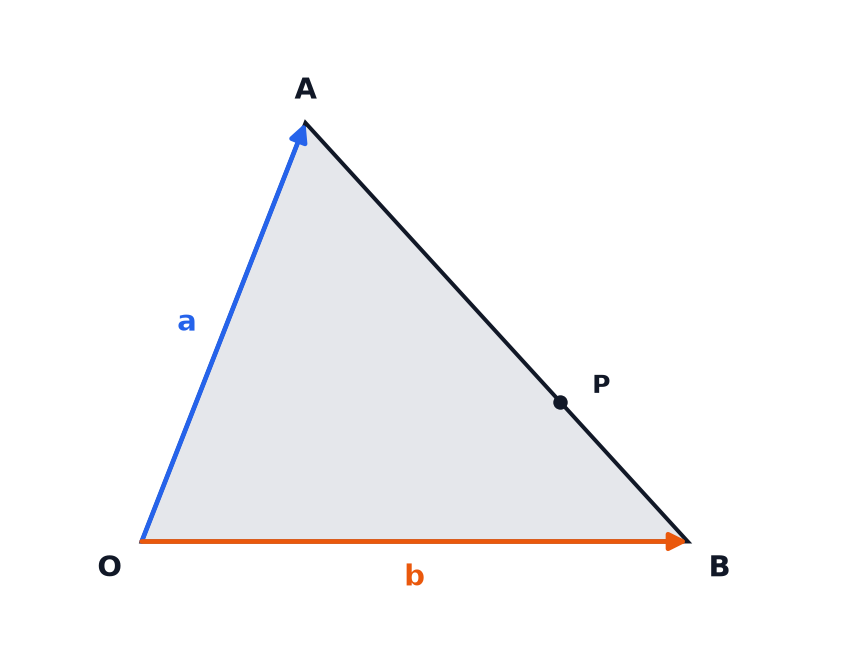
\(OAB\) is a triangle with \(\overrightarrow{OA} = \mathbf{a}\) and \(\overrightarrow{OB} = \mathbf{b}\). \(P\) is the point on \(AB\) such that \(AP : PB = 2 : 1\). (a) Write down \(\overrightarrow{AB}\) in terms of \(\mathbf{a}\) and \(\mathbf{b}\). [1 mark] (b) Find \(\overrightarrow{OP}\) in terms of \(\mathbf{a}\) and \(\mathbf{b}\). Give your answer in its simplest form. [3 marks]
Mark scheme — 4 marks available
- (a) \(\mathbf{b} - \mathbf{a}\) — B1
- (b) \(\overrightarrow{AP} = \dfrac{2}{3}\overrightarrow{AB}\) — M1
- (b) \(\mathbf{a} + \dfrac{2}{3}(\mathbf{b} - \mathbf{a})\) — M1
- (b) \(\dfrac{1}{3}\mathbf{a} + \dfrac{2}{3}\mathbf{b}\) — A1
Model answer
(a) \(\overrightarrow{AB} = \mathbf{b} - \mathbf{a}\). (b) \(AP = \dfrac{2}{3}AB\), so \(\overrightarrow{AP} = \dfrac{2}{3}(\mathbf{b} - \mathbf{a})\). Then \(\overrightarrow{OP} = \mathbf{a} + \dfrac{2}{3}(\mathbf{b} - \mathbf{a}) = \dfrac{1}{3}\mathbf{a} + \dfrac{2}{3}\mathbf{b}\).
\(\overrightarrow{OA} = \mathbf{a}\), \(\overrightarrow{OB} = \mathbf{b}\) and \(\overrightarrow{OC} = 4\mathbf{b} - 3\mathbf{a}\). Prove that \(A\), \(B\) and \(C\) lie on a straight line. [3 marks]
Mark scheme — 3 marks available
- \(\overrightarrow{AB} = \mathbf{b} - \mathbf{a}\) — M1
- \(\overrightarrow{BC} = 3\mathbf{b} - 3\mathbf{a}\) or \(3\overrightarrow{AB}\) — M1
- Parallel with a common point, so collinear — A1
Model answer
\(\overrightarrow{AB} = \mathbf{b} - \mathbf{a}\) and \(\overrightarrow{BC} = -\mathbf{b} + 4\mathbf{b} - 3\mathbf{a} = 3\mathbf{b} - 3\mathbf{a} = 3\overrightarrow{AB}\). The vectors are parallel and share the point \(B\), so \(A\), \(B\) and \(C\) are on a straight line.
\(\overrightarrow{OA} = \mathbf{a}\) and \(\overrightarrow{OB} = \mathbf{b}\). \(Q\) is the point on \(OA\) such that \(OQ : QA = 1 : 3\). Find \(\overrightarrow{BQ}\) in terms of \(\mathbf{a}\) and \(\mathbf{b}\). [3 marks]
Mark scheme — 3 marks available
- \(\overrightarrow{OQ} = \dfrac{1}{4}\mathbf{a}\) — M1
- \(\overrightarrow{BQ} = \overrightarrow{BO} + \overrightarrow{OQ}\) or \(-\mathbf{b} + \dfrac{1}{4}\mathbf{a}\) — M1
- \(\dfrac{1}{4}\mathbf{a} - \mathbf{b}\) — A1
Model answer
\(OQ = \dfrac{1}{4}OA\), so \(\overrightarrow{OQ} = \dfrac{1}{4}\mathbf{a}\). Then \(\overrightarrow{BQ} = \overrightarrow{BO} + \overrightarrow{OQ} = -\mathbf{b} + \dfrac{1}{4}\mathbf{a} = \dfrac{1}{4}\mathbf{a} - \mathbf{b}\).
\(\overrightarrow{OA} = \mathbf{a}\) and \(\overrightarrow{OB} = \mathbf{b}\). \(X\) is the point such that \(\overrightarrow{OX} = 2\mathbf{a}\), and \(Y\) is the point such that \(\overrightarrow{OY} = 2\mathbf{b}\). Show that \(XY\) is parallel to \(AB\). [3 marks]
Mark scheme — 3 marks available
- \(\overrightarrow{XY} = 2\mathbf{b} - 2\mathbf{a}\) — M1
- \(2\overrightarrow{AB}\) or \(2(\mathbf{b} - \mathbf{a})\) — M1
- A multiple, so parallel — A1
Model answer
\(\overrightarrow{XY} = -2\mathbf{a} + 2\mathbf{b} = 2(\mathbf{b} - \mathbf{a}) = 2\overrightarrow{AB}\). It is a multiple of \(\overrightarrow{AB}\), so the lines are parallel.
\(\overrightarrow{PQ} = \begin{pmatrix} 6 \\ 8 \end{pmatrix}\) and \(\overrightarrow{QR} = \begin{pmatrix} 3 \\ 4 \end{pmatrix}\). (a) Show that \(P\), \(Q\) and \(R\) lie on a straight line. [2 marks] (b) Calculate the length of \(PR\). [1 mark]
Mark scheme — 3 marks available
- (a) \(\overrightarrow{PQ} = 2\overrightarrow{QR}\) — M1
- (a) Parallel with a common point, so collinear — A1
- (b) 15 — B1
Model answer
(a) \(\begin{pmatrix} 6 \\ 8 \end{pmatrix} = 2 \times \begin{pmatrix} 3 \\ 4 \end{pmatrix}\), so \(\overrightarrow{PQ} = 2\overrightarrow{QR}\). The vectors are parallel and share \(Q\), so the points are collinear. (b) \(\overrightarrow{PR} = \begin{pmatrix} 9 \\ 12 \end{pmatrix}\), and the length is \(\sqrt{81 + 144} = \sqrt{225} = 15\).
\(\overrightarrow{OA} = \mathbf{a}\) and \(\overrightarrow{OB} = \mathbf{b}\). What is \(\overrightarrow{AB}\)?
Why: Go from \(A\) to \(O\) (\(-\mathbf{a}\)) and then to \(B\) (\(\mathbf{b}\)).
\(\overrightarrow{OA} = \mathbf{a}\). What is \(\overrightarrow{AO}\)?
Why: Going backwards reverses the vector.
\(\overrightarrow{OA} = \mathbf{a}\) and \(\overrightarrow{OB} = \mathbf{b}\). \(M\) is the midpoint of \(AB\). What is \(\overrightarrow{OM}\)?
Why: \(\overrightarrow{OM} = \mathbf{a} + \dfrac{1}{2}(\mathbf{b} - \mathbf{a}) = \dfrac{1}{2}(\mathbf{a} + \mathbf{b})\).
\(P\) is on \(AB\) with \(AP : PB = 1 : 2\). What fraction of \(AB\) is \(AP\)?
Why: There are \(1 + 2 = 3\) parts, and \(AP\) is 1 of them.
\(\overrightarrow{OA} = \mathbf{a}\), \(\overrightarrow{OB} = \mathbf{b}\), and \(P\) is on \(AB\) with \(AP : PB = 1 : 2\). What is \(\overrightarrow{OP}\)?
Why: \(\overrightarrow{OP} = \mathbf{a} + \dfrac{1}{3}(\mathbf{b} - \mathbf{a}) = \dfrac{2}{3}\mathbf{a} + \dfrac{1}{3}\mathbf{b}\).
How do you show that two lines are parallel using vectors?
Why: Parallel vectors are scalar multiples of each other.
\(\overrightarrow{AB} = 2\overrightarrow{BC}\). What does this show?
Why: The vectors are parallel and share the point \(B\), so the three points are collinear.
\(\overrightarrow{OA} = \mathbf{a}\), \(\overrightarrow{OB} = \mathbf{b}\) and \(\overrightarrow{OC} = 3\mathbf{b} - 2\mathbf{a}\). What is \(\overrightarrow{BC}\)?
Why: \(\overrightarrow{BC} = -\mathbf{b} + 3\mathbf{b} - 2\mathbf{a} = 2\mathbf{b} - 2\mathbf{a}\).
What is the length of the vector \(\begin{pmatrix} 5 \\ 12 \end{pmatrix}\)?
Why: \(\sqrt{5^2 + 12^2} = \sqrt{169} = 13\).