Viewing as
Teacher view: planning notes, the answers to every question, and the teacher copies of the files.
Maths · Area and volume
Circles
The parts of a circle, the circumference \(C = \pi d\) and the area \(A = \pi r^2\) - with answers to the nearest tenth or exact in terms of \(\pi\), and working back from a circumference or area to the radius.
Teacher resources
The teacher copies: slides with the questions built in, the answers, and anything else attached to this lesson for whoever is teaching it.
- Circles - Teacher Slides.pptx Teacher The lesson slides with the teacher's notes on each slide, and every question and mark scheme built in. Built from the lesson script on 29 September 2026. View
- Circles - Teacher Notes.docx Teacher The complete notes with the teacher's notes and every model answer in full. Built from the lesson script on 29 September 2026. View
Student handouts
The same files the students see, to print or hand out.
Last Lesson and Before
Answer each one, then check.
-
1
What is the radius of a circle with diameter 18 cm?
Show answerHide answer
9 cm
-
2
Work out \(5^2\).
Show answerHide answer
25
-
3
Round 28.274 to 1 decimal place.
Show answerHide answer
28.3
-
4
Solve \(r^2 = 16\) (positive answer).
Show answerHide answer
\(r = 4\)
Learning Objectives
- 1Name the parts of a circle.
- 2Work out the circumference of a circle.
- 3Work out the area of a circle.
- 4Give answers in terms of \(\pi\).
- 5Work backwards from a circumference or area to the radius.
Parts of a Circle
The diameter is twice the radius: \(d = 2r\). A chord joins two points on the circle; the diameter is the longest chord. A tangent touches the circle at one point. A sector is bounded by two radii and an arc; a segment by a chord and an arc.
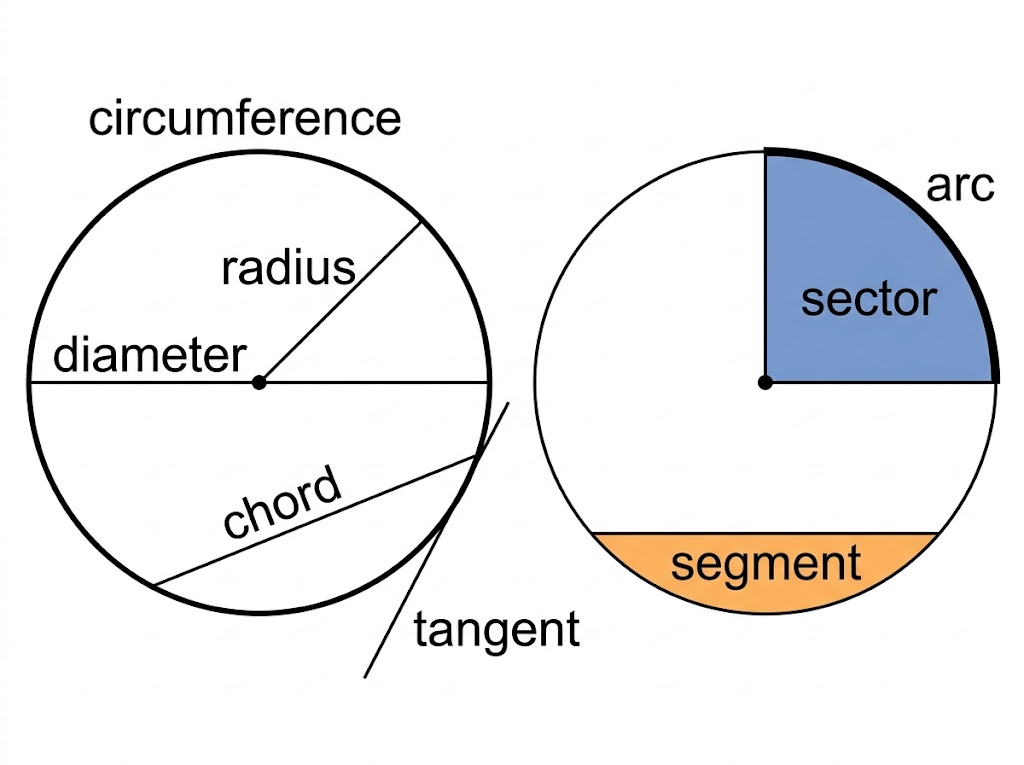
Know every label - the words appear in exam questions without diagrams.
The Formulae
\(\pi\) (pi) is the number of times the diameter fits around the circumference: 3.14159...
-
Circumference
\(C = \pi d\), or \(C = 2\pi r\).
-
Area
\(A = \pi r^2\) - always the RADIUS, never the diameter.
-
Order
For \(\pi r^2\), square the radius first, then multiply by \(\pi\).
-
In terms of \(\pi\)
Leave \(\pi\) in the answer to give it exactly: radius 5 gives area \(25\pi\) cm².
Circumference
A circle has diameter 9 cm. Work out its circumference, to 1 decimal place.
Show the solutionHide the solution
- 1 Write the formula \(C = \pi d\)
- 2 Substitute \(C = \pi \times 9 = 9\pi\)
- 3 Calculate \(28.274\ldots\)
Answer28.3 cm
Area
A circle has diameter 15 cm. Work out its area, to 1 decimal place.
Show the solutionHide the solution
- 1 Halve the diameter \(r = 7.5\)
- 2 Write the formula \(A = \pi r^2 = \pi \times 7.5^2\)
- 3 Calculate \(\pi \times 56.25 = 176.71\ldots\)
Answer176.7 cm²
A Semicircle
Work out the perimeter of a semicircle with diameter 10 cm. Give your answer (a) in terms of \(\pi\) and (b) to 1 decimal place.
Show the solutionHide the solution
- 1 Half the circumference \(\frac{1}{2} \times \pi \times 10 = 5\pi\)
- 2 Add the straight edge, the diameter \(5\pi + 10\)
- 3 Calculate \(25.707\ldots\)
Answer(a) \(5\pi + 10\) cm (b) 25.7 cm
Working Backwards
A circle has area 50 cm². Work out its radius, to 2 decimal places.
Show the solutionHide the solution
- 1 Write the formula \(\pi r^2 = 50\)
- 2 Divide by \(\pi\) \(r^2 = \dfrac{50}{\pi} = 15.915\ldots\)
- 3 Square root \(r = 3.989\ldots\)
Answer3.99 cm
Case study
Archimedes and Pi
Around 250 BC, the Greek mathematician Archimedes trapped \(\pi\) between two numbers. He drew a regular polygon just inside a circle and another just outside it, and worked out both perimeters - starting with hexagons and doubling the sides again and again up to 96-sided polygons. The circle's circumference had to lie between the two. He proved that \(\pi\) is between \(3\frac{10}{71}\) and \(3\frac{1}{7}\): between 3.1408 and 3.1429. The fraction \(\frac{22}{7}\) still used today comes from his upper bound.
Measure Pi
Collect five circular objects - a coin, a mug, a plate, a roll of tape, a bin. Measure the diameter of each with a ruler and the circumference with string. Work out circumference ÷ diameter for each. What do you notice?
1. Measure carefully in mm.
2. Divide circumference by diameter.
3. Compare with your calculator's \(\pi\).
A good answer shows: Every ratio should come out close to 3.1, whatever the size. Measuring errors make some a little high or low; the mean of the class's results is usually very close to \(\pi\).
Can I...?
- 1Name the parts of a circle.
- 2Work out the circumference from the radius or diameter.
- 3Work out the area from the radius or diameter.
- 4Give an answer in terms of \(\pi\).
- 5Find the perimeter and area of a semicircle.
- 6Find the radius from the circumference or area.
Summary & Exam Focus
- \(C = \pi d = 2\pi r\).
- \(A = \pi r^2\).
- Semicircle perimeter: half the circumference plus the diameter.
- Work backwards: divide by \(\pi\), then (for area) square root.
Exam focus
A bicycle wheel has diameter 60 cm. How many complete turns does the wheel make when the bicycle travels 1 km? (4 marks) (4 marks)
Check whether you've been given the radius or the diameter - and remember area needs the radius. "Give your answer in terms of \(\pi\)" means leave \(\pi\) in: don't multiply it out.
Key terms
The vocabulary this lesson expects you to use. Each one is linked from the first place it appears above.
- Radius
- The distance from the centre to the edge of a circle.
- Diameter
- A straight line across a circle through its centre; twice the radius.
- Circumference
- The distance around the edge of a circle.
- Chord
- A straight line joining two points on a circle.
- Tangent
- A straight line that touches a circle at exactly one point.
- \(\pi\)
- Pi: the circumference divided by the diameter of any circle, 3.14159...
Questions and answers
6 questions set on this lesson, with the mark schemes and model answers open.
A circle has a diameter of 9 cm. Work out the circumference of the circle. Give your answer correct to 1 decimal place.
Mark scheme — 2 marks available
- \(\pi \times 9\) — M1
- 28.3 — A1
Model answer
\(\pi \times 9 = 28.27\ldots = 28.3\) cm
A circle has a radius of 5 cm. Work out the area of the circle. Give your answer in terms of \(\pi\).
Mark scheme — 2 marks available
- \(\pi \times 5^2\) — M1
- \(25\pi\) — A1
Model answer
\(\pi \times 5^2 = 25\pi\) cm²
The diagram shows a semicircle with diameter 10 cm. Work out the perimeter of the semicircle. Give your answer correct to 1 decimal place.
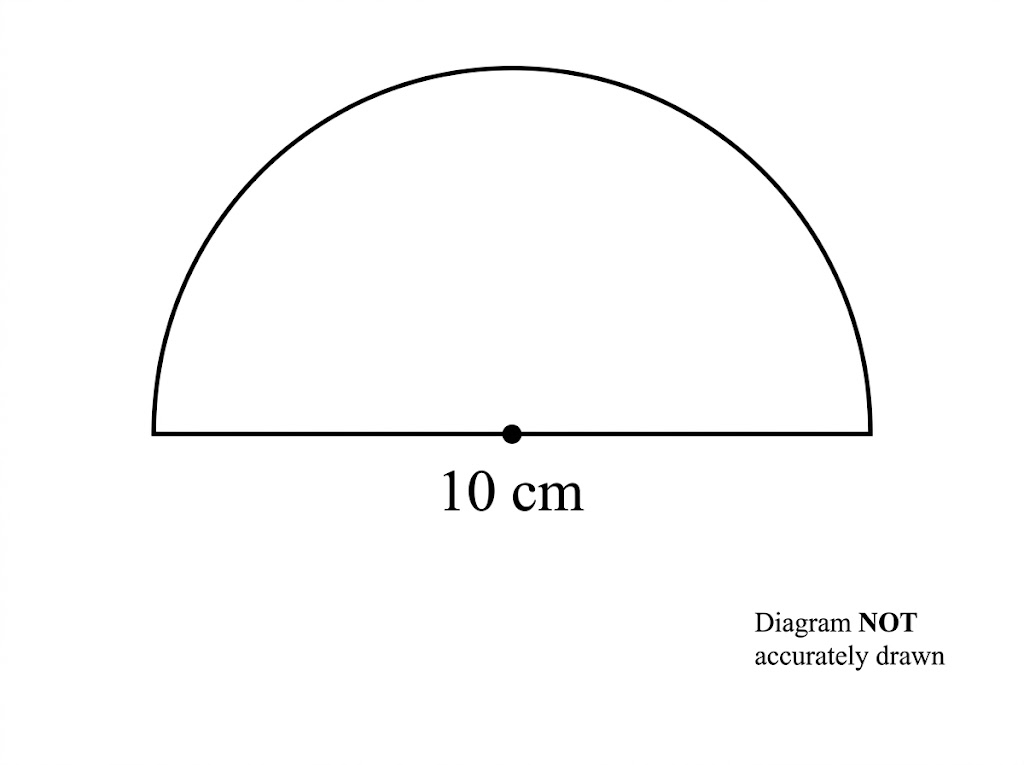
Mark scheme — 3 marks available
- \(\frac{1}{2} \times \pi \times 10\) — M1
- Adding 10 — M1
- 25.7 — A1
Model answer
Arc \(\frac{1}{2} \times \pi \times 10 = 5\pi = 15.707\ldots\) Perimeter \(15.707\ldots + 10 = 25.7\) cm.
A bicycle wheel has a diameter of 60 cm. How many complete turns does the wheel make when the bicycle travels 1 km?
Mark scheme — 4 marks available
- \(\pi \times 60\) — P1
- 1 km = 100 000 cm (or circumference in km) — P1
- \(100\,000 \div 188.49\ldots\) — P1
- 530 — A1
Model answer
Circumference \(= \pi \times 60 = 188.49\ldots\) cm. 1 km = 100 000 cm. \(100\,000 \div 188.49\ldots = 530.5\ldots\), so 530 complete turns.
What is the name of a straight line that touches a circle at exactly one point?
Why: A tangent touches; a chord cuts across; a radius goes to the centre.
A circle has radius 4 cm. What is its area in terms of \(\pi\)?
Why: \(\pi r^2 = \pi \times 16 = 16\pi\).