Viewing as
Teacher view: planning notes, the answers to every question, and the teacher copies of the files.
Maths · Fractions, ratio and percentages
Ratio and proportion
When two quantities are in proportion, knowing one tells you the other. Recipes, best buys and currency are direct proportion; more workers finishing a job faster is inverse proportion.
Teacher resources
The teacher copies: slides with the questions built in, the answers, and anything else attached to this lesson for whoever is teaching it.
- Ratio and proportion - Teacher Slides.pptx Teacher The lesson slides with the teacher's notes on each slide, and every question and mark scheme built in. Built from the lesson script on 29 September 2026. View
- Ratio and proportion - Teacher Notes.docx Teacher The complete notes with the teacher's notes and every model answer in full. Built from the lesson script on 29 September 2026. View
Student handouts
The same files the students see, to print or hand out.
- Ratio and proportion.pptx Built from the lesson script on 29 September 2026. View
- Ratio and proportion - Completed Notes.docx The full notes for the lesson, to revise from. Built from the lesson script on 29 September 2026. View
- Ratio and proportion - Exam Questions.docx Built from the lesson script on 29 September 2026. View
Last Lesson and Before
Answer each one, then check.
-
1
Last lesson: share 20 in the ratio \(1 : 4\).
Show answerHide answer
4 and 16
-
2
Work out \(12 \times 1.5\).
Show answerHide answer
18
-
3
Work out \(450 \div 6\).
Show answerHide answer
75
-
4
Last lesson: write \(4 : 10\) in the form \(1 : n\).
Show answerHide answer
\(1 : 2.5\)
Learning Objectives
- 1Solve direct proportion problems with the unitary method.
- 2Compare best buys.
- 3Convert between currencies.
- 4Solve inverse proportion problems.
- 5Recognise direct and inverse proportion from a graph.
Direct Proportion
Two quantities are in direct proportion when they increase at the same rate: double one and the other doubles.
-
The unitary method
Find the value of ONE, then multiply: if 6 pens cost £4.20, one costs 70p, so 10 cost £7.
-
Scaling
Multiply both by the same number: 6 people to 9 people is \(\times 1.5\).
-
The graph
A straight line through the origin.
-
Examples
Cost and number of items, recipe amounts and servings, pounds and euros.
A Recipe
A recipe for 6 people uses 450 g of flour. How much flour is needed for 10 people?
Show the solutionHide the solution
- 1 Find the amount for 1 person \(450 \div 6 = 75\) g
- 2 Multiply by 10 \(75 \times 10 = 750\) g
Answer750 g of flour
Best Buy
A 500 g bag of rice costs £1.85. A 750 g bag costs £2.70. Which is better value?
Show the solutionHide the solution
- 1 Find the cost of the same amount of each, say 100 g \(185 \div 5 = 37\)p and \(270 \div 7.5 = 36\)p
- 2 Compare 36p is less than 37p
AnswerThe 750 g bag is better value (36p per 100 g).
Currency Conversion
Exchange rates are direct proportion.
-
Multiply to convert from pounds
If £1 = €1.15, then £240 is \(240 \times 1.15 = 276\) euros, €276.
-
Divide to convert back
€92 is \(92 \div 1.15 = 80\) pounds, £80.
-
Check the size
Each pound buys more than one euro, so the euro amount should be bigger.
Inverse Proportion
Two quantities are in inverse proportion when one goes up as the other goes down, and their product stays the same.
-
The idea
Double the number of workers and the job takes half the time.
-
The method
Find the total "work": 6 painters \(\times\) 8 days = 48 painter-days. Then divide.
-
The graph
A curve that gets closer and closer to both axes.
-
Examples
Workers and time, speed and journey time, people sharing a prize.
An Inverse Proportion Problem
6 painters take 8 days to paint a building. How long would 4 painters take, working at the same rate?
Show the solutionHide the solution
- 1 Find the total work \(6 \times 8 = 48\) painter-days
- 2 Divide by the new number of painters \(48 \div 4 = 12\)
Answer12 days
Direct and Inverse Proportion Graphs
The shape of a graph tells you which kind of proportion you have. A straight line through the origin means direct proportion. A curve falling towards both axes means inverse proportion.
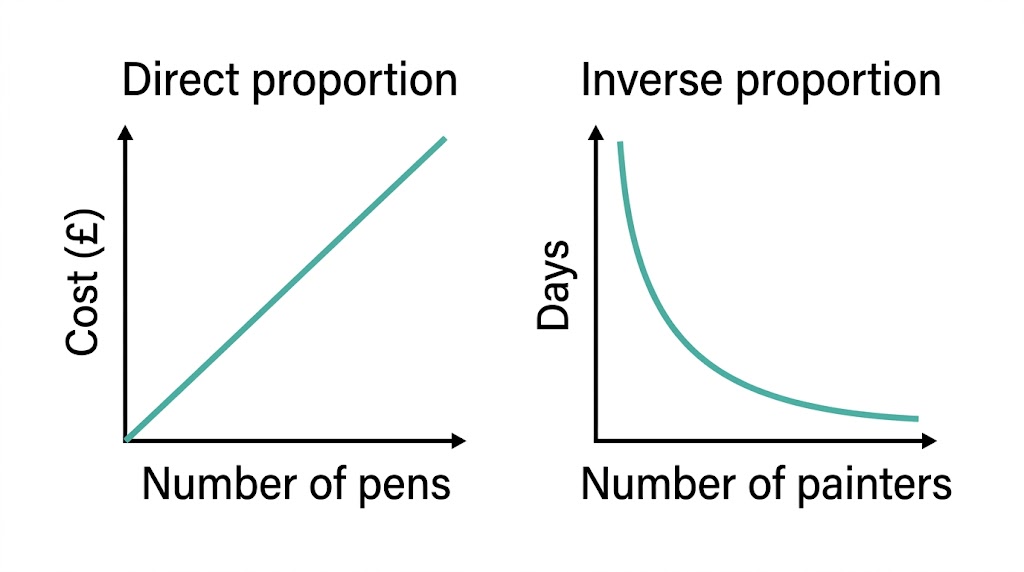
Direct: a straight line through the origin. Inverse: a curve towards both axes.
Shopping Detective
Which is the best buy? (a) Cereal: 500 g for £2.40 or 750 g for £3.45. (b) Juice: 1 litre for £1.10 or 1.5 litres for £1.62. (c) Eggs: 6 for £1.35 or 15 for £3.30. Then: 3 friends share a prize and get £40 each. How much would each get if 5 friends shared it?
1. Compare the same amount of each.
2. Show the unit price.
3. Decide, and say why.
A good answer shows: (a) 48p vs 46p per 100 g: 750 g box. (b) 11p vs 10.8p per 100 ml: 1.5 litres. (c) 22.5p vs 22p per egg: 15 eggs. Prize: \(3 \times 40 = 120\); \(120 \div 5 = £24\) each.
Can I...?
- 1Use the unitary method.
- 2Scale a recipe.
- 3Compare best buys.
- 4Convert between currencies.
- 5Solve inverse proportion problems.
- 6Recognise direct and inverse proportion graphs.
Summary & Exam Focus
- Direct proportion: find one, then multiply.
- Best buy: compare the price of the same amount.
- Currency: multiply one way, divide the other.
- Inverse proportion: the product stays the same.
Exam focus
It takes 5 machines 12 hours to make an order. How long would 3 machines take? (2 marks) (2 marks)
Ask first: if one quantity doubles, does the other double (direct) or halve (inverse)? Getting that right is most of the marks.
Key terms
The vocabulary this lesson expects you to use. Each one is linked from the first place it appears above.
- Direct proportion
- Two quantities that increase at the same rate; their ratio stays the same.
- Inverse proportion
- As one quantity increases, the other decreases; their product stays the same.
- Unitary method
- Finding the value of one item first, then scaling up.
- Exchange rate
- How much of one currency you get for one unit of another.
- Best buy
- The option that gives the most for your money.
Questions and answers
7 questions set on this lesson, with the mark schemes and model answers open.
A recipe for 8 biscuits uses 120 g of butter and 200 g of flour. Jo wants to make 20 biscuits. She has 250 g of butter. Does she have enough butter? Show how you decide.
Mark scheme — 3 marks available
- \(120 \div 8\) or \(20 \div 8 = 2.5\) — P1
- 300 g — A1
- No, with 300 g compared to 250 g — C1
Model answer
One biscuit uses \(120 \div 8 = 15\) g of butter. 20 biscuits need \(20 \times 15 = 300\) g. She has 250 g, so she does not have enough.
Toothpaste is sold in two sizes: 75 ml for £1.80 and 125 ml for £2.85. Which is the better value? You must show your working.
Mark scheme — 3 marks available
- A correct method to compare, e.g. price per ml for one size — M1
- Both correct: 2.4p and 2.28p per ml — A1
- 125 ml, from correct figures — C1
Model answer
75 ml: \(180 \div 75 = 2.4\)p per ml. 125 ml: \(285 \div 125 = 2.28\)p per ml. The 125 ml tube is better value.
It takes 5 machines 12 hours to make an order. How long would 3 machines take, working at the same rate?
Mark scheme — 2 marks available
- \(5 \times 12\) or 60 — M1
- 20 hours — A1
Model answer
\(5 \times 12 = 60\) machine-hours. \(60 \div 3 = 20\) hours.
The exchange rate is £1 = $1.26. Lara changes £350 into dollars. How many dollars does she get?
Mark scheme — 2 marks available
- \(350 \times 1.26\) — M1
- $441 — A1
Model answer
\(350 \times 1.26 = 441\) dollars
4 pens cost £2.40. How much do 7 pens cost?
Why: One pen costs \(2.40 \div 4 = 60\)p, so 7 cost \(7 \times 60 = 420\)p = £4.20.
4 people take 6 hours to paint a fence. How long would 8 people take?
Why: Inverse proportion: \(4 \times 6 = 24\) person-hours, and \(24 \div 8 = 3\) hours.
Which graph shows direct proportion?
Why: Direct proportion is always a straight line through the origin.