Viewing as
Teacher view: planning notes, the answers to every question, and the teacher copies of the files.
Maths · Fractions, ratio and percentages
Ratios
A ratio compares the sizes of two or more amounts. Simplifying ratios, writing them as fractions and sharing amounts in a given ratio all come down to one idea - finding the value of one part.
Teacher resources
The teacher copies: slides with the questions built in, the answers, and anything else attached to this lesson for whoever is teaching it.
- Ratios - Teacher Slides.pptx Teacher The lesson slides with the teacher's notes on each slide, and every question and mark scheme built in. Built from the lesson script on 29 September 2026. View
- Ratios - Teacher Notes.docx Teacher The complete notes with the teacher's notes and every model answer in full. Built from the lesson script on 29 September 2026. View
Student handouts
The same files the students see, to print or hand out.
Last Lesson and Before
Answer each one, then check.
-
1
What is the HCF of 12 and 18?
Show answerHide answer
6
-
2
Last lesson: work out \(\frac{3}{5}\) of 40.
Show answerHide answer
24
-
3
Simplify \(\frac{15}{25}\).
Show answerHide answer
\(\frac{3}{5}\)
-
4
How many grams are in 1.2 kg?
Show answerHide answer
1200 g
Learning Objectives
What a Ratio Is
A ratio compares amounts: 3 red counters to 5 blue is written \(3 : 5\).
-
The order matters
\(3 : 5\) (red to blue) is not the same as \(5 : 3\).
-
Simplify
Divide every part by the HCF: \(12 : 18 = 2 : 3\).
-
Same units first
45 cm : 1.2 m becomes 45 : 120 (both in cm), then \(3 : 8\).
-
Decimals and fractions
Multiply every part to make whole numbers: \(1.5 : 2 = 3 : 4\).
Simplifying with Different Units
Write 45 cm : 1.2 m in its simplest form.
Show the solutionHide the solution
- 1 Put both in the same units 1.2 m = 120 cm
- 2 Write the ratio in cm \(45 : 120\)
- 3 The HCF of 45 and 120 is 15 \(45 \div 15 = 3\), \(120 \div 15 = 8\)
Answer\(3 : 8\)
Ratios and Fractions
A ratio tells you how many parts there are altogether.
-
Total parts
In the ratio \(3 : 5\) there are \(3 + 5 = 8\) parts.
-
As fractions
The first amount is \(\frac{3}{8}\) of the total and the second is \(\frac{5}{8}\).
-
Not the same thing
\(3 : 5\) does NOT mean \(\frac{3}{5}\) of the total - it means \(\frac{3}{8}\).
-
Unit ratios
Divide to make one part 1: \(4 : 10 = 1 : 2.5\), and \(10 : 4 = 2.5 : 1\).
Sharing with a Bar Model
A bar model makes a ratio visible. The ratio \(3 : 4\) has 7 equal parts. £84 shared into 7 parts is £12 a part, so the shares are \(3 \times 12 = £36\) and \(4 \times 12 = £48\).
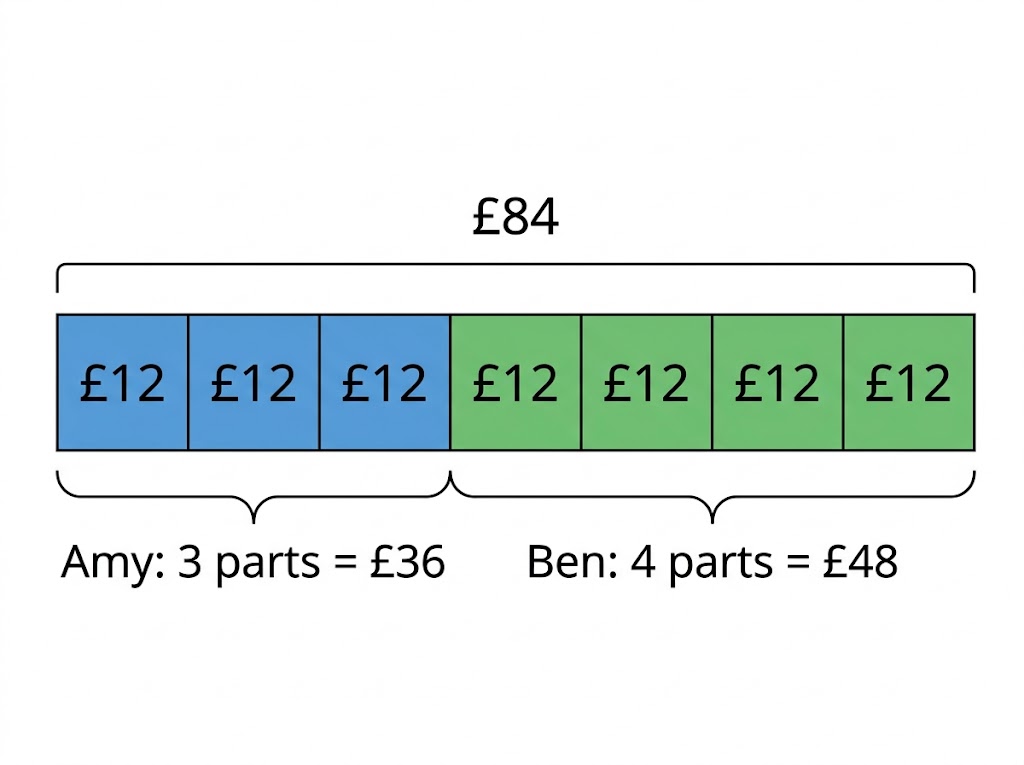
7 parts share £84, so each part is £12.
Sharing in a Ratio
Share £84 between Amy and Ben in the ratio \(3 : 4\).
Show the solutionHide the solution
- 1 Add the parts \(3 + 4 = 7\) parts
- 2 Find one part \(84 \div 7 = 12\)
- 3 Multiply for each person Amy \(3 \times 12 = 36\), Ben \(4 \times 12 = 48\)
- 4 Check \(36 + 48 = 84\)
AnswerAmy £36, Ben £48
When You Know the Difference
The ages of a father and son are in the ratio \(5 : 2\). The father is 18 years older than the son. How old is each?
Show the solutionHide the solution
- 1 The difference in parts \(5 - 2 = 3\) parts
- 2 3 parts are 18 years, so one part is \(18 \div 3 = 6\)
- 3 Multiply Father \(5 \times 6 = 30\), son \(2 \times 6 = 12\)
- 4 Check the difference \(30 - 12 = 18\)
AnswerFather 30, son 12
Ratio Problems Relay
(a) Simplify \(24 : 36 : 60\). (b) Share 450 g of sweets in the ratio \(2 : 3 : 4\). (c) Paint is mixed blue to white in the ratio \(2 : 7\). How much white is mixed with 5 litres of blue? (d) Write \(8 : 5\) in the form \(n : 1\).
1. Decide what you know: the total, one part, or a difference.
2. Find the value of one part.
3. Answer the question asked.
A good answer shows: (a) \(2 : 3 : 5\) (b) 100 g, 150 g, 200 g (c) \(5 \div 2 = 2.5\) litres per part, so \(7 \times 2.5 = 17.5\) litres (d) \(1.6 : 1\)
Can I...?
- 1Simplify a ratio.
- 2Simplify a ratio with different units.
- 3Write a ratio as \(1 : n\) or \(n : 1\).
- 4Write a ratio as fractions of the total.
- 5Share an amount in a ratio.
- 6Solve problems when I know one part or the difference.
Summary & Exam Focus
- Simplify by dividing every part by the HCF; use the same units first.
- Total parts = sum of the ratio; each share is a fraction of the total.
- Find the value of one part, then multiply.
- A difference in amounts matches the difference in parts.
Exam focus
Red and blue beads are in the ratio \(3 : 7\). There are 28 more blue beads than red beads. How many beads are there altogether? (3 marks) (3 marks)
Decide what the number in the question stands for: the total, one person's share, or the difference. Each needs a different number of parts.
Key terms
The vocabulary this lesson expects you to use. Each one is linked from the first place it appears above.
- Ratio
- A comparison of the sizes of two or more quantities.
- Simplest form
- A ratio whose parts have no common factor other than 1.
- Part
- One share of a ratio; the total number of parts is the sum of the ratio.
- Unit ratio
- A ratio written with one part equal to 1, such as \(1 : n\).
Questions and answers
7 questions set on this lesson, with the mark schemes and model answers open.
Write \(24 : 36 : 60\) in its simplest form.
Mark scheme — 1 mark available
- \(2 : 3 : 5\) — B1
Model answer
\(2 : 3 : 5\)
Share £450 between Asha, Ben and Cal in the ratio \(2 : 3 : 4\).
Mark scheme — 3 marks available
- 9 parts, or \(450 \div 9\) — M1
- 50 — M1
- £100, £150, £200 — A1
Model answer
\(2 + 3 + 4 = 9\) parts; \(450 \div 9 = 50\). Asha £100, Ben £150, Cal £200.
The ratio of boys to girls in a club is \(4 : 5\). There are 45 girls. How many members does the club have?
Mark scheme — 3 marks available
- \(45 \div 5 = 9\) — P1
- 36 boys — P1
- 81 — A1
Model answer
5 parts = 45, so 1 part = 9. Boys: \(4 \times 9 = 36\). Total \(36 + 45 = 81\).
Red and blue beads are in the ratio \(3 : 7\). There are 28 more blue beads than red beads. How many beads are there altogether?
Mark scheme — 3 marks available
- 4 parts identified as the difference — P1
- 1 part = 7 — P1
- 70 — A1
Model answer
Difference in parts: \(7 - 3 = 4\). 4 parts = 28, so 1 part = 7. Total \(10 \times 7 = 70\) beads.
What is \(18 : 12\) in its simplest form?
Why: Divide both by the HCF, 6.
Juice and water are mixed in the ratio \(1 : 4\). What fraction of the drink is juice?
Why: There are \(1 + 4 = 5\) parts, and 1 of them is juice.
Write \(5 : 8\) in the form \(1 : n\).
Why: Divide both parts by 5: \(1 : 1.6\).