Viewing as
Teaching this? The teacher view adds 2 files, the mark schemes and the model answers.
Maths · Probability
Conditional probability
Work out probabilities when one event changes the next, such as taking items without replacement, and use two-way tables to find conditional probabilities.
Warm-up
Answer each one, then check.
-
1
Work out \(\dfrac{5}{8} \times \dfrac{4}{7}\).
Show answerHide answer
\(\dfrac{5}{14}\)
-
2
Simplify \(\dfrac{30}{56}\).
Show answerHide answer
\(\dfrac{15}{28}\)
-
3
Work out \(1 - \dfrac{5}{14}\).
Show answerHide answer
\(\dfrac{9}{14}\)
-
4
What does "independent" mean?
Show answerHide answer
One event does not affect the other
-
5
What does "with replacement" mean?
Show answerHide answer
The item is put back before the next pick
Learning Objectives
- 1Explain what conditional probability means.
- 2Draw a tree diagram for events without replacement.
- 3Work out probabilities of combined events without replacement.
- 4Find a conditional probability from a two-way table.
CONDITIONAL PROBABILITY
The probability of an event happening, given that another event has already happened, is a conditional probability.
Without replacement, the numbers change after each pick.
A Tree Without Replacement
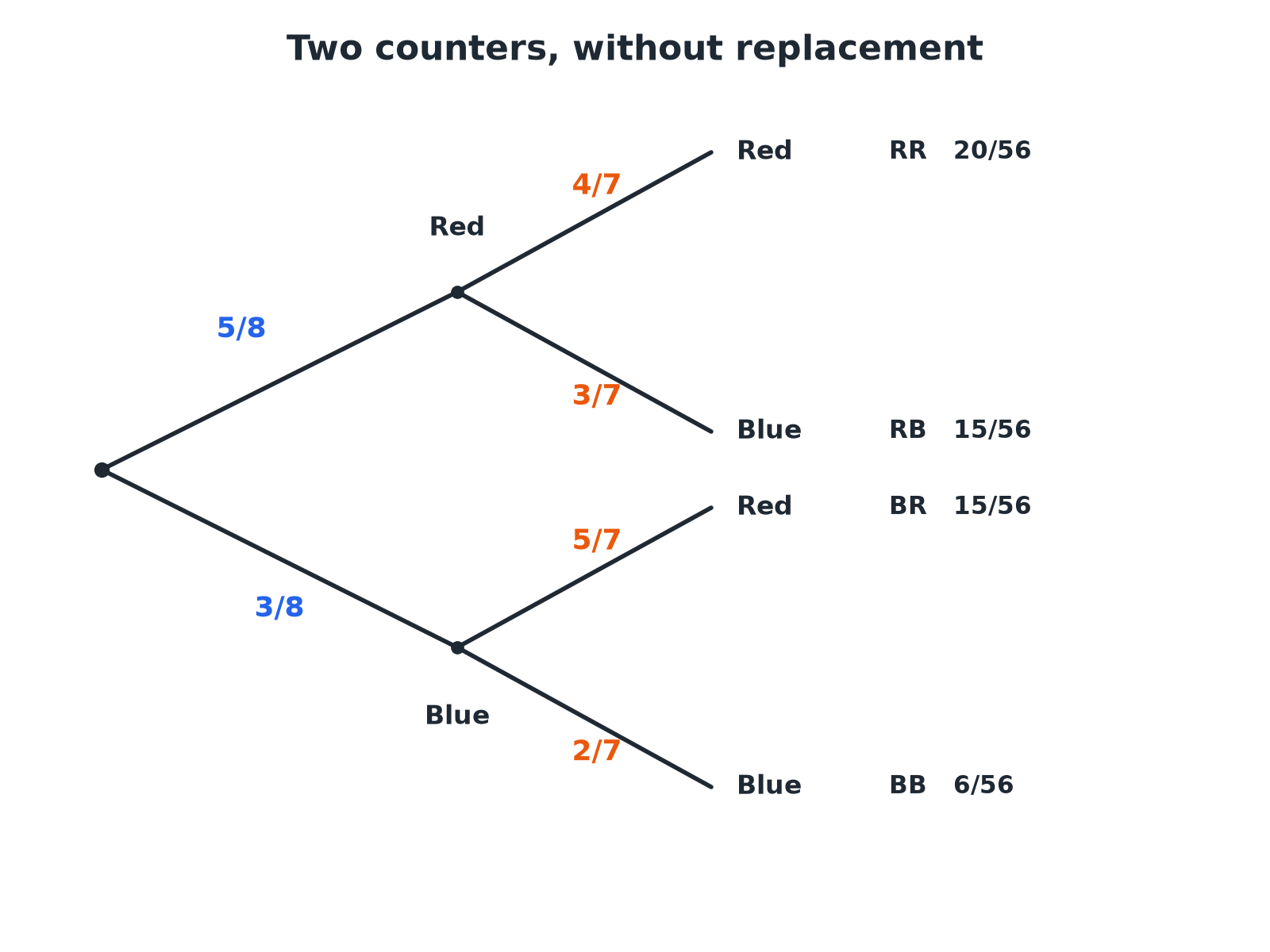
After one counter is taken, only 7 are left, so the second-stage probabilities change.
Without Replacement
A bag has 5 red and 3 blue counters. Two counters are taken at random without replacement. Find the probability that both are red.
Show the solutionHide the solution
- 1 First counter red \(\dfrac{5}{8}\)
- 2 Now 4 red among 7 remaining \(\dfrac{4}{7}\)
- 3 Multiply \(\dfrac{5}{8} \times \dfrac{4}{7} = \dfrac{20}{56}\)
- 4 Simplify \(\dfrac{5}{14}\)
Answer\(\dfrac{5}{14}\)
One of Each Colour
For the same bag, find the probability that the two counters are different colours.
Show the solutionHide the solution
- 1 Red then blue \(\dfrac{5}{8} \times \dfrac{3}{7} = \dfrac{15}{56}\)
- 2 Blue then red \(\dfrac{3}{8} \times \dfrac{5}{7} = \dfrac{15}{56}\)
- 3 Add \(\dfrac{30}{56}\)
- 4 Simplify \(\dfrac{15}{28}\)
Answer\(\dfrac{15}{28}\)
At Least One Red
A bag has 4 red and 6 blue counters. Two are taken without replacement. Find the probability that at least one is red.
Show the solutionHide the solution
- 1 At least one red is the opposite of both blue Use \(1 - P(\text{both blue})\)
- 2 Both blue \(\dfrac{6}{10} \times \dfrac{5}{9} = \dfrac{30}{90} = \dfrac{1}{3}\)
- 3 Subtract from 1 \(1 - \dfrac{1}{3} = \dfrac{2}{3}\)
Answer\(\dfrac{2}{3}\)
Two-Way Tables
Conditional probabilities can be read from a table by restricting to a group.
-
The idea
For "given that", use only the people in that group as the total.
-
Example
60 students: 35 like football, and 20 of those are boys. Given that a student likes football, the probability that they are a boy is \(\dfrac{20}{35}\).
-
Simplify
\(\dfrac{20}{35} = \dfrac{4}{7}\).
A Two-Way Table
60 students were asked whether they like football.
-
Boys
Does not like football: 20. Total: 10. 30
-
Girls
Does not like football: 15. Total: 15. 30
-
Total
Does not like football: 35. Total: 25. 60
Given That
Use the table. A student is chosen at random. Find the probability that they are a boy given that they like football.
Show the solutionHide the solution
- 1 Restrict to students who like football 35 students
- 2 Boys among them 20
- 3 Probability \(\dfrac{20}{35} = \dfrac{4}{7}\)
Answer\(\dfrac{4}{7}\)
Cards Without Replacement
Three cards are taken from a pack of ten cards numbered 1 to 10, one after another without replacement. Find the probability that the first is even and the second is odd, and that the first two are both greater than 7.
1. Reduce the numbers after each pick.
2. Multiply along the path.
A good answer shows: First even and second odd: \(\dfrac{5}{10} \times \dfrac{5}{9} = \dfrac{25}{90} = \dfrac{5}{18}\). Both greater than 7: \(\dfrac{3}{10} \times \dfrac{2}{9} = \dfrac{6}{90} = \dfrac{1}{15}\).
Can I...?
- 1Explain what conditional means.
- 2Adjust the numbers after a pick.
- 3Draw a tree diagram without replacement.
- 4Multiply along the branches.
- 5Add paths for combined outcomes.
- 6Use "1 minus" for at least one.
- 7Find a conditional probability from a table.
- 8Simplify my fractions.
Summary & Exam Focus
- Without replacement, probabilities on the second branches change.
- Multiply along the branches; add different paths.
- "Given that" means restrict to that group.
- At least one \(= 1 -\) none.
Exam focus
A bag has 5 red and 3 blue counters. Two counters are taken at random without replacement. Work out the probability that the counters are different colours. (3 marks) (3 marks)
Both orders count: red then blue AND blue then red. Reduce the total by 1 for the second pick.
Key terms
The vocabulary this lesson expects you to use. Each one is linked from the first place it appears above.
- Conditional probability
- The probability of an event given that another has happened.
- Without replacement
- The item is not put back, so later probabilities change.
- Dependent events
- Events where one affects the probability of the other.
- Tree diagram
- A diagram showing outcomes and probabilities on branches.
- Two-way table
- A table showing two categories at once.
- Complement
- The event "not A".
Practice questions
Have a go at each one before you open its answer.
-
Question 1 Non-calculator 3 marks
A bag contains 5 red counters and 3 blue counters. Two counters are taken at random without replacement. Work out the probability that both counters are red.
Show answerHide answer
Model answer
\(\dfrac{5}{8} \times \dfrac{4}{7} = \dfrac{20}{56} = \dfrac{5}{14}\).
Mark scheme
- \(\dfrac{5}{8}\) — M1
- \(\dfrac{5}{8} \times \dfrac{4}{7}\) — M1
- \(\dfrac{5}{14}\) — A1
-
Question 2 Non-calculator 3 marks
For the same bag, work out the probability that the two counters are different colours.
Show answerHide answer
Model answer
\(\dfrac{5}{8} \times \dfrac{3}{7} + \dfrac{3}{8} \times \dfrac{5}{7} = \dfrac{15}{56} + \dfrac{15}{56} = \dfrac{15}{28}\).
Mark scheme
- One correct product — M1
- Adding both orders — M1
- \(\dfrac{15}{28}\) — A1
-
Question 3 Non-calculator 3 marks
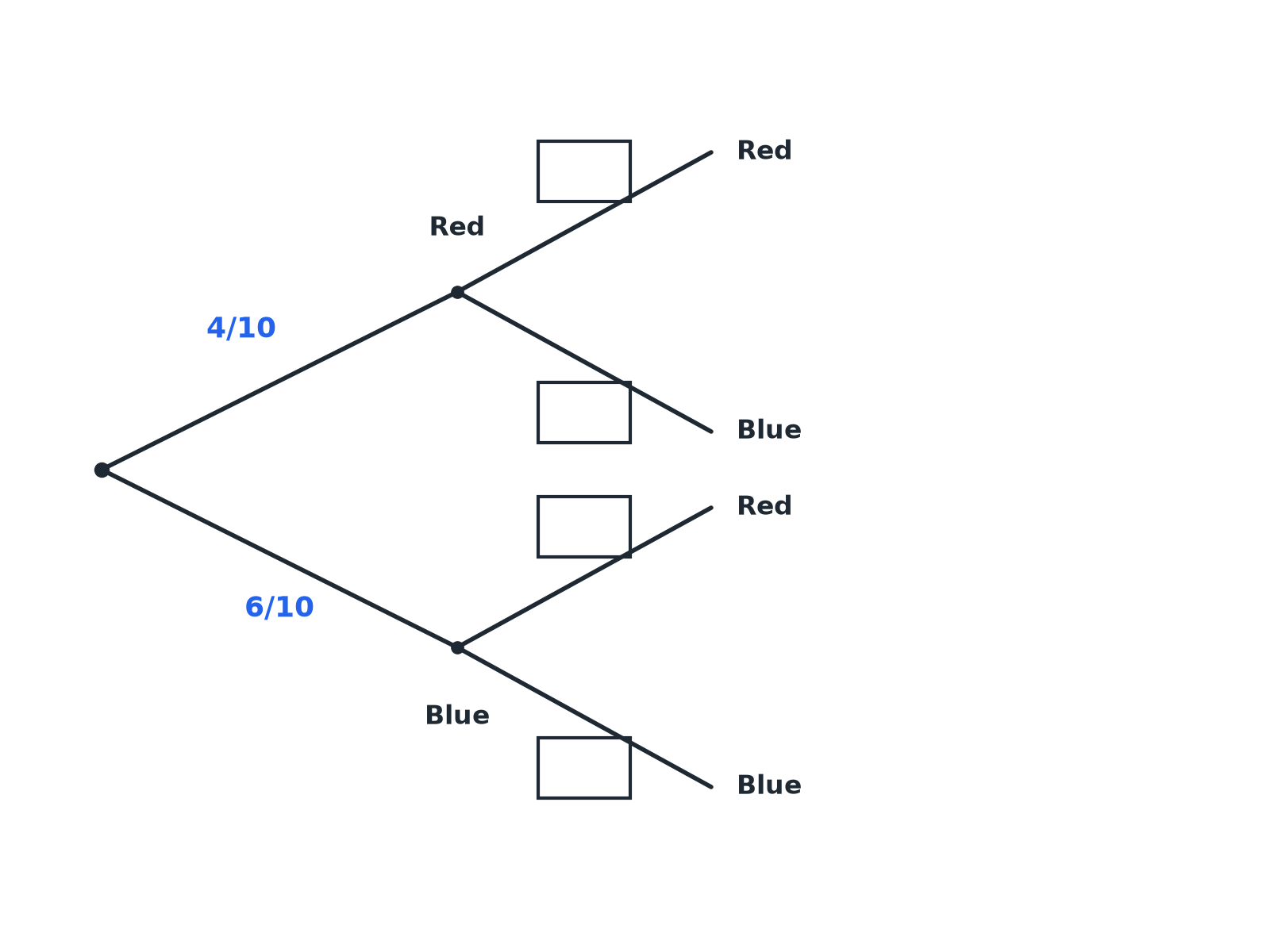
A bag contains 4 red counters and 6 blue counters. Two counters are taken at random without replacement. Complete the tree diagram.
Show answerHide answer
Model answer
After red: red 3/9 and blue 6/9. After blue: red 4/9 and blue 5/9.
Mark scheme
- Denominator 9 on all four branches — B1
- After red: 3/9, 6/9 — B1
- After blue: 4/9, 5/9 — B1
-
Question 4 Non-calculator 3 marks
Using the tree diagram, work out the probability that both counters are blue.
Show answerHide answer
Model answer
\(\dfrac{6}{10} \times \dfrac{5}{9} = \dfrac{30}{90} = \dfrac{1}{3}\).
Mark scheme
- \(\dfrac{6}{10} \times \dfrac{5}{9}\) — M1
- \(\dfrac{30}{90}\) — A1
- \(\dfrac{1}{3}\) — A1
-
Question 5 Non-calculator 3 marks
Using the tree diagram, work out the probability that at least one of the counters is red.
Show answerHide answer
Model answer
\(1 - P(\text{both blue}) = 1 - \dfrac{1}{3} = \dfrac{2}{3}\).
Mark scheme
- \(1 - P(\text{both blue})\) — M1
- \(1 - \dfrac{1}{3}\) — M1
- \(\dfrac{2}{3}\) — A1
-
Question 6 Non-calculator 3 marks
60 students were asked whether they like football. 35 like football, and 20 of these are boys. 30 of the 60 students are boys. A student is chosen at random. Given that the student likes football, work out the probability that they are a boy.
Show answerHide answer
Model answer
Of the 35 who like football, 20 are boys. The probability is \(\dfrac{20}{35} = \dfrac{4}{7}\).
Mark scheme
- 35 as the total — M1
- \(\dfrac{20}{35}\) — A1
- \(\dfrac{4}{7}\) — A1
Quick check
-
A bag has 4 red and 6 blue counters. One is taken and not replaced. How many counters are left?
Show answerHide answer
B: 9
\(10 - 1 = 9\).
-
A bag has 5 red and 3 blue counters. A red is taken and not replaced. What is P(second is red)?
Show answerHide answer
C: \(\dfrac{4}{7}\)
4 red remain out of 7: \(\dfrac{4}{7}\).
-
Without replacement, the events are...
Show answerHide answer
D: Dependent
The first pick changes what is left, so they are dependent.
-
"The probability that a student is a girl, given that they play tennis" means you should...
Show answerHide answer
A: Look only at the tennis players
Use only the tennis players as the total.
-
A bag has 3 red and 2 blue counters. Two are taken without replacement. What is P(both red)?
Show answerHide answer
B: \(\dfrac{3}{10}\)
\(\dfrac{3}{5} \times \dfrac{2}{4} = \dfrac{6}{20} = \dfrac{3}{10}\).
-
A bag has 2 red and 2 blue counters. Two are taken without replacement. What is P(different colours)?
Show answerHide answer
C: \(\dfrac{2}{3}\)
\(\dfrac{2}{4} \times \dfrac{2}{3} + \dfrac{2}{4} \times \dfrac{2}{3} = \dfrac{1}{3} + \dfrac{1}{3} = \dfrac{2}{3}\).
Downloads
Free to keep, print and annotate.
- Conditional probability.pptx Built from the lesson script on 30 September 2026. View
- Conditional probability - Completed Notes.docx The full notes for the lesson, to revise from. Built from the lesson script on 30 September 2026. View
- Conditional probability - Exam Questions.docx Built from the lesson script on 30 September 2026. View
Something here looks wrong?
Tell us what and we will go and look. It goes to whoever writes these pages, nobody else, and we do not ask who you are — so there is nothing to sign and nothing comes back to you.