Viewing as
Teacher view: planning notes, the answers to every question, and the teacher copies of the files.
Maths · Transformations and constructions
Scale drawings and bearings
Use map and drawing scales, measure and write three-figure bearings, find back bearings, and solve journey problems.
Teacher resources
The teacher copies: slides with the questions built in, the answers, and anything else attached to this lesson for whoever is teaching it.
- Scale drawings and bearings - Teacher Slides.pptx Teacher The lesson slides with the teacher's notes on each slide, and every question and mark scheme built in. Built from the lesson script on 30 September 2026. View
- Scale drawings and bearings - Teacher Notes.docx Teacher The complete notes with the teacher's notes and every model answer in full. Built from the lesson script on 30 September 2026. View
Student handouts
The same files the students see, to print or hand out.
- Scale drawings and bearings.pptx Built from the lesson script on 30 September 2026. View
- Scale drawings and bearings - Completed Notes.docx The full notes for the lesson, to revise from. Built from the lesson script on 30 September 2026. View
- Scale drawings and bearings - Exam Questions.docx Built from the lesson script on 30 September 2026. View
Warm-up
Answer each one, then check.
-
1
How many centimetres are in a kilometre?
Show answerHide answer
100 000
-
2
What do the angles round a point add up to?
Show answerHide answer
\(360^\circ\)
-
3
What do co-interior angles add up to?
Show answerHide answer
\(180^\circ\)
-
4
Work out \(3.2 \times 50\,000\).
Show answerHide answer
160 000
-
5
What is the compass direction opposite to north-east?
Show answerHide answer
South-west
Learning Objectives
- 1Use a scale in the form \(1 : n\) to change between drawing and real lengths.
- 2Measure and write three-figure bearings.
- 3Find the bearing back from B to A.
- 4Solve problems using bearings and right-angled triangles.
Map Scales
A scale of \(1 : 50\,000\) means 1 cm on the map is 50 000 cm in real life.
-
Map to real
Multiply by the scale, then change units. 3.2 cm on a \(1 : 50\,000\) map is 160 000 cm, which is 1.6 km.
-
Real to map
Divide by the scale. 4.5 km is 450 000 cm, so on a \(1 : 25\,000\) map it is \(450\,000 \div 25\,000 = 18\) cm.
-
Units
100 000 cm = 1 km and 100 cm = 1 m.
BEARINGS
A bearing is an angle measured clockwise from north, always written with three figures.
North is 000°, east is 090°, south is 180° and west is 270°.
Reading a Bearing
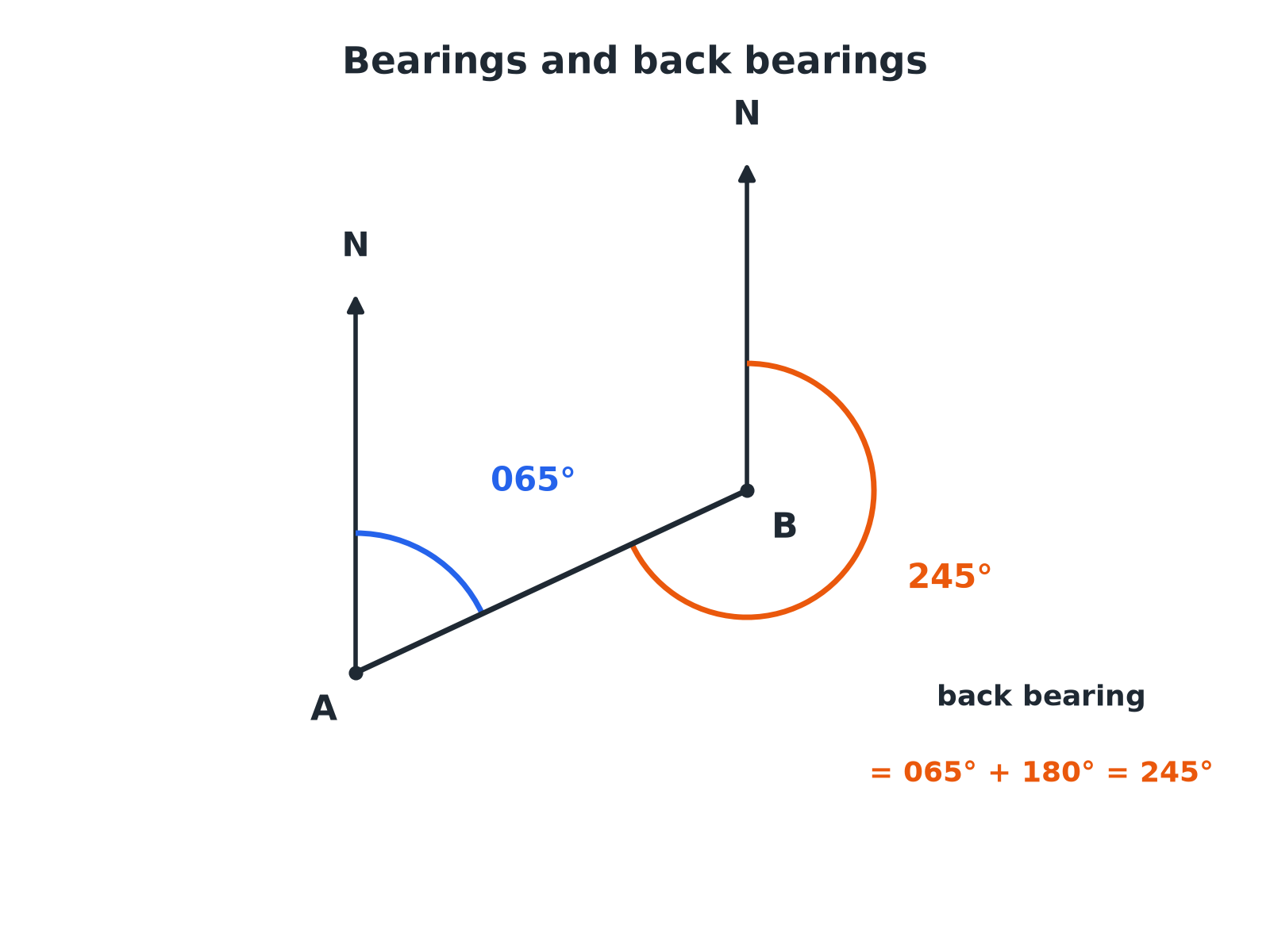
Measure clockwise from north, at the point you are travelling from.
Measuring a Bearing
Follow the same steps every time.
-
1
Find the starting point
The bearing of B from A starts at A.
-
2
Draw or imagine a north line at A
It points straight up the page.
-
3
Measure clockwise
From the north line round to the line AB.
-
4
Write three figures
Add zeros at the front, e.g. \(065^\circ\).
A Back Bearing
The bearing of B from A is \(065^\circ\). Work out the bearing of A from B.
Show the solutionHide the solution
- 1 The north lines at A and B are parallel Co-interior angles add up to \(180^\circ\)
- 2 Add \(180^\circ\) to a bearing under \(180^\circ\) \(065 + 180\)
- 3 Work it out \(245\)
Answer\(245^\circ\)
A Journey with Bearings
A ship sails 8 km on a bearing of \(070^\circ\) and then 6 km on a bearing of \(160^\circ\). How far is it from its starting point?
Show the solutionHide the solution
- 1 The two bearings differ by \(160 - 70 = 90\), so the path turns through a right angle
- 2 Use Pythagoras \(8^2 + 6^2 = 64 + 36 = 100\)
- 3 Distance \(\sqrt{100} = 10\)
Answer10 km
Using a Map Scale
Two towns are 3.2 cm apart on a map with scale \(1 : 50\,000\). How far apart are they in real life?
Show the solutionHide the solution
- 1 Real length in cm \(3.2 \times 50\,000 = 160\,000\)
- 2 Change to kilometres \(160\,000 \div 100\,000\)
Answer1.6 km
Back Bearings
Add or subtract 180 so the answer stays between 0 and 360.
-
065°
Rule: + 180°. Bearing of A from B: 245°
-
130°
Rule: + 180°. Bearing of A from B: 310°
-
250°
Rule: − 180°. Bearing of A from B: 070°
-
305°
Rule: − 180°. Bearing of A from B: 125°
Treasure Trail
Start at a point marked A. Draw the route: 5 cm on a bearing of \(050^\circ\), then 4 cm on a bearing of \(140^\circ\), then 6 cm on a bearing of \(230^\circ\). Measure the final distance and bearing back to A. If the scale is 1 cm to 100 m, work out the real distance.
1. Draw a north line at each point.
2. Use a protractor from north.
3. Convert with the scale.
A good answer shows: Students should end near the start; the route back to A is roughly 3 to 4 cm on a bearing near 300°. Real distance is about 300 to 400 m.
Can I...?
- 1Use a map scale \(1 : n\).
- 2Convert between cm, m and km.
- 3Measure a bearing.
- 4Write a bearing with three figures.
- 5Find a back bearing.
- 6Draw a bearing accurately.
- 7Use bearings with Pythagoras.
- 8Explain why the north lines are parallel.
Summary & Exam Focus
- Bearings are measured clockwise from north, with three figures.
- Back bearing: \(\pm 180^\circ\).
- Scale \(1 : n\): multiply to get the real length; divide to get the drawing length.
- Draw a sketch and mark north lines.
Exam focus
The bearing of B from A is \(072^\circ\). Work out the bearing of A from B. (3 marks) (3 marks)
Add 180 when the bearing is less than 180, and subtract 180 when it is more. Draw a north line at both points and mark the co-interior angles.
Key terms
The vocabulary this lesson expects you to use. Each one is linked from the first place it appears above.
- Bearing
- An angle measured clockwise from north, written with three figures.
- Scale
- The ratio of a length on a drawing to the real length.
- Back bearing
- The bearing of A from B when you know the bearing of B from A.
- Clockwise
- The direction the hands of a clock turn.
- Three-figure bearing
- A bearing written with hundreds, tens and units, such as 045°.
- Compass point
- One of N, E, S, W and their combinations.
Questions and answers
12 questions set on this lesson, with the mark schemes and model answers open.
The scale on a map is \(1 : 50\,000\). Two towns are 3.2 cm apart on the map. Work out the real distance between the towns, in kilometres.
Mark scheme — 2 marks available
- \(3.2 \times 50\,000\) — M1
- 1.6 — A1
Model answer
\(3.2 \times 50\,000 = 160\,000\) cm \(= 1.6\) km.
Two villages are 4.5 km apart. Work out the distance between them on a map with scale \(1 : 25\,000\). Give your answer in centimetres.
Mark scheme — 2 marks available
- \(450\,000\) seen — M1
- 18 — A1
Model answer
\(4.5\) km \(= 450\,000\) cm. \(450\,000 \div 25\,000 = 18\) cm.
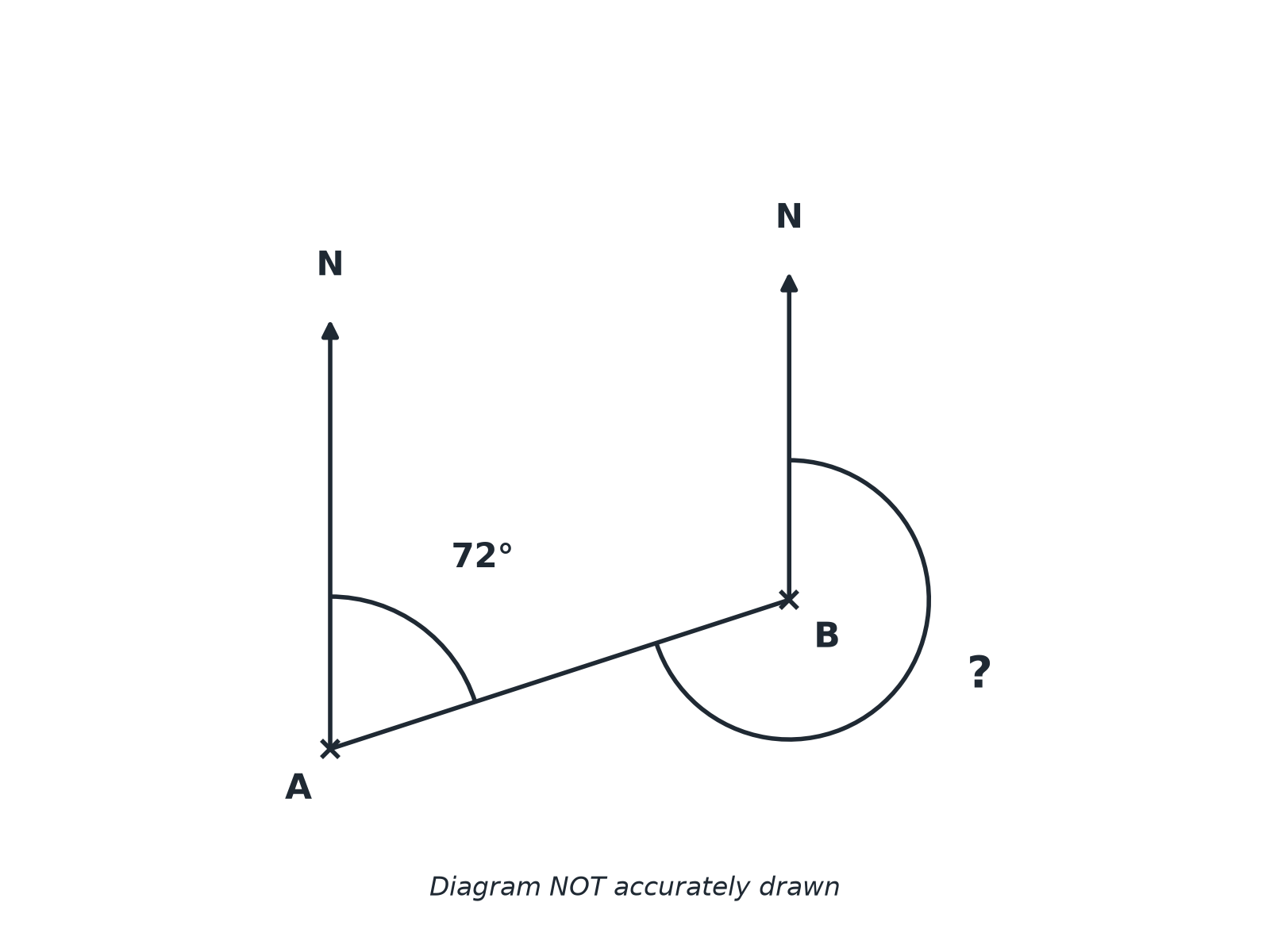
The diagram shows two points, A and B. The bearing of B from A is \(072^\circ\). Work out the bearing of A from B.
Mark scheme — 3 marks available
- \(180 + 72\) or \(360 - (180 - 72)\) — M1
- 252 — A1
- A reason: parallel lines or back bearing — C1
Model answer
\(72 + 180 = 252^\circ\). The north lines are parallel, so the co-interior angles add up to \(180^\circ\).
A ship sails 8 km on a bearing of \(070^\circ\). It then sails 6 km on a bearing of \(160^\circ\). Work out the distance of the ship from its starting point.
Mark scheme — 4 marks available
- Right angle found — M1
- \(8^2 + 6^2\) — M1
- 100 — A1
- 10 — A1
Model answer
The two bearings differ by \(160 - 70 = 90^\circ\), so the path forms a right angle. Distance \(= \sqrt{8^2 + 6^2} = \sqrt{100} = 10\) km.
A lighthouse is due south-west of a harbour. Write down the bearing of the lighthouse from the harbour.
Mark scheme — 2 marks available
- 225 — B2
Model answer
\(225^\circ\).
The bearing of Q from P is \(250^\circ\). Work out the bearing of P from Q.
Mark scheme — 2 marks available
- \(250 - 180\) — M1
- 070 — A1
Model answer
\(250 - 180 = 070^\circ\).
What is the bearing of east?
Why: East is a quarter turn clockwise from north: 090°.
How should the bearing 45° be written?
Why: Bearings always have three figures.
The bearing of B from A is 130°. What is the bearing of A from B?
Why: \(130 + 180 = 310\).
A map scale is 1 : 20 000. 5 cm on the map is how far in real life?
Why: \(5 \times 20\,000 = 100\,000\) cm = 1 km.
Bearings are measured from...
Why: North, going clockwise.
The bearing of B from A is 300°. What is the bearing of A from B?
Why: \(300 - 180 = 120\).