Viewing as
Teacher view: planning notes, the answers to every question, and the teacher copies of the files.
Maths · More trigonometry
Calculating areas and the sine rule
Use the labelling of triangles, area \(= \tfrac{1}{2}ab\sin C\), and the sine rule to find missing sides and angles in non-right-angled triangles.
Teacher resources
The teacher copies: slides with the questions built in, the answers, and anything else attached to this lesson for whoever is teaching it.
- Calculating areas and the sine rule - Teacher Slides.pptx Teacher The lesson slides with the teacher's notes on each slide, and every question and mark scheme built in. Built from the lesson script on 30 September 2026. View
- Calculating areas and the sine rule - Teacher Notes.docx Teacher The complete notes with the teacher's notes and every model answer in full. Built from the lesson script on 30 September 2026. View
Student handouts
The same files the students see, to print or hand out.
- Calculating areas and the sine rule.pptx Built from the lesson script on 30 September 2026. View
- Calculating areas and the sine rule - Completed Notes.docx The full notes for the lesson, to revise from. Built from the lesson script on 30 September 2026. View
- Calculating areas and the sine rule - Exam Questions.docx Built from the lesson script on 30 September 2026. View
Warm-up
Answer each one, then check.
-
1
What is the area of a triangle?
Show answerHide answer
\(\tfrac{1}{2} \times \text{base} \times \text{height}\)
-
2
What do the angles in a triangle add up to?
Show answerHide answer
\(180^\circ\)
-
3
What is \(\sin^{-1}(0.5)\)?
Show answerHide answer
\(30^\circ\)
-
4
Which side is opposite the right angle?
Show answerHide answer
The hypotenuse
-
5
What does SOH CAH TOA help with?
Show answerHide answer
Right-angled triangles only
Learning Objectives
SINE RULE
In any triangle, the sides and the sines of their opposite angles are in proportion.
\(\dfrac{a}{\sin A} = \dfrac{b}{\sin B} = \dfrac{c}{\sin C}\). Flip it to find an angle: \(\dfrac{\sin A}{a} = \dfrac{\sin B}{b}\).
Labelling a Triangle
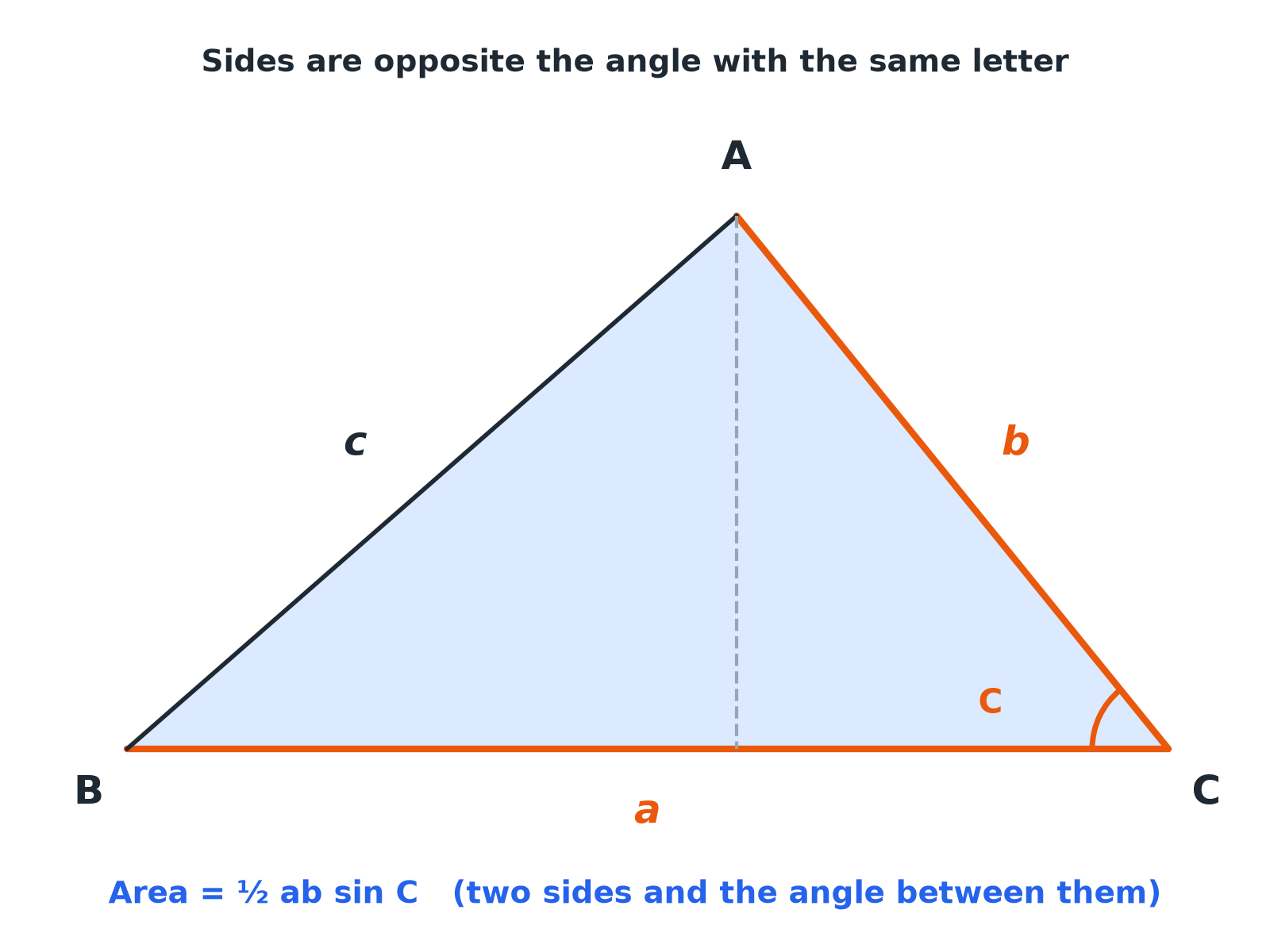
Side a is opposite angle A, and so on. Area uses two sides and the angle between them.
Which Formula?
-
Area
\(\tfrac{1}{2}ab\sin C\): two sides and the angle between them.
-
Sine rule (side)
Two angles and a side, need another side.
-
Sine rule (angle)
Two sides and a non-included angle, need an angle.
-
Neither
Three sides, or two sides and the included angle: use the cosine rule (next lesson).
Area of a Triangle
Find the area of a triangle with sides \(a = 8\) cm and \(b = 11\) cm and angle \(C = 50^\circ\) between them. Give your answer to 3 significant figures.
Show the solutionHide the solution
- 1 Write the formula Area \(= \tfrac{1}{2}ab\sin C\)
- 2 Substitute \(\tfrac{1}{2} \times 8 \times 11 \times \sin 50^\circ\)
- 3 Work out \(44 \times 0.7660 = 33.7\)
AnswerArea \(= 33.7\) cm\(^2\)
Sine Rule: Finding a Side
In triangle ABC, \(A = 40^\circ\), \(B = 65^\circ\) and \(a = 8\) cm. Find \(b\).
Show the solutionHide the solution
- 1 Set up \(\dfrac{b}{\sin 65^\circ} = \dfrac{8}{\sin 40^\circ}\)
- 2 Rearrange \(b = \dfrac{8 \times \sin 65^\circ}{\sin 40^\circ}\)
- 3 Work out \(b = 11.28\)
Answer\(b = 11.3\) cm (3 s.f.)
Sine Rule: Finding an Angle
In triangle ABC, \(a = 7\) cm, \(b = 9\) cm and angle \(A = 35^\circ\). Find angle \(B\).
Show the solutionHide the solution
- 1 Set up \(\dfrac{\sin B}{9} = \dfrac{\sin 35^\circ}{7}\)
- 2 Rearrange \(\sin B = \dfrac{9 \times \sin 35^\circ}{7} = 0.7375\)
- 3 Inverse sine \(B = \sin^{-1}(0.7375) = 47.5^\circ\)
Answer\(B = 47.5^\circ\) (1 d.p.)
Setting Out
Put the unknown on top.
-
Missing side
Write the rule with sides on top: \(\dfrac{a}{\sin A} = \dfrac{b}{\sin B}\).
-
Missing angle
Write the rule with sines on top: \(\dfrac{\sin A}{a} = \dfrac{\sin B}{b}\).
-
Diagram
Mark which side is opposite which angle before you start.
-
Check
The biggest angle is opposite the longest side.
Choose the Method
For each, say whether you would use the area formula, the sine rule, or neither yet, and why. (a) Two angles and one side, find another side. (b) Two sides and the angle between them, find the area. (c) Three sides, find an angle. (d) Two sides and an angle not between them, find another angle.
1. List what is given.
2. Choose the formula.
A good answer shows: (a) Sine rule. (b) Area \(= \tfrac{1}{2}ab\sin C\). (c) Neither yet: cosine rule. (d) Sine rule.
Can I...?
- 1Label sides and angles.
- 2Write the area formula.
- 3Find the area of a triangle.
- 4Write the sine rule.
- 5Find a missing side.
- 6Find a missing angle.
- 7Put the unknown on top.
- 8Check the answer is sensible.
Summary & Exam Focus
- Area \(= \tfrac{1}{2}ab\sin C\).
- Sine rule: \(\dfrac{a}{\sin A} = \dfrac{b}{\sin B}\).
- Use the sine rule with two angles and a side, or two sides and a non-included angle.
- Check side lengths against angles.
Exam focus
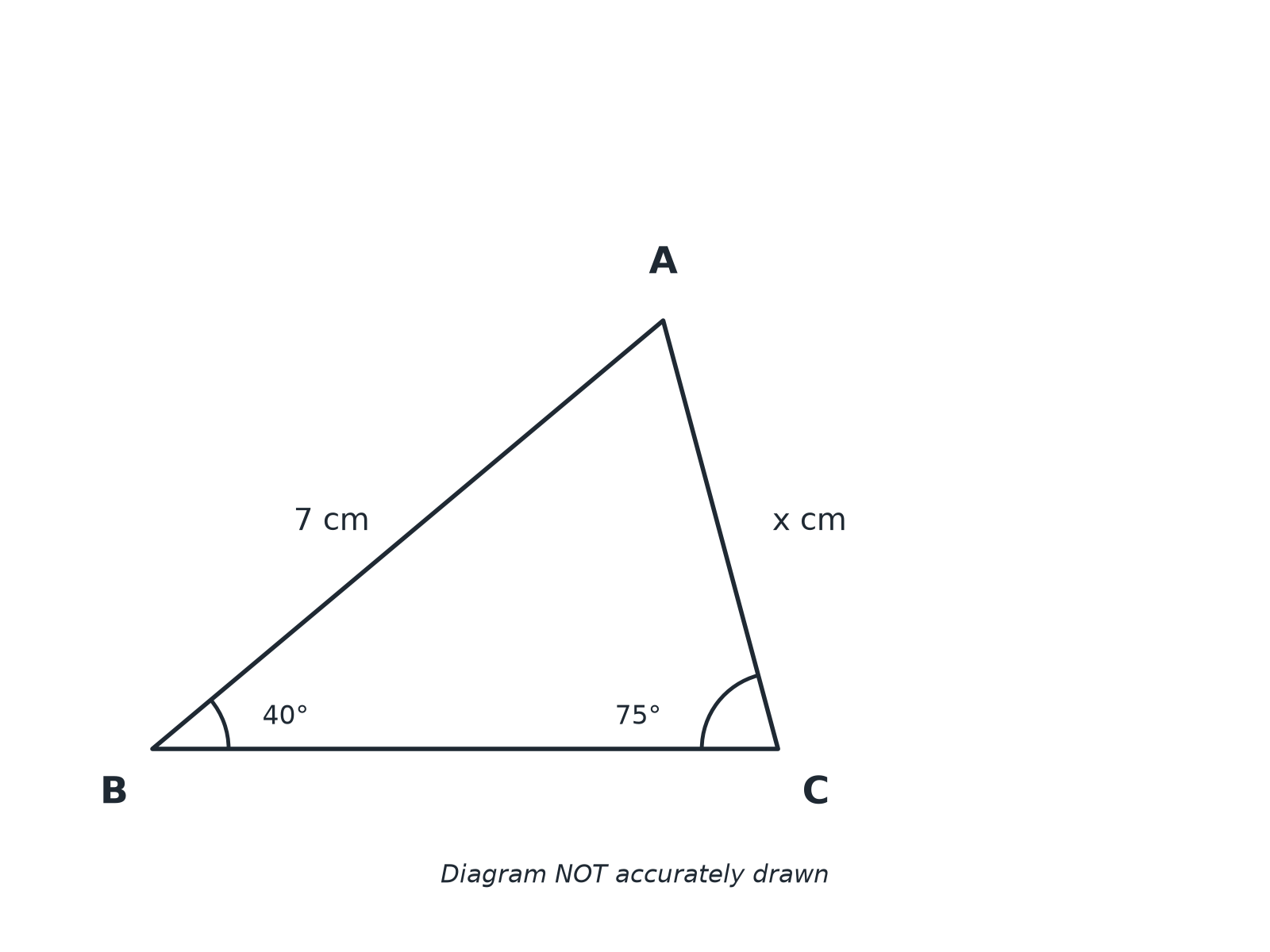
In triangle ABC, \(AB = 7\) cm, angle \(B = 40^\circ\) and angle \(C = 75^\circ\). Work out the length of \(AC\). Give your answer correct to 3 significant figures. (3 marks) (3 marks)
Write the sine rule with the unknown side on top. Keep your calculator in degrees.
Key terms
The vocabulary this lesson expects you to use. Each one is linked from the first place it appears above.
- Sine rule
- \(\frac{a}{\sin A} = \frac{b}{\sin B} = \frac{c}{\sin C}\).
- Opposite
- Across the triangle from an angle, not touching it.
- Included angle
- The angle between two given sides.
- Scalene
- A triangle with no equal sides.
- Vertex
- A corner of a shape.
- Non-right-angled
- A triangle with no \(90^\circ\) angle.
Questions and answers
12 questions set on this lesson, with the mark schemes and model answers open.
In triangle ABC, \(AB = 7\) cm, angle \(ABC = 40^\circ\) and angle \(ACB = 75^\circ\). Work out the length of \(AC\). Give your answer correct to 3 significant figures.
Mark scheme — 3 marks available
- \(\dfrac{AC}{\sin 40^\circ} = \dfrac{7}{\sin 75^\circ}\) — M1
- \(\dfrac{7 \times \sin 40^\circ}{\sin 75^\circ}\) — M1
- 4.66 — A1
Model answer
\(AC = \dfrac{7 \sin 40^\circ}{\sin 75^\circ} = 4.66\) cm
In triangle ABC, angle \(A = 52^\circ\), angle \(B = 71^\circ\) and \(BC = 9.4\) cm. Work out the length of \(AC\). Give your answer correct to 3 significant figures.
Mark scheme — 3 marks available
- \(\dfrac{AC}{\sin 71^\circ} = \dfrac{9.4}{\sin 52^\circ}\) — M1
- \(\dfrac{9.4 \times \sin 71^\circ}{\sin 52^\circ}\) — M1
- 11.3 — A1
Model answer
\(AC = \dfrac{9.4 \sin 71^\circ}{\sin 52^\circ} = 11.3\) cm
In triangle ABC, \(BC = 7\) cm, \(AC = 9\) cm and angle \(BAC = 35^\circ\). Work out the size of angle \(ABC\). Give your answer correct to 1 decimal place. (Angle \(ABC\) is acute.)
Mark scheme — 3 marks available
- \(\dfrac{\sin B}{9} = \dfrac{\sin 35^\circ}{7}\) — M1
- \(\sin B = 0.7375...\) — M1
- 47.5 — A1
Model answer
\(\sin B = \dfrac{9 \sin 35^\circ}{7} = 0.7375\), so \(B = 47.5^\circ\)
A triangle has two sides of length 9.5 cm and 6.2 cm with an angle of \(112^\circ\) between them. Work out the area of the triangle. Give your answer correct to 3 significant figures.
Mark scheme — 2 marks available
- \(\tfrac{1}{2} \times 9.5 \times 6.2 \times \sin 112^\circ\) — M1
- 27.3 — A1
Model answer
\(\tfrac{1}{2} \times 9.5 \times 6.2 \times \sin 112^\circ = 27.3\) cm\(^2\)
The area of a triangle is 25 cm\(^2\). Two of its sides are 5 cm and 10 cm and the angle between them is acute. Work out the size of the angle between these two sides. Give your answer correct to 1 decimal place.
Mark scheme — 4 marks available
- \(\tfrac{1}{2} \times 5 \times 10 \times \sin C = 25\) — M1
- \(25 \sin C = 25\) — M1
- \(\sin C = 1\) — A1
- 90.0 — A1
Model answer
\(\tfrac{1}{2} \times 5 \times 10 \times \sin C = 25\), so \(\sin C = 1\), giving \(C = 90^\circ\).
In a triangle, angle \(A = 30^\circ\), \(a = 6\) cm and \(b = 10\) cm. Show that \(\sin B = \dfrac{5}{6}\).
Mark scheme — 3 marks available
- Sine rule set up — M1
- \(\sin 30^\circ = 0.5\) — M1
- Completes the proof — A1
Model answer
\(\dfrac{\sin B}{10} = \dfrac{\sin 30^\circ}{6}\), so \(\sin B = \dfrac{10 \times 0.5}{6} = \dfrac{5}{6}\).
In triangle ABC, side \(a\) is opposite...
Why: Lower-case a is the side opposite capital A.
The area of a triangle with sides \(a\), \(b\) and included angle \(C\) is...
Why: \(\tfrac{1}{2}ab\sin C\).
Which lets you find a side using the sine rule?
Why: Two angles and a side.
To find an angle with the sine rule, write it as...
Why: Sines on top: \(\dfrac{\sin A}{a} = \dfrac{\sin B}{b}\).
A triangle has sides 4 and 6 with an angle of \(30^\circ\) between them. Its area is...
Why: \(\tfrac{1}{2} \times 4 \times 6 \times 0.5 = 6\).
In a triangle, the longest side is opposite...
Why: The largest angle.