Viewing as
Teacher view: planning notes, the answers to every question, and the teacher copies of the files.
Maths · More trigonometry
Graph of the cosine function
Sketch and read the graph of \(y = \cos x\), use its symmetry to find all solutions to \(\cos x = k\) between \(0^\circ\) and \(360^\circ\), and compare it with the sine graph.
Teacher resources
The teacher copies: slides with the questions built in, the answers, and anything else attached to this lesson for whoever is teaching it.
- Graph of the cosine function - Teacher Slides.pptx Teacher The lesson slides with the teacher's notes on each slide, and every question and mark scheme built in. Built from the lesson script on 30 September 2026. View
- Graph of the cosine function - Teacher Notes.docx Teacher The complete notes with the teacher's notes and every model answer in full. Built from the lesson script on 30 September 2026. View
Student handouts
The same files the students see, to print or hand out.
- Graph of the cosine function.pptx Built from the lesson script on 30 September 2026. View
- Graph of the cosine function - Completed Notes.docx The full notes for the lesson, to revise from. Built from the lesson script on 30 September 2026. View
- Graph of the cosine function - Exam Questions.docx Built from the lesson script on 30 September 2026. View
Warm-up
Answer each one, then check.
-
1
What is \(\cos 60^\circ\)?
Show answerHide answer
\(0.5\)
-
2
What is \(\cos 0^\circ\)?
Show answerHide answer
\(1\)
-
3
What does CAH mean?
Show answerHide answer
\(\cos = \text{adjacent} \div \text{hypotenuse}\)
-
4
What is the period of the sine graph?
Show answerHide answer
\(360^\circ\)
-
5
What are the largest and smallest values of sine?
Show answerHide answer
\(1\) and \(-1\)
Learning Objectives
COSINE GRAPH
The graph of \(y = \cos x\) is the sine wave shifted \(90^\circ\) to the left.
It starts at 1 when \(x = 0^\circ\), falls to 0 at \(90^\circ\), reaches \(-1\) at \(180^\circ\), is 0 at \(270^\circ\) and back to 1 at \(360^\circ\).
The Cosine Graph
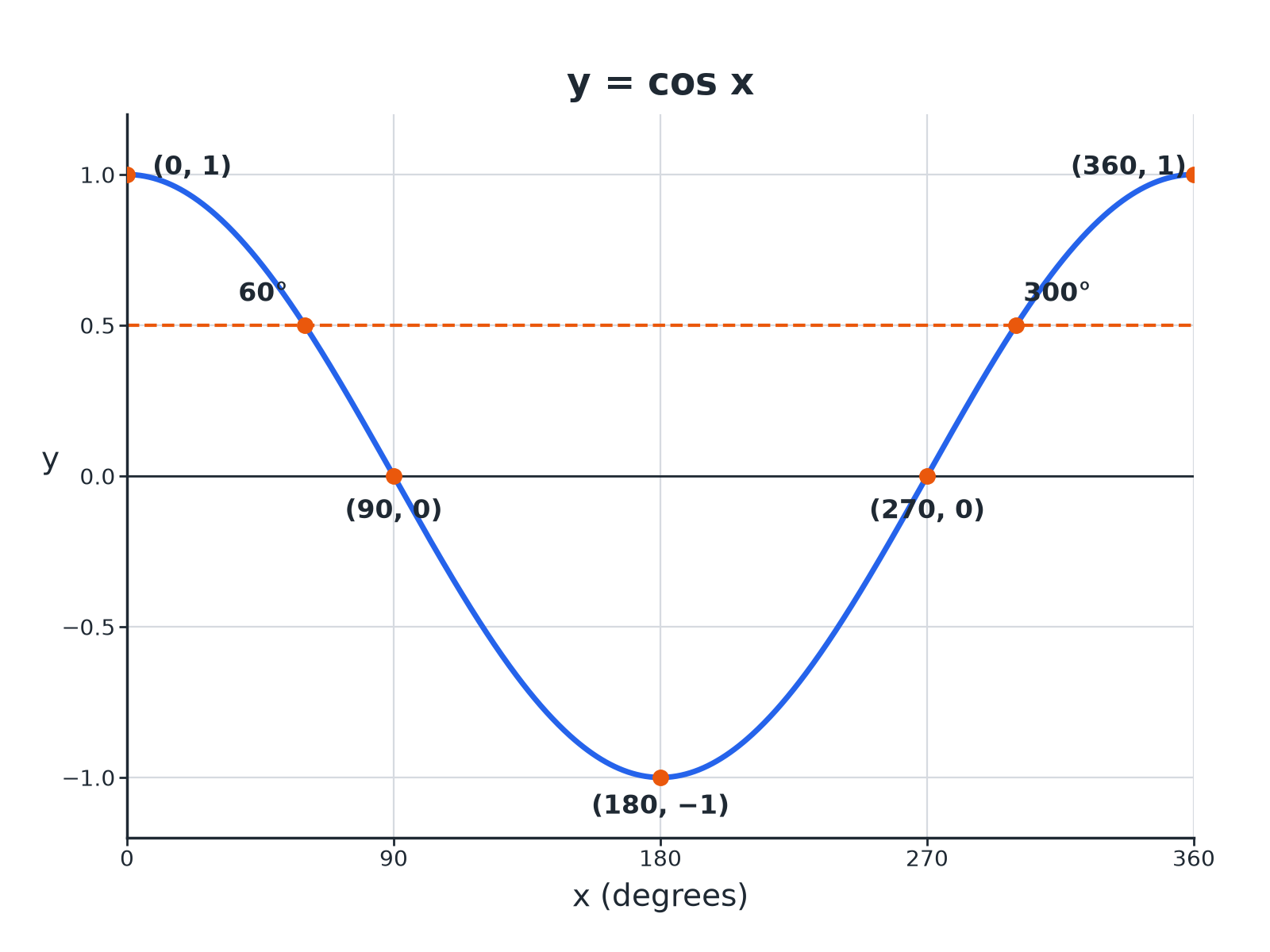
Cosine x equals 0.5 has two solutions: 60 degrees and 300 degrees.
Key Values of Cosine
These are worth learning.
-
\(\cos x\)
\(0^\circ\): \(1\). \(60^\circ\): \(0.5\). \(90^\circ\): \(0\). \(180^\circ\): \(-1\) | \(0\) | \(0.5\) | \(1\)
Features of the Graph
-
Period
Repeats every \(360^\circ\).
-
Maximum
\(1\) at \(x = 0^\circ\) and \(360^\circ\).
-
Minimum
\(-1\) at \(x = 180^\circ\).
-
Roots
\(x = 90^\circ\) and \(270^\circ\).
-
Symmetry
Symmetrical about \(x = 180^\circ\).
Finding Two Solutions
Use symmetry about \(x = 180^\circ\).
-
1
Use the calculator
Find \(x = \cos^{-1}(k)\); this is the first solution
-
2
Reflect about 180
Second solution \(= 360^\circ - x\)
-
3
Check the range
Both must be between \(0^\circ\) and \(360^\circ\)
-
4
Negative values
\(\cos^{-1}\) of a negative gives an angle between \(90^\circ\) and \(180^\circ\)
Solving cos x = 0.5
Solve \(\cos x = 0.5\) for \(0^\circ \le x \le 360^\circ\).
Show the solutionHide the solution
- 1 Calculator \(x = \cos^{-1}(0.5) = 60^\circ\)
- 2 Reflect \(x = 360^\circ - 60^\circ = 300^\circ\)
Answer\(x = 60^\circ\) and \(x = 300^\circ\)
Solving a Negative Value
Solve \(\cos x = -0.7\) for \(0^\circ \le x \le 360^\circ\), correct to 1 decimal place.
Show the solutionHide the solution
- 1 Calculator \(x = \cos^{-1}(-0.7) = 134.4^\circ\)
- 2 Reflect \(360^\circ - 134.4^\circ = 225.6^\circ\)
Answer\(x = 134.4^\circ\) and \(x = 225.6^\circ\)
Sine and Cosine Graphs
y = sin x
- Starts at 0.
- Maximum at \(90^\circ\), minimum at \(270^\circ\).
- Second solution: \(180^\circ - x\).
y = cos x
- Starts at 1.
- Maximum at \(0^\circ\) and \(360^\circ\), minimum at \(180^\circ\).
- Second solution: \(360^\circ - x\).
Sine Meets Cosine
Sketch \(y = \sin x\) and \(y = \cos x\) on the same axes for \(0^\circ\) to \(360^\circ\). (a) Where do they cross? (b) What single translation maps sine onto cosine?
1. Draw both curves.
2. Read the crossing points.
A good answer shows: (a) At \(x = 45^\circ\) and \(225^\circ\). (b) A translation of \(90^\circ\) to the left.
Can I...?
- 1Sketch the cosine graph.
- 2State its maximum and minimum.
- 3Recall cos 0, cos 60 and cos 90.
- 4Use cos inverse.
- 5Find the second solution.
- 6Solve for negative values.
- 7Compare sine and cosine.
- 8Read solutions from a graph.
Summary & Exam Focus
- Cosine starts at 1, falls to \(-1\) at \(180^\circ\), returns to 1 at \(360^\circ\).
- \(\cos x = k\) has two solutions in \(0^\circ\) to \(360^\circ\) for \(-1 < k < 1\).
- Solutions are \(x\) and \(360^\circ - x\).
- Cosine is sine shifted \(90^\circ\) left.
Exam focus
Solve \(\cos x = 0.3\) for \(0^\circ \le x \le 360^\circ\). Give answers correct to 1 decimal place. (3 marks) (3 marks)
Second solution is \(360^\circ - x\).
Key terms
The vocabulary this lesson expects you to use. Each one is linked from the first place it appears above.
- Cosine graph
- The wave \(y = \cos x\).
- Period
- \(360^\circ\) for both sine and cosine.
- Inverse cosine
- \(\cos^{-1}\), the calculator function that finds an angle.
- Translation
- Sliding a graph without turning it.
- Symmetry
- The graph mirrors itself about a line.
- Solution
- A value of \(x\) that gives the required \(y\).
Questions and answers
12 questions set on this lesson, with the mark schemes and model answers open.
Solve \(\cos x = 0.3\) for \(0^\circ \le x \le 360^\circ\). Give your answers correct to 1 decimal place.
Mark scheme — 3 marks available
- \(\cos^{-1}(0.3) = 72.5^\circ\) — B1
- \(360 - 72.5\) — M1
- 287.5 — A1
Model answer
\(x = 72.5^\circ\) and \(x = 287.5^\circ\)
Write down the value of (a) \(\cos 0^\circ\) (b) \(\cos 180^\circ\)
Mark scheme — 2 marks available
- 1 — B1
- \(-1\) — B1
Model answer
(a) 1 (b) \(-1\)
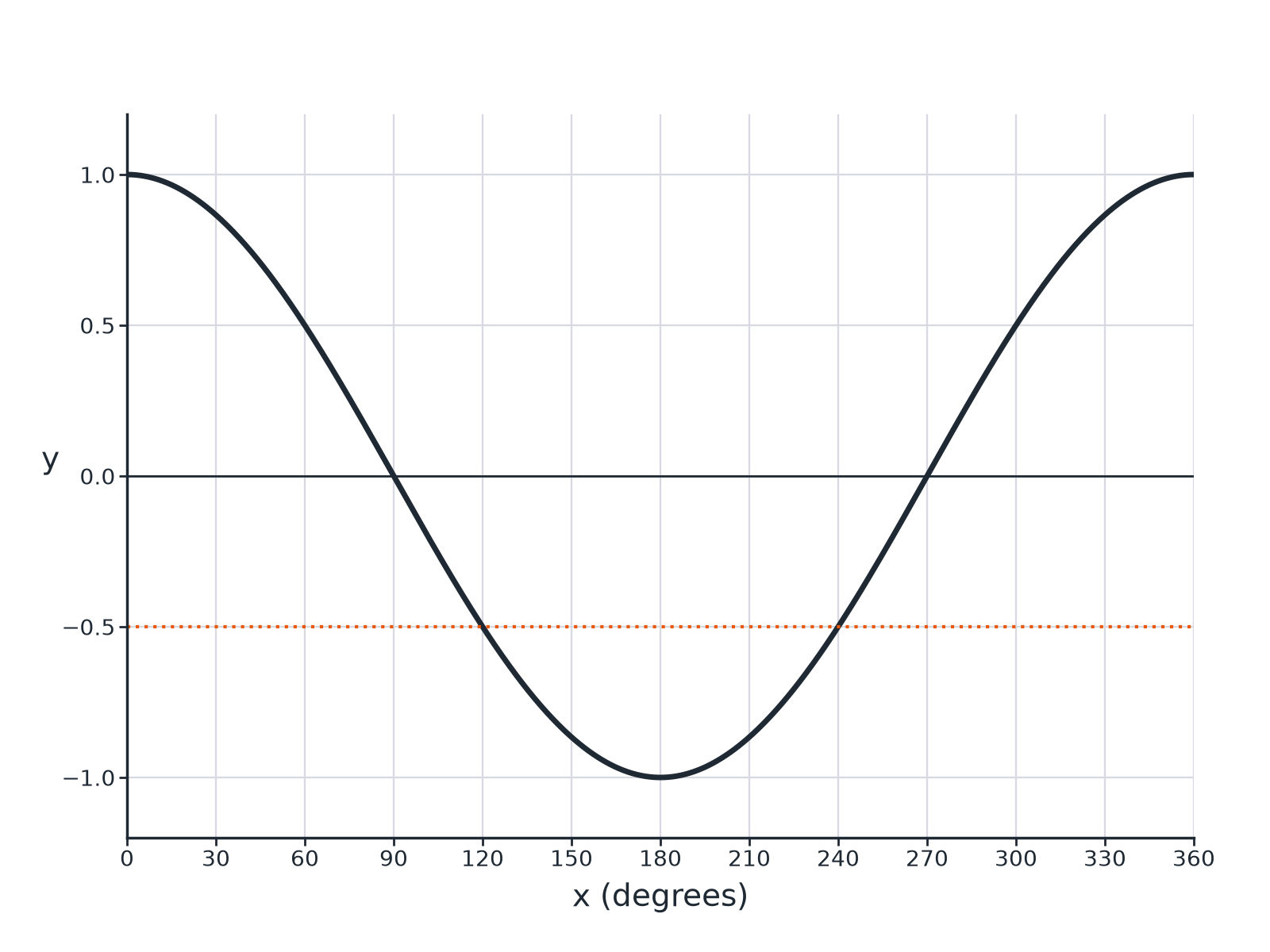
The graph shows \(y = \cos x\) for \(0^\circ \le x \le 360^\circ\). Use the graph to solve \(\cos x = -0.5\) and to write down the minimum value of \(\cos x\).
Mark scheme — 3 marks available
- 120 — B1
- 240 — B1
- \(-1\) — B1
Model answer
\(x = 120^\circ\) and \(x = 240^\circ\); minimum value \(-1\).
Solve \(\cos x = -0.7\) for \(0^\circ \le x \le 360^\circ\). Give your answers correct to 1 decimal place.
Mark scheme — 3 marks available
- \(\cos^{-1}(-0.7) = 134.4^\circ\) — B1
- \(360 - 134.4\) — M1
- 225.6 — A1
Model answer
\(x = 134.4^\circ\) and \(x = 225.6^\circ\)
\(\cos 50^\circ = 0.64\) (to 2 decimal places). Write down another angle between \(0^\circ\) and \(360^\circ\) with cosine 0.64.
Mark scheme — 2 marks available
- \(360 - 50\) — M1
- 310 — A1
Model answer
\(310^\circ\)
Describe the single transformation that maps the graph of \(y = \sin x\) onto the graph of \(y = \cos x\).
Mark scheme — 2 marks available
- Translation — M1
- \(90^\circ\) to the left — A1
Model answer
A translation of \(90^\circ\) to the left.
What is \(\cos 0^\circ\)?
Why: The cosine graph starts at its maximum of 1.
\(\cos 60^\circ = 0.5\). Another solution between 0 and 360 is...
Why: \(360 - 60 = 300\).
The minimum of \(\cos x\) occurs at...
Why: The graph is lowest at 180 degrees.
\(\cos x = 0\) at \(x =\)...
Why: The graph crosses the axis at 90 and 270 degrees.
The cosine graph is symmetrical about...
Why: The line \(x = 180^\circ\).
The graph of \(\cos x\) can be made from the graph of \(\sin x\) by...
Why: Shift the sine wave 90 degrees to the left.