Viewing as
Teaching this? The teacher view adds 2 files, the mark schemes and the model answers.
Maths · More trigonometry
Transforming trigonometric graphs 2
Transform trigonometric graphs horizontally: translations \(y = f(x + a)\) and stretches \(y = f(ax)\), and find the period and equation from a graph.
Warm-up
Answer each one, then check.
-
1
What is the period of \(y = \sin x\)?
Show answerHide answer
\(360^\circ\)
-
2
Where is the first maximum of \(y = \sin x\)?
Show answerHide answer
\(x = 90^\circ\)
-
3
What does \(y = \sin x + 2\) do to the graph?
Show answerHide answer
Moves it up 2
-
4
What is the period of \(y = \tan x\)?
Show answerHide answer
\(180^\circ\)
-
5
What does \(y = 3\sin x\) do to the graph?
Show answerHide answer
Stretches it vertically by 3
Learning Objectives
- 1Describe and sketch \(y = \sin(x + a)\) and \(y = \cos(x - a)\).
- 2Describe and sketch \(y = \sin ax\) and \(y = \cos ax\).
- 3Find the period of \(y = \sin ax\).
- 4Solve equations such as \(\sin 2x = 0.5\).
HORIZONTAL TRANSFORMATIONS
Changes inside the brackets move or stretch the graph left and right, and often do the opposite of what you expect.
\(y = f(x + a)\) translates left by \(a\). \(y = f(x - a)\) translates right by \(a\). \(y = f(ax)\) stretches horizontally with scale factor \(\dfrac{1}{a}\).
Four Horizontal Transformations
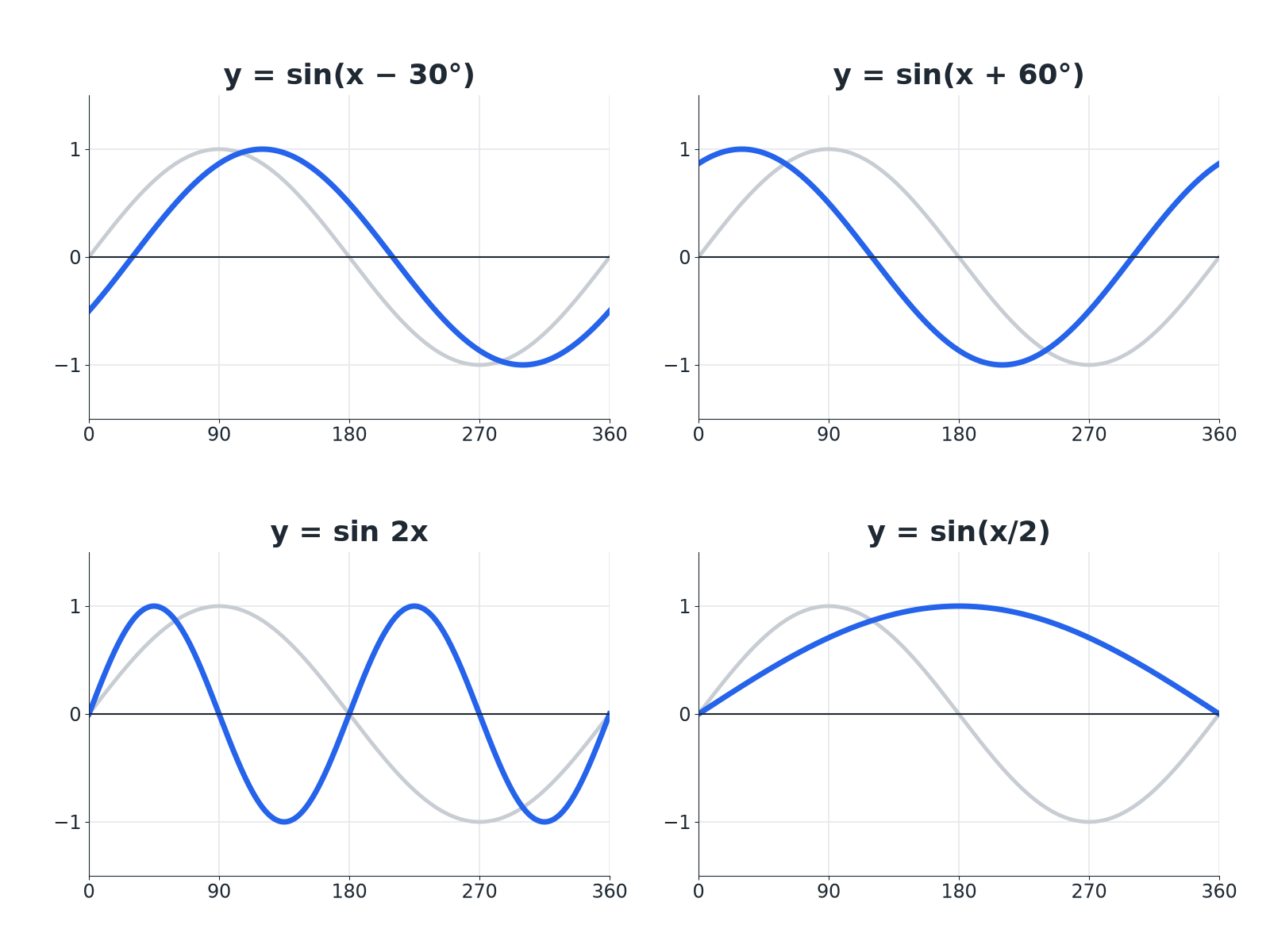
The faint curve is y equals sine x.
Effects on the Graph
Read the change inside the brackets.
-
\(y = \sin(x - 30^\circ)\)
Transformation: Translate right 30. Period: \(360^\circ\)
-
\(y = \sin(x + 60^\circ)\)
Transformation: Translate left 60. Period: \(360^\circ\)
-
\(y = \sin 2x\)
Transformation: Horizontal stretch, scale factor \(\tfrac{1}{2}\). Period: \(180^\circ\)
-
\(y = \cos 3x\)
Transformation: Horizontal stretch, scale factor \(\tfrac{1}{3}\). Period: \(120^\circ\)
-
\(y = \sin\tfrac{x}{2}\)
Transformation: Horizontal stretch, scale factor 2. Period: \(720^\circ\)
A Horizontal Translation
The graph of \(y = \sin x\) is translated to give \(y = \sin(x + 30^\circ)\). Describe the translation and find the first maximum.
Show the solutionHide the solution
- 1 Plus inside the bracket Moves left by \(30^\circ\)
- 2 Maximum was at \(90^\circ\)
- 3 Now at \(90^\circ - 30^\circ = 60^\circ\)
AnswerA translation of \(30^\circ\) to the left; the first maximum is at \(x = 60^\circ\).
A Horizontal Stretch
State the period of \(y = \cos 3x\) and how many full waves there are between \(0^\circ\) and \(360^\circ\).
Show the solutionHide the solution
- 1 Period \(\dfrac{360^\circ}{3} = 120^\circ\)
- 2 Number of waves \(\dfrac{360}{120} = 3\)
AnswerThe period is \(120^\circ\), giving 3 full waves.
Solving sin 2x = 0.5
Solve \(\sin 2x = 0.5\) for \(0^\circ \le x \le 360^\circ\).
Show the solutionHide the solution
- 1 Range for \(2x\) \(0^\circ \le 2x \le 720^\circ\)
- 2 Solve for \(2x\) \(2x = 30^\circ,\ 150^\circ,\ 390^\circ,\ 510^\circ\)
- 3 Halve \(x = 15^\circ,\ 75^\circ,\ 195^\circ,\ 255^\circ\)
Answer\(x = 15^\circ,\ 75^\circ,\ 195^\circ,\ 255^\circ\)
Inside and Outside the Brackets
Outside the brackets: vertical
- \(y = a\sin x\): stretch in y.
- \(y = \sin x + a\): translate up.
- Does what it looks like.
Inside the brackets: horizontal
- \(y = \sin(x + a)\): translate left.
- \(y = \sin ax\): stretch in x by \(\tfrac{1}{a}\).
- Does the opposite of what it looks like.
Period Detective
State the period of each graph. (a) \(y = \sin 4x\) (b) \(y = \cos\tfrac{x}{3}\) (c) \(y = \tan 2x\). Then say where the first maximum of (a) is.
1. Divide the normal period by the number.
2. Divide the first maximum position in the same way.
A good answer shows: (a) \(90^\circ\). (b) \(1080^\circ\). (c) \(90^\circ\) (tangent's normal period is \(180^\circ\), so divide by 2). First maximum of (a) at \(x = 22.5^\circ\).
Can I...?
- 1Describe y = sin(x + a).
- 2Describe y = sin(x - a).
- 3Describe y = sin ax.
- 4Find the period.
- 5Find a first maximum.
- 6Sketch a transformed graph.
- 7Solve sin 2x = k.
- 8Find a from a graph.
Summary & Exam Focus
- \(y = f(x + a)\): translate left by \(a\). \(y = f(x - a)\): translate right.
- \(y = f(ax)\): stretch in x by scale factor \(\tfrac{1}{a}\).
- Period of \(\sin ax\) or \(\cos ax\): \(\dfrac{360^\circ}{a}\).
- Solving \(\sin ax = k\): extend the range to \(360a\).
Exam focus
Solve \(\sin 2x = 0.5\) for \(0^\circ \le x \le 360^\circ\). (4 marks) (4 marks)
Find the range for the whole bracket first. Then solve, then divide.
Key terms
The vocabulary this lesson expects you to use. Each one is linked from the first place it appears above.
- Period
- The length after which the graph repeats.
- Horizontal stretch
- A stretch that changes the x-values.
- Translation
- A slide left, right, up or down.
- Scale factor
- The number the x-values are multiplied by.
- Full wave
- One complete cycle of the graph.
- Phase shift
- A horizontal translation of a trig graph.
Practice questions
Have a go at each one before you open its answer.
-
Question 1 Find 2 marks
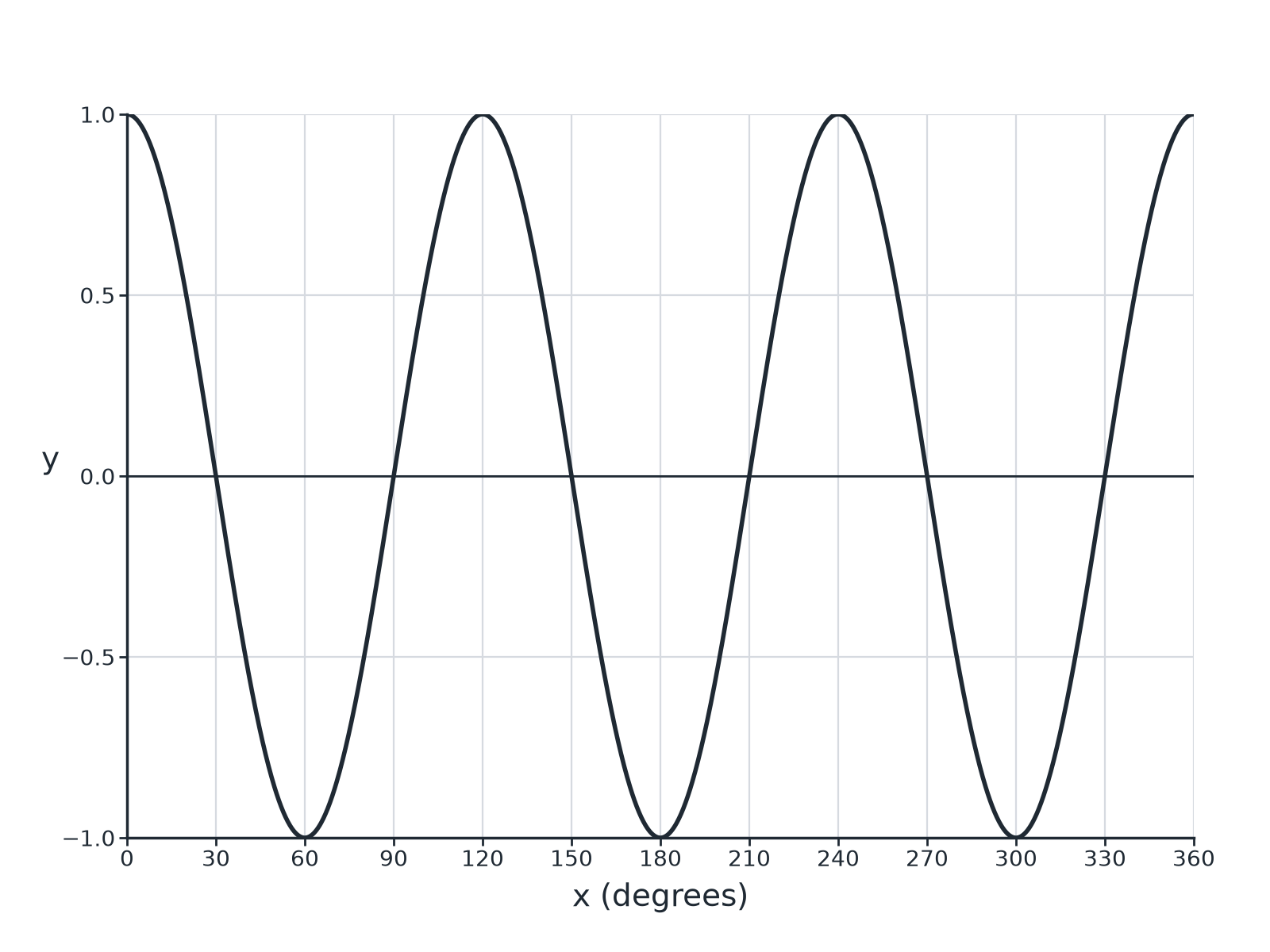
The graph shows \(y = \cos ax\) for \(0^\circ \le x \le 360^\circ\), where \(a\) is a positive whole number. Find the value of \(a\).
Show answerHide answer
Model answer
\(a = 3\)
Mark scheme
- Three waves or period \(120^\circ\) — M1
- 3 — A1
-
Question 2 Describe 2 marks
Describe the single transformation that maps the graph of \(y = \sin x\) onto the graph of \(y = \sin(x - 40^\circ)\).
Show answerHide answer
Model answer
A translation of \(40^\circ\) to the right, that is by the vector \(\begin{pmatrix}40 \\ 0\end{pmatrix}\).
Mark scheme
- Translation — M1
- \(40^\circ\) to the right — A1
-
Question 3 Write down 1 mark
Write down the period of \(y = \sin 4x\).
Show answerHide answer
Model answer
\(90^\circ\)
Mark scheme
- 90 — B1
-
Question 4 Write down 2 marks
Write down the coordinates of the first maximum point of \(y = \sin(x - 30^\circ)\) for \(x > 0\).
Show answerHide answer
Model answer
\((120^\circ, 1)\)
Mark scheme
- \(x = 120\) — B1
- \(y = 1\) — B1
-
Question 5 Sketch 3 marks
On a grid, sketch the graph of \(y = \sin 2x\) for \(0^\circ \le x \le 360^\circ\).
Show answerHide answer
Model answer
Two full sine waves: maxima of 1 at \(45^\circ\) and \(225^\circ\), minima of \(-1\) at \(135^\circ\) and \(315^\circ\), crossing the x-axis at \(0^\circ, 90^\circ, 180^\circ, 270^\circ, 360^\circ\).
Mark scheme
- Two full waves — B1
- Maximum 1 and minimum \(-1\) — B1
- Correct roots or turning points — B1
-
Question 6 Solve 4 marks
Solve \(\sin 2x = 0.5\) for \(0^\circ \le x \le 360^\circ\).
Show answerHide answer
Model answer
\(x = 15^\circ,\ 75^\circ,\ 195^\circ,\ 255^\circ\)
Mark scheme
- \(2x = 30\) — M1
- \(2x = 150\) — M1
- Extends to \(390\) and \(510\) — M1
- All four answers — A1
Quick check
-
\(y = \sin(x + 20^\circ)\) is a translation of \(y = \sin x\)...
Show answerHide answer
A: 20 left
A plus inside the brackets moves the graph left.
-
The period of \(y = \cos 2x\) is...
Show answerHide answer
C: \(180^\circ\)
\(360 \div 2 = 180\).
-
\(y = \sin\tfrac{x}{2}\) has period...
Show answerHide answer
D: \(720^\circ\)
\(360 \div \tfrac{1}{2} = 720\).
-
How many full waves does \(y = \sin 3x\) have for \(0 \le x \le 360\)?
Show answerHide answer
B: 3
The period is 120, so there are 3 full waves.
-
The first maximum of \(y = \sin(x - 50^\circ)\) is at...
Show answerHide answer
C: \(140^\circ\)
\(90 + 50 = 140\).
-
To solve \(\sin 2x = 0.5\) for \(0 \le x \le 360\), the range for \(2x\) is...
Show answerHide answer
A: 0 to 720
Double the range: 0 to 720.
Downloads
Free to keep, print and annotate.
- Transforming trigonometric graphs 2.pptx Built from the lesson script on 30 September 2026. View
- Transforming trigonometric graphs 2 - Completed Notes.docx The full notes for the lesson, to revise from. Built from the lesson script on 30 September 2026. View
- Transforming trigonometric graphs 2 - Exam Questions.docx Built from the lesson script on 30 September 2026. View
Something here looks wrong?
Tell us what and we will go and look. It goes to whoever writes these pages, nobody else, and we do not ask who you are — so there is nothing to sign and nothing comes back to you.