Viewing as
Teaching this? The teacher view adds 2 files, the mark schemes and the model answers.
Maths · Multiplicative reasoning
Growth and decay
Use multipliers to solve repeated percentage change problems, including compound interest, depreciation and exponential growth and decay.
Warm-up
Answer each one, then check.
-
1
What is the multiplier for a 15% increase?
Show answerHide answer
1.15
-
2
What is the multiplier for a 20% decrease?
Show answerHide answer
0.8
-
3
Work out \(1.1^2\).
Show answerHide answer
1.21
-
4
Increase £200 by 10%.
Show answerHide answer
£220
-
5
What is \(0.5^3\)?
Show answerHide answer
0.125
Learning Objectives
- 1Use multipliers for repeated percentage change.
- 2Calculate compound interest and depreciation.
- 3Use the formula \(\text{final} = \text{initial} \times \text{multiplier}^n\).
- 4Solve growth and decay problems in context.
THE KEY IDEA
For repeated percentage change, multiply by the multiplier once for each period.
\(\text{final amount} = \text{original amount} \times (\text{multiplier})^n\)
Multipliers
Write the multiplier as a decimal.
-
Increase by 5%
Multiplier: 1.05. Type: Growth
-
Increase by 20%
Multiplier: 1.2. Type: Growth
-
Decrease by 15%
Multiplier: 0.85. Type: Decay
-
Decrease by 40%
Multiplier: 0.6. Type: Decay
-
Halves each time
Multiplier: 0.5. Type: Decay
-
Doubles each time
Multiplier: 2. Type: Growth
Compound Interest
£5000 is invested at 3% compound interest per year. Work out its value after 4 years.
Show the solutionHide the solution
- 1 Multiplier for a 3% increase \(1.03\)
- 2 Apply it 4 times \(5000 \times 1.03^4\)
- 3 Work it out \(5000 \times 1.12550881 = 5627.54\)
Answer£5627.54
Compound Growth Beats Simple Interest
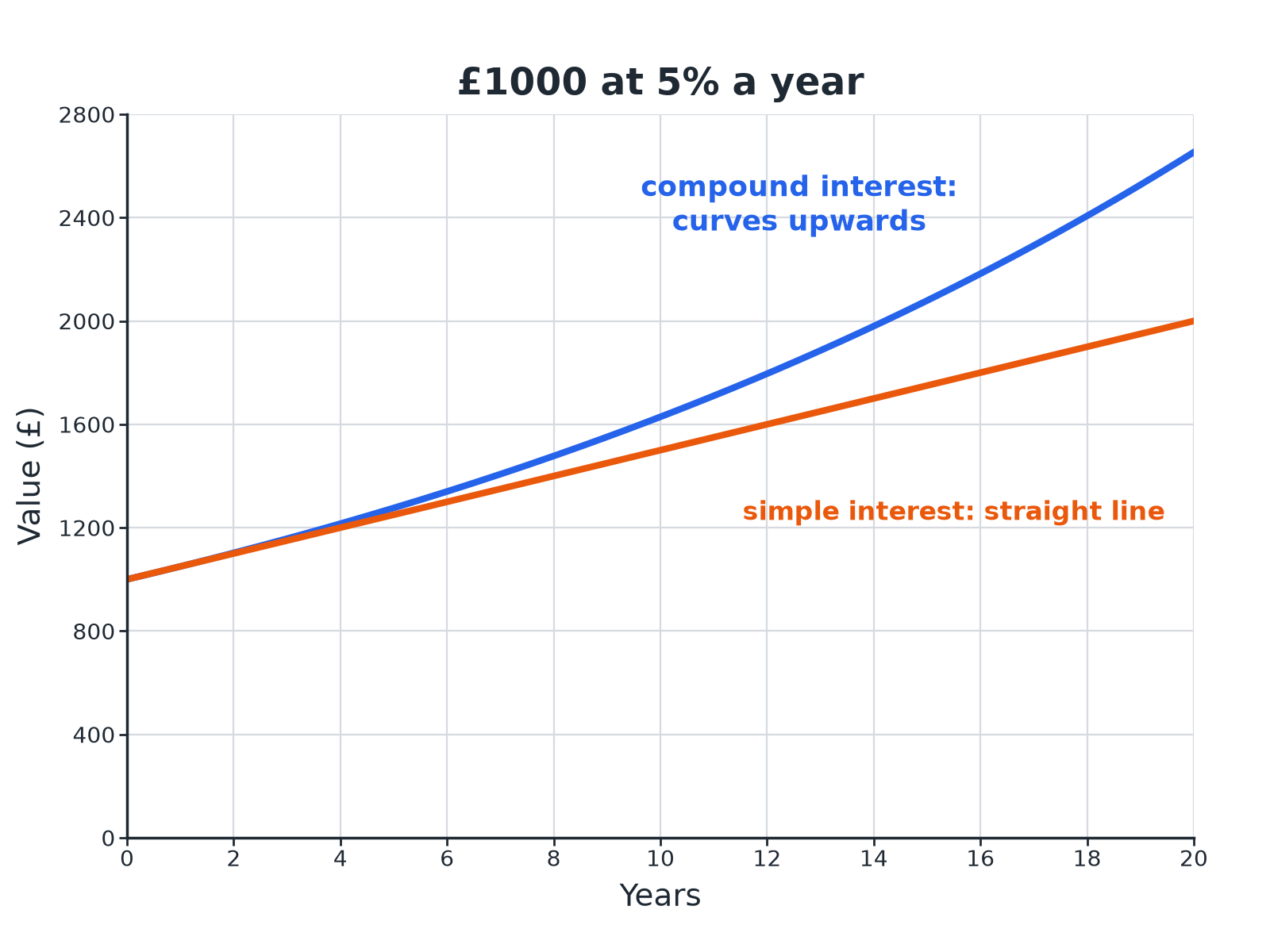
Compound interest earns interest on interest, so its graph curves upwards.
Depreciation
A car worth £12 000 loses 15% of its value each year. Find its value after 3 years.
Show the solutionHide the solution
- 1 Multiplier for a 15% decrease \(0.85\)
- 2 Apply it 3 times \(12\,000 \times 0.85^3\)
- 3 Work it out \(12\,000 \times 0.614125\)
Answer£7369.50
Exponential Growth
A culture of 500 bacteria grows by 20% every hour. Find the number of bacteria after 6 hours, to the nearest whole number.
Show the solutionHide the solution
- 1 Multiplier \(1.2\)
- 2 Apply it 6 times \(500 \times 1.2^6\)
- 3 Work it out \(500 \times 2.985984 = 1492.99\)
Answer1493 bacteria
Halving Each Time
A radioactive sample has mass 80 g. Its mass halves every 10 days. Find its mass after 30 days.
Show the solutionHide the solution
- 1 30 days is three halvings \(30 \div 10 = 3\)
- 2 Multiplier \(0.5\)
- 3 Apply it 3 times \(80 \times 0.5^3 = 80 \times 0.125\)
Answer10 g
Growth or Decay?
Growth
- The multiplier is greater than 1.
- Examples: interest, population increase, inflation.
- The graph curves upwards.
Decay
- The multiplier is between 0 and 1.
- Examples: depreciation, radioactive decay, cooling.
- The graph curves down and flattens towards zero.
Working Backwards and Solving for Time
Sometimes the unknown is the starting amount or the number of periods.
-
Original value
Divide by the multiplier: if £441 is after 2 years at 5%, the start is \(441 \div 1.05^2 = £400\).
-
Number of periods
Try values of n in \(\text{initial} \times \text{multiplier}^n\) until you reach the target.
-
Use the formula
Write the equation first, then substitute.
Double Your Money
An investment of £1000 earns 6% compound interest per year. By trying different numbers of years, find how many complete years it takes for the value to reach at least £2000.
1. Use a table of values.
2. Check the final year carefully.
A good answer shows: \(1000 \times 1.06^{11} = 1898.30\) and \(1000 \times 1.06^{12} = 2012.20\). It takes 12 years.
Can I...?
- 1Find a multiplier from a percentage change.
- 2Use a power for repeated change.
- 3Calculate compound interest.
- 4Calculate depreciation.
- 5Solve exponential growth problems.
- 6Solve exponential decay problems.
- 7Find an original value.
- 8Find the number of periods by trial.
Summary & Exam Focus
- Growth multiplier above 1; decay multiplier below 1.
- Final \(=\) initial \(\times\) multiplier\(^n\).
- Compound interest and depreciation use the same idea.
- To reverse a change, divide by the multiplier.
Exam focus
A car is worth £12 000. It loses 15% of its value each year. Work out its value after 3 years. (3 marks) (3 marks)
Write the multiplier, then use the power. Do not calculate 15% three times separately.
Key terms
The vocabulary this lesson expects you to use. Each one is linked from the first place it appears above.
- Multiplier
- The number you multiply by to increase or decrease.
- Compound interest
- Interest paid on the original amount and on interest already added.
- Depreciation
- The fall in value of an item over time.
- Exponential growth
- Growth by a constant multiplier greater than 1 each period.
- Exponential decay
- Decay by a constant multiplier between 0 and 1 each period.
- Original value
- The amount at the start.
Practice questions
Have a go at each one before you open its answer.
-
Question 1 Calculator 3 marks
£5000 is invested at 3% compound interest per year. Work out the value of the investment after 4 years. Give your answer to the nearest penny.
Show answerHide answer
Model answer
\(5000 \times 1.03^4 = 5627.54\).
Mark scheme
- Multiplier 1.03 — M1
- \(5000 \times 1.03^4\) — M1
- 5627.54 — A1
-
Question 2 Calculator 3 marks
A car is worth £12 000. Its value falls by 15% each year. Work out its value after 3 years.
Show answerHide answer
Model answer
\(12\,000 \times 0.85^3 = 7369.50\), so £7369.50.
Mark scheme
- Multiplier 0.85 — M1
- \(12\,000 \times 0.85^3\) — M1
- 7369.50 — A1
-
Question 3 Calculator 3 marks
A culture has 500 bacteria. The number increases by 20% every hour. Work out the number of bacteria after 6 hours. Give your answer to the nearest whole number.
Show answerHide answer
Model answer
\(500 \times 1.2^6 = 1492.99\), so 1493.
Mark scheme
- Multiplier 1.2 — M1
- \(500 \times 1.2^6\) — M1
- 1493 — A1
-
Question 4 Calculator 4 marks
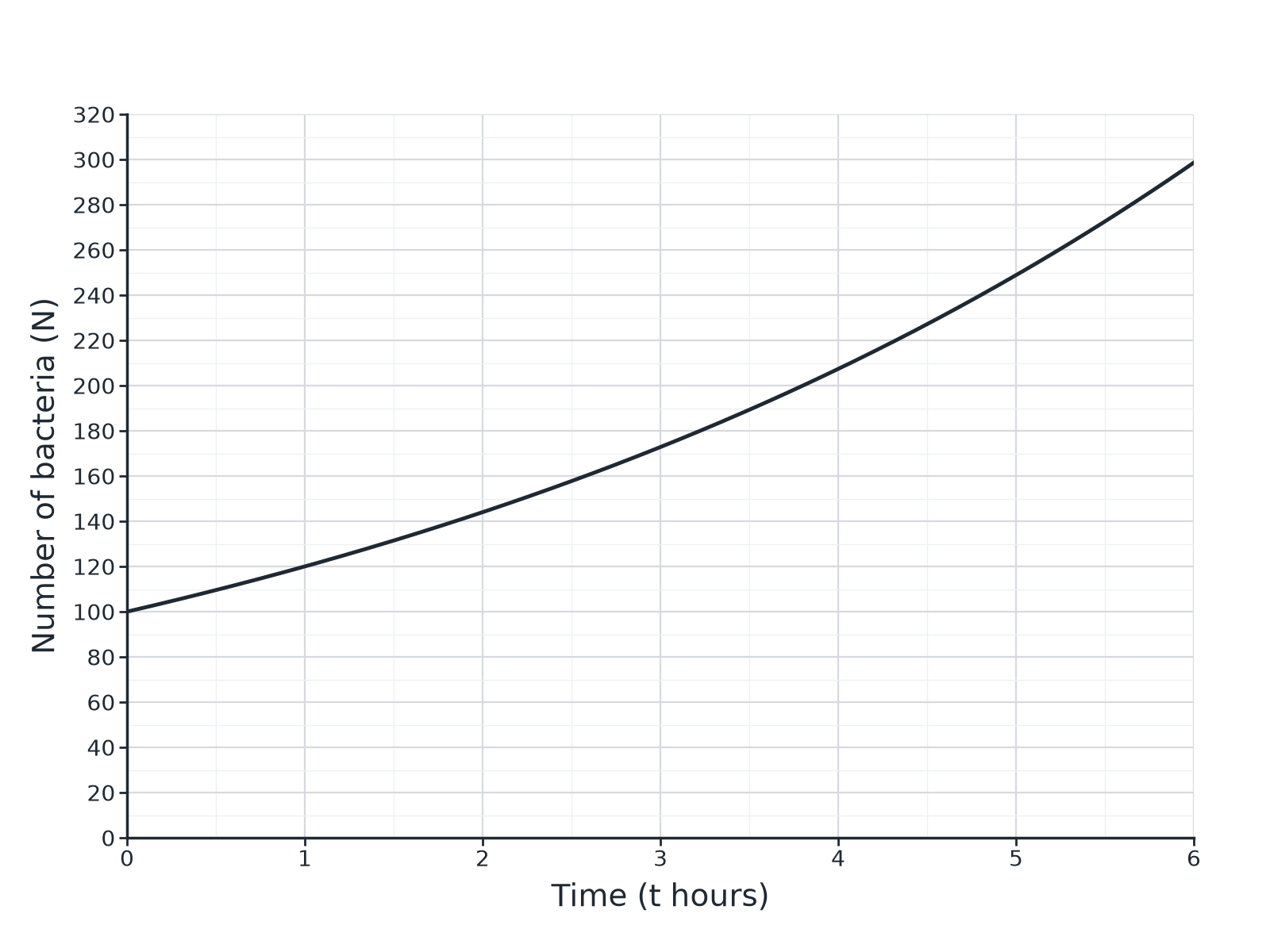
The graph shows the number of bacteria in a culture, \(N\), after \(t\) hours. The graph is a curve. (a) Use the graph to estimate the number of bacteria after 3.5 hours. (b) Use the graph to estimate the time when there are 200 bacteria.
Show answerHide answer
Model answer
(a) About 190 (accept 185 to 195). (b) About 3.8 hours (accept 3.7 to 3.9).
Mark scheme
- (a) Reading at \(t = 3.5\) — M1
- (a) 190 (185 to 195) — A1
- (b) Reading at \(N = 200\) — M1
- (b) 3.8 (3.7 to 3.9) — A1
-
Question 5 Non-calculator 3 marks
A radioactive sample has a mass of 80 g. Its mass halves every 10 days. Work out its mass after 30 days.
Show answerHide answer
Model answer
30 days is 3 halvings, so \(80 \times 0.5^3 = 10\) g.
Mark scheme
- 3 halvings — M1
- \(80 \times \dfrac{1}{8}\) — M1
- 10 — A1
-
Question 6 Calculator 3 marks
The population of a town is 2000. It decreases by 5% each year. Work out the population after 10 years. Give your answer to the nearest whole number.
Show answerHide answer
Model answer
\(2000 \times 0.95^{10} = 1197.47\), so 1197.
Mark scheme
- Multiplier 0.95 — M1
- \(2000 \times 0.95^{10}\) — M1
- 1197 — A1
Quick check
-
What is the multiplier for a 12% decrease?
Show answerHide answer
B: 0.88
\(100\% - 12\% = 88\% = 0.88\).
-
£200 grows at 10% per year for 2 years. What is it worth?
Show answerHide answer
C: £242
\(200 \times 1.1^2 = 242\).
-
A value of £600 falls by 50% each year. What is it worth after 2 years?
Show answerHide answer
A: £150
\(600 \times 0.5^2 = 150\).
-
To find the original value after a 5% rise gave £420, you...
Show answerHide answer
D: Divide by 1.05
Divide by the multiplier: \(420 \div 1.05 = 400\).
-
Which multiplier shows exponential decay?
Show answerHide answer
B: 0.97
A multiplier between 0 and 1.
-
How does the graph of compound interest compare with simple interest?
Show answerHide answer
C: It curves upwards
Compound interest curves above the straight line of simple interest.
Downloads
Free to keep, print and annotate.
- Growth and decay.pptx Built from the lesson script on 30 September 2026. View
- Growth and decay - Completed Notes.docx The full notes for the lesson, to revise from. Built from the lesson script on 30 September 2026. View
- Growth and decay - Exam Questions.docx Built from the lesson script on 30 September 2026. View
Something here looks wrong?
Tell us what and we will go and look. It goes to whoever writes these pages, nobody else, and we do not ask who you are — so there is nothing to sign and nothing comes back to you.