Viewing as
Teaching this? The teacher view adds 2 files, the mark schemes and the model answers.
Physics · Atomic structure
Mass number, atomic number and isotopes
Use atomic number and mass number, write nuclear symbols, and describe isotopes and ions.
Warm-up
Answer each one, then check.
-
1
How many protons does carbon have?
Show answerHide answer
6
-
2
What is an element?
Show answerHide answer
A substance with only one type of atom
-
3
What is an ion?
Show answerHide answer
A charged atom
-
4
What does the atomic number tell you?
Show answerHide answer
The number of protons
-
5
What is a neutron?
Show answerHide answer
A neutral particle in the nucleus
Learning Objectives
- 1Define atomic number and mass number.
- 2Work out the numbers of protons, neutrons and electrons in an atom.
- 3Explain what isotopes are and relate differences in isotope symbols to identities, charges and masses.
- 4Explain how atoms become positive ions.
ATOMIC NUMBER AND MASS NUMBER
The atomic number is the number of protons in an atom. The mass number is the total number of protons and neutrons.
Isotopes of an element have the same number of protons but different numbers of neutrons.
Nuclear Symbols and Isotopes
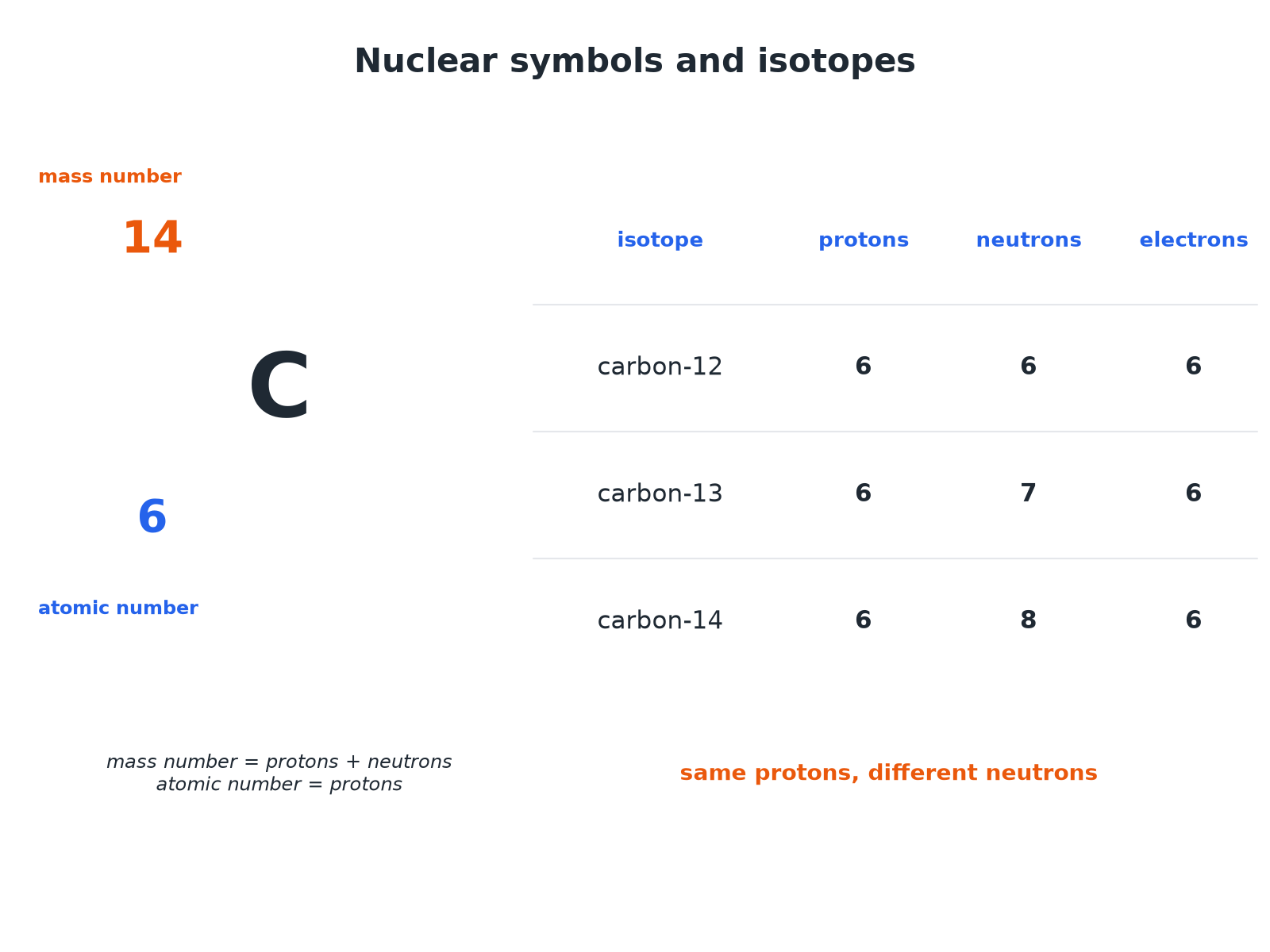
Same number of protons, different numbers of neutrons.
Counting Particles
An atom of \(^{14}_{6}\text{C}\) is neutral. How many protons, neutrons and electrons does it have?
Show the solutionHide the solution
- 1 Protons Atomic number = 6
- 2 Neutrons Mass number − atomic number = \(14 - 6 = 8\)
- 3 Electrons Same as protons in a neutral atom = 6
Answer6 protons, 8 neutrons and 6 electrons.
Isotopes
Compare the atoms \(^{35}_{17}\text{Cl}\) and \(^{37}_{17}\text{Cl}\).
Show the solutionHide the solution
- 1 Protons Both have 17
- 2 Electrons Both have 17 if neutral
- 3 Neutrons \(35 - 17 = 18\) and \(37 - 17 = 20\)
AnswerThey are isotopes: the same number of protons and electrons but different numbers of neutrons (2 more in chlorine-37).
Ions
A sodium atom \(^{23}_{11}\text{Na}\) loses one electron. Describe the ion formed.
Show the solutionHide the solution
- 1 Protons Still 11
- 2 Electrons Now 10
- 3 Charge One more proton than electrons: +1
AnswerA positive ion, \(\text{Na}^+\), with 11 protons, 12 neutrons and 10 electrons.
Key Ideas
Learn these.
-
Element
Determined by the number of protons.
-
Isotopes
Same element, so same chemical properties, but different masses.
-
Charge
Ions have an unequal number of protons and electrons.
-
Symbols
The mass number is the top number; the atomic number is the bottom number.
Fill the Table
For \(^{7}_{3}\text{Li}\) and \(^{6}_{3}\text{Li}\), state the number of protons, neutrons and electrons in each neutral atom. Explain why they are isotopes.
1. Use atomic number for protons.
2. Mass number minus atomic number for neutrons.
A good answer shows: Li-7: 3 protons, 4 neutrons, 3 electrons. Li-6: 3 protons, 3 neutrons, 3 electrons. They have the same number of protons but different numbers of neutrons.
Can I...?
- 1Define atomic number.
- 2Define mass number.
- 3Work out neutrons.
- 4Read a nuclear symbol.
- 5Define isotopes.
- 6Compare two isotopes.
- 7Explain positive ions.
- 8Say why isotopes react the same.
Summary & Exam Focus
- Atomic number = protons.
- Mass number = protons + neutrons.
- Isotopes: same protons, different neutrons.
- A positive ion has lost electrons.
Exam focus
An atom has 6 protons and 8 neutrons. State its mass number. (1 mark) (1 marks)
Add protons and neutrons.
Key terms
The vocabulary this lesson expects you to use. Each one is linked from the first place it appears above.
- Atomic number
- The number of protons in an atom.
- Mass number
- The total number of protons and neutrons.
- Isotopes
- Atoms of the same element with different numbers of neutrons.
- Ion
- An atom that has lost or gained electrons.
- Element
- A substance made of atoms with the same number of protons.
- Nuclide
- A particular type of nucleus, such as carbon-14.
Practice questions
Have a go at each one before you open its answer.
-
Question 1 Calculate 2 marks
An atom of carbon-14 is represented as \(^{14}_{6}\text{C}\). State the number of protons and the number of neutrons in the atom.
Show answerHide answer
Model answer
6 protons; 14 − 6 = 8 neutrons.
Mark scheme
- 6 protons — 1 mark
- 8 neutrons — 1 mark
-
Question 2 Explain 2 marks
Explain what is meant by isotopes.
Show answerHide answer
Model answer
Atoms of the same element (same number of protons) that have different numbers of neutrons.
Mark scheme
- Same number of protons or same element — 1 mark
- Different number of neutrons — 1 mark
-
Question 3 Compare 3 marks
Chlorine has two isotopes: \(^{35}_{17}\text{Cl}\) and \(^{37}_{17}\text{Cl}\). State one similarity and one difference between atoms of these isotopes.
Show answerHide answer
Model answer
Similarity: same number of protons (17) or electrons. Difference: chlorine-37 has 2 more neutrons (20 rather than 18), so a larger mass number.
Mark scheme
- Similarity — 1 mark
- Difference in neutrons — 1 mark
- With numbers or different mass — 1 mark
-
Question 4 Explain 3 marks
A lithium atom \(^{7}_{3}\text{Li}\) becomes a positive ion. Explain how this happens and give the number of electrons in the ion if the charge is +1.
Show answerHide answer
Model answer
The atom loses an outer electron. It has 3 protons and 2 electrons, so the charge is +1.
Mark scheme
- Loses an electron — 1 mark
- 3 protons and 2 electrons — 1 mark
- More protons than electrons gives positive charge — 1 mark
-
Question 5 Calculate 3 marks
An atom of uranium-235 has 92 protons. Calculate the number of neutrons and the number of electrons in a neutral atom of uranium-235.
Show answerHide answer
Model answer
Neutrons: 235 − 92 = 143. Electrons: 92.
Mark scheme
- Neutrons = mass number − atomic number — 1 mark
- 143 — 1 mark
- 92 electrons — 1 mark
Quick check
-
The number of protons is the...
Show answerHide answer
C: atomic number
Atomic number = protons.
-
Isotopes have the same number of...
Show answerHide answer
D: protons
Same element.
-
Carbon-14 has 6 protons and mass number 14. Neutrons =
Show answerHide answer
A: 8
14 − 6 = 8.
-
A neutral atom with 11 protons has how many electrons?
Show answerHide answer
B: 11
Equal to protons.
-
An atom that loses an electron is...
Show answerHide answer
C: a positive ion
More protons than electrons.
Downloads
Free to keep, print and annotate.
- Mass number atomic number and isotopes.pptx Built from the lesson script on 30 September 2026. View
- Mass number atomic number and isotopes - Completed Notes.docx The full notes for the lesson, to revise from. Built from the lesson script on 30 September 2026. View
- Mass number atomic number and isotopes - Exam Questions.docx Built from the lesson script on 30 September 2026. View
Something here looks wrong?
Tell us what and we will go and look. It goes to whoever writes these pages, nobody else, and we do not ask who you are — so there is nothing to sign and nothing comes back to you.