Viewing as
Teacher view: planning notes, the answers to every question, and the teacher copies of the files.
Physics · Atomic structure
Nuclear fission and fusion
Describe nuclear fission and chain reactions, how they are controlled in a reactor, and nuclear fusion.
Teacher resources
The teacher copies: slides with the questions built in, the answers, and anything else attached to this lesson for whoever is teaching it.
- Nuclear fission and fusion - Teacher Slides.pptx Teacher The lesson slides with the teacher's notes on each slide, and every question and mark scheme built in. Built from the lesson script on 30 September 2026. View
- Nuclear fission and fusion - Teacher Notes.docx Teacher The complete notes with the teacher's notes and every model answer in full. Built from the lesson script on 30 September 2026. View
Student handouts
The same files the students see, to print or hand out.
- Nuclear fission and fusion.pptx Built from the lesson script on 30 September 2026. View
- Nuclear fission and fusion - Completed Notes.docx The full notes for the lesson, to revise from. Built from the lesson script on 30 September 2026. View
- Nuclear fission and fusion - Exam Questions.docx Built from the lesson script on 30 September 2026. View
Warm-up
Answer each one, then check.
-
1
What is a nucleus?
Show answerHide answer
The centre of an atom, made of protons and neutrons
-
2
What is an isotope?
Show answerHide answer
An atom with the same protons but different neutrons
-
3
What is energy conserved?
Show answerHide answer
Energy cannot be created or destroyed
-
4
What happens to mass in E = mc²?
Show answerHide answer
It can be converted to energy
-
5
What is a chain reaction?
Show answerHide answer
A reaction that keeps itself going
Learning Objectives
- 1Describe nuclear fission and how a chain reaction occurs.
- 2Explain how the chain reaction is controlled in a nuclear reactor and uncontrolled in a nuclear weapon.
- 3Draw and interpret diagrams of fission and chain reactions.
- 4Describe nuclear fusion.
FISSION AND FUSION
Nuclear fission is the splitting of a large and unstable nucleus, such as uranium or plutonium. Nuclear fusion is the joining of two light nuclei to form a heavier nucleus.
In both, energy is released. In fusion some of the mass is converted into the energy of radiation.
A Fission Chain Reaction
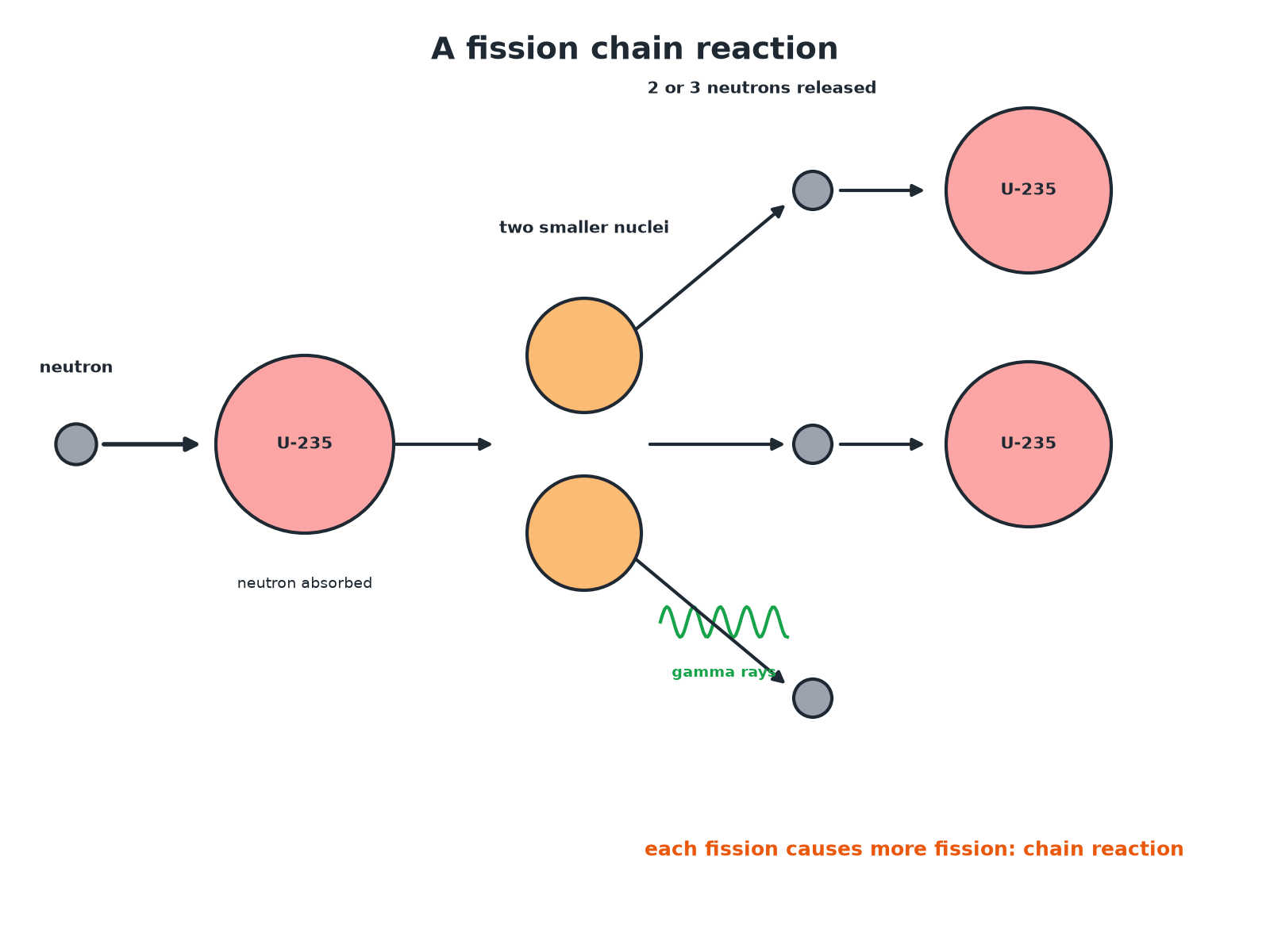
Each fission produces neutrons that cause more fission.
Nuclear Fusion
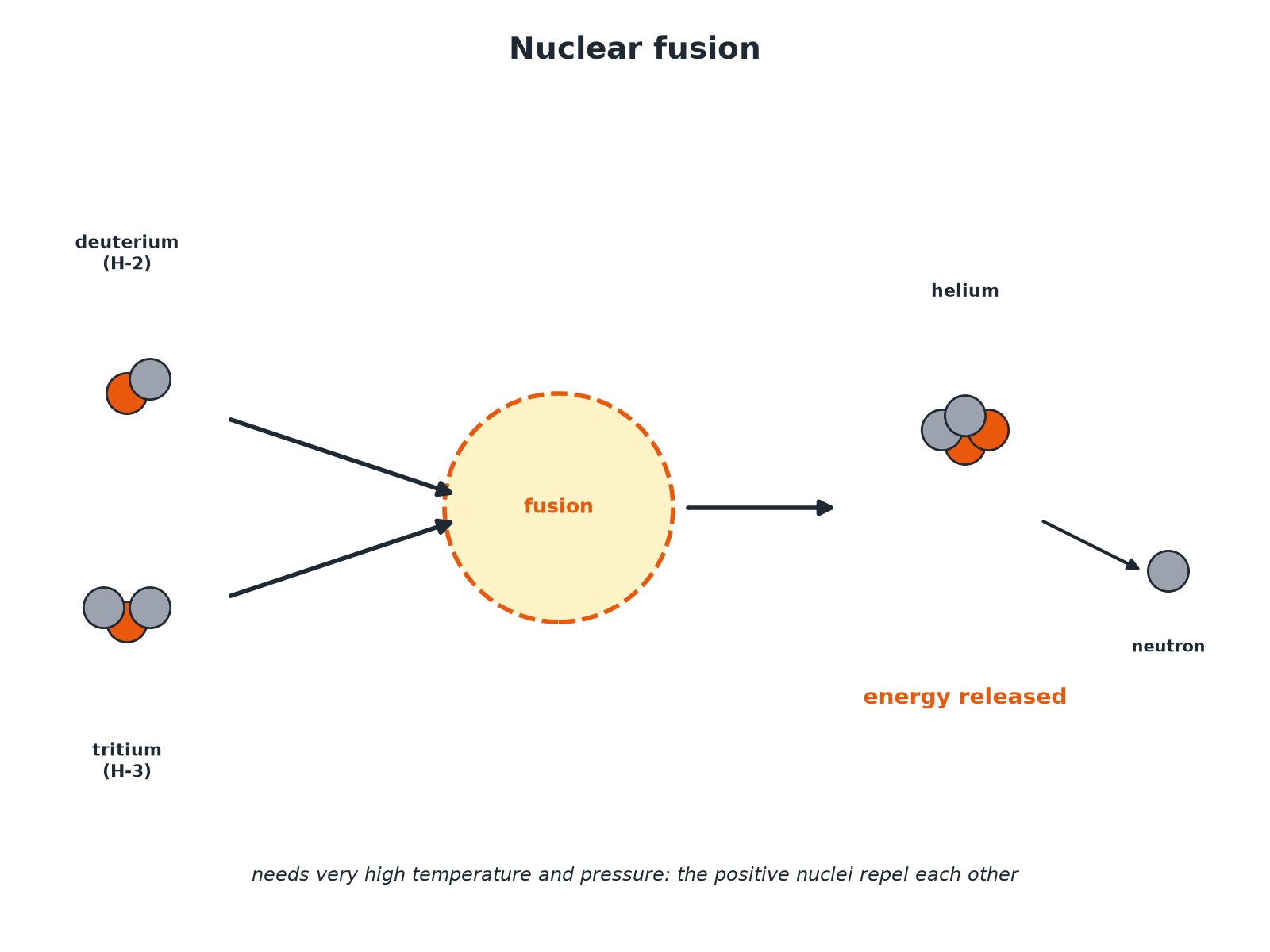
Two light nuclei join to make a heavier one.
Nuclear Fission
Follow the steps.
-
1
A neutron is absorbed
An unstable nucleus such as uranium-235 absorbs a neutron.
-
2
The nucleus splits
Into two smaller nuclei, roughly equal in size.
-
3
Two or three neutrons are released
Also gamma rays.
-
4
Energy is released
All the fission products have kinetic energy.
-
5
Chain reaction
The neutrons go on to cause further fission.
Controlled or Uncontrolled?
In a nuclear reactor
- The chain reaction is controlled.
- Control rods absorb excess neutrons so only one neutron from each fission causes another.
- Energy is released steadily to heat water.
In a nuclear weapon
- The chain reaction is uncontrolled.
- Neutrons cause many more fissions each time.
- A huge amount of energy is released in an instant: an explosion.
Describing a Chain Reaction
Explain how a chain reaction occurs in a fission reactor.
Show the solutionHide the solution
- 1 Start A neutron is absorbed by a uranium-235 nucleus which splits
- 2 Neutrons released 2 or 3 neutrons are released
- 3 Continues These neutrons are absorbed by more nuclei, which also split, so the reaction keeps going
AnswerThe neutrons released in each fission cause further fissions, so the reaction sustains itself.
Fusion
Describe what happens in nuclear fusion.
Show the solutionHide the solution
- 1 Two light nuclei Join together to form a heavier nucleus
- 2 Mass Some of the mass is converted to energy released as radiation
- 3 Conditions Very high temperature and pressure are needed to overcome the repulsion between the positive nuclei
AnswerLight nuclei join to form a heavier nucleus, releasing energy.
Comparing Them
Points to remember.
-
Fission
A large nucleus splits into two smaller ones; releases neutrons; chain reaction.
-
Fusion
Two small nuclei join; needs very high temperature; powers the Sun.
-
Both
Release energy; fusion releases more per kilogram of fuel than fission.
-
Waste
Fission produces radioactive waste; fusion products are largely not radioactive for long.
Fission or Fusion?
State whether each is fission or fusion: (a) uranium-235 absorbs a neutron and splits (b) hydrogen nuclei join to make helium (c) a chain reaction in a reactor (d) the process in the Sun.
1. Decide if a nucleus splits or joins.
A good answer shows: (a) Fission (b) Fusion (c) Fission (d) Fusion.
Can I...?
- 1Define fission.
- 2Define fusion.
- 3Describe a chain reaction.
- 4Describe control in a reactor.
- 5Describe uncontrolled fission.
- 6Draw and interpret a fission diagram.
- 7Describe fusion conditions.
- 8Compare fission and fusion.
Summary & Exam Focus
- Fission: large nucleus splits into two smaller nuclei plus 2 to 3 neutrons and gamma.
- Chain reaction: neutrons cause further fission.
- Controlled in a reactor, uncontrolled in a weapon.
- Fusion: two light nuclei join, releasing energy.
Exam focus
Describe what happens in nuclear fission. (3 marks) (3 marks)
Neutron absorbed, nucleus splits, neutrons and energy released.
Key terms
The vocabulary this lesson expects you to use. Each one is linked from the first place it appears above.
- Nuclear fission
- The splitting of a large, unstable nucleus.
- Nuclear fusion
- The joining of two light nuclei to form a heavier nucleus.
- Chain reaction
- A reaction in which the products cause more of the same reaction.
- Control rods
- Rods that absorb neutrons to control a reactor.
- Fission products
- The smaller nuclei produced by fission.
- Nuclear reactor
- A device in which fission is controlled.
Questions and answers
10 questions set on this lesson, with the mark schemes and model answers open.
What is meant by nuclear fission?
Mark scheme — 2 marks available
- Splitting of a large unstable nucleus — 1 mark
- Into two smaller nuclei — 1 mark
Model answer
The splitting of a large and unstable nucleus (such as uranium or plutonium) into two smaller nuclei.
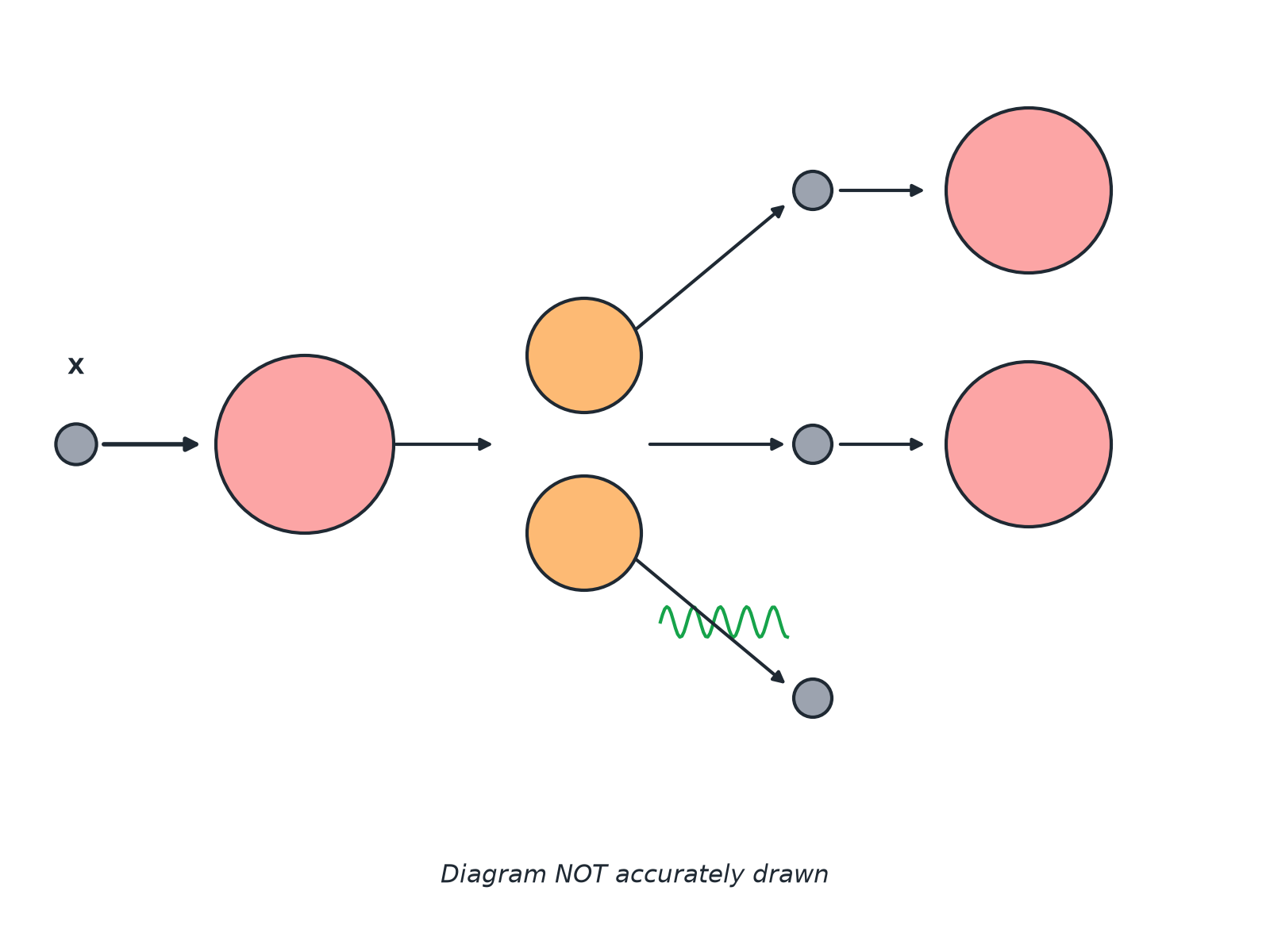
The diagram shows part of a fission chain reaction. (a) Name the particle labelled X. (b) Explain how the diagram shows that a chain reaction can happen.
Mark scheme — 3 marks available
- X is a neutron — 1 mark
- Each fission releases more than one neutron — 1 mark
- These cause more nuclei to split — 1 mark
Model answer
(a) A neutron. (b) Each fission releases two or three neutrons, which cause further nuclei to split, so the reaction continues.
Explain how the chain reaction is controlled in a nuclear reactor.
Mark scheme — 3 marks available
- Control rods absorb neutrons — 1 mark
- Only one neutron from each fission goes on to cause fission — 1 mark
- So the rate of energy release is steady — 1 mark
Model answer
Control rods absorb some of the neutrons produced. This means on average only one neutron from each fission causes another fission, so the reaction continues steadily without getting out of control.
Describe what happens in nuclear fusion, and state one condition needed for it to happen.
Mark scheme — 3 marks available
- Two light nuclei join — 1 mark
- Energy released — 1 mark
- Very high temperature or pressure needed — 1 mark
Model answer
Two light nuclei join to form a heavier nucleus, and some of the mass is converted to energy. Very high temperature (and pressure) is needed to overcome the repulsion between the nuclei.
Compare nuclear fission and nuclear fusion.
Mark scheme — 4 marks available
- Fission: splitting — 1 mark
- Fusion: joining — 1 mark
- Both release energy — 1 mark
- A difference in conditions or products — 1 mark
Model answer
Fission is the splitting of a large unstable nucleus into two smaller nuclei; fusion is the joining of two light nuclei to make a heavier one. Both release energy. Fission releases neutrons that cause a chain reaction; fusion needs very high temperature and pressure.
In nuclear fission a large nucleus...
Why: That is what fission means.
Nuclear fusion is...
Why: Light nuclei fuse to make a heavier one.
Control rods in a reactor...
Why: They control the chain reaction.
How many neutrons does each fission of uranium-235 release?
Why: That is what allows a chain reaction.
Fusion happens in...
Why: Hydrogen nuclei fuse into helium.