Viewing as
Teacher view: planning notes, the answers to every question, and the teacher copies of the files.
Physics · Electricity
Electrical power
Use \(P = VI\) and \(P = I^2R\) to calculate the power of electrical devices.
Teacher resources
The teacher copies: slides with the questions built in, the answers, and anything else attached to this lesson for whoever is teaching it.
- Electrical power - Teacher Slides.pptx Teacher The lesson slides with the teacher's notes on each slide, and every question and mark scheme built in. Built from the lesson script on 30 September 2026. View
- Electrical power - Teacher Notes.docx Teacher The complete notes with the teacher's notes and every model answer in full. Built from the lesson script on 30 September 2026. View
Student handouts
The same files the students see, to print or hand out.
- Electrical power.pptx Built from the lesson script on 30 September 2026. View
- Electrical power - Completed Notes.docx The full notes for the lesson, to revise from. Built from the lesson script on 30 September 2026. View
- Electrical power - Exam Questions.docx Built from the lesson script on 30 September 2026. View
Warm-up
Answer each one, then check.
-
1
What is the unit of power?
Show answerHide answer
Watt (W)
-
2
Write the equation linking energy and time for power.
Show answerHide answer
\(P = E \div t\)
-
3
What is \(V = IR\) used for?
Show answerHide answer
Linking pd, current and resistance
-
4
Convert 2.3 kW to watts.
Show answerHide answer
2300 W
-
5
Work out \(3^2\).
Show answerHide answer
9
Learning Objectives
- 1Explain how the power transfer in a device is related to the pd across it and the current through it.
- 2Recall and apply \(P = VI\).
- 3Recall and apply \(P = I^2R\).
- 4Rearrange to find current, pd or resistance.
ELECTRICAL POWER
power \(=\) potential difference \(\times\) current \(P = VI\)
Also \(P = I^2R\) (power = current squared × resistance). Power is in watts (W), pd in volts (V), current in amperes (A) and resistance in ohms (Ω).
Power in a Circuit
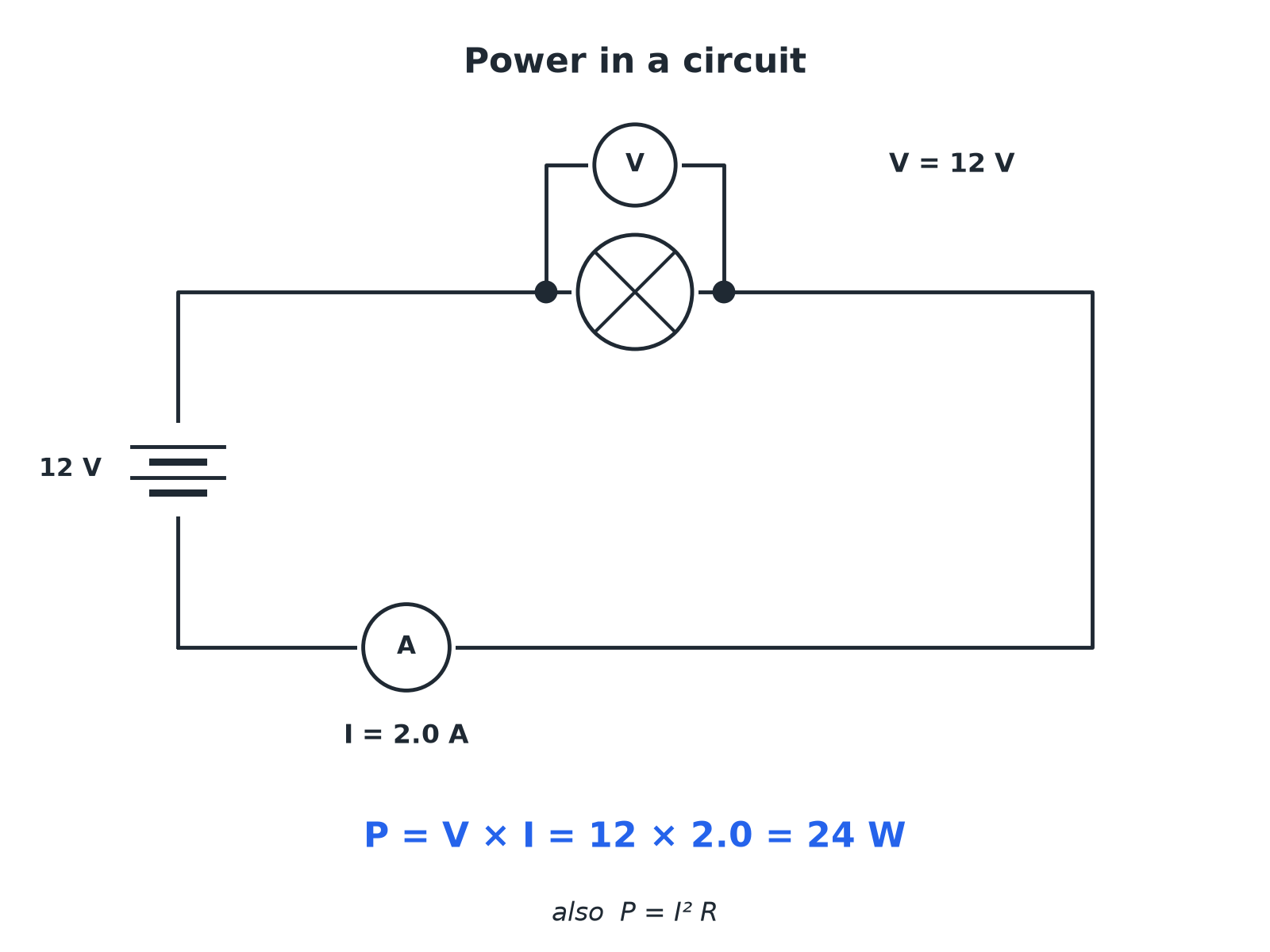
A device with a bigger pd or current has a greater power.
Using P = VI
A kettle has a current of 10 A when connected to the 230 V mains. Calculate its power.
Show the solutionHide the solution
- 1 Write the equation \(P = VI\)
- 2 Substitute \(P = 230 \times 10\)
- 3 Answer \(P = 2300\) W
Answer2300 W (2.3 kW)
Using P = I²R
A current of 6.0 A flows through a 5.0 Ω resistor. Calculate the power.
Show the solutionHide the solution
- 1 Write the equation \(P = I^2R\)
- 2 Square the current first \(6.0^2 = 36\)
- 3 Substitute \(P = 36 \times 5.0\)
- 4 Answer \(P = 180\) W
Answer180 W
Finding the Current
A 60 W lamp is connected to the 230 V mains. Calculate the current.
Show the solutionHide the solution
- 1 Rearrange \(I = P \div V\)
- 2 Substitute \(I = 60 \div 230\)
- 3 Answer \(I = 0.26\) A
Answer0.26 A
Which Equation?
Look at what you are given.
-
V and I
Use: \(P = VI\)
-
I and R
Use: \(P = I^2R\)
-
V and R
Use: Find I first with \(I = V \div R\), then \(P = VI\)
-
E and t
Use: \(P = E \div t\)
Common Mistakes
Take care with squares.
-
Squaring
Square only the current, then multiply by the resistance.
-
Units
Convert mA to A and kW to W first.
-
Rating labels
The power rating of an appliance is at its normal pd.
Rating Plate
A hair dryer is rated 1500 W at 230 V. Calculate the current. A toaster takes 4.0 A at 230 V; find its power.
1. Rearrange P = VI for current.
2. Then calculate the toaster power.
A good answer shows: Hair dryer: \(1500 \div 230 = 6.5\) A. Toaster: \(230 \times 4.0 = 920\) W.
Can I...?
- 1Recall P = VI.
- 2Recall P = I²R.
- 3Choose the right equation.
- 4Rearrange for current.
- 5Square the current correctly.
- 6Convert units to W and A.
- 7Explain what power means.
- 8Give the unit.
Summary & Exam Focus
- \(P = VI\).
- \(P = I^2R\).
- Power is in watts.
- Higher power means faster energy transfer.
Exam focus
A kettle draws 10 A from the 230 V mains. Calculate its power. (2 marks) (2 marks)
Choose P = VI, substitute and give W.
Key terms
The vocabulary this lesson expects you to use. Each one is linked from the first place it appears above.
- Power
- The rate at which energy is transferred.
- Watt
- One joule per second.
- Power rating
- The power an appliance transfers in normal use.
- Kilowatt
- 1000 watts.
- Potential difference
- Energy transferred per coulomb of charge.
- Current
- The rate of flow of charge.
Questions and answers
10 questions set on this lesson, with the mark schemes and model answers open.
A kettle is connected to the 230 V mains and the current is 10 A. Calculate the power of the kettle. Use the equation: power = potential difference × current
Mark scheme — 2 marks available
- Correct substitution — 1 mark
- 2300 W — 1 mark
Model answer
\(P = 230 \times 10 = 2300\) W
A current of 6.0 A flows through a resistor of resistance 5.0 Ω. Calculate the power. Use the equation: power = (current)² × resistance
Mark scheme — 3 marks available
- Squares the current — 1 mark
- Correct substitution — 1 mark
- 180 W — 1 mark
Model answer
\(P = 6.0^2 \times 5.0 = 180\) W
A lamp has a power of 60 W and works at 230 V. Calculate the current in the lamp.
Mark scheme — 3 marks available
- Rearranges to I = P ÷ V — 1 mark
- Correct substitution — 1 mark
- 0.26 A — 1 mark
Model answer
\(I = P \div V = 60 \div 230 = 0.26\) A
A student says that the power of a device only depends on the current. Explain why the student is not correct.
Mark scheme — 2 marks available
- Power = V × I — 1 mark
- Depends on pd (or resistance) as well as current — 1 mark
Model answer
Power depends on both the current and the potential difference (P = VI), or on the current and the resistance (P = I²R).
An electric heater has a resistance of 46 Ω and is connected to a 230 V supply. Calculate the power of the heater.
Mark scheme — 4 marks available
- Rearranges V = IR — 1 mark
- 5.0 A — 1 mark
- Correct substitution into P = VI — 1 mark
- 1150 W — 1 mark
Model answer
\(I = 230 \div 46 = 5.0\) A; \(P = 230 \times 5.0 = 1150\) W
The equation for electrical power is...
Why: Power is pd times current.
A 12 V, 3 A device has a power of...
Why: 12 × 3 = 36 W.
A 2 A current through a 5 Ω resistor gives a power of...
Why: \(2^2 \times 5 = 20\) W.
A higher current at the same pd gives a...
Why: P = VI.
The unit of power is the...
Why: Watts, W.