Viewing as
Teacher view: planning notes, the answers to every question, and the teacher copies of the files.
Physics · Electricity
Mains electricity and safety
Explain the difference between direct and alternating potential difference, and describe the three-core cable and the dangers of live wires.
Teacher resources
The teacher copies: slides with the questions built in, the answers, and anything else attached to this lesson for whoever is teaching it.
- Mains electricity and safety - Teacher Slides.pptx Teacher The lesson slides with the teacher's notes on each slide, and every question and mark scheme built in. Built from the lesson script on 30 September 2026. View
- Mains electricity and safety - Teacher Notes.docx Teacher The complete notes with the teacher's notes and every model answer in full. Built from the lesson script on 30 September 2026. View
Student handouts
The same files the students see, to print or hand out.
- Mains electricity and safety.pptx Built from the lesson script on 30 September 2026. View
- Mains electricity and safety - Completed Notes.docx The full notes for the lesson, to revise from. Built from the lesson script on 30 September 2026. View
- Mains electricity and safety - Exam Questions.docx Built from the lesson script on 30 September 2026. View
Warm-up
Answer each one, then check.
-
1
What is the unit of frequency?
Show answerHide answer
Hertz (Hz)
-
2
What colour is the earth wire?
Show answerHide answer
Green and yellow stripes
-
3
What does a fuse do?
Show answerHide answer
Melts and breaks the circuit if the current is too large
-
4
What does AC stand for?
Show answerHide answer
Alternating current
-
5
What is the potential difference of the mains?
Show answerHide answer
About 230 V
Learning Objectives
- 1State the frequency and potential difference of UK mains.
- 2Explain the difference between dc and ac.
- 3Identify the live, neutral and earth wires by colour and function.
- 4Explain why a live wire can be dangerous even when a switch is open, and the dangers of connecting live to earth.
MAINS ELECTRICITY
Mains electricity in the UK is an alternating supply of about 230 V with a frequency of 50 Hz.
Direct pd (dc) always pushes charge in the same direction. Alternating pd (ac) repeatedly changes direction.
Direct and Alternating pd
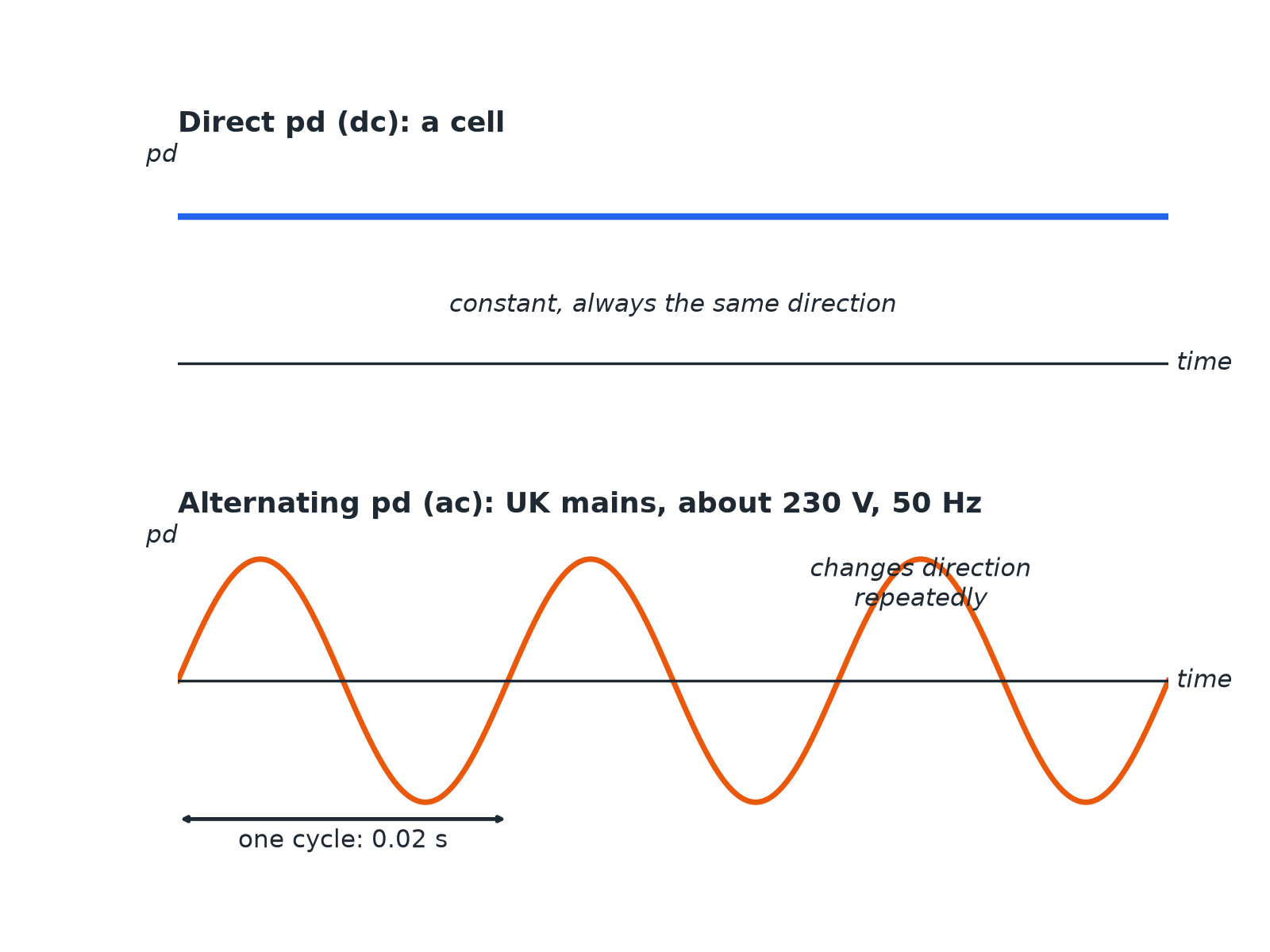
Alternating pd changes direction 50 times each second.
A Three-pin Plug
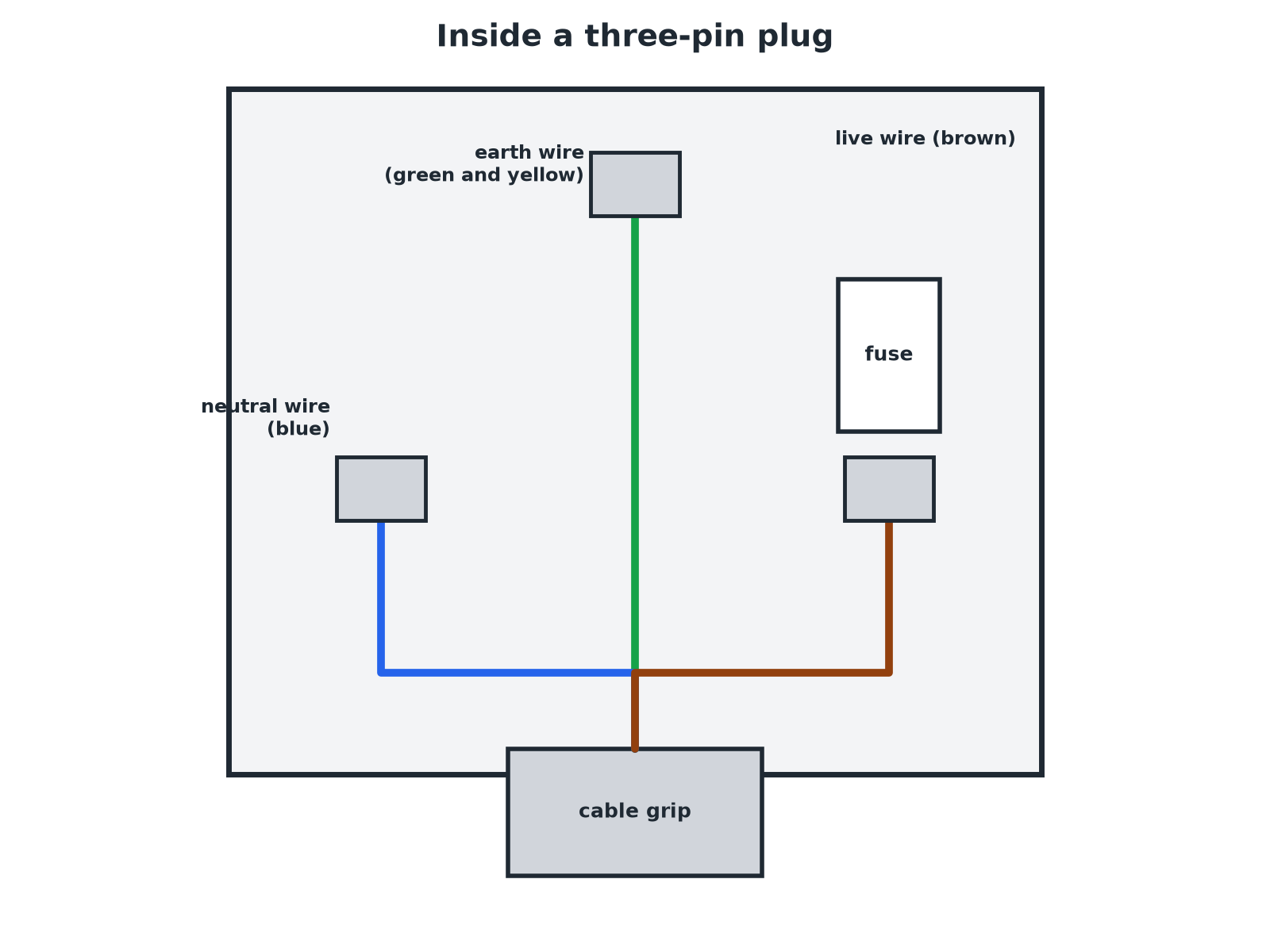
Colour coding makes the wires easy to identify.
The Three-Core Cable
Learn the colour, name and job of each wire.
-
Live
Colour: Brown. Job: Carries the alternating pd from the supply. Potential difference: About 230 V
-
Neutral
Colour: Blue. Job: Completes the circuit. Potential difference: At or close to 0 V
-
Earth
Colour: Green and yellow stripes. Job: Safety wire: stops the appliance becoming live. Potential difference: 0 V; only carries a current if there is a fault
Why the Live Wire Is Dangerous
Explain why touching a live wire can be dangerous even when the switch in the appliance is open.
Show the solutionHide the solution
- 1 Switch position If the switch is in the neutral wire, the live wire stays connected to the appliance
- 2 Potential difference The live wire is at about 230 V compared with earth
- 3 Danger A person touching it can provide a path to earth, and a current flows through the person
AnswerThe live wire is at 230 V even when the switch is open (if the switch is in the neutral); touching it can give a dangerous current.
Live and Earth
Explain the dangers of a connection between the live wire and earth.
Show the solutionHide the solution
- 1 Low resistance path A very large current can flow to earth
- 2 Effects The wires heat up, which can cause a fire; a person may be electrocuted
- 3 Earth wire It gives a safe path so a fuse blows or the trip operates
AnswerA connection between live and earth can cause a large current, overheating, fires or electric shock.
Safety Tips
Exam-ready reasons.
-
Fuse and switch
They go in the live wire so the appliance is disconnected from 230 V.
-
Earth wire
Connected to the metal case so that if the live wire touches it, a large current flows and the fuse melts.
-
Double-insulated appliances
Have no earth wire because they have a plastic case.
Plug Detective
A plug's wires are brown, blue and green and yellow. State the name of each wire and its job. Then say why a switch should go in the live wire.
1. Name each wire.
2. Say what it does.
A good answer shows: Brown: live, carries 230 V. Blue: neutral, completes the circuit. Green and yellow: earth, safety wire. A switch in the live wire disconnects the appliance from the 230 V supply.
Can I...?
- 1State the frequency and pd of UK mains.
- 2Explain dc and ac.
- 3Name the three wires and their colours.
- 4State the job of each wire.
- 5Say the live wire is at 230 V.
- 6Explain why a live wire is dangerous with the switch open.
- 7Explain the dangers of live-to-earth connections.
- 8Explain the purpose of the earth wire.
Summary & Exam Focus
- UK mains: 230 V, 50 Hz, ac.
- Live: brown; neutral: blue; earth: green and yellow.
- Earth wire only carries current if there is a fault.
- Switches go in the live wire.
Exam focus
Give the colour of the live wire and state its potential difference compared with earth. (2 marks) (2 marks)
Brown, and about 230 V.
Key terms
The vocabulary this lesson expects you to use. Each one is linked from the first place it appears above.
- Direct pd (dc)
- A pd that always pushes charge in the same direction.
- Alternating pd (ac)
- A pd that repeatedly changes direction.
- Frequency
- The number of cycles per second, in hertz.
- Live wire
- The wire carrying the alternating pd, at about 230 V.
- Neutral wire
- The wire that completes the circuit, at about 0 V.
- Earth wire
- The safety wire, at 0 V, connected to the metal case.
Questions and answers
10 questions set on this lesson, with the mark schemes and model answers open.
State the frequency and the approximate potential difference of the UK mains supply.
Mark scheme — 2 marks available
- 50 Hz — 1 mark
- 230 V — 1 mark
Model answer
50 Hz and about 230 V.
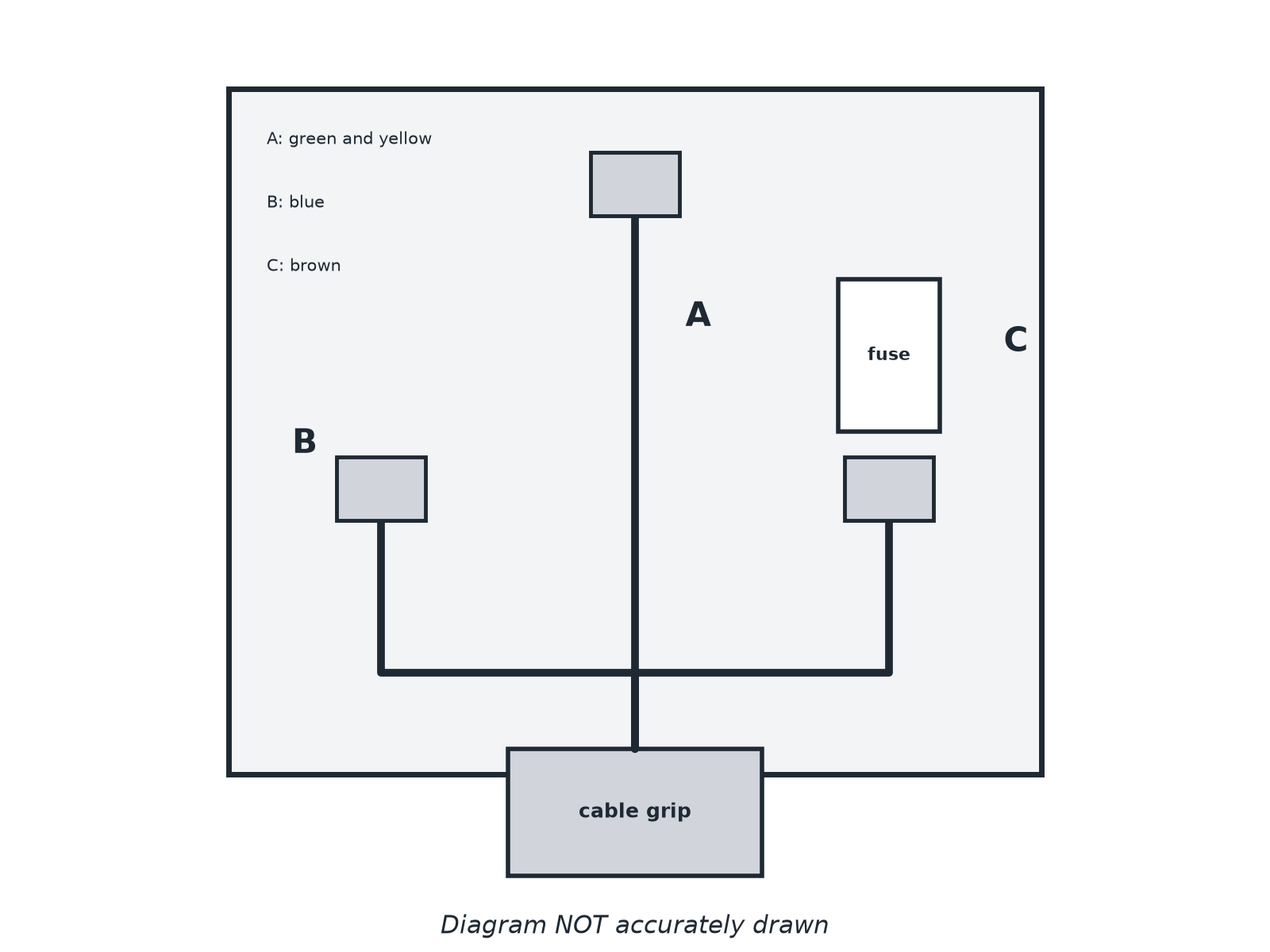
The diagram shows the wires in a three-pin plug labelled A, B and C. Give the name of each wire.
Mark scheme — 3 marks available
- Earth — 1 mark
- Neutral — 1 mark
- Live — 1 mark
Model answer
A: earth (green and yellow), B: neutral (blue), C: live (brown).
Explain the difference between direct potential difference and alternating potential difference.
Mark scheme — 2 marks available
- Direct: one direction — 1 mark
- Alternating: changes direction repeatedly — 1 mark
Model answer
A direct pd always causes charge to flow in the same direction. An alternating pd repeatedly changes direction.
The earth wire in a kettle is connected to its metal case. Explain the purpose of the earth wire.
Mark scheme — 3 marks available
- Safety wire — 1 mark
- Stops the case becoming live — 1 mark
- Only carries current if there is a fault, so the fuse melts — 1 mark
Model answer
It is a safety wire. If the live wire touches the case, a large current flows through the earth wire, which stops the case from becoming live, and the fuse melts.
A person touches the live wire in a broken appliance, but the switch in the appliance was off. Explain why the person could still receive an electric shock, and why connecting the live wire to earth is dangerous.
Mark scheme — 4 marks available
- Live wire is at about 230 V — 1 mark
- Switch may be in the neutral wire, so live remains connected — 1 mark
- Current flows through the person to earth — 1 mark
- Live to earth: very large current causing heating, fire or shock — 1 mark
Model answer
The live wire is at about 230 V, and if the switch is in the neutral wire the live wire is still connected to the supply, so the person provides a path to earth and a current flows through them. A connection between live and earth gives a very large current which can cause a fire or shock.
The frequency of UK mains is...
Why: 50 cycles each second.
The colour of the neutral wire is...
Why: Neutral is blue.
The earth wire is...
Why: Green and yellow stripes.
Alternating pd...
Why: That is what alternating means.
The live wire is at about...
Why: It carries the alternating pd from the supply.