Viewing as
Teacher view: planning notes, the answers to every question, and the teacher copies of the files.
Physics · Energy
Efficiency
Calculate efficiency as a decimal or a percentage using energy or power, interpret Sankey diagrams, and describe ways to increase efficiency (Higher tier).
Teacher resources
The teacher copies: slides with the questions built in, the answers, and anything else attached to this lesson for whoever is teaching it.
- Efficiency - Teacher Slides.pptx Teacher The lesson slides with the teacher's notes on each slide, and every question and mark scheme built in. Built from the lesson script on 30 September 2026. View
- Efficiency - Teacher Notes.docx Teacher The complete notes with the teacher's notes and every model answer in full. Built from the lesson script on 30 September 2026. View
Student handouts
The same files the students see, to print or hand out.
Warm-up
Answer each one, then check.
-
1
What is dissipated energy?
Show answerHide answer
Energy spread to the surroundings in less useful stores
-
2
What is 0.35 as a percentage?
Show answerHide answer
35%
-
3
Write 60% as a decimal.
Show answerHide answer
0.60
-
4
Give the unit of power.
Show answerHide answer
Watt
-
5
What does 'useful' energy mean?
Show answerHide answer
Energy transferred in the way we want
Learning Objectives
- 1Recall and apply the efficiency equations.
- 2Give efficiency as a decimal or a percentage.
- 3Interpret Sankey diagrams.
- 4Describe ways to increase the efficiency of an energy transfer (Higher tier).
EFFICIENCY
efficiency \(= \dfrac{\text{useful output energy transfer}}{\text{total input energy transfer}}\)
Also: efficiency \(= \dfrac{\text{useful power output}}{\text{total power input}}\). Efficiency has no units and is never more than 1 (100%).
A Sankey Diagram
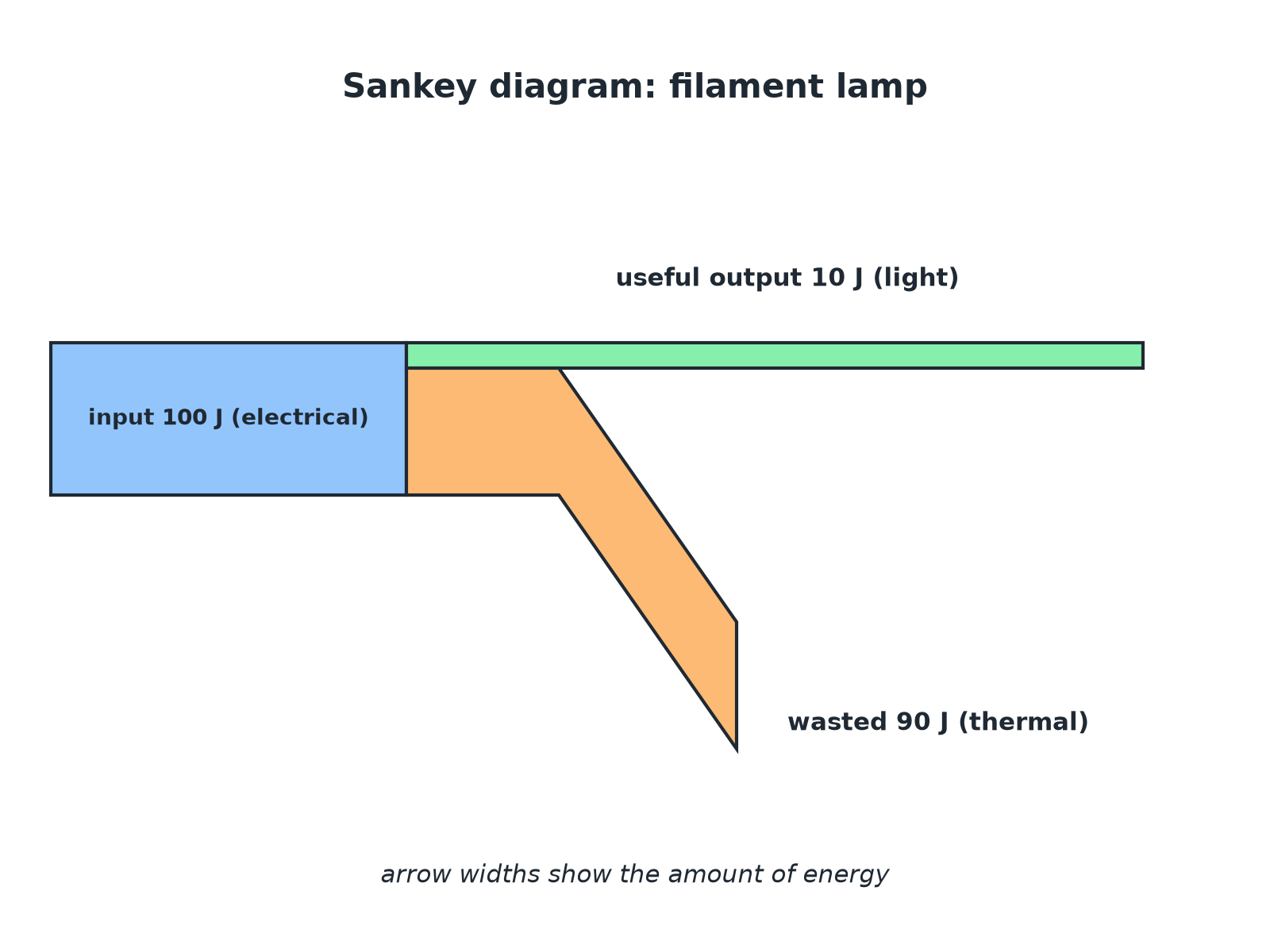
The width of each arrow shows the amount of energy.
Efficiency of a Lamp
A lamp transfers 100 J of electrical energy and 8 J of it is transferred as light. Calculate its efficiency.
Show the solutionHide the solution
- 1 Write the equation efficiency \(= \dfrac{\text{useful output}}{\text{total input}}\)
- 2 Substitute \(\dfrac{8}{100}\)
- 3 Decimal \(0.08\)
- 4 Percentage \(0.08 \times 100 = 8\%\)
AnswerEfficiency \(= 0.08\) or \(8\%\).
Using Power
A motor has a total power input of 500 W and a useful power output of 350 W. Calculate its efficiency as a percentage.
Show the solutionHide the solution
- 1 Substitute \(\dfrac{350}{500}\)
- 2 Decimal \(0.70\)
- 3 Percentage \(70\%\)
Answer70%
Finding the Useful Output
A machine is 85% efficient. How much useful energy does it transfer from a 400 J input?
Show the solutionHide the solution
- 1 Efficiency as a decimal \(0.85\)
- 2 Multiply \(0.85 \times 400 = 340\) J
Answer340 J
Ways to Increase Efficiency (Higher Tier)
Reduce the energy that is dissipated.
-
Lubrication
Reduces friction between moving parts.
-
Thermal insulation
Reduces energy lost by heating, for example around a boiler or a house.
-
Streamlining
Reduces air resistance so less energy is wasted.
-
Better design
For example LED lamps transfer more input energy as light.
-
Higher tier
The question may ask you to suggest a way suitable for a described machine.
Common Mistakes
Check your answer.
-
Efficiency above 1
It cannot be greater than 1 (100%): useful output cannot be more than the input.
-
Wrong way up
Useful output goes on top.
-
Units
Do not write J or W after an efficiency.
-
Percent or decimal
Read the question for the form required.
Compare the Lamps
LED lamp: efficiency 0.85, input power 8 W. Filament lamp: efficiency 0.10, input power 60 W. Calculate the useful power output of each and say which lamp is better.
1. Rearrange the equation for useful power.
2. Compare the two answers.
A good answer shows: LED: 0.85 × 8 = 6.8 W. Filament: 0.10 × 60 = 6.0 W. The LED gives more useful output from far less input, so it is better.
Can I...?
- 1Recall both efficiency equations.
- 2Calculate efficiency.
- 3Convert decimal and percentage.
- 4Interpret a Sankey diagram.
- 5Explain efficiency cannot exceed 1.
- 6Find useful output from an efficiency.
- 7Describe ways to increase efficiency.
- 8Compare devices.
Summary & Exam Focus
- Efficiency = useful output ÷ total input.
- Also useful power ÷ total power.
- Multiply by 100 for a percentage.
- Efficiency is never more than 1.
Exam focus
A device has an input of 400 J and a useful output of 100 J. Calculate the efficiency. (2 marks) (2 marks)
Put useful over total.
Key terms
The vocabulary this lesson expects you to use. Each one is linked from the first place it appears above.
- Efficiency
- The fraction of the input energy that is transferred usefully.
- Useful output
- Energy transferred in the way that is wanted.
- Wasted energy
- Energy transferred to stores that are not useful.
- Sankey diagram
- A diagram with arrow widths that show energy amounts.
- Streamlining
- Shaping an object to reduce air resistance.
- Input
- The energy or power supplied to a device.
Questions and answers
11 questions set on this lesson, with the mark schemes and model answers open.
A device transfers 400 J of energy as input and 100 J of useful energy. Calculate the efficiency of the device. Use the equation: efficiency = useful output energy transfer ÷ total input energy transfer
Mark scheme — 2 marks available
- Correct substitution — 1 mark
- 0.25 or 25% — 1 mark
Model answer
\(100 \div 400 = 0.25\) (25%)
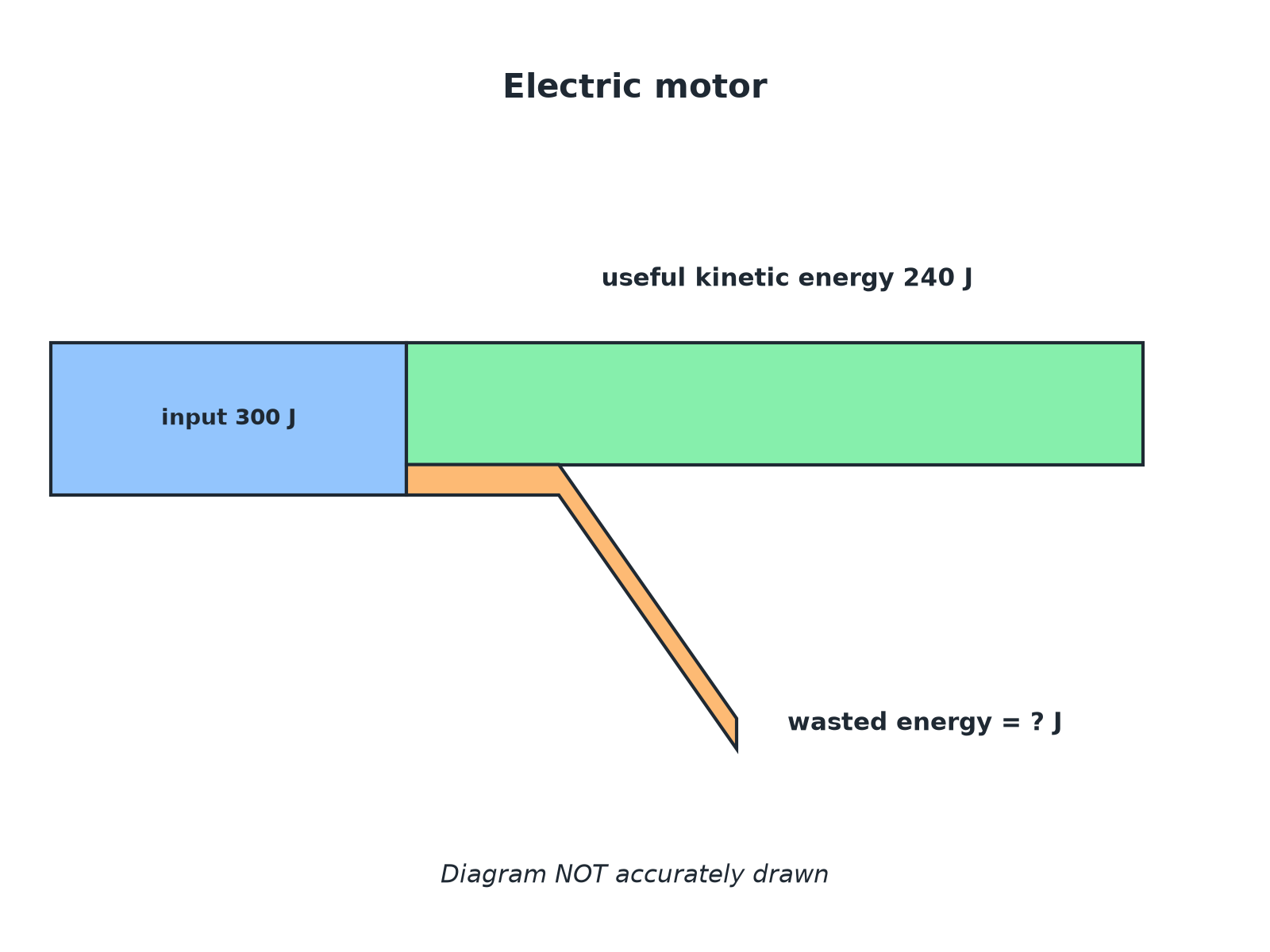
The Sankey diagram shows the energy transfers in an electric motor. (a) Calculate the energy wasted every second. (b) Calculate the efficiency of the motor.
Mark scheme — 3 marks available
- 60 J — 1 mark
- Correct substitution — 1 mark
- 0.80 or 80% — 1 mark
Model answer
(a) 300 − 240 = 60 J. (b) 240 ÷ 300 = 0.80 (80%).
A lamp has an efficiency of 0.20 and a total power input of 60 W. Calculate the useful power output of the lamp.
Mark scheme — 3 marks available
- Rearranges to power output = efficiency × input — 1 mark
- Correct substitution — 1 mark
- 12 W — 1 mark
Model answer
\(0.20 \times 60 = 12\) W
A car engine wastes a lot of energy. Suggest two ways to increase the efficiency of the car.
Mark scheme — 2 marks available
- First way — 1 mark
- Second way — 1 mark
Model answer
Any two from: lubricate moving parts to reduce friction; streamline the shape to reduce air resistance; improve insulation or design of the engine to reduce thermal losses.
An LED lamp has an efficiency of 0.85 and an input power of 8 W. A filament lamp has an efficiency of 0.10 and an input power of 60 W. Compare the useful power output of the two lamps. Which is the better lamp? Show your calculations.
Mark scheme — 4 marks available
- 6.8 W — 1 mark
- 6.0 W — 1 mark
- LED gives more useful power — 1 mark
- With much less input power — 1 mark
Model answer
LED: 0.85 × 8 = 6.8 W. Filament: 0.10 × 60 = 6.0 W. The LED lamp transfers more useful power while using far less input power, so it is the better lamp.
A student says that a machine has an efficiency of 120%. Explain why this cannot be correct.
Mark scheme — 2 marks available
- Energy cannot be created — 1 mark
- Useful output cannot exceed the total input — 1 mark
Model answer
Useful output cannot be greater than the input because energy cannot be created.
Efficiency is calculated by...
Why: Useful over total.
A device is 0.40 efficient. As a percentage this is...
Why: Multiply by 100.
A machine takes in 200 J and gives 50 J useful. Efficiency is...
Why: 50 ÷ 200 = 0.25.
Which reduces wasted energy in a machine?
Why: Lubrication reduces friction.
The widths of arrows in a Sankey diagram show...
Why: Wider arrows mean more energy.