Viewing as
Teaching this? The teacher view adds 2 files, the mark schemes and the model answers.
Physics · Energy
Kinetic, elastic and gravitational potential energy
Calculate the energy in a moving object, a stretched spring and an object raised above the ground, using \(E_k = \tfrac{1}{2}mv^2\), \(E_e = \tfrac{1}{2}ke^2\) and \(E_p = mgh\).
Warm-up
Answer each one, then check.
-
1
Write the unit for mass.
Show answerHide answer
Kilograms (kg)
-
2
Convert 6.0 cm to metres.
Show answerHide answer
\(0.060\) m
-
3
Work out \(4^2\).
Show answerHide answer
\(16\)
-
4
What does g stand for in \(E_p = mgh\)?
Show answerHide answer
-
5
What is the unit of speed?
Show answerHide answer
Metres per second (m/s)
Learning Objectives
- 1Recall and apply the equation for kinetic energy.
- 2Recall and apply the equation for elastic potential energy.
- 3Apply the equation for gravitational potential energy.
- 4Use energy conservation to find speeds and heights.
- 5Convert units and give answers to an appropriate number of significant figures.
THREE ENERGY EQUATIONS
\(E_k = \tfrac{1}{2}mv^2\) \(E_e = \tfrac{1}{2}ke^2\) \(E_p = mgh\)
Learn the first two. \(E_p = mgh\) is on the equation sheet, and the value of \(g\) (9.8 N/kg) is always given in the question.
Three Stores, Three Equations
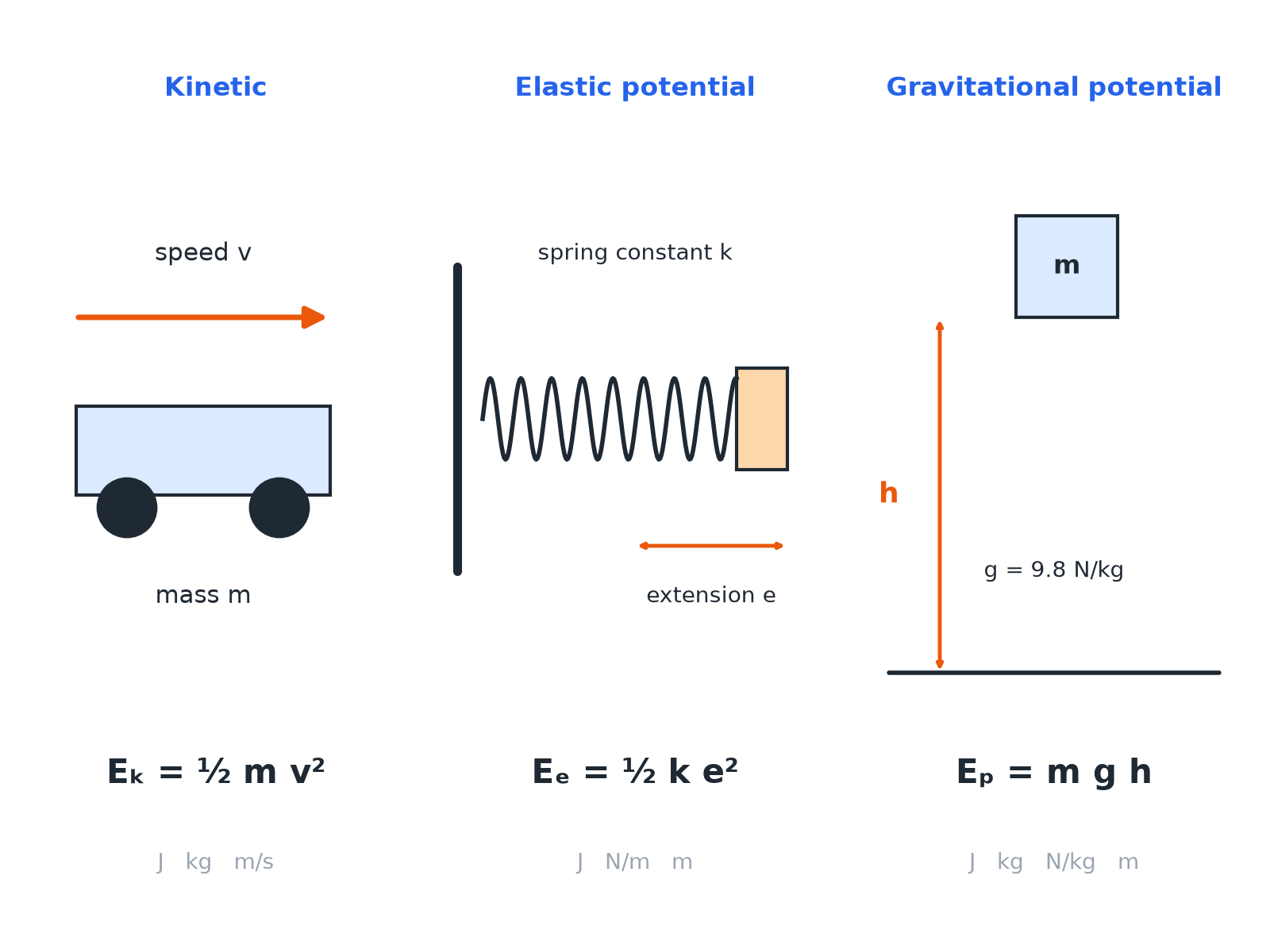
Check the units before you substitute.
Quantities and Units
Always use these units.
-
Kinetic energy
Symbol: \(E_k\). Unit: joules (J)
-
Elastic potential energy
Symbol: \(E_e\). Unit: joules (J)
-
Gravitational potential energy
Symbol: \(E_p\). Unit: joules (J)
-
Mass
Symbol: \(m\). Unit: kilograms (kg)
-
Speed
Symbol: \(v\). Unit: metres per second (m/s)
-
Spring constant
Symbol: \(k\). Unit: newtons per metre (N/m)
-
Extension
Symbol: \(e\). Unit: metres (m)
-
Gravitational field strength
Symbol: \(g\). Unit: newtons per kilogram (N/kg)
-
Height
Symbol: \(h\). Unit: metres (m)
Kinetic Energy
A car of mass 1200 kg travels at 15 m/s. Calculate its kinetic energy.
Show the solutionHide the solution
- 1 Write the equation \(E_k = \tfrac{1}{2}mv^2\)
- 2 Substitute \(E_k = 0.5 \times 1200 \times 15^2\)
- 3 Square first \(15^2 = 225\)
- 4 Answer \(E_k = 135\,000\) J
AnswerKinetic energy \(= 135\,000\) J (or 135 kJ).
Elastic Potential Energy
A spring has a spring constant of 40 N/m. It is stretched by 25 cm. Calculate the elastic potential energy stored.
Show the solutionHide the solution
- 1 Convert the extension \(25\) cm \(= 0.25\) m
- 2 Substitute \(E_e = 0.5 \times 40 \times 0.25^2\)
- 3 Answer \(E_e = 1.25\) J
Answer\(1.25\) J
Gravitational Potential Energy
A 2.0 kg book is lifted 3.0 m onto a shelf. g = 9.8 N/kg. Calculate the gain in gravitational potential energy.
Show the solutionHide the solution
- 1 Write the equation \(E_p = mgh\)
- 2 Substitute \(E_p = 2.0 \times 9.8 \times 3.0\)
- 3 Answer \(E_p = 58.8\) J
Answer\(58.8\) J (about 59 J)
Using Energy Conservation
A roller coaster car starts from rest at a height of 20 m. Ignoring friction, find its speed at the bottom. g = 9.8 N/kg.
Show the solutionHide the solution
- 1 Gravitational potential lost equals kinetic gained \(mgh = \tfrac{1}{2}mv^2\)
- 2 The mass cancels \(v^2 = 2gh = 2 \times 9.8 \times 20 = 392\)
- 3 Square root \(v = 19.8\) m/s
Answer\(19.8\) m/s
Common Mistakes
Marks are often lost here.
-
Squaring
Square only the speed or extension, not the whole of \(\tfrac{1}{2}mv\).
-
Units
Convert cm to m and g to kg before substituting.
-
Halving
Do not forget the 0.5 in the kinetic and elastic equations.
-
Significant figures
Give the answer to the same number of s.f. as the least accurate data, usually 2 or 3.
Energy Race
Calculate each. (a) A 0.50 kg ball moving at 8.0 m/s. (b) A spring with k = 100 N/m stretched by 0.10 m. (c) A 60 kg climber 15 m up a cliff (g = 9.8 N/kg).
1. Write the equation.
2. Substitute and calculate.
3. Add the unit.
A good answer shows: (a) 16 J (b) 0.50 J (c) 8820 J (about 8800 J).
Can I...?
- 1Recall the kinetic energy equation.
- 2Recall the elastic potential energy equation.
- 3Use the gravitational potential energy equation.
- 4Convert cm to m.
- 5Square the correct quantity.
- 6Use conservation of energy to find a speed.
- 7Give units and sensible significant figures.
- 8Rearrange an equation.
Summary & Exam Focus
- \(E_k = \tfrac{1}{2}mv^2\).
- \(E_e = \tfrac{1}{2}ke^2\), with e in metres.
- \(E_p = mgh\), with g given.
- Energy lost from one store is gained by another if no energy is dissipated.
Exam focus
A 0.40 kg ball moves at 12 m/s. Calculate its kinetic energy. (2 marks) (2 marks)
Write the equation, substitute, then give the unit.
Key terms
The vocabulary this lesson expects you to use. Each one is linked from the first place it appears above.
- Kinetic energy
- Energy stored in the movement of an object.
- Elastic potential energy
- Energy stored in a stretched or compressed object.
- Gravitational potential energy
- Energy stored in an object raised above the ground.
- Spring constant
- How stiff a spring is; force needed per metre of extension.
- Extension
- The increase in length of a spring.
- Gravitational field strength
- The force on each kilogram; 9.8 N/kg on Earth.
Practice questions
Have a go at each one before you open its answer.
-
Question 1 Calculate 2 marks
A ball of mass 0.40 kg moves at 12 m/s. Calculate the kinetic energy of the ball. Use the equation: kinetic energy = 0.5 × mass × (speed)²
Show answerHide answer
Model answer
\(E_k = 0.5 \times 0.40 \times 12^2 = 28.8\) J
Mark scheme
- Correct substitution — 1 mark
- 28.8 J — 1 mark
-
Question 2 Calculate 3 marks
A person of mass 55 kg climbs a ladder to a height of 4.0 m. Calculate the increase in gravitational potential energy. Gravitational field strength = 9.8 N/kg. Give your answer to 2 significant figures.
Show answerHide answer
Model answer
\(E_p = 55 \times 9.8 \times 4.0 = 2156\) J, which is 2200 J (2 s.f.)
Mark scheme
- Correct substitution — 1 mark
- 2156 J — 1 mark
- 2200 J — 1 mark
-
Question 3 Calculate 3 marks
A spring has a spring constant of 25 N/m. It is stretched by 6.0 cm. Calculate the elastic potential energy stored in the spring. Assume the limit of proportionality has not been exceeded.
Show answerHide answer
Model answer
\(e = 0.060\) m; \(E_e = 0.5 \times 25 \times 0.060^2 = 0.045\) J
Mark scheme
- Converts 6.0 cm to 0.060 m — 1 mark
- Correct substitution — 1 mark
- 0.045 J — 1 mark
-
Question 4 Calculate 4 marks
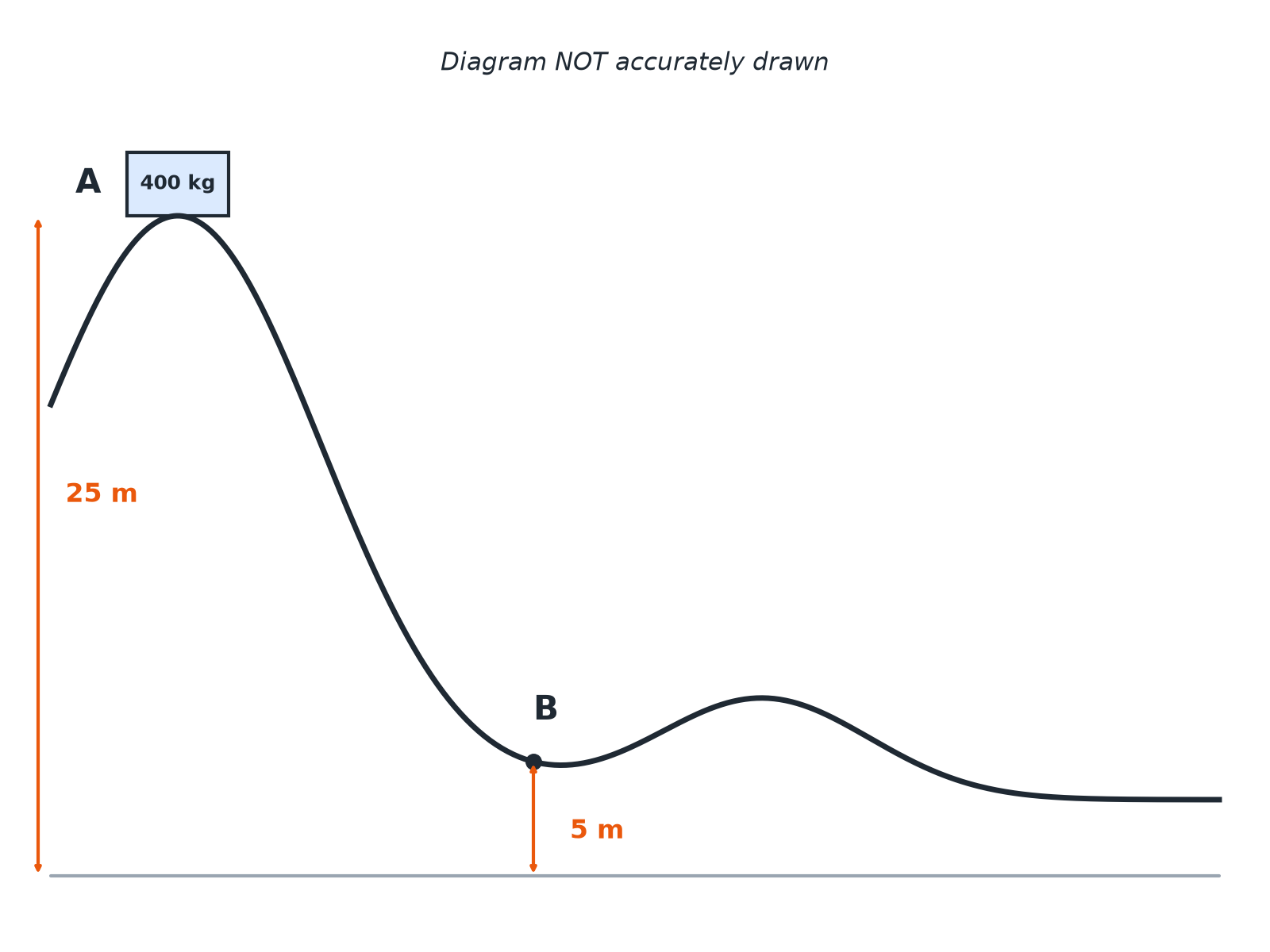
The diagram shows a roller coaster car of mass 400 kg. It is released from rest at A. Gravitational field strength = 9.8 N/kg. (a) Calculate the gravitational potential energy stored when the car is at A. (b) Assume no energy is dissipated. Calculate the speed of the car at B.
Show answerHide answer
Model answer
(a) \(E_p = 400 \times 9.8 \times 25 = 98\,000\) J. (b) At B, \(E_p = 400 \times 9.8 \times 5 = 19\,600\) J. Kinetic energy = 98 000 − 19 600 = 78 400 J. \(v = \sqrt{2 \times 78\,400 \div 400} = 19.8\) m/s
Mark scheme
- 98 000 J — 1 mark
- Kinetic energy gained = 78 400 J — 1 mark
- \(v^2 = 2E_k \div m\) — 1 mark
- 19.8 m/s (accept 20 m/s) — 1 mark
-
Question 5 Calculate 4 marks
A ball of mass 0.050 kg is thrown vertically upwards at 20 m/s. Assume there is no air resistance. Calculate the maximum height reached by the ball. Gravitational field strength = 9.8 N/kg.
Show answerHide answer
Model answer
\(E_k = 0.5 \times 0.050 \times 20^2 = 10\) J. This becomes gravitational potential energy: \(h = 10 \div (0.050 \times 9.8) = 20.4\) m
Mark scheme
- Kinetic energy = 10 J — 1 mark
- Kinetic energy equals gravitational potential energy at the top — 1 mark
- \(h = E_p \div (mg)\) — 1 mark
- 20 m (accept 20.4 m) — 1 mark
Quick check
-
Which equation gives kinetic energy?
Show answerHide answer
C: \(0.5 \times m \times v^2\)
Kinetic energy is half mass times speed squared.
-
A 2 kg object moves at 3 m/s. Its kinetic energy is...
Show answerHide answer
D: 9 J
\(0.5 \times 2 \times 9 = 9\) J.
-
A spring stretches 0.2 m with k = 50 N/m. Elastic potential energy is...
Show answerHide answer
A: 1 J
\(0.5 \times 50 \times 0.04 = 1\) J.
-
A 5 kg mass is raised 2 m. g = 10 N/kg. Gain in gravitational potential energy...
Show answerHide answer
B: 100 J
\(5 \times 10 \times 2 = 100\) J.
-
If the speed of an object doubles, its kinetic energy...
Show answerHide answer
C: quadruples
Kinetic energy depends on speed squared, so doubling speed gives four times the energy.
Downloads
Free to keep, print and annotate.
- Kinetic elastic and gravitational potential energy.pptx Built from the lesson script on 30 September 2026. View
- Kinetic elastic and gravitational potential energy - Completed Notes.docx The full notes for the lesson, to revise from. Built from the lesson script on 30 September 2026. View
- Kinetic elastic and gravitational potential energy - Exam Questions.docx Built from the lesson script on 30 September 2026. View
Something here looks wrong?
Tell us what and we will go and look. It goes to whoever writes these pages, nobody else, and we do not ask who you are — so there is nothing to sign and nothing comes back to you.